Patterns for Pirates

P4P stylish, modern, wearable patterns

  • Home
  • Blog
    • Frequently Asked Questions
    • Pattern Releases
      • Free Patterns
    • P4P University
      • Fitting
      • Sewing with Stretch, Knit Fabrics
      • Sewing with Woven Fabrics
      • Sewing Machines
    • Sew-A-Longs
    • Fabric for Pirates
    • Pattern Hacks
    • Announcement
      • Blog Tours
      • Contest/Giveaway
  • Shop
  • Bundle Discounts
  • Flash Friday
  • Gift Cards
  • My Account
  • Cart

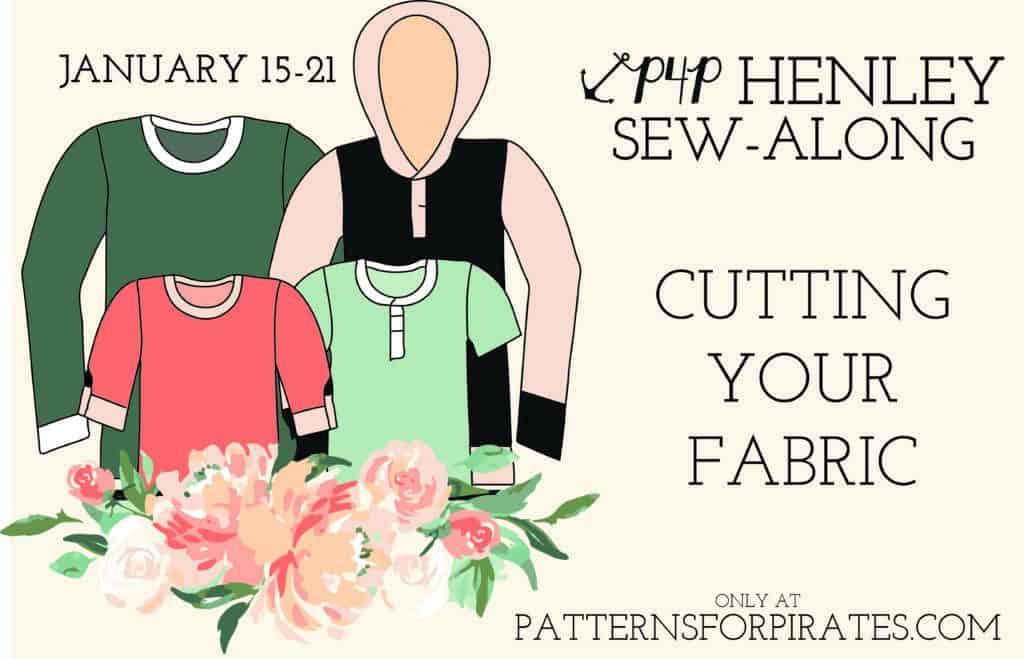
P4P Henley Sew-Along | Cutting Fabric

January 16, 2018

Welcome back!  So far, we’ve learned how to pick the perfect fabrics and get the perfect fit.  Today, we are diving right in and cutting into your beautiful fabrics.  We’re also sharing two new hacks so before you cut into your pretties, check them out first!

Is this your first time using one of our patterns?  Check out our Pattern Markings 101 and Grainline blog posts for more tips about cutting out your fabric correctly.  Now, on to the hacks…..

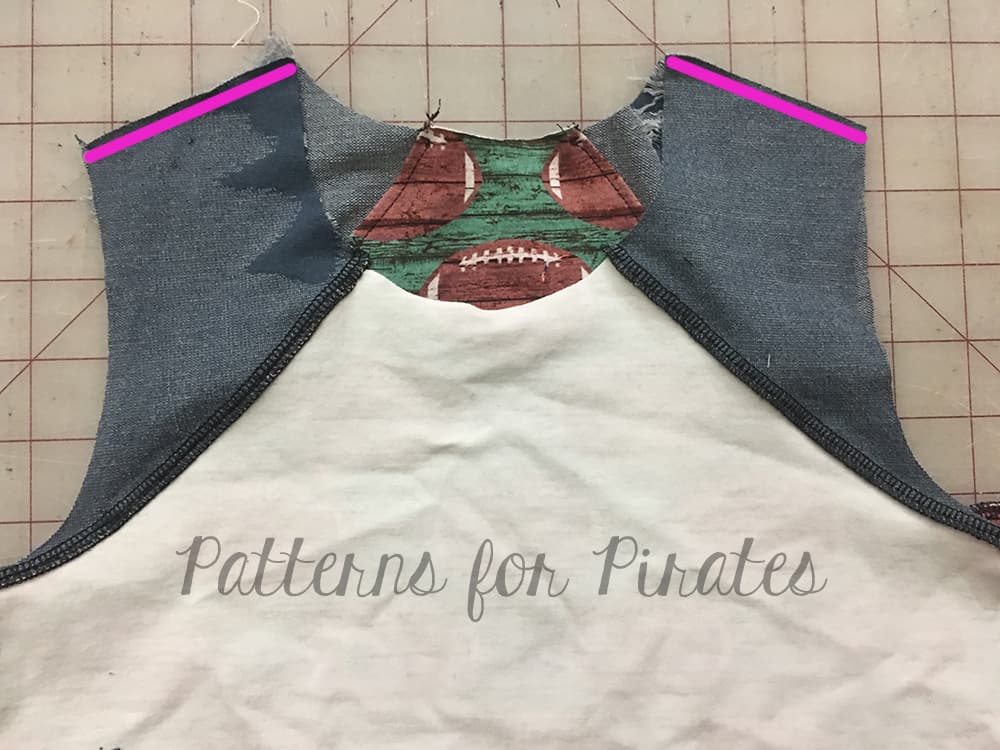
Henley Raglan Color Block Hack

Download the Color Block Pieces for the Women’s Henley and Yo Ho Henley HERE.

French Terry
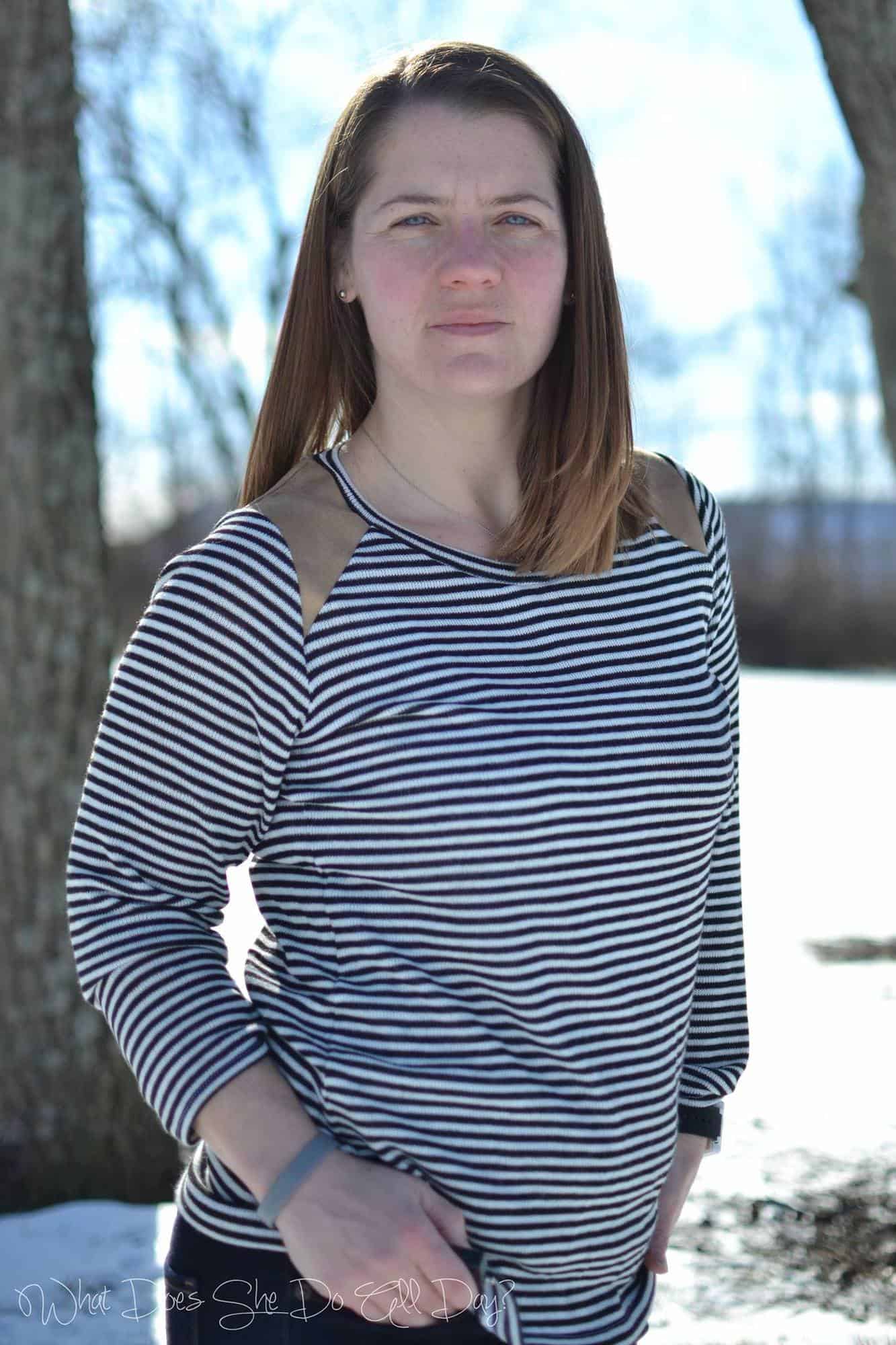
Sweater Knit and Suede accents


Here we go!

Print out the Henley Main and Color Block pieces
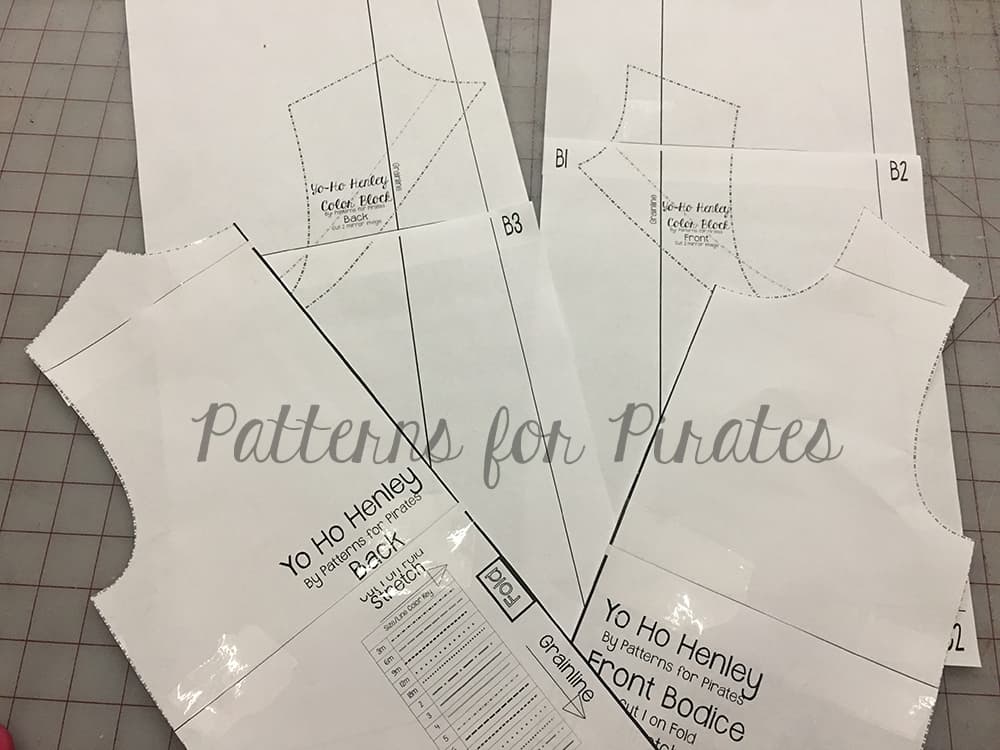
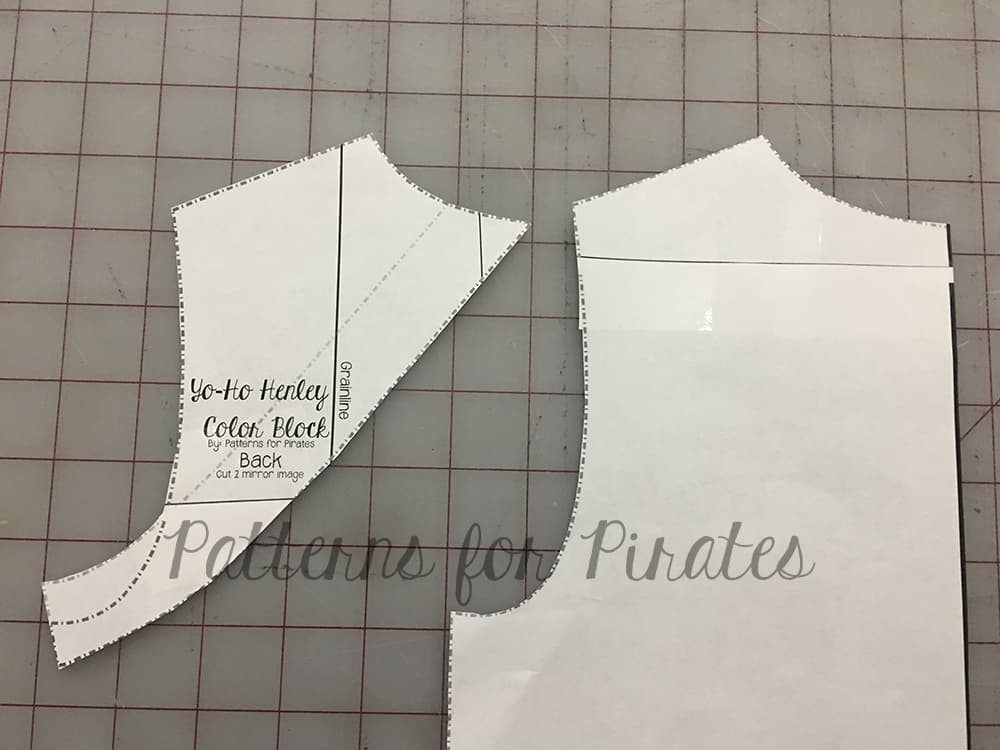
Picture of Back Main and Color Block Pieces
Picture of Front Main and Color Block Pieces
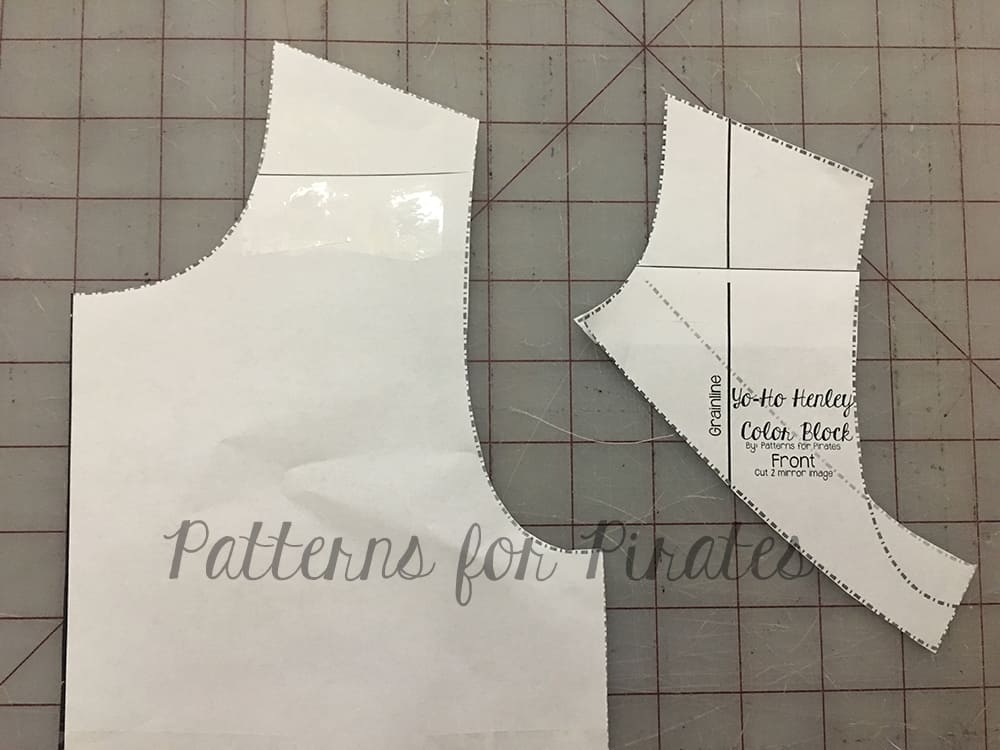
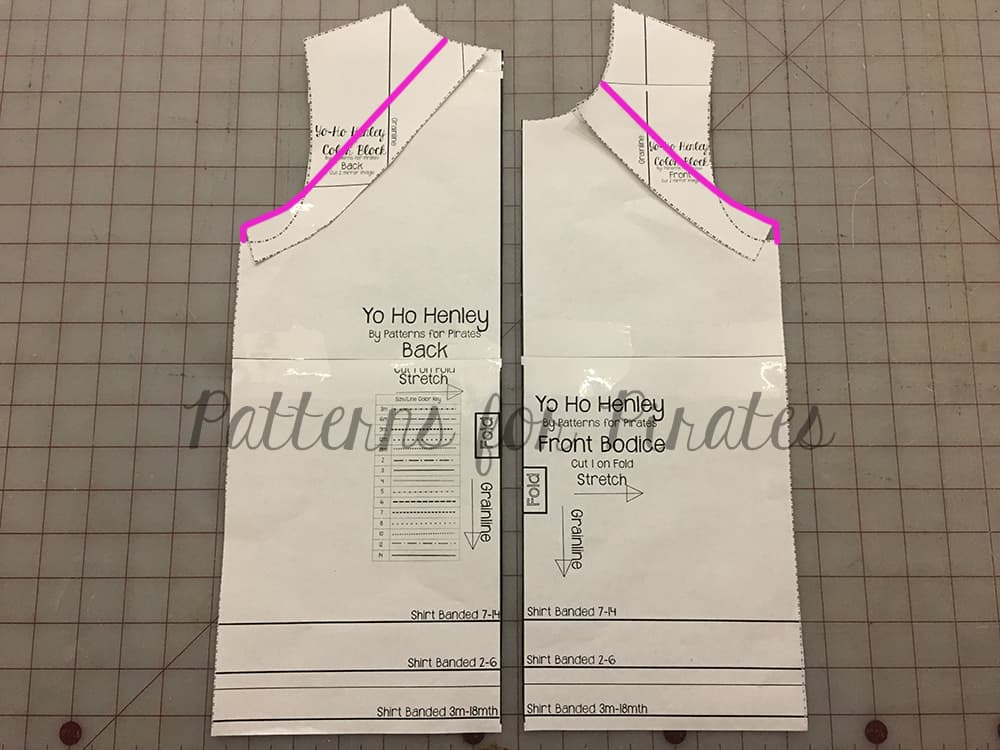
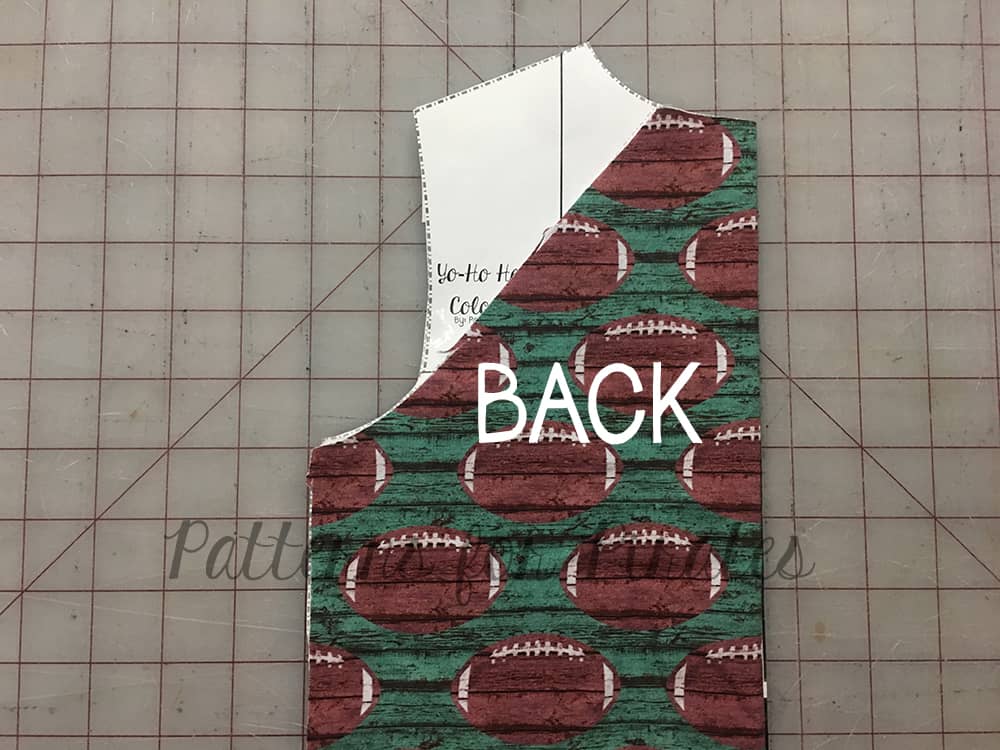
The Color Block Pieces should line up at the shoulder seam with the main body.
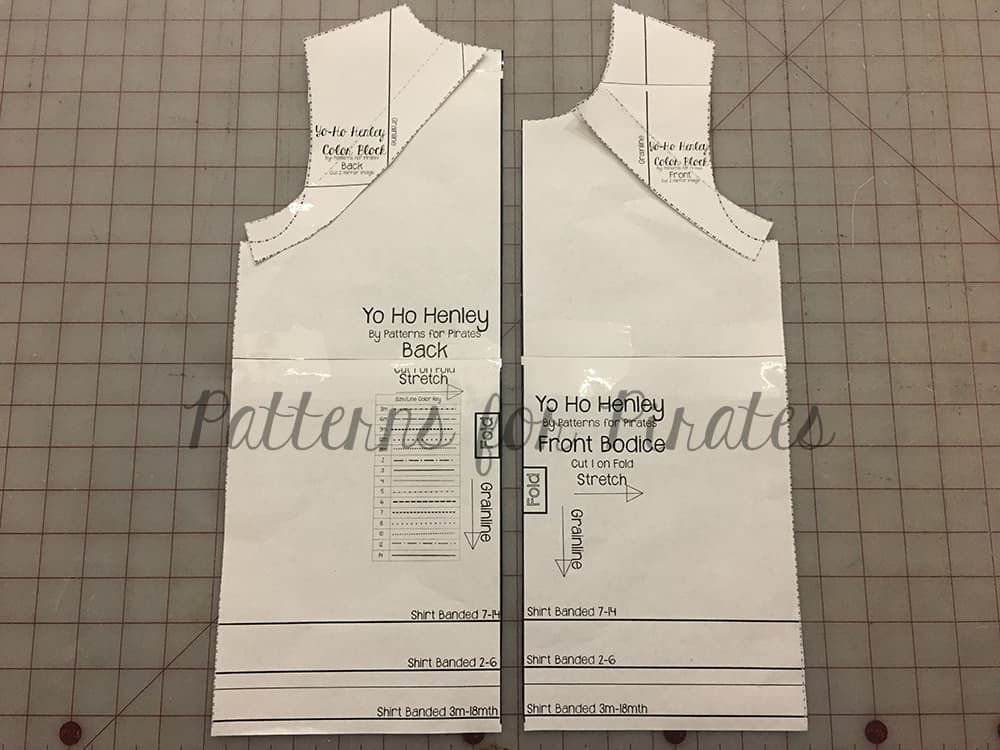
Transfer the faded line (shown in pink here) to your main body as this will be your new bottom color block. If you do not want to cut your main pattern piece you can also fold it along that line when you cut your fabric.
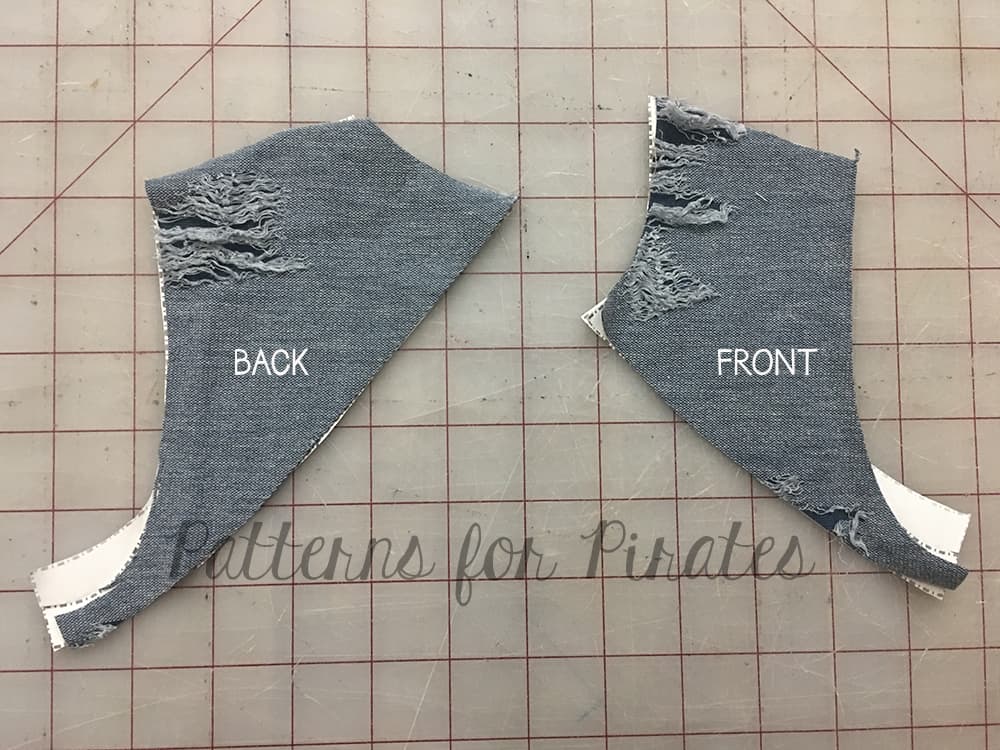
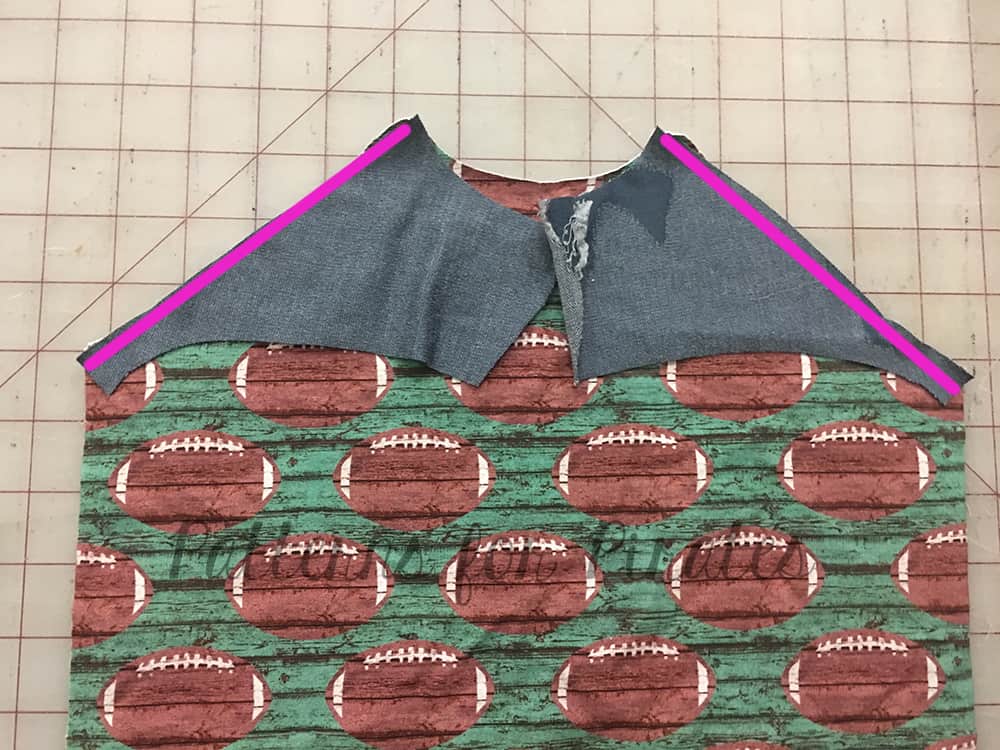
Cut 2 (mirror image) of the top color block. Follow the darker size line along the armscye.
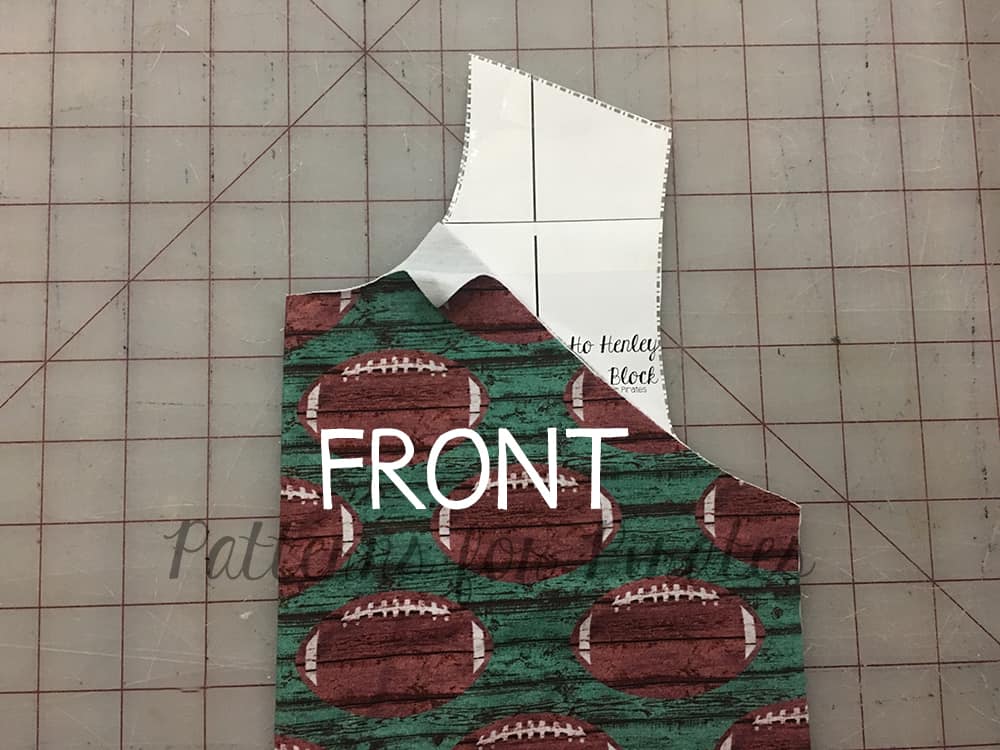
Cut 1 Front on the fold along the line you transferred in the previous step.
Cut 1 Back on the fold along the line you transferred in the previous step.
With right sides together, and using a 1/2″ seam allowance, stitch top color block to front bodice.
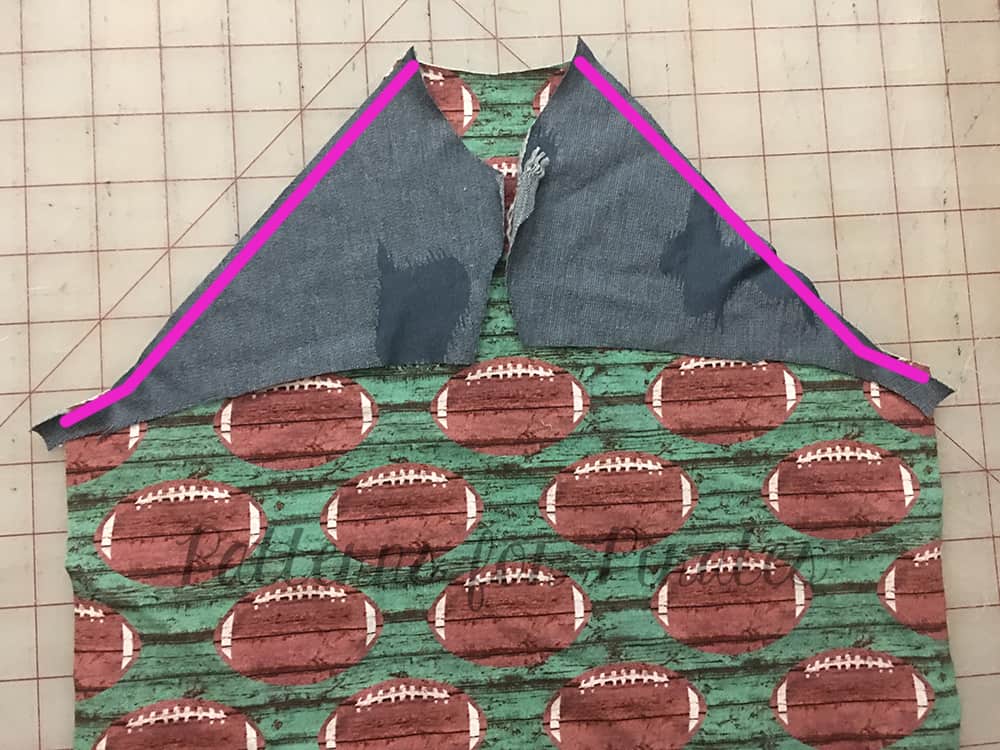
With right sides together, and using a 1/2″ seam allowance, stitch top color block to back bodice.
Press seam allowance down and top-stitch. Repeat for the back.
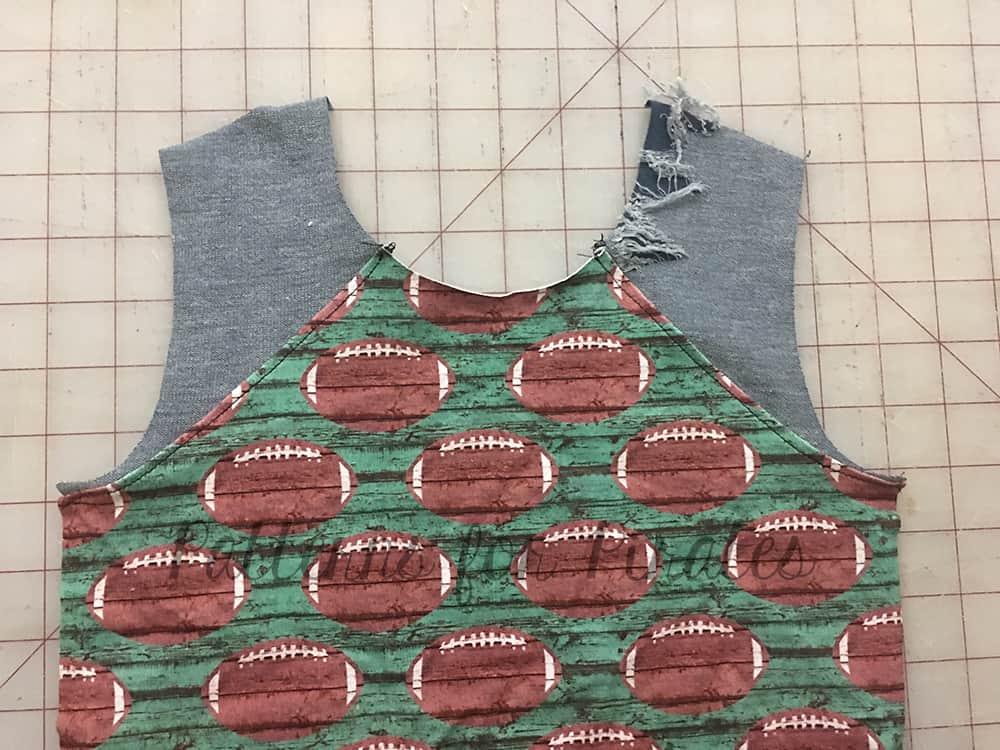
Continue as instructed in your pattern.
 

Women’s Long Sleeve Tall Cuffs Hack
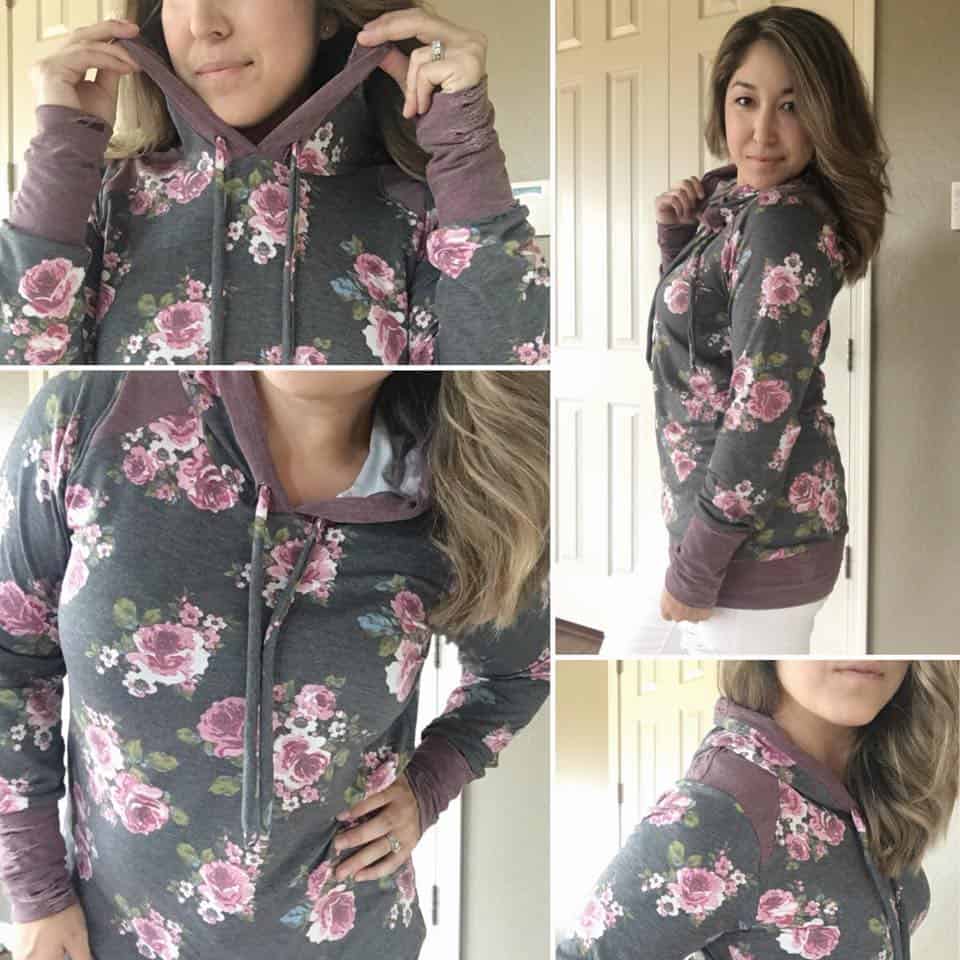


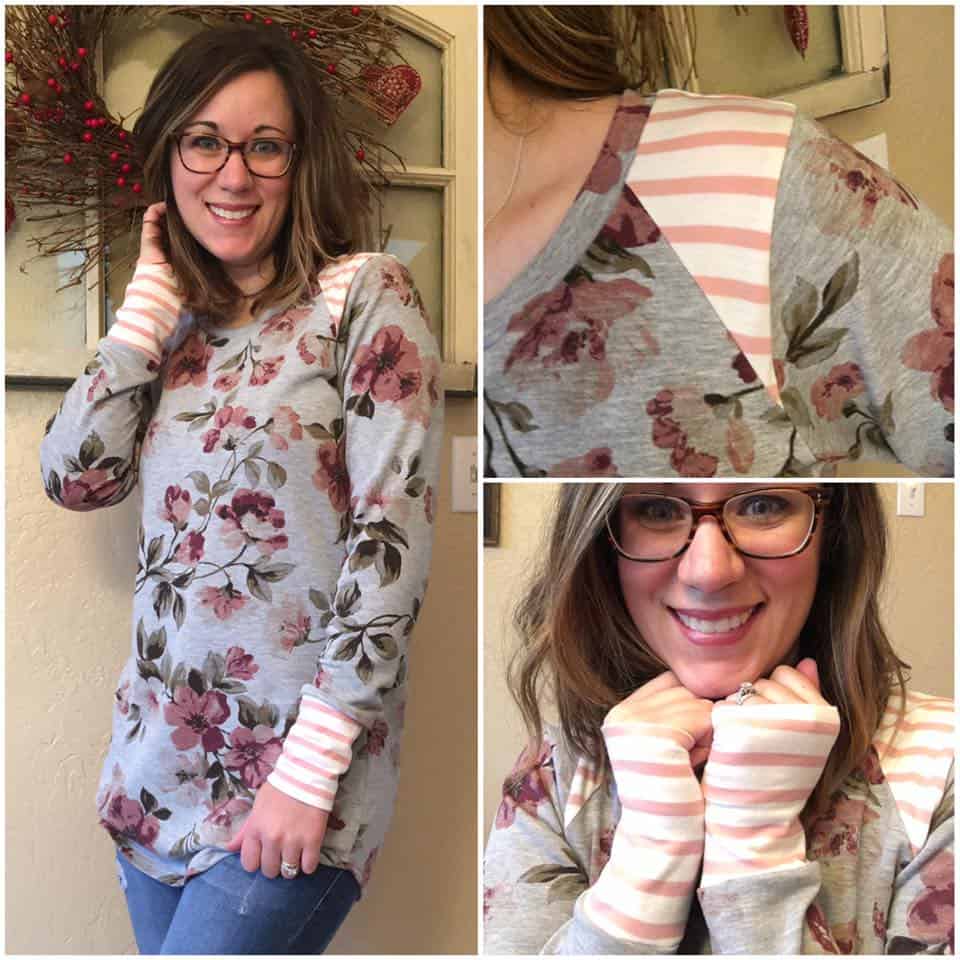
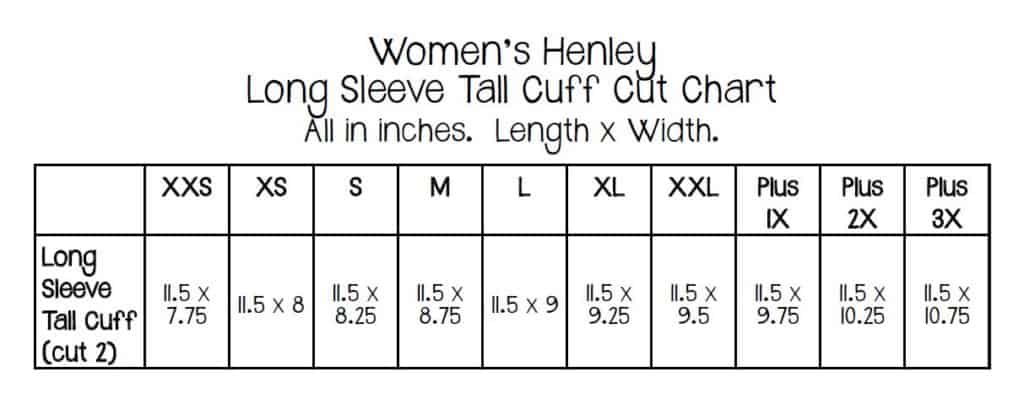
If you’ve been following in the main Facebook Group, a few weeks ago I hacked the Henley and upsized it for a more looser top! With that, I also did a longer cuff.  It received lots of love, so we thought we’d make it easy on y’all and share the new cuff measurements.  Cut your sleeve on the “Roll up” Cut line and use the measurements below for your cuffs.  Construction is the same as the other cuff/band options. 🙂
 

We hope you love these hacks as much as we do!  Check back tomorrow for more details on the Placket….. It’s really not as tricky as you think 😉


**The links won’t be active until the scheduled date.

January 14: Announcement.
January 15: Choosing Your Fabrics, Printing + Measuring.
January 16: Cutting Fabric.
January 17: Placket.
January 18: Sleeves.
January 19: Attaching Neckband + Hood.
January 20-21: Catch-Up Days.
January 22: Recap + Winners Announced!
Filed Under: Sew-A-Long, Uncategorized 1 Comment

P4P Henley Sew-Along | Choosing Fabrics, Printing + Measuring

January 15, 2018

Today is all about prepping your pattern and fabric and making sure you get the best fit before you even cut a single fiber!

LET’S TALK FABRIC

The best part of the henley patterns is that they work with a huge array of fabrics.  French Terry, sweater knit, thermal, interlock, rayon spandex, and single/double brushed poly-spandex are just to name a few.  Check out our Knit 101 Blog post if you need more help with the fabric types.

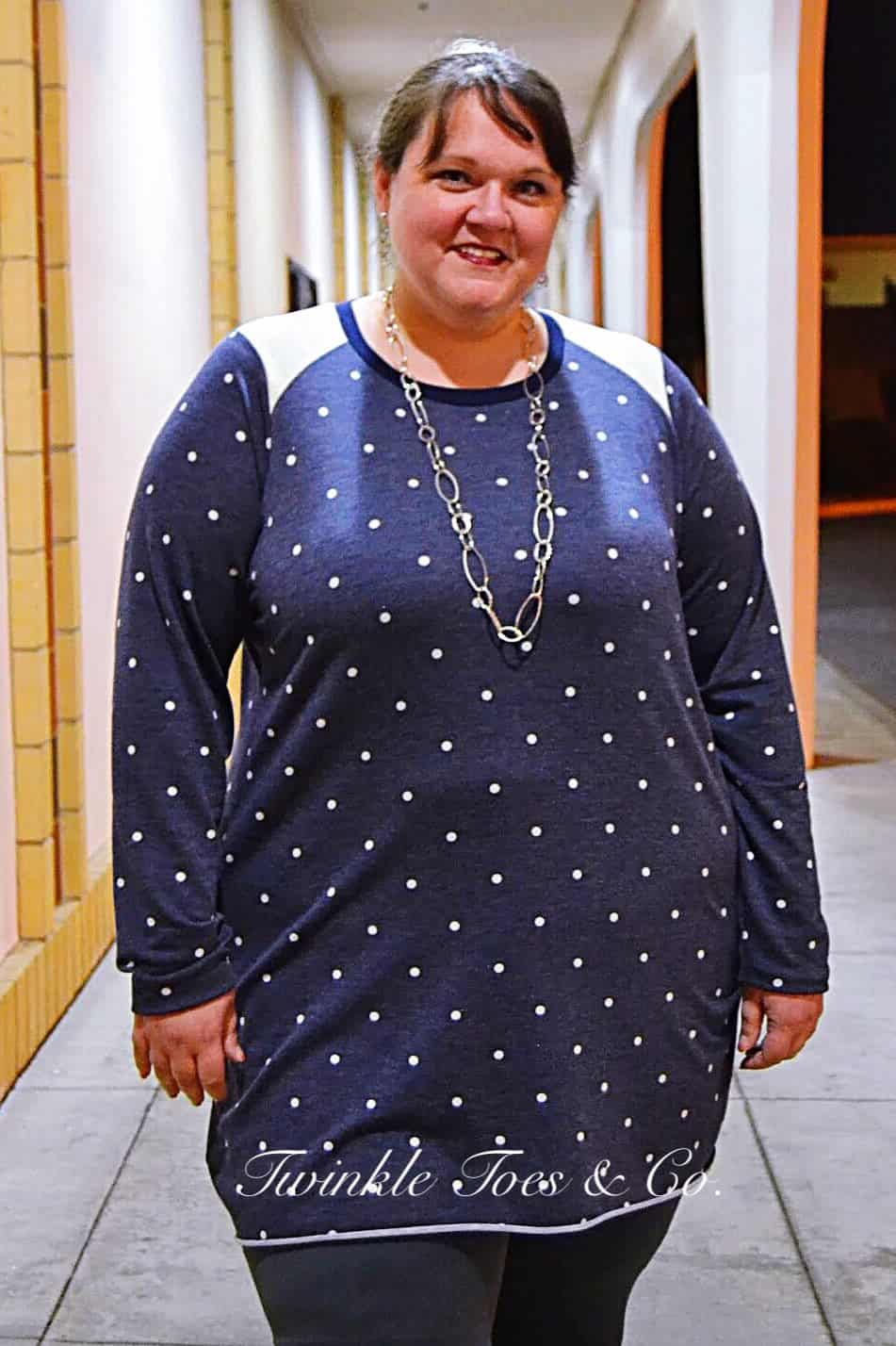
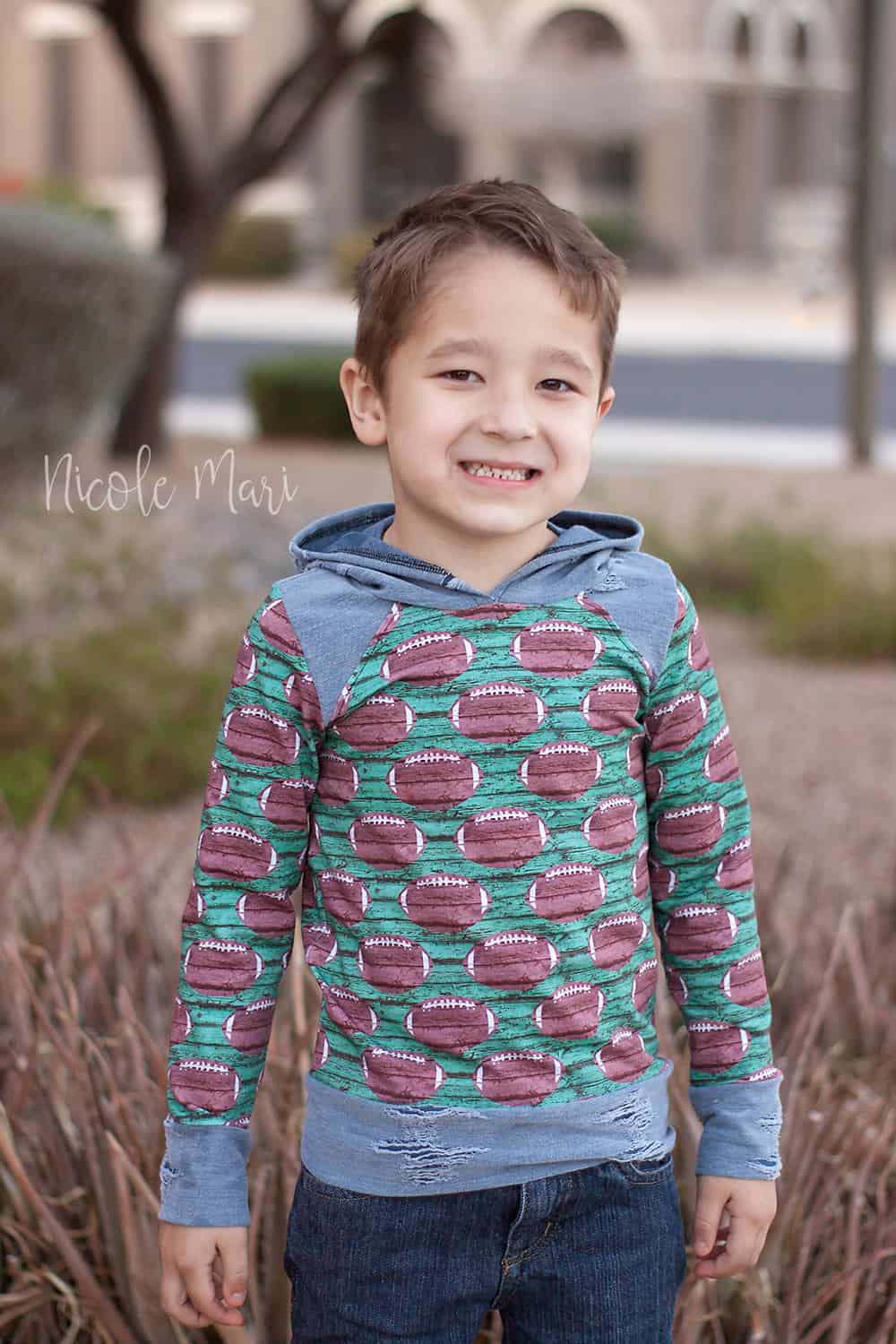
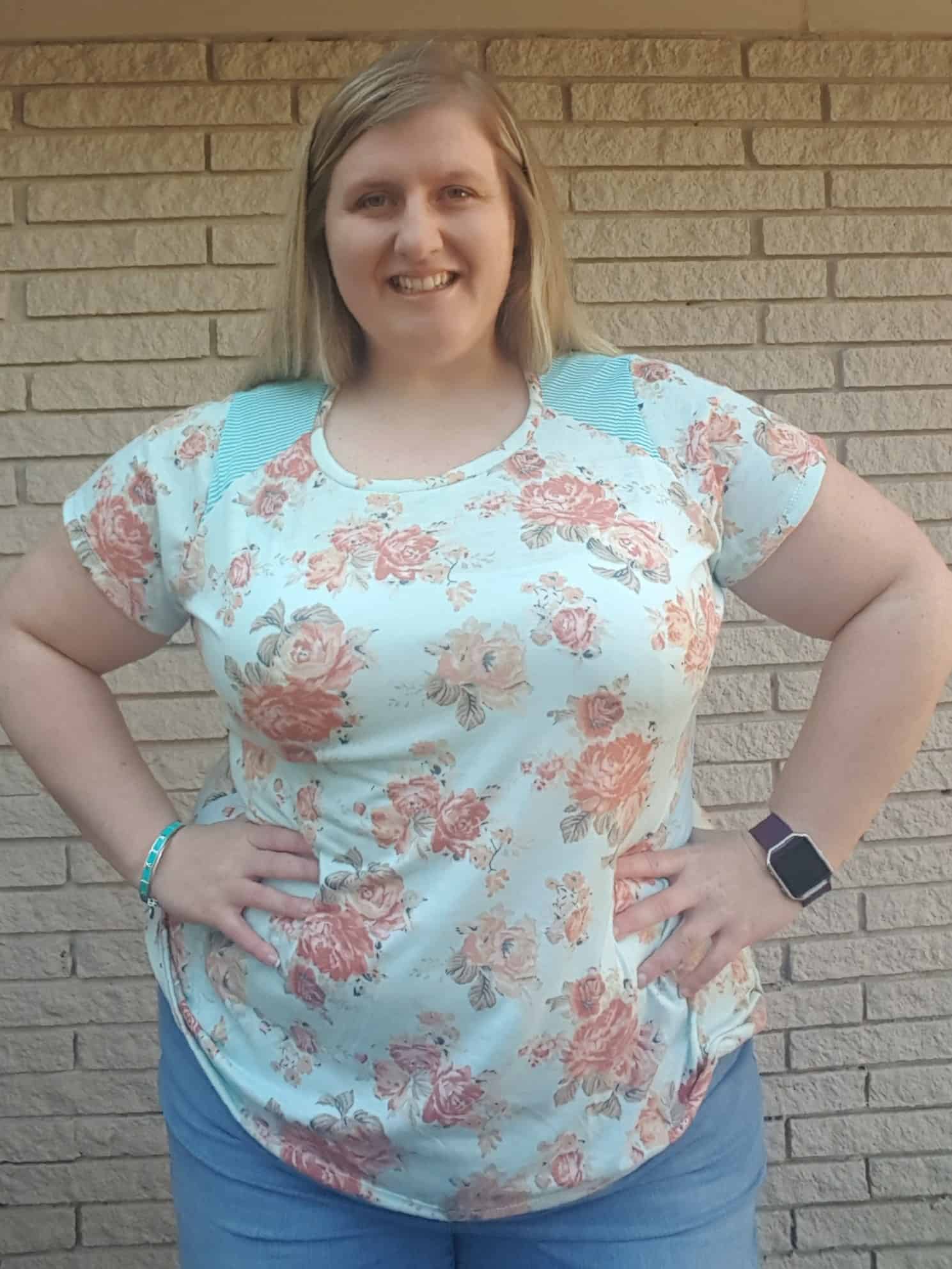
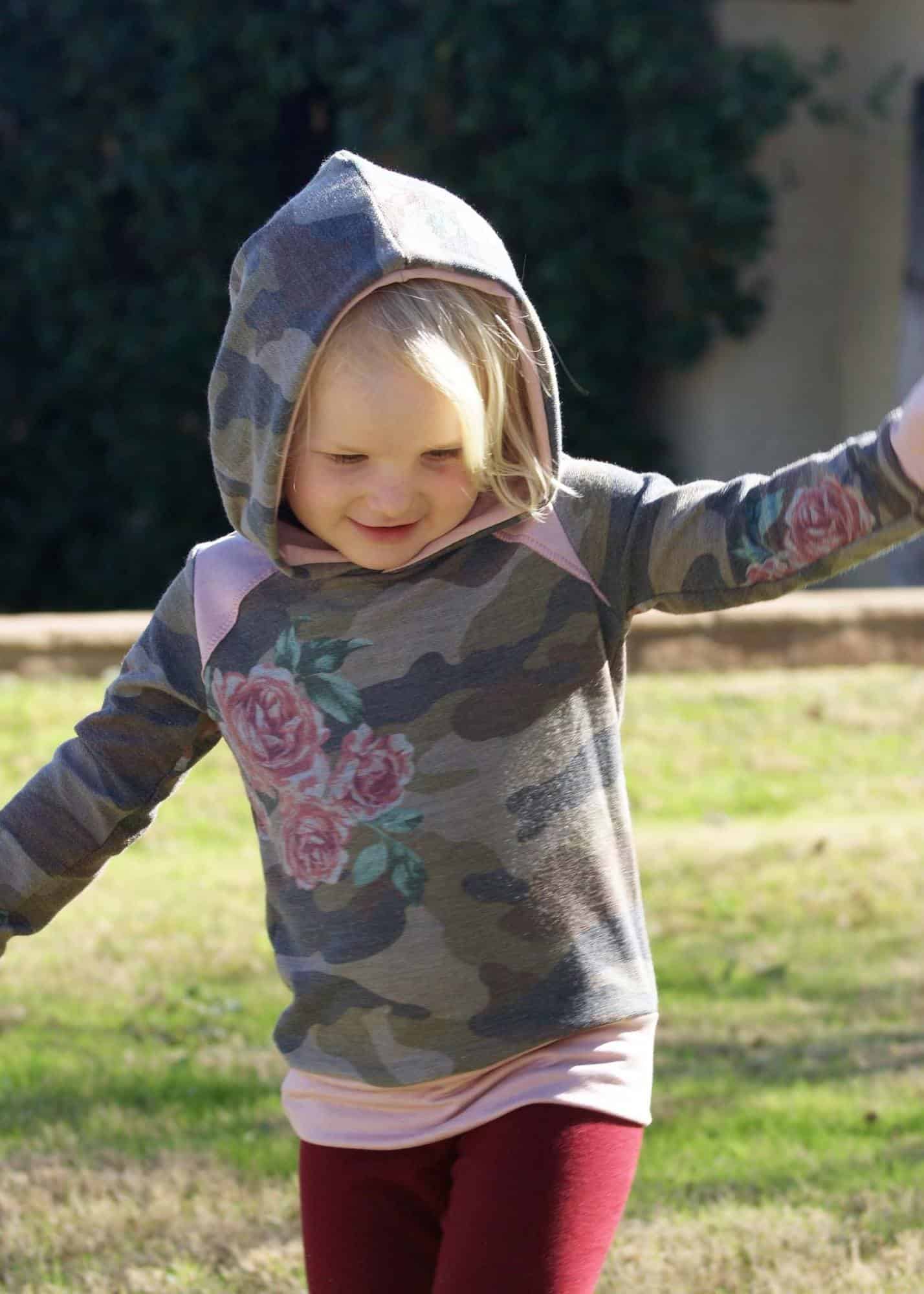
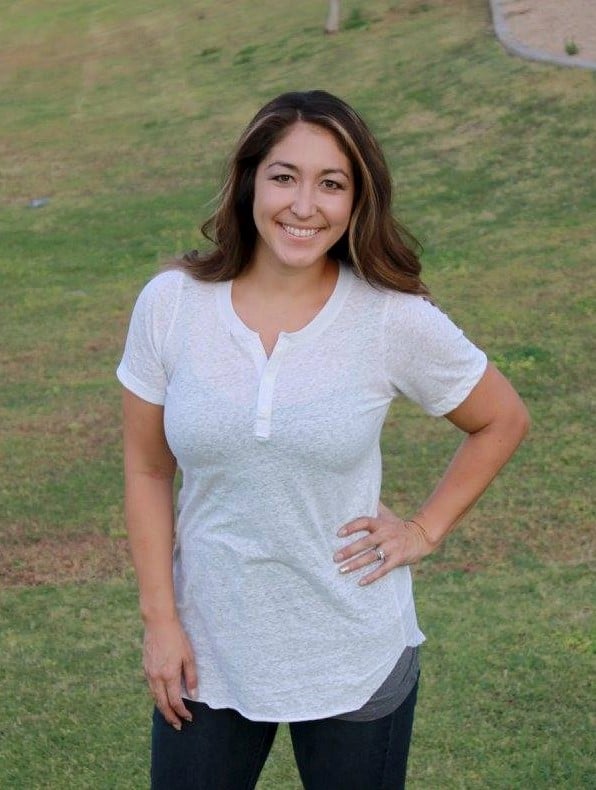
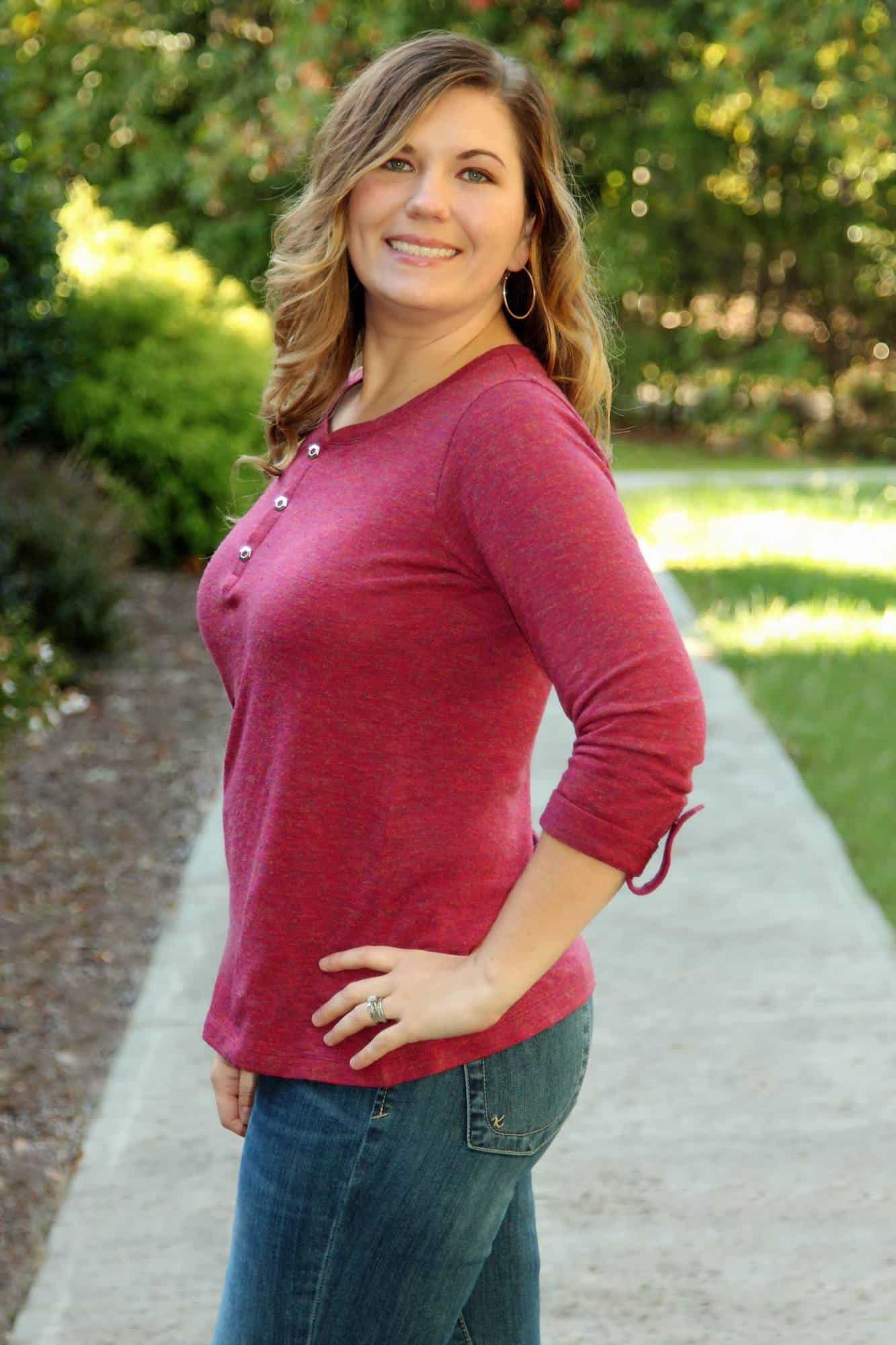
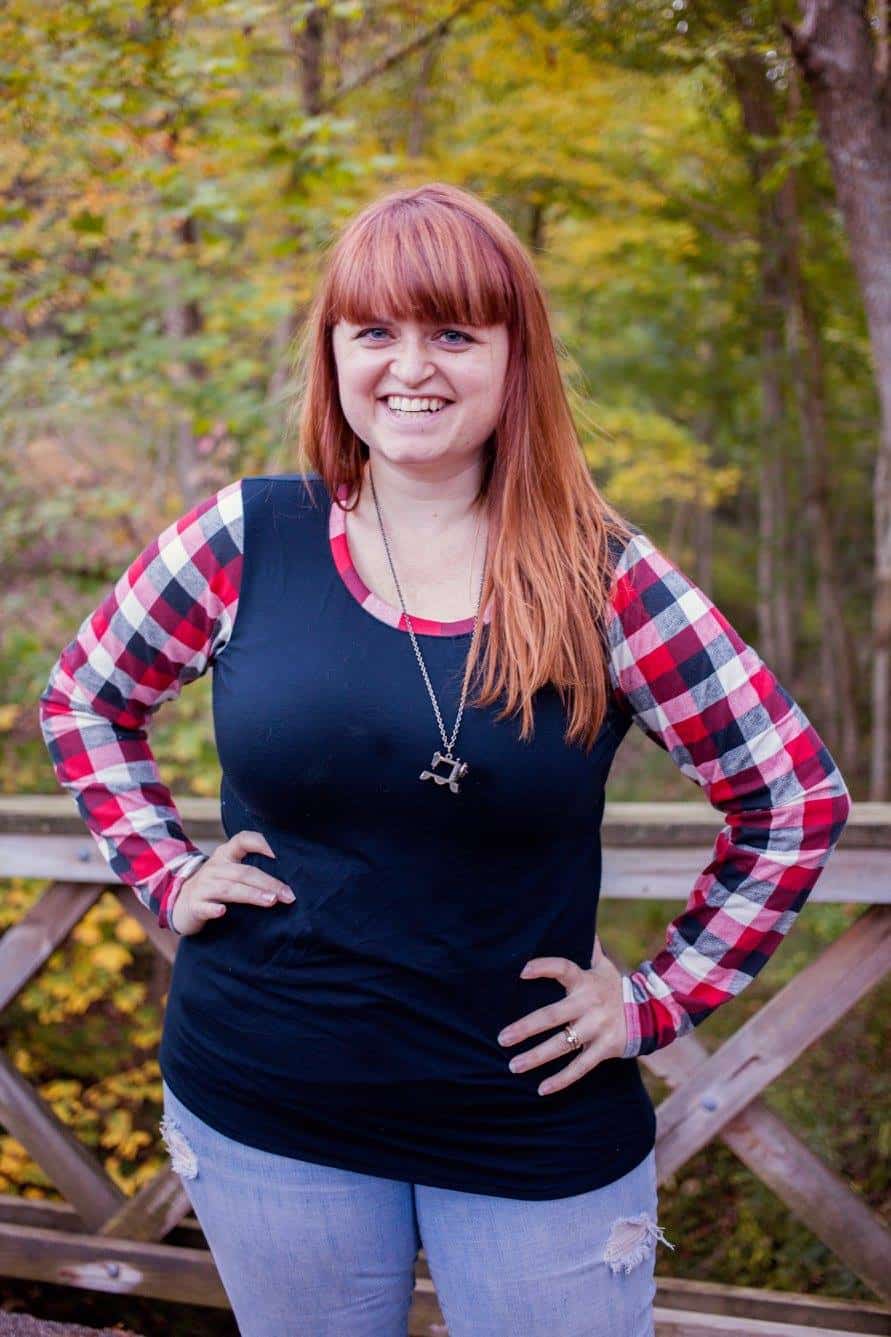
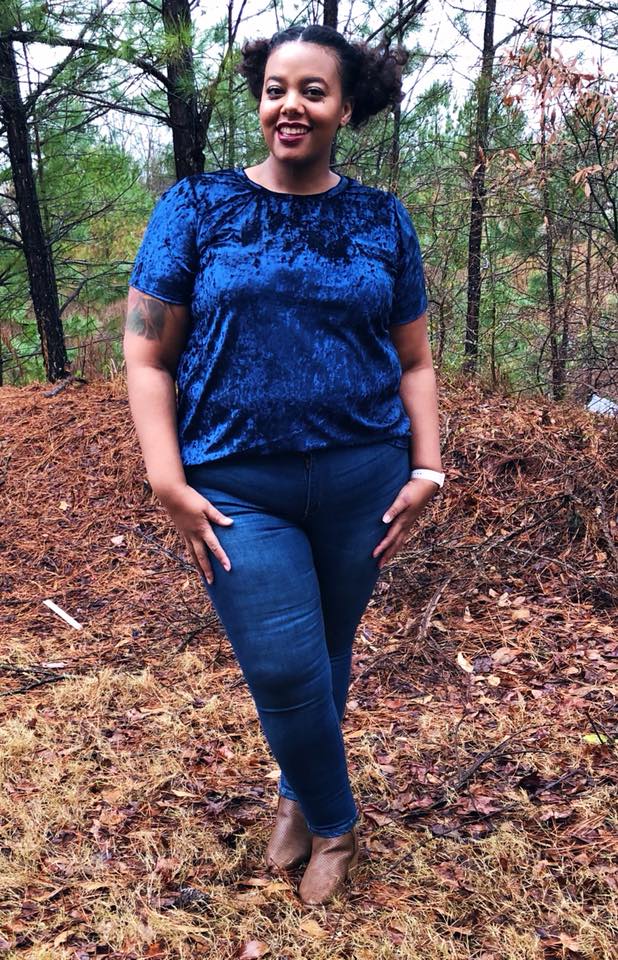
Here are a few examples from our testers!  And be on the lookout for the raglan shoulder color block hack later this week.  😉

Sweater Knit
Rayon Spandex/Jersey
French Terry

Crushed Velvet
Sweater Knit and Suede accents
Burnout Jersey/Rayon Spandex Placket

Thermal
Cotton Lycra
Cotton Lycra
French Terry


MEASURE YOURSELF

The Henley Patterns are all focusing on three measurement points: Chest, Waist and Hips.  Judy created an entire post dedicated to measurements and how to properly measure yourself.  You can see the full post HERE.

Chest/Full Bust — Full bust is around the fullest/biggest part of your bust.  You want the tape as even horizontally as possible.  For men/children, the fullest part of their chest is where the measurement needs to be taken.

IMG_7952

Hip – This is a deceiving name.  It is measured around your fullest/biggest part, which is usually your booty.  Try to keep your tape as even horizontally as possible (a mirror really helps on this one!)

IMG_7966

Waist– This is your natural waistline.  Contrary to most belief, it is NOT your belly button or where you wear your pants (even though you might like high waisted pants).  It is taken at the smallest part of your mid section.  if you don’t have a very defined natural waist there is a very easy way to find it.

Take any kind of stretch trim, fold over elastic, thin elastic, even a strip of knit will work, and tie it snuggly around your mid section.  Now MOVE around, bend walk around, sit down, it will naturally settle on  your smallest part.  This is your natural waist.

IMG_7969 IMG_8011

What if you’re taller or shorter than the pattern is drafted for?

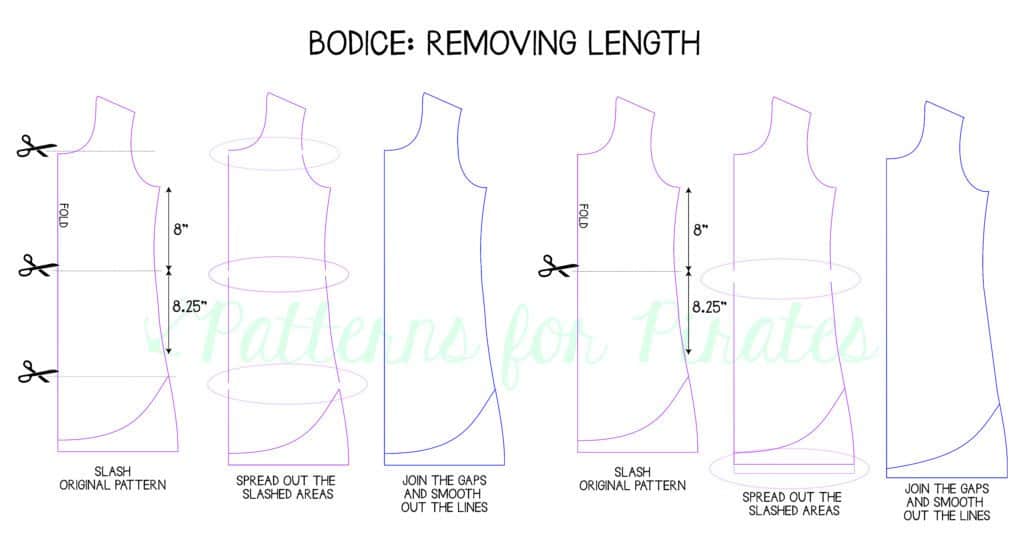
Wouldn’t you know that we have an entire blog post dedicated to helping you with that as well?  The “rule of thumb” is to add/subtract 1/2″ for every inch that you are different than the pattern is drafted for.  For example, at 5’10” there is a 5″ difference so I would need to add 2.5″ throughout the pattern.  If I were 5’1″ then I would remove 2″ of length since there is a 4″ difference.

Head HERE to read more about it!

What if your measurements don’t fall within one size?

That is why you’re sewing for yourself, isn’t it?  To get the perfect fit?  Well then let’s get that perfect fit!

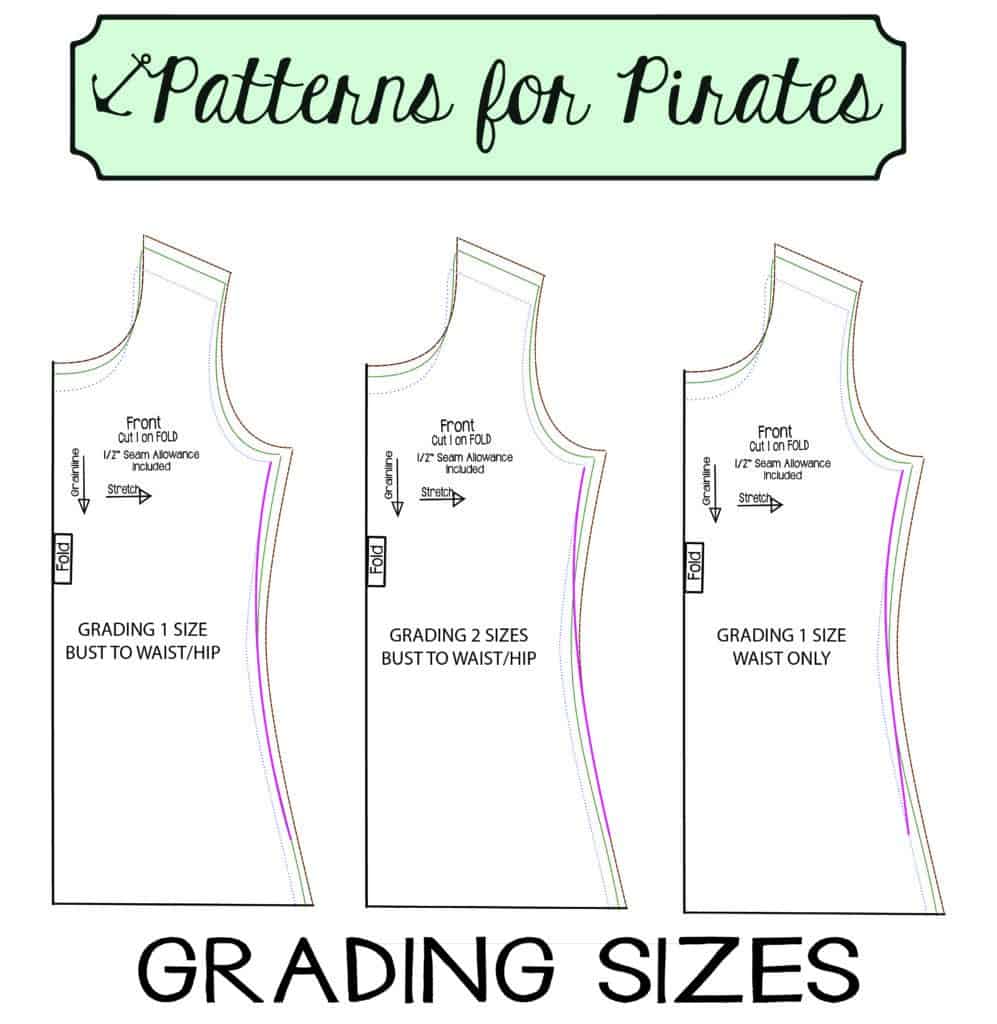
Now that you have determined your size and if you’d like to grade, how do you do it? Below are a few examples of grading for a larger waist and hip size.  Any adjustments should be made to both the FRONT and BACK pieces.  Do not be discouraged if your measurements put you within different or larger sizes than ready-to-wear store-bought clothes as pattern sizing does not translate the same.  Our bodies come in all shapes and sizes, and we are all uniquely beautiful.

PRINT YOUR PATTERN(S)

All three henley patterns are “no-trim” pages.  That is exactly what it sounds like!  The pages are set up to print and be taped/glued together without needing to get scissors out and trim the edges before assembly.  It makes this step of the process even quicker.  Need help assembling the no-trim pages?  No problem!  Judy created this fabulous video for us.  Go check it out HERE. (You have to be a member of the P4P Facebook group to be able to see the video.)

Before you hit print, BE SURE that your pages are set to print at 100%, no scaling.  We still recommend printing only the first page and measuring your 1″ x 1″ (or 4cm x 4cm) square to verify the print size is correct before printing the entire pattern.  Even if your square is off by the teeniest amount, the entire pattern will be affected and your dress will not fit.  Save yourself some ink and paper (and fabric!) and verify the settings first.

Patterns for Pirates how to print layered pdf sewing patterns using adobe (4)

Whew!  That was a lot of information to take in, wasn’t it?

Hopefully now, your pattern is printed, taped/glued together, you have properly measured for your size, cut the pattern pieces out and are ready to start cutting into your pretty fabrics tomorrow.  If you’re sewing along with us, be sure to tag @PatternsforPirates and #P4PHENLEYSAL on Instagram.  Don’t forget to join us on the P4P event page either: Henley SAL on Facebook.

**The links won’t be active until the scheduled date.

January 14: Announcement.
January 15: Choosing Your Fabrics, Printing + Measuring.
January 16: Cutting Fabric.
January 17: Placket.
January 18: Sleeves.
January 19: Attaching Neckband + Hood.
January 20-21: Catch-Up Days.
January 22: Recap + Winners Announced!
Filed Under: Sew-A-Long, Uncategorized 3 Comments

P4P Henley Sew-Along | Get Ready!

January 14, 2018

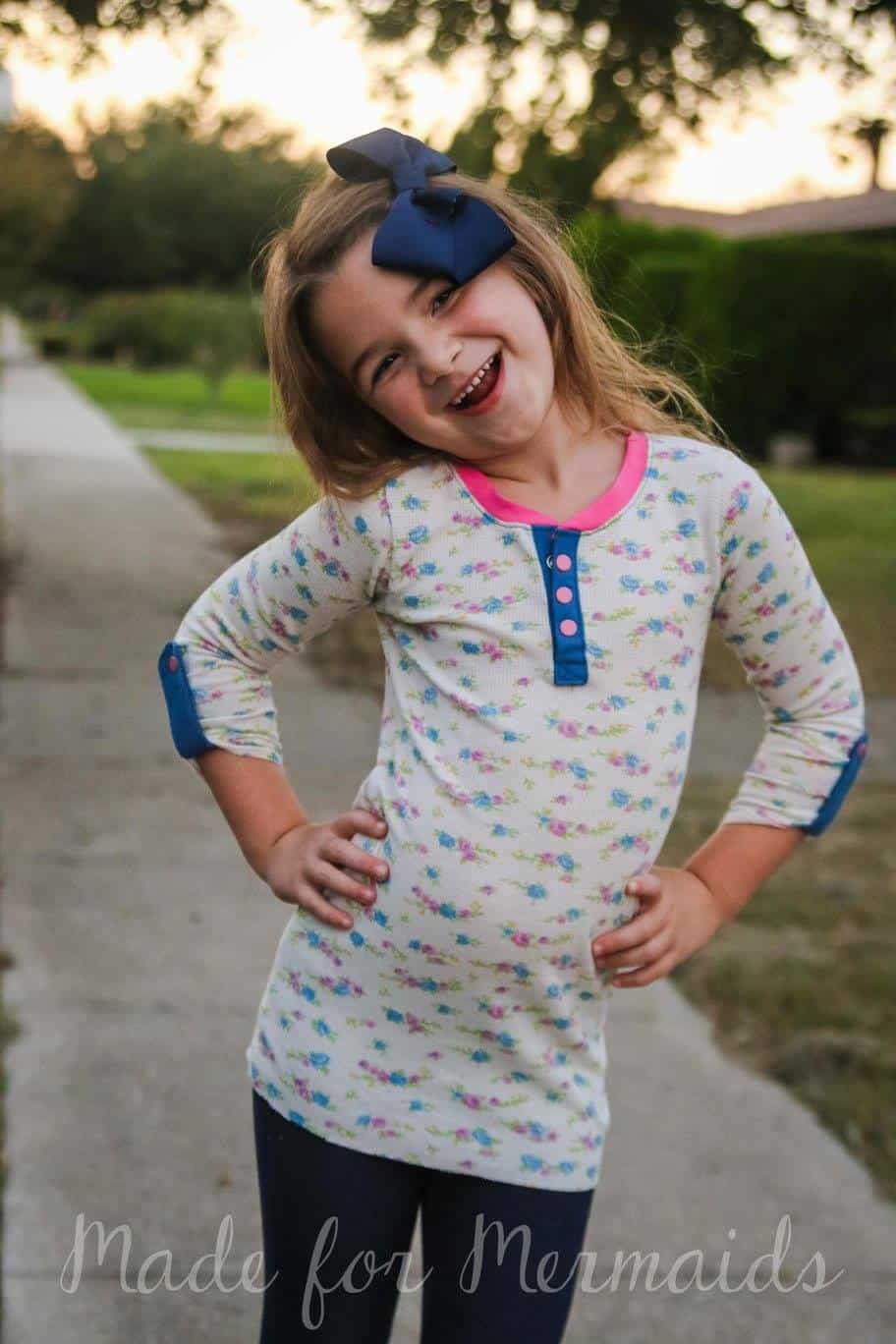
Are you ready for another sew-along with the Pirate Crew?  We are so excited to tell you that we are bringing an entire week of P4P Henley love!  We thought it was time to shine some light on these “oldie but goodie” patterns of ours, and especially love it because the patterns cover your entire family.

Welcome to Henley Sew-Along Week, friends!

The party doesn’t start officially until tomorrow, but that doesn’t mean you can’t prepare yourself a little bit beforehand.  In celebration of the Henley Sew-Along Week, all three patterns can be discounted an additional $3, using the code “henleysal” until January 20, 2018 (11:59pm Central Time).

Yo Ho Henley | Women’s Henley | Men’s Henley | Henley Bundle

Be sure to join us in the Event Page for the Sew-Along on Facebook: HERE.
The SAL itself will be on this very blog, but we will be extending the party over to the group and event on Facebook for even more interactive fun!

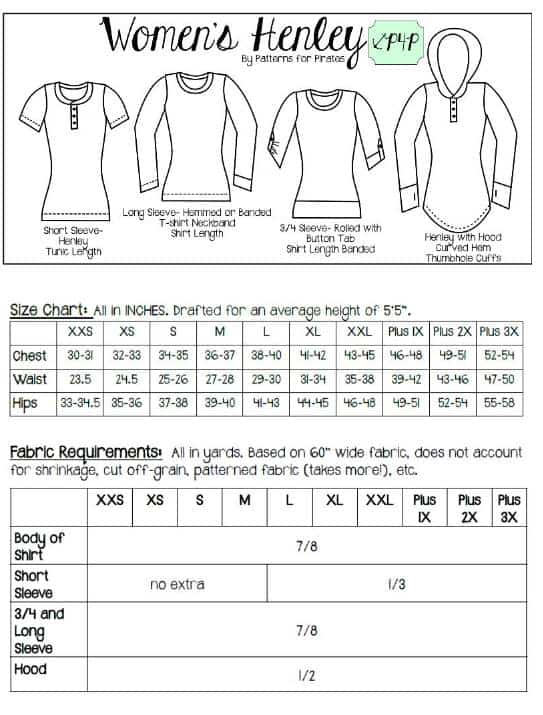
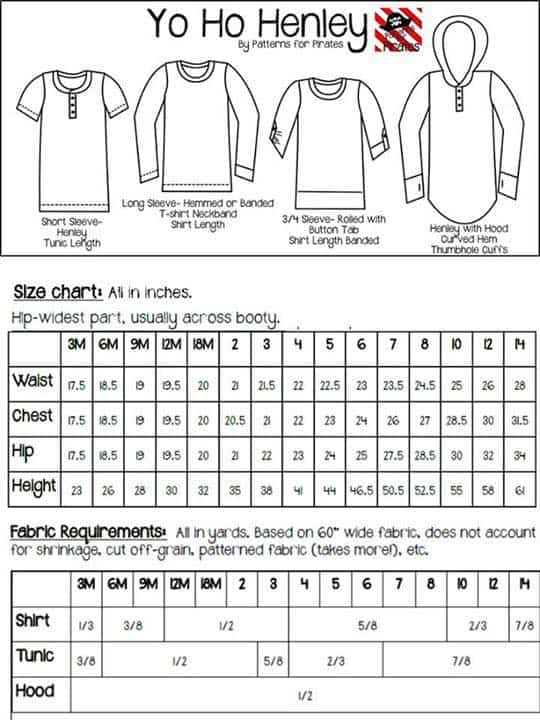
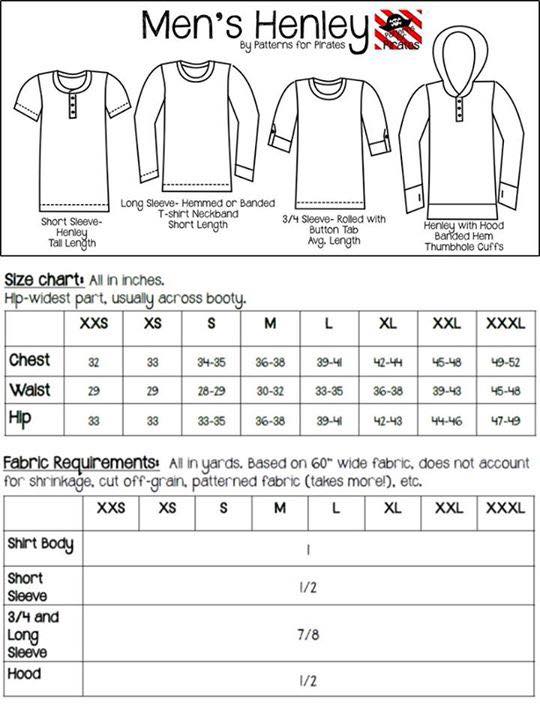
If you’d like to get a leg up on the yardage of fabric you’ll be needing, here are the size charts and fabric requirements, for easy access:

And before we go…here is the schedule, so you know what to expect from us.  We will even be throwing in some new tricks and pattern hacks, so you can get even more out of these adorable patterns.  Can’t wait!!

**The links won’t be active until the scheduled date.

January 14: Announcement.
January 15: Choosing Your Fabrics, Printing + Measuring.
January 16: Cutting Fabric.
January 17: Placket.
January 18: Sleeves.
January 19: Attaching Neckband + Hood.
January 20-21: Catch-Up Days.
January 22: Recap + Winners Announced!
Filed Under: Announcement, Contest/Giveaway, Sew-A-Long 4 Comments

P4P University – knit cuffs

January 9, 2018

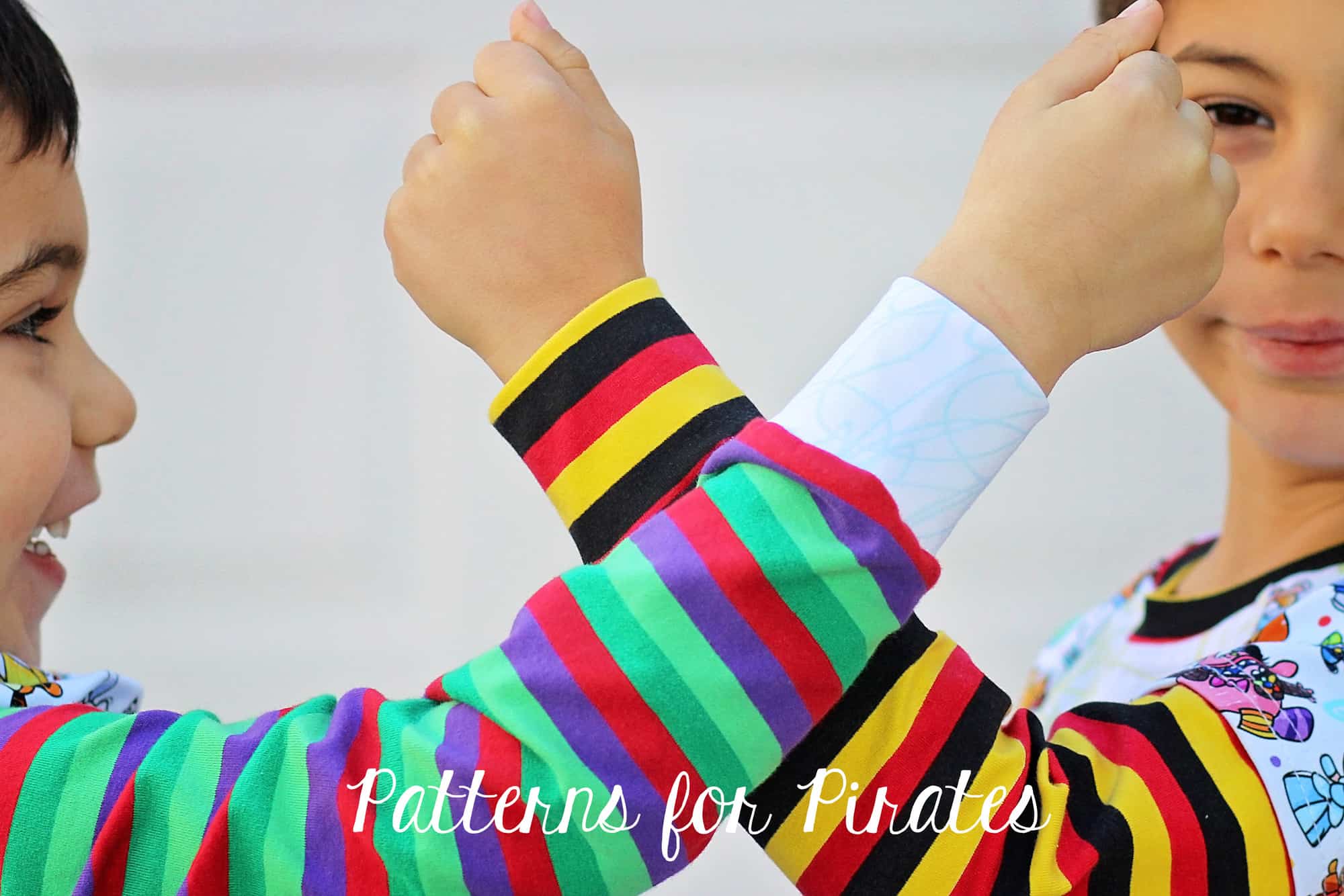
Ahoy Pirates! In our first P4P University blog of the year I wanted to give you a few tips and tricks to make adding knit cuffs to your projects easy peasy. Whether you’re sewing for yourself, your significant other or your little ones, adding cuffs to your sleeves or leg openings can be a tedious job. We can change that!
*Choose the right fabric for the cuff!

As I mentioned in the Neckbands 101 blog post, choosing the correct fabric for your cuffs will make a huge difference. The best one is rib knit or ribbing. If you do not have any ribbing handy or the colors you have do not work for your project the next best thing would be cotton spandex. I mainly use cotton spandex in for my kids’ shirts and joggers cuffs as I like to coordinate it with the main fabric. Whatever fabric you pick, make sure it has at least 50% stretch and excellent recovery.

*Always cut the cuff with the greatest stretch horizontally.

Always cut your cuffs cross grain! Even if the fabric you use stretches over 50% in both directions, you should never cut against the grain. Read all about the importance of “the grain” in Roberta’s blog post, When It Goes Against the Grain. 

*Press your cuffs!

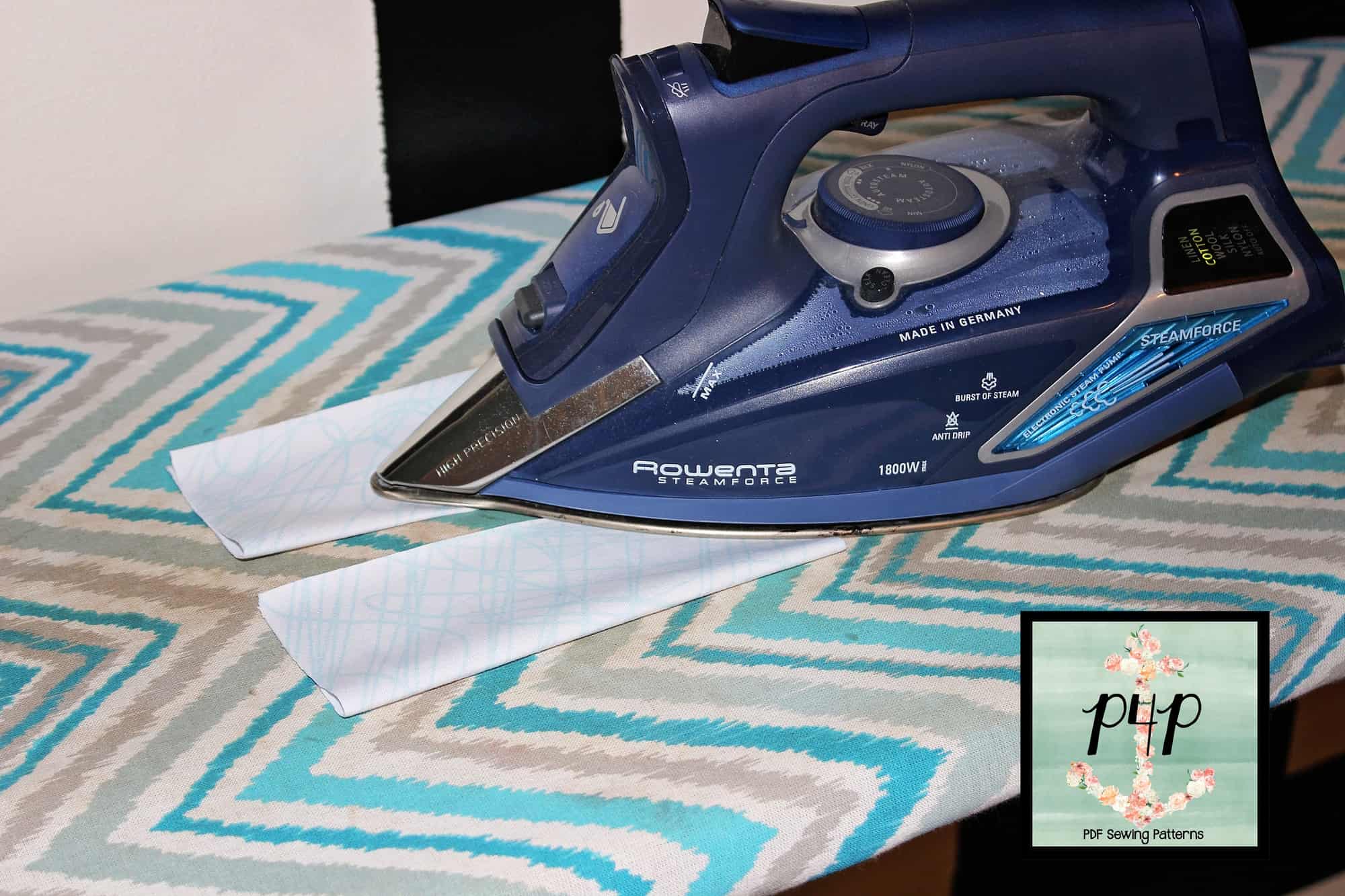
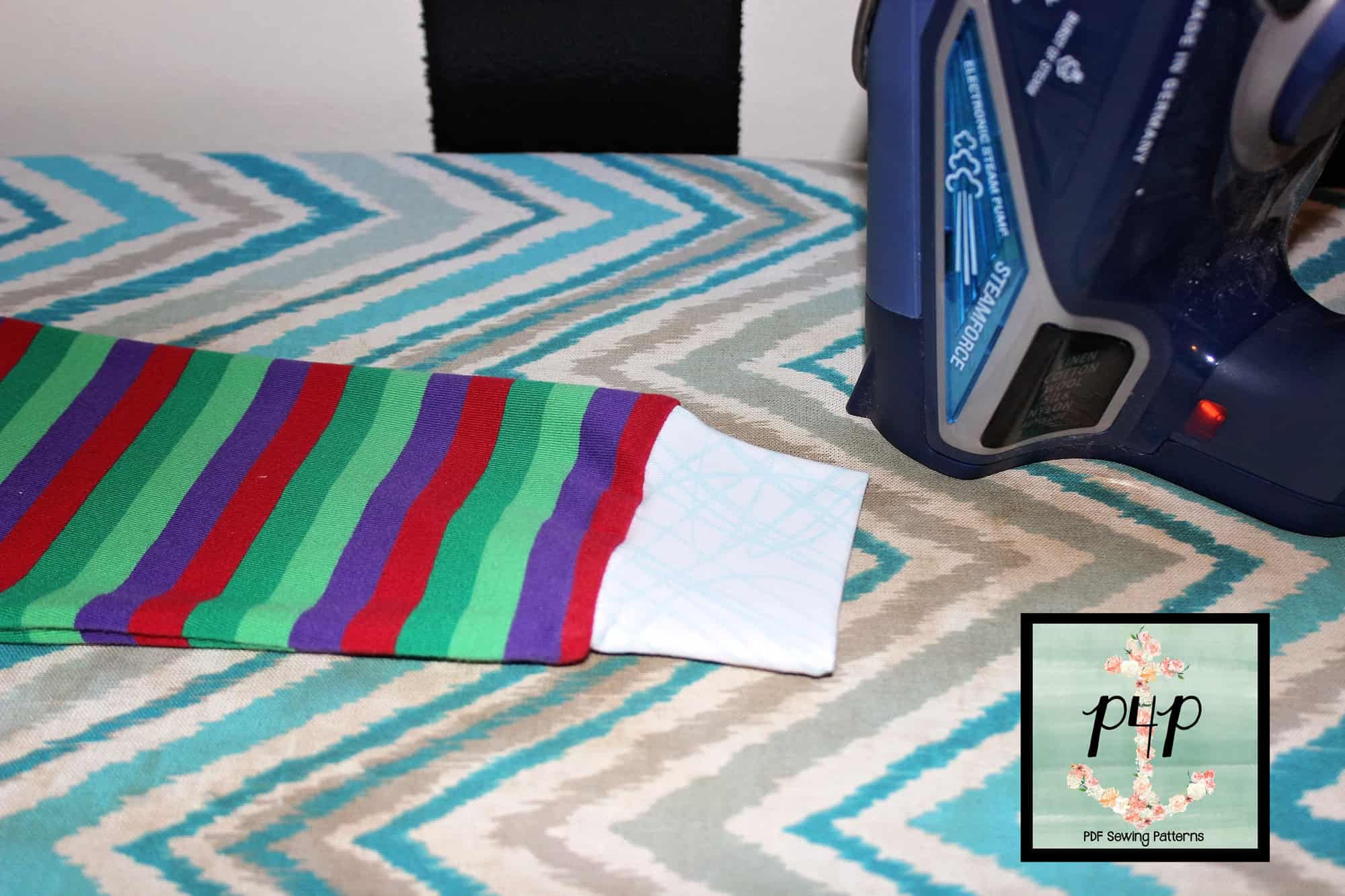
I know I talk about pressing a lot in my blogs, but you have to believe me, it makes your sewing life so much easier. I recommend grabbing those cuffs and giving them a good steam press as soon as you cut your fabric. This will create a memory hem that will make it so much easier to fold them once you sew the “loop” closed.

Press your cuffs after you sew them on too! 🙂

*Snip the seam allowance to create less bulk

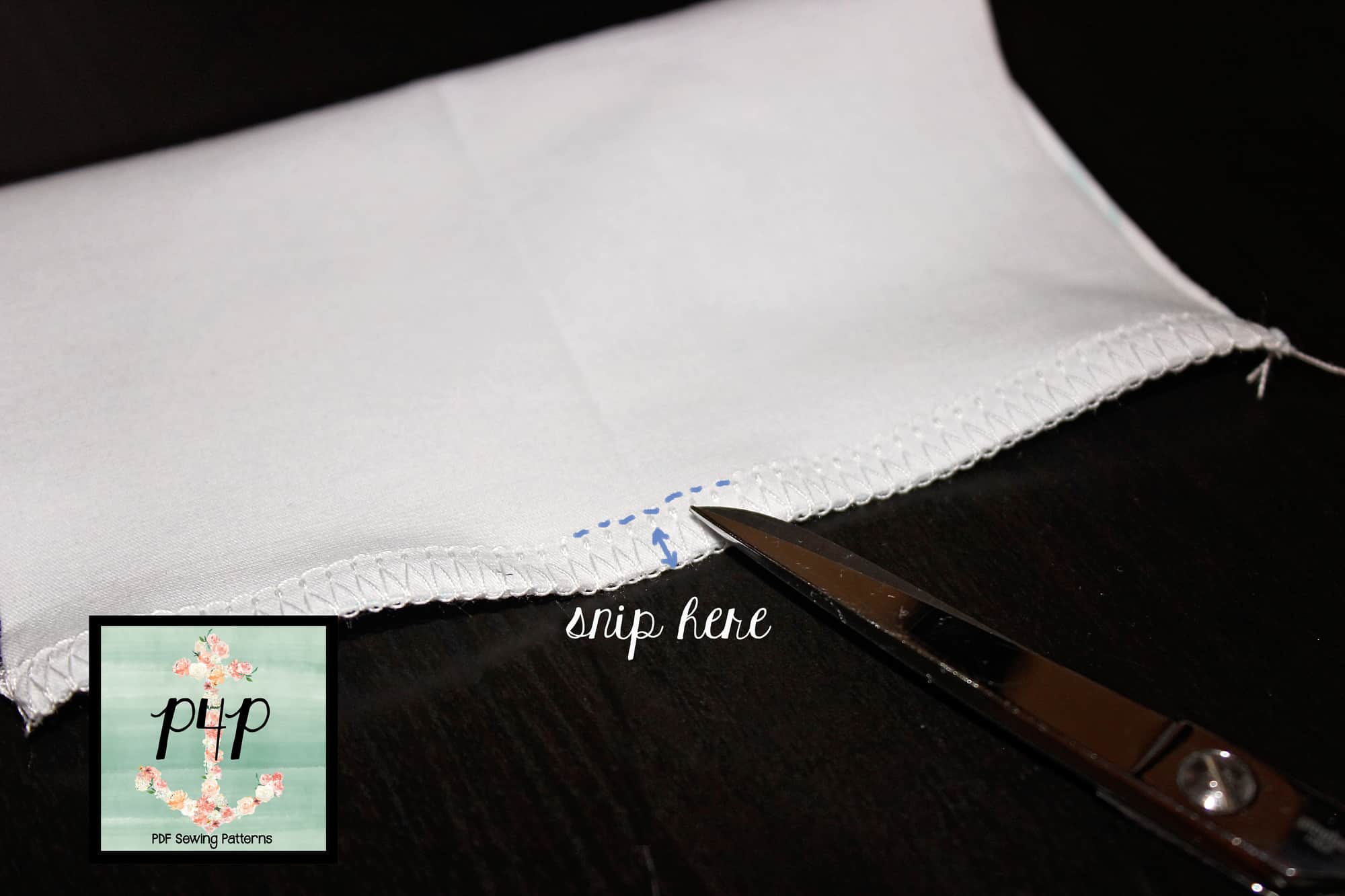
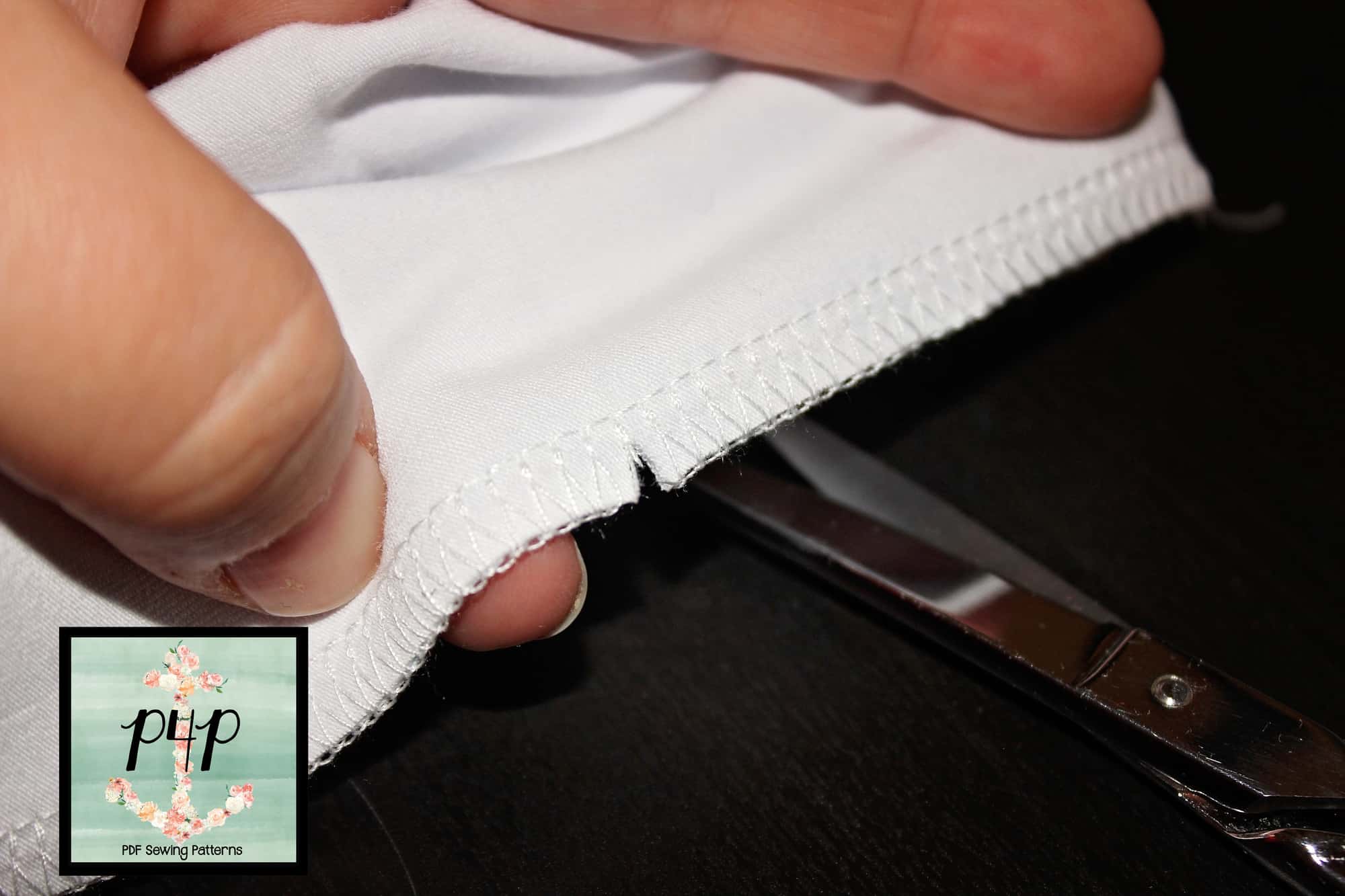
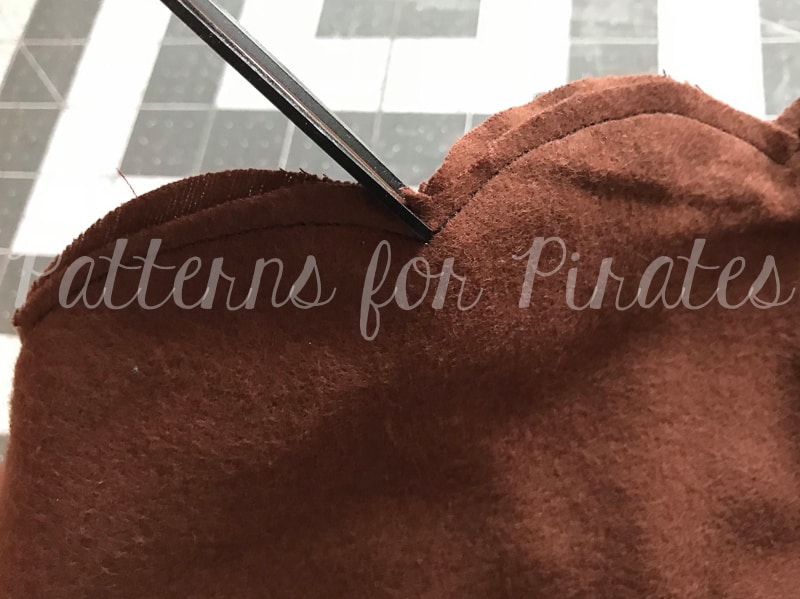
This is one of tricks for creating less bulk at he seam. Once you sew the cuff to create a loop, grab your sharpest scissors and make a cut as close to the stitch as possible without, of course, snipping the stitch.

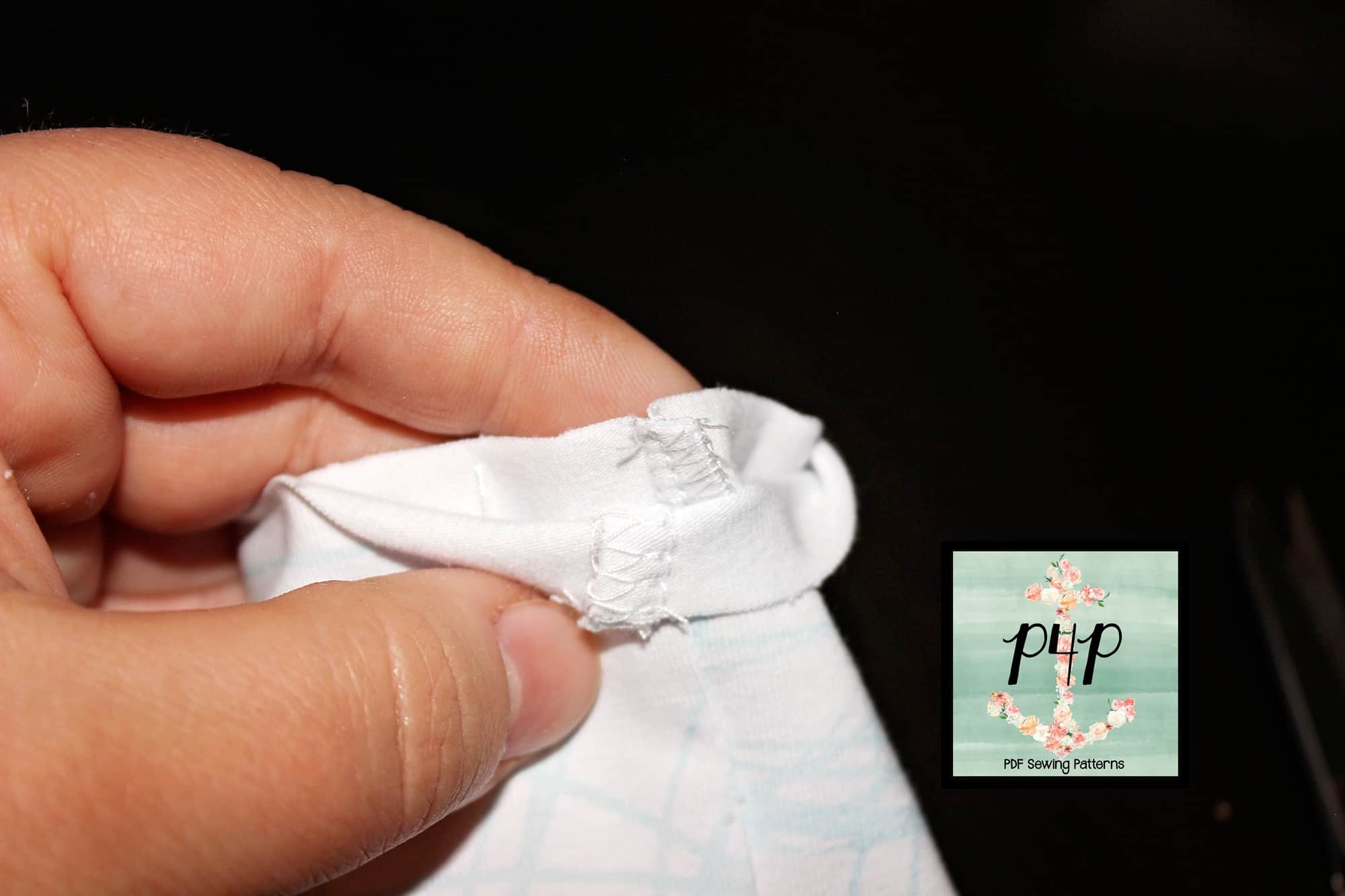
That little snip will make it so easy to please the seam allowances on opposite sides when you sew fold the cuff. In doing so, you will have so much less bulk at the seam, your serger will thank you! 🙂

*Place your sleeve inside the cuffs

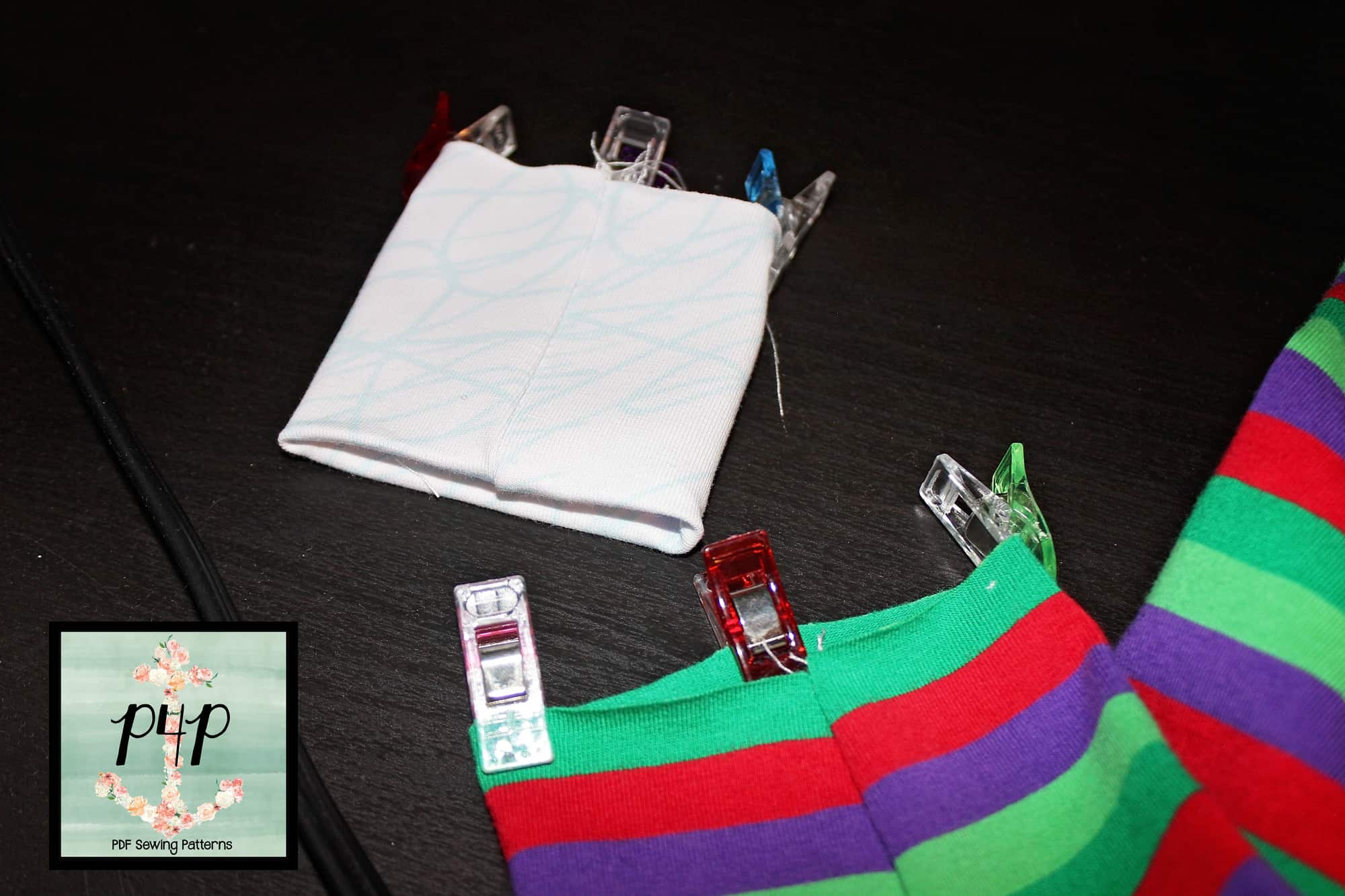
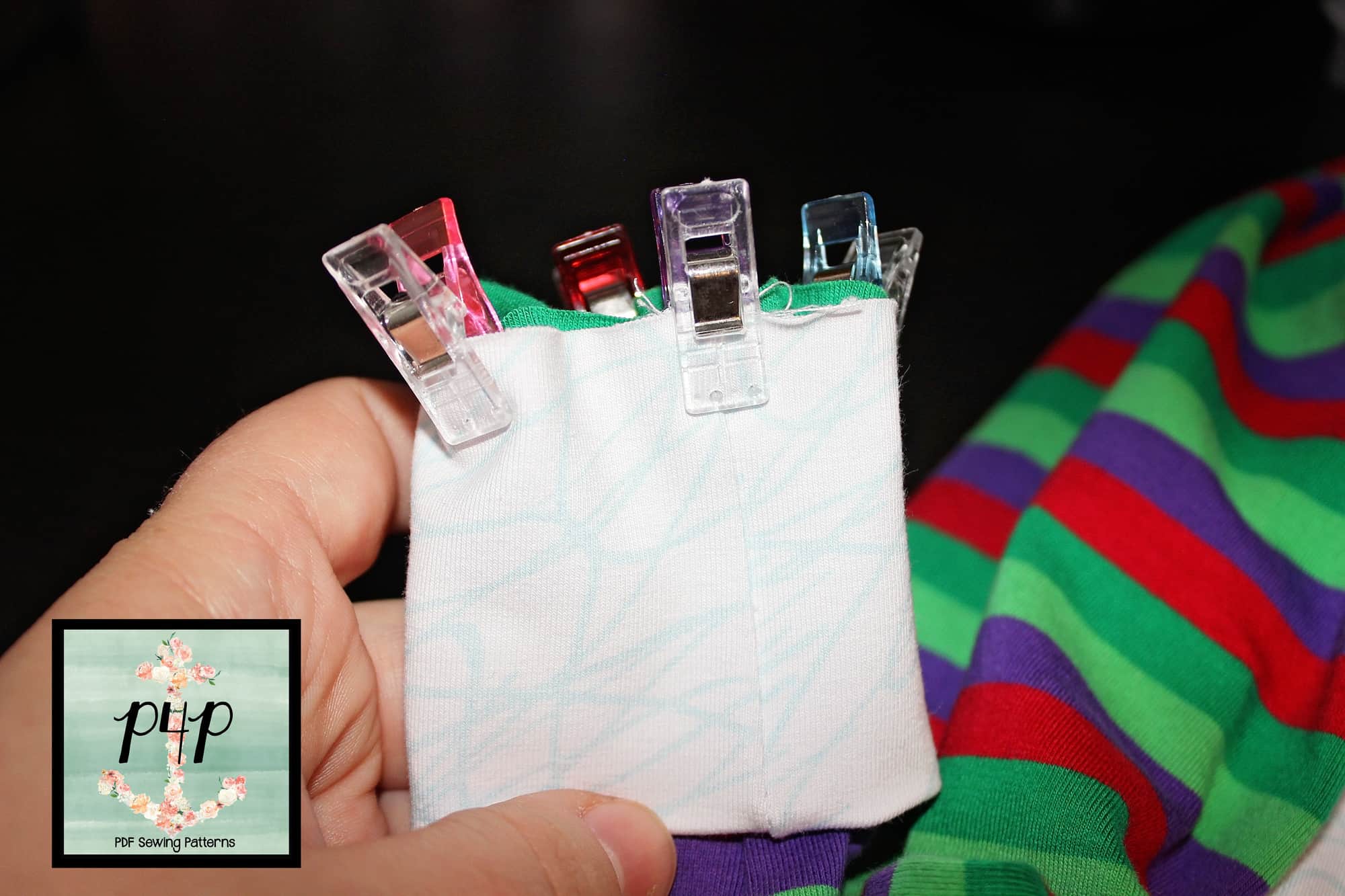
Mark the quarter points on the sleeve (or leg) opening as well as the cuffs. I find that for the smallest of sizes, marking just the half point is sufficient.

To make sure you will not have your seam allowance on the outside of your sleeve (or ankle) 😉 place the right side of your sleeve inside the cuff and match the quarter (or half way) points.

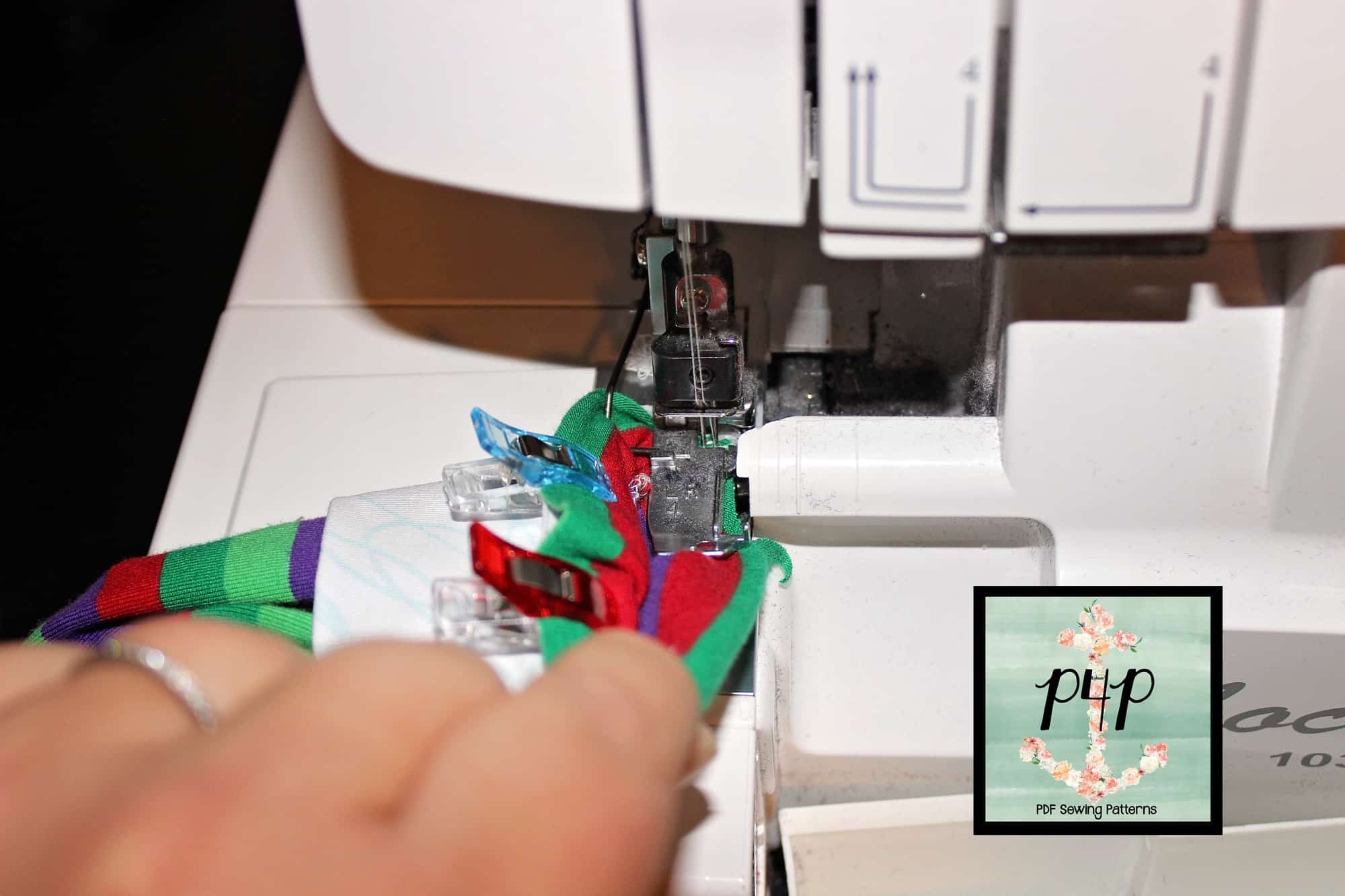
*Sew or serge with the presser foot inside the sleeve

Most of the time the sleeve opening is pretty small so I find that it is easier the place the presser foot of my serger (or sewing machine) inside the sleeve as opposed to stitching on the outside. This is especially important when you make Baby Bear Joggers or and kids shirts with cuffs, like the Jolly Roger Raglan or the Yo Ho Henley.

*Do not topstitch.

As opposed to necklines, I find that cuffs and waistbands look a lot better if you do not topstitch them down. I do encourage you to press your garments when you finish sewing it, including the cuffs.

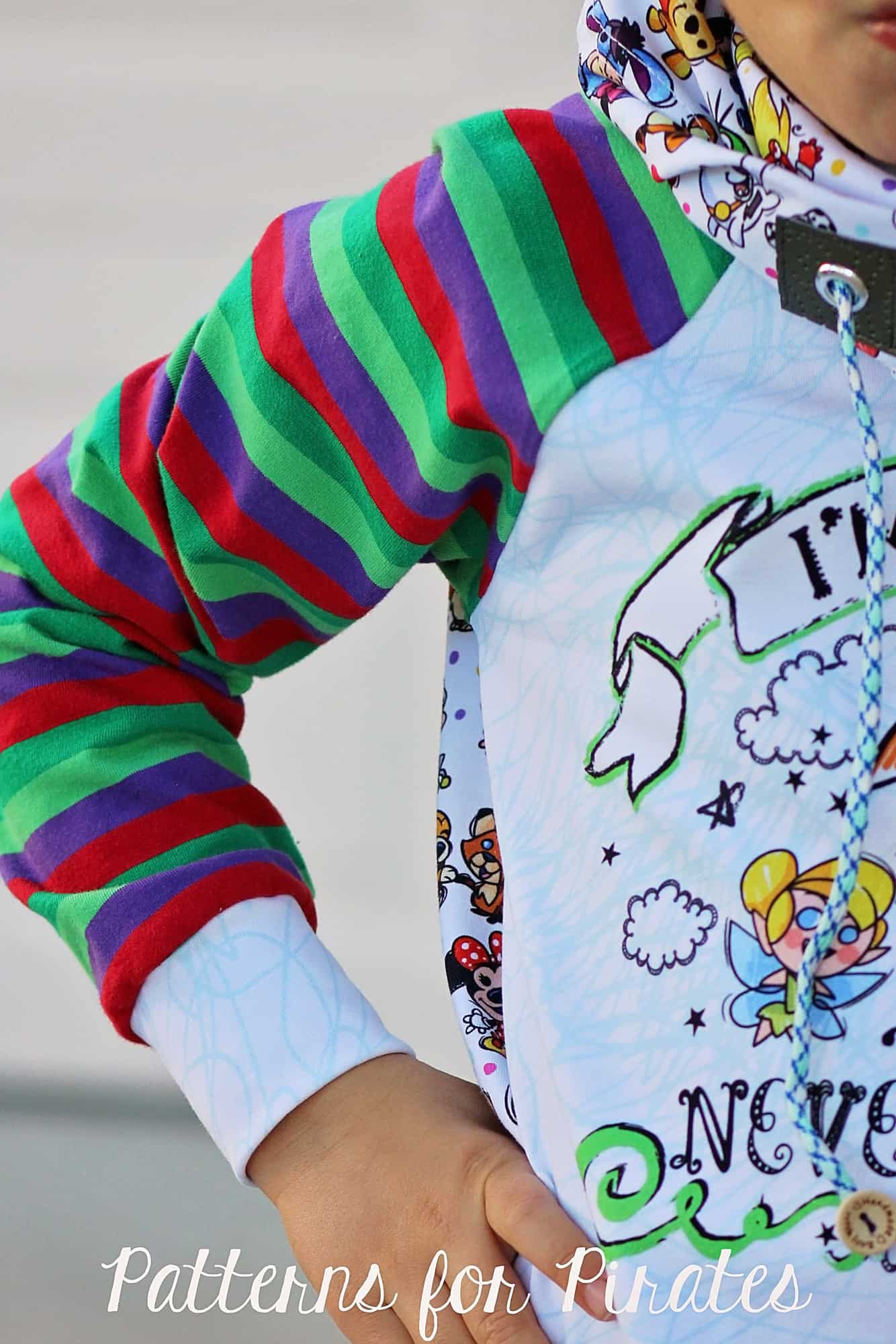
There you have it! 7 easy tips to follow when adding cuffs to your favorite P4P knit patterns. My boys are both rocking the JRR with add on cowl neck from the pack and faux layered sleeves from the blog.

Which one will you be making first? Make sure you post your creations in the P4P group and let me know if adding cuffs is now an easier “task”. 🙂


Filed Under: Frequently Asked Questions, P4P University, Sewing with Stretch, Knit Fabrics, Uncategorized 6 Comments

Pattern Markings 101

December 19, 2017

Many moons ago, I can remember calling my mom in a panic. I had printed out my first pattern for a garment, assembled it, and then just stared at all of the markings! Even though I’d sewn quilts for years before, this was my first attempt at making clothes and the pattern looked like a map in which I had no clue how to follow. After my “what did I get myself into” talk with her, she slowly walked me through each question I had and now after all these years we’ve come full circle and I’m making clothes for her!

Like many people, you will probably experience (or already have!) the “What have I done?” moment in sewing and question why you started a project to begin with. Have no fear! We’re here to help. We decided it was time to break that map down for you and help you learn how to navigate through the amazing world of garment sewing. In this post, you’ll find a description of all the key terms and symbols you might expect to see when starting your sewing adventures! So let’s get those patterns printed, assembled and let the fun begin! (If you’re staring at all of those pages you’ve just printed- don’t worry there either! Click here for our First Time User Tips, which includes how to assemble patterns).

Grainline

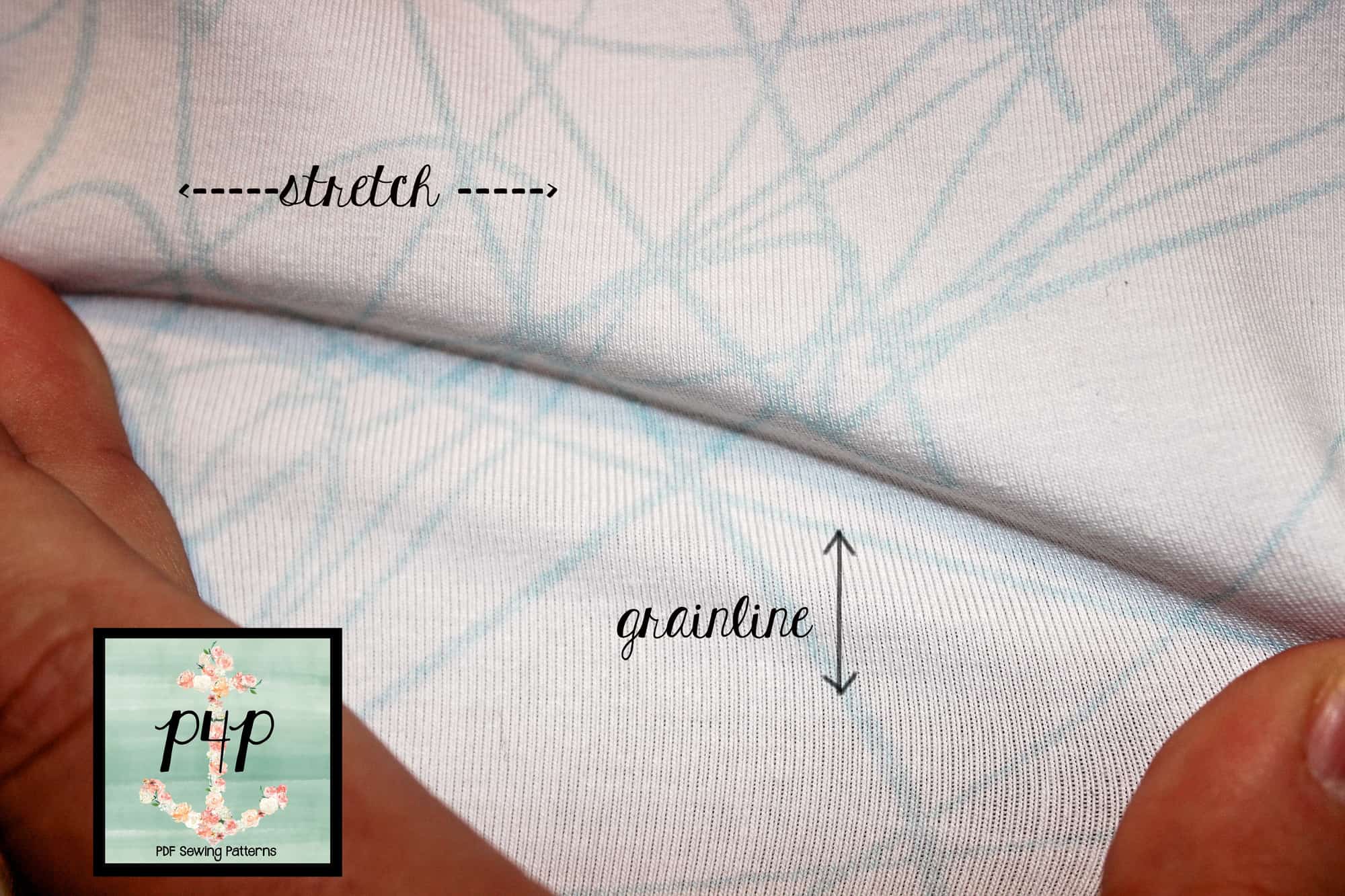
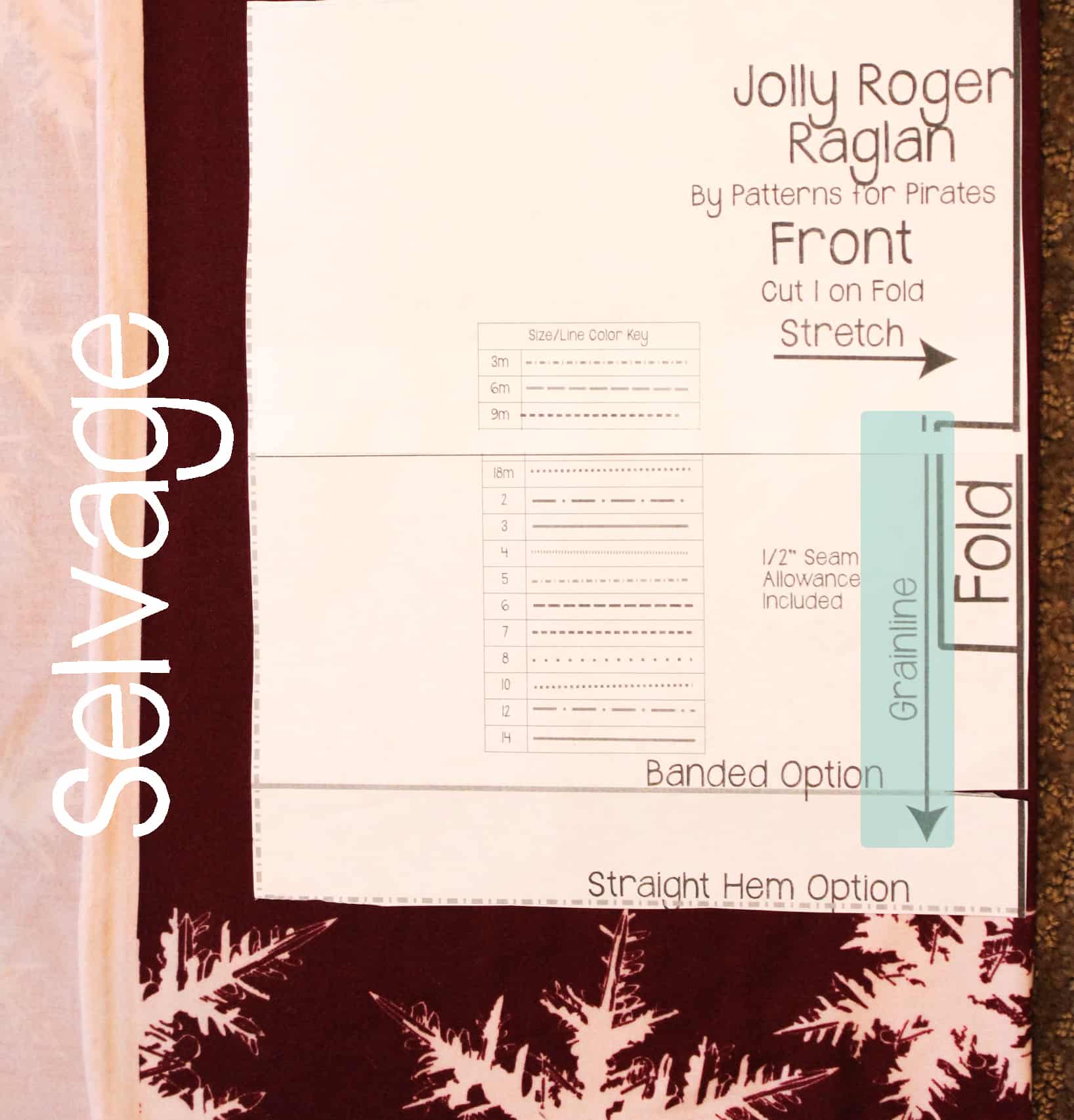
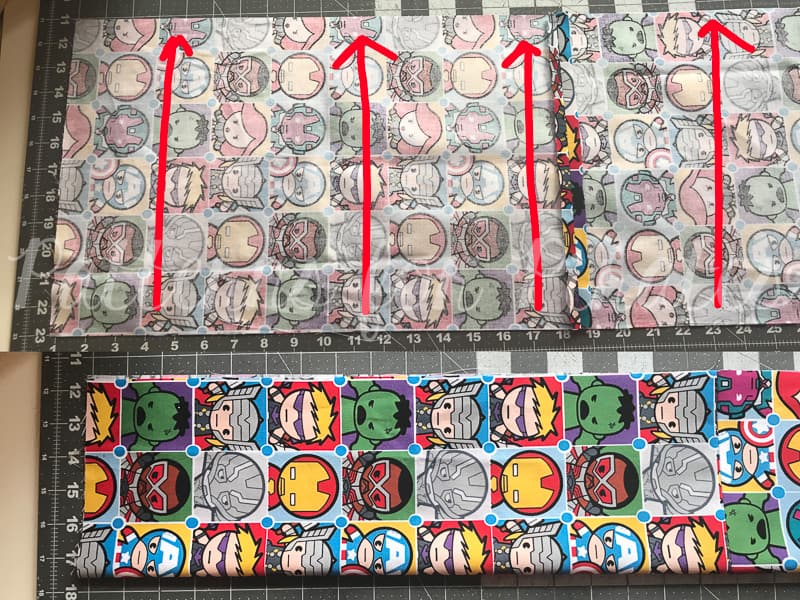
The grainline tells you which direction the grain of your fabric should run. The grainline will run parallel between the selvages, or finished edges of your fabric. There are usually printer markings, contrasting trims, solid colors, etc found on the selvage. Typically, your grainline will have the less amount of stretch in knit fabric. A few weeks ago, Roberta shared some details and information about grainlines, why they’re important, and much more. You can check that out here. 

Stretch

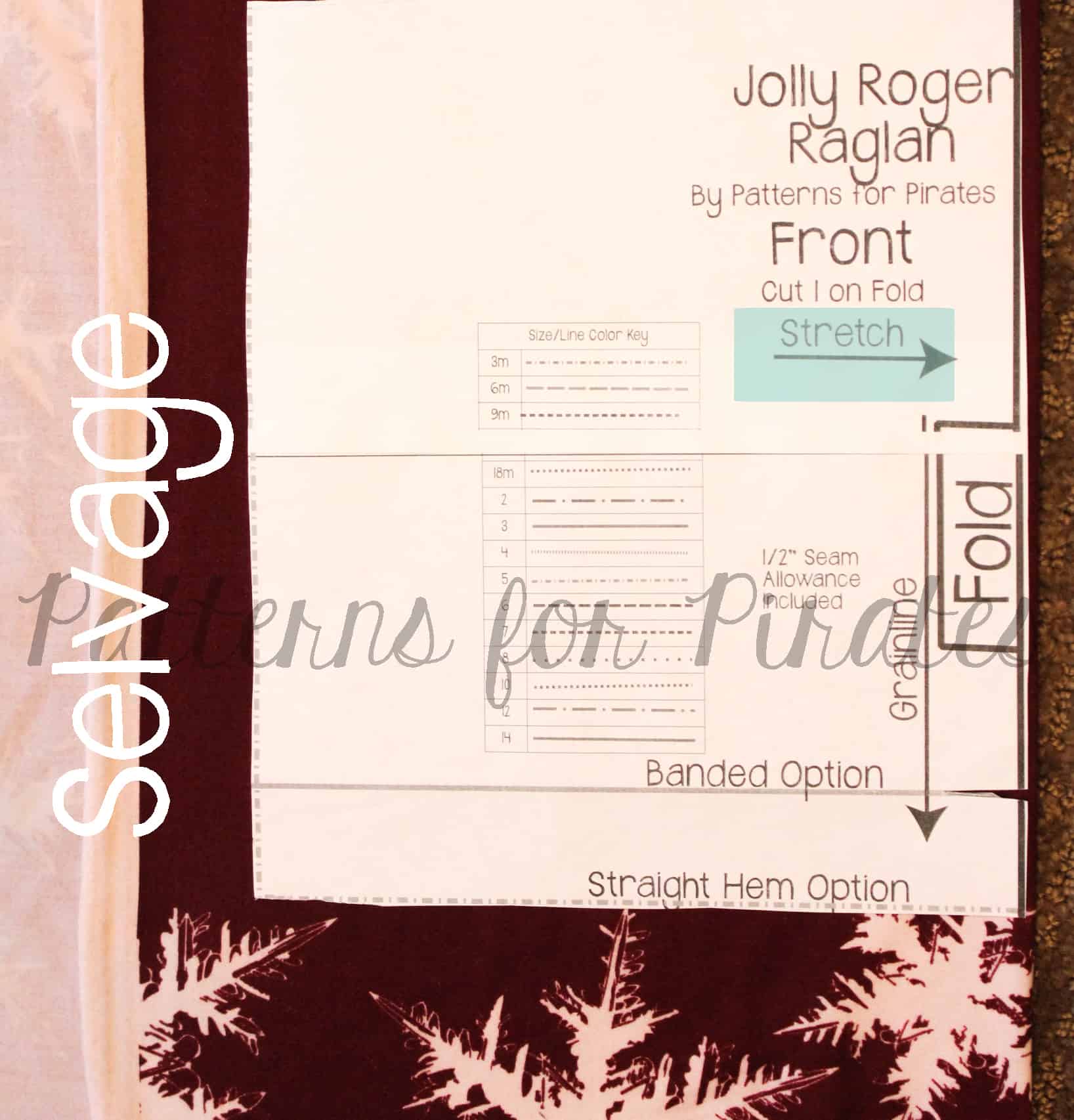
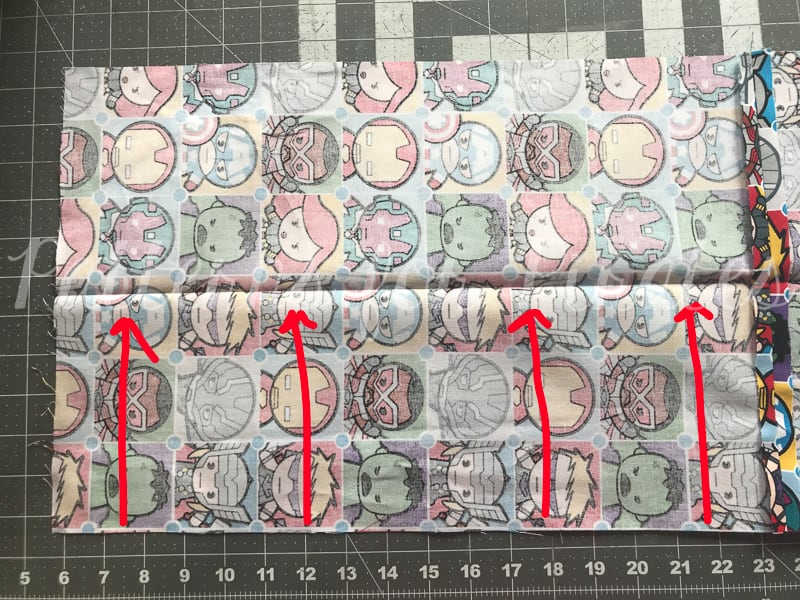
The stretch of your fabric will run perpendicular to the grainline/selvage and will be the direction with the most stretch. As you can see in the picture below, the stretch is running the opposite way as the grainline. It is extremely important to have the right direction of stretch when it comes to the fit of your garment. The stretch will go around your body for most pattern pieces and is accounted for when the ease of a pattern is drafted (read more about ease here). For example, if a pattern is drafted with negative ease (finished measurements are smaller than your body) and you have the stretch going in the wrong direction, chances are, it won’t fit.

Fold

If a pattern piece is symmetrical on both sides, you will notice the center with a “FOLD” marking. This is commonly found on pieces such as the bodice, back, or sleeve in which both the left and right sides have the same appearance. You will want to fold your fabric wide enough for your pattern piece and align this marking to the fold of the fabric. To help conserve fabric, I like to fold it just wide enough for the pattern piece (shown above). A common error can be to fold the fabric exactly down the middle, leaving wasted material.

Notches

You might have noticed small triangles on some pattern pieces. These notches serve several different purposes. One of the purposes is to help distinguish the back from the front. For example, something like a raglan style top can easily get mixed up when assembling. These notches will help keep the front  with the front and back with the back. The second purpose is to help with alignment. By matching these notches up, your pieces will be in the correct position.

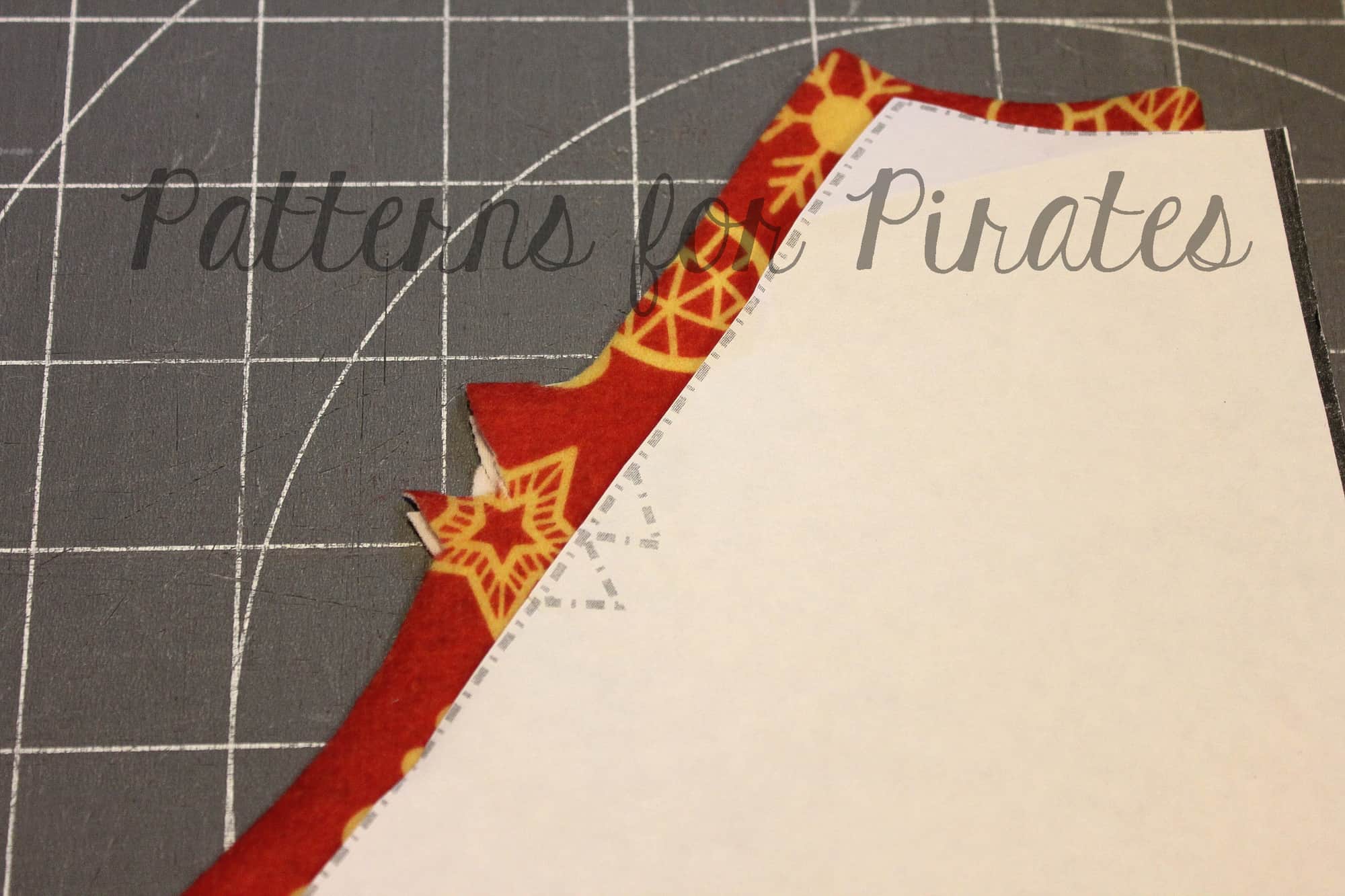
TIP: I always cut my notches out rather than in as to avoid accidentally cutting too far into the seam allowance.

Hem Gauge

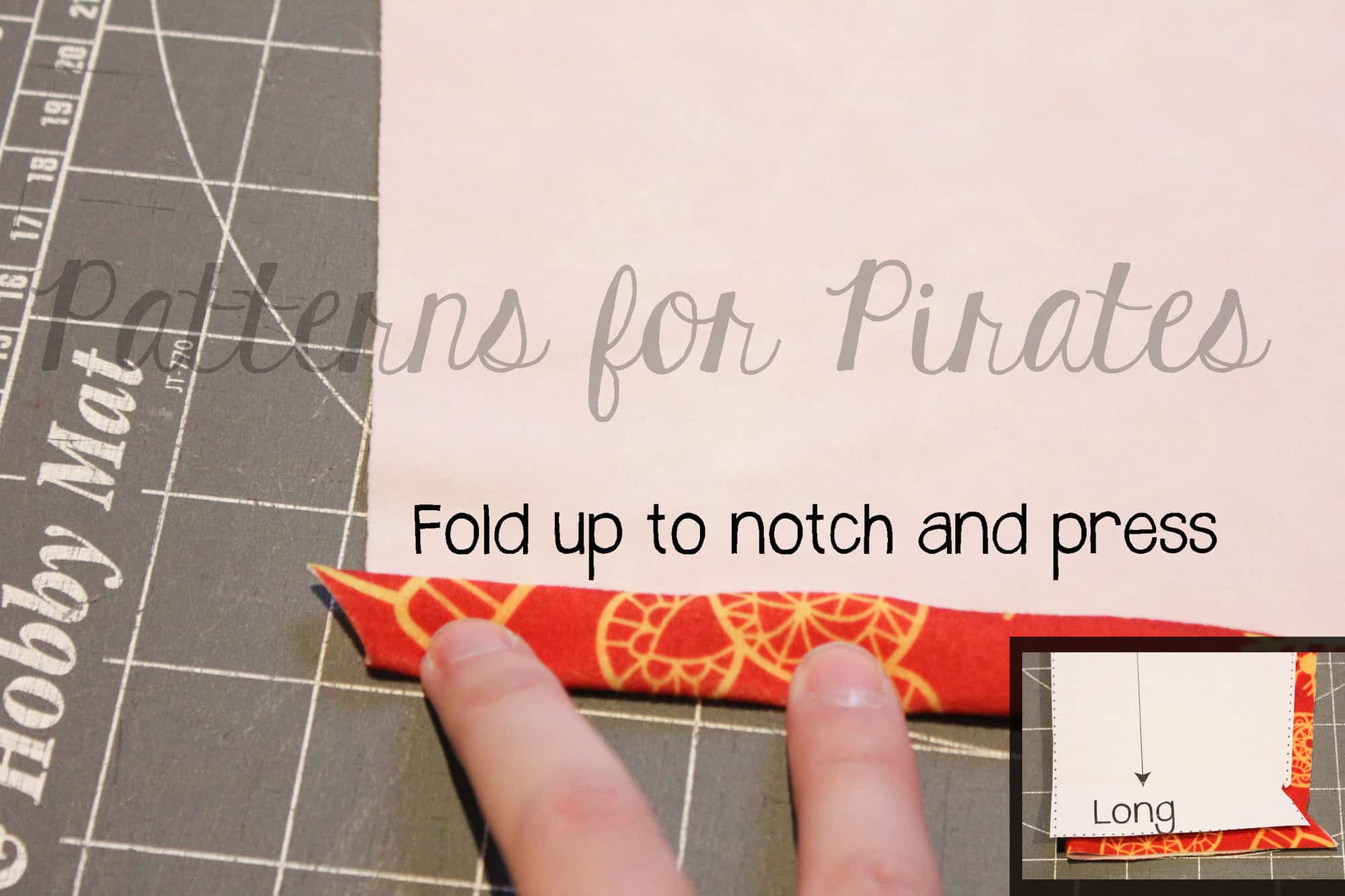
You will typically find a hem gauge on both the sleeves and bottom edges. This is usually a triangular shape that notches out. It will mark the correct allowance for your hem. This is particularly useful when creating a memory hem. All you will need to do is fold your fabric up to this notch, press and unfold. Once you’ve sewn the seams, you will still have your pressed fold in place with the correct seam allowance.


Cut Chart

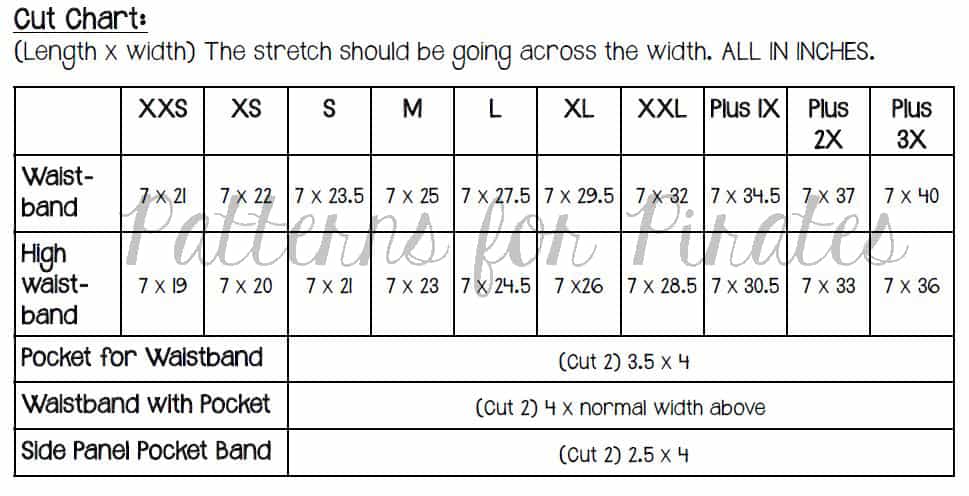
Most Patterns for Pirates patterns will include a cut chart. The cut chart is typically found within the first few pages of the tutorial and will give measurements for any rectangular pieces. For example, items like neckbands, cuffs, waistbands and elastic would all be found here. Some designers will included these as actual pattern pieces, however by providing a cut chart, you are able to save on both paper and ink. When cutting these pieces, I find it easiest to do so using a quilters ruler and rotary cutter.

Hopefully these tips help! Remember that we are always here to help, especially in our Facebook group. If you’re not a already a member, be sure to join so that you can ask questions and share all of your amazing Patterns for Pirates creations!

~ Erinn

Filed Under: Frequently Asked Questions, P4P University, Sewing Techniques, Uncategorized 2 Comments

Faux Sleeve Hack

December 12, 2017

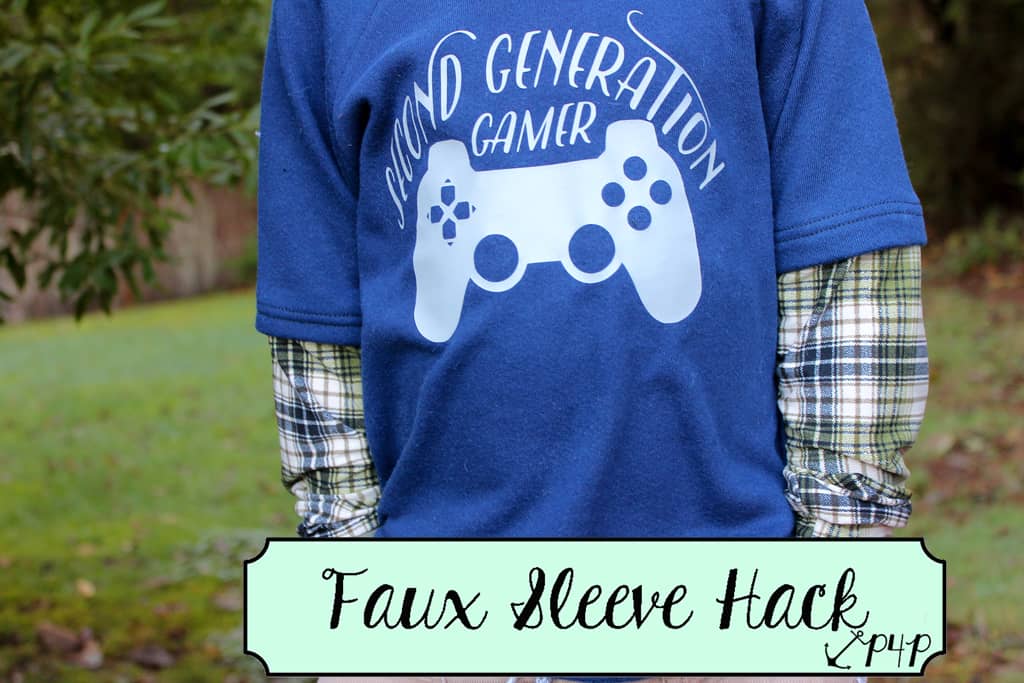
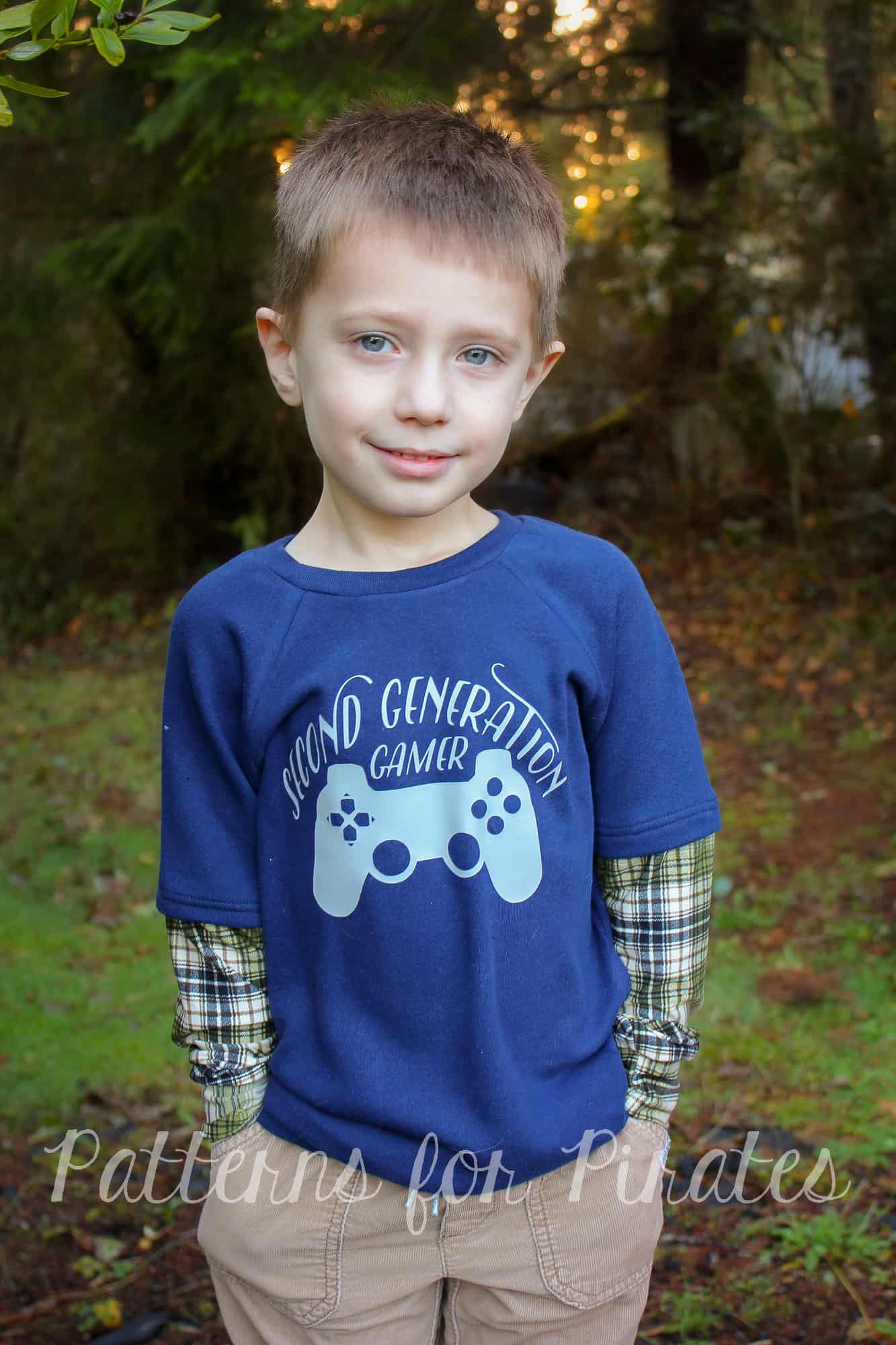
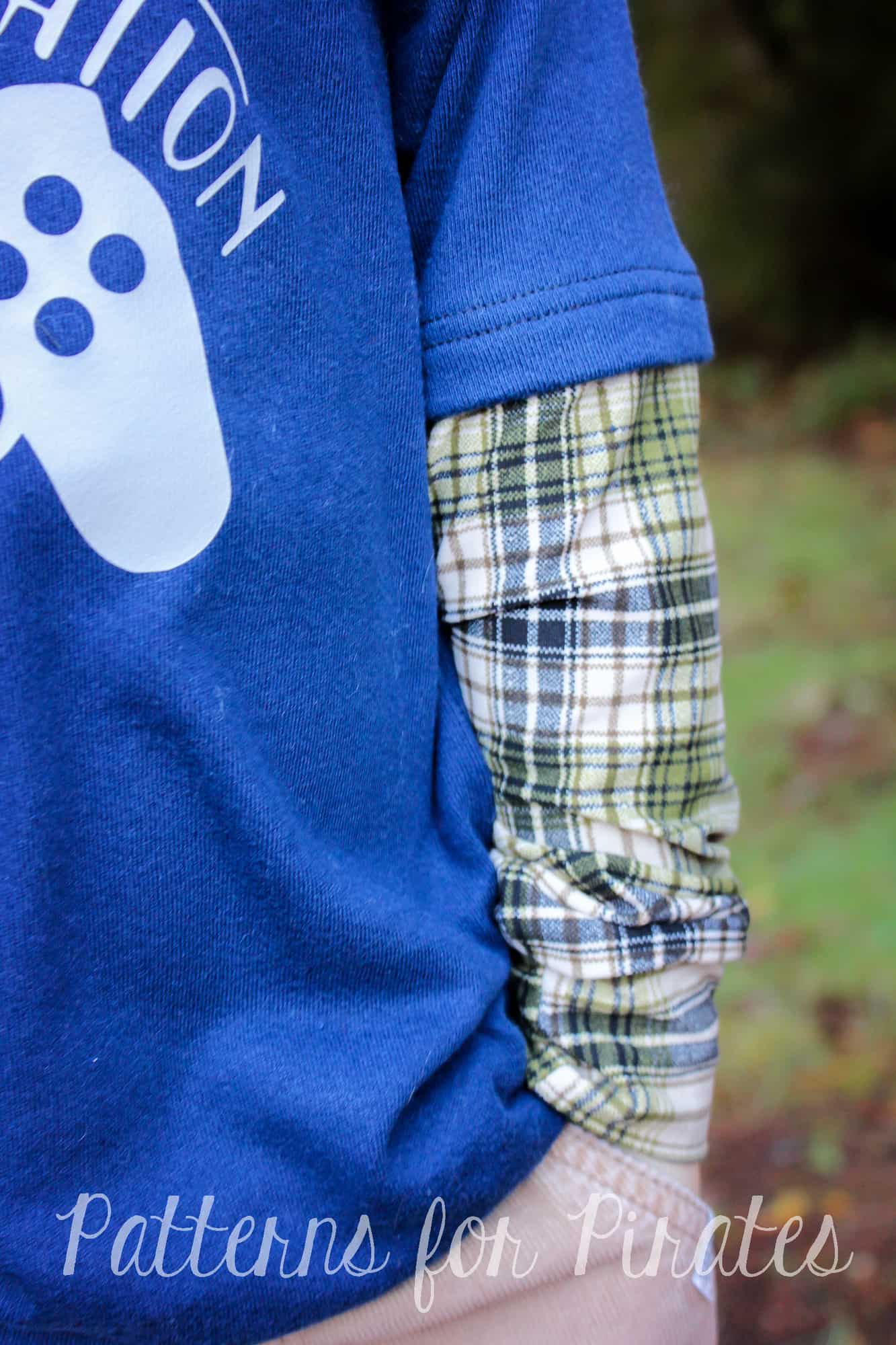
The Jolly Roger is probably one of the most used patterns in my son’s wardrobe! It’s fast, easy, and has lots of option to mix it up with the add-on pack. However, one of my favorite looks is a layered sleeve, which can be hard to accomplish when my son always wants to wear a sweatshirt! Enter- the faux sleeve! This hack is very easy to do and can also be used with other long sleeve patterns, including the Yo-ho Henley and Relaxed Raglan.

The only modification you will need to complete to achieve this look is to alter the sleeve. All other pieces will be cut out as directed and sewn as per the tutorial.

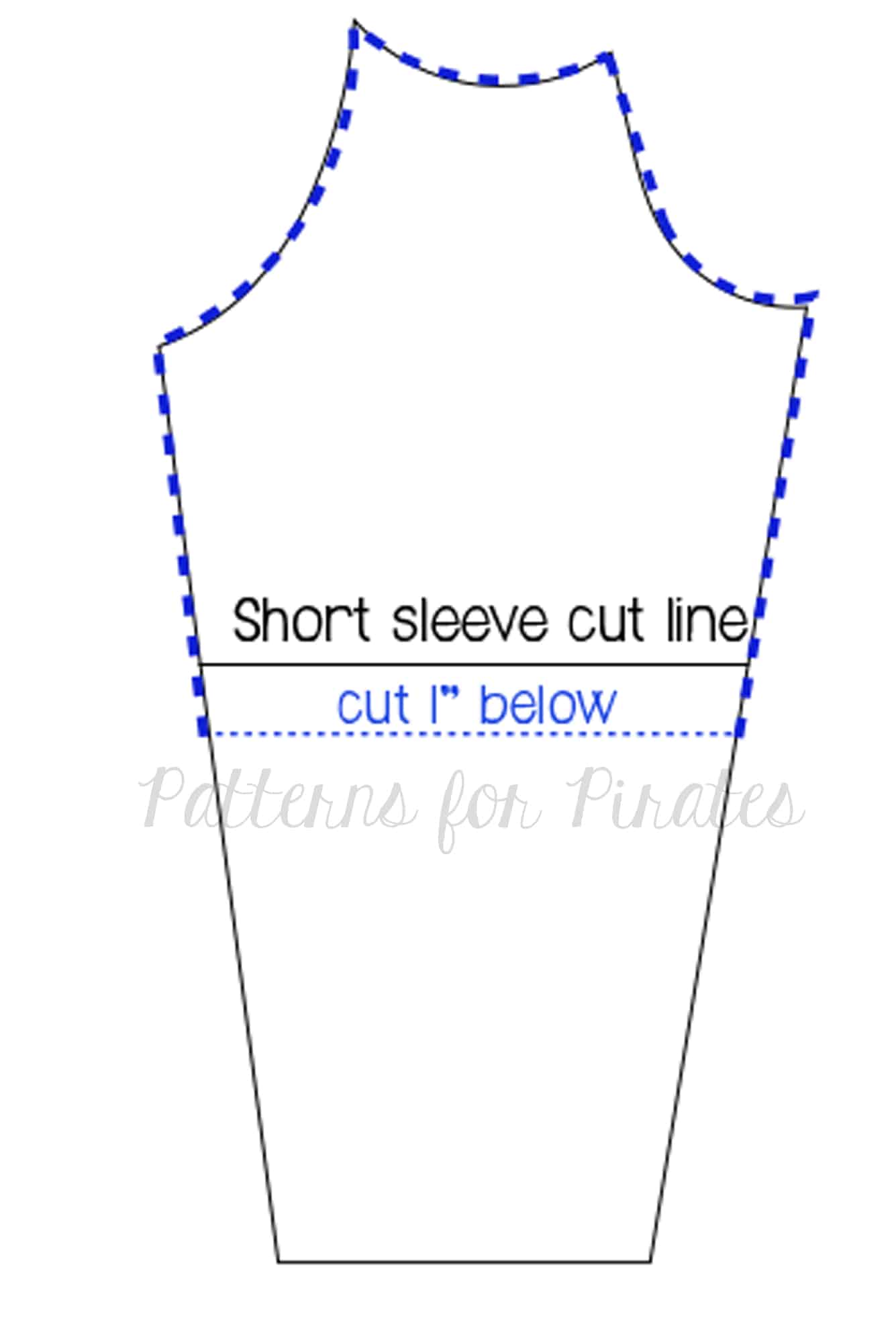
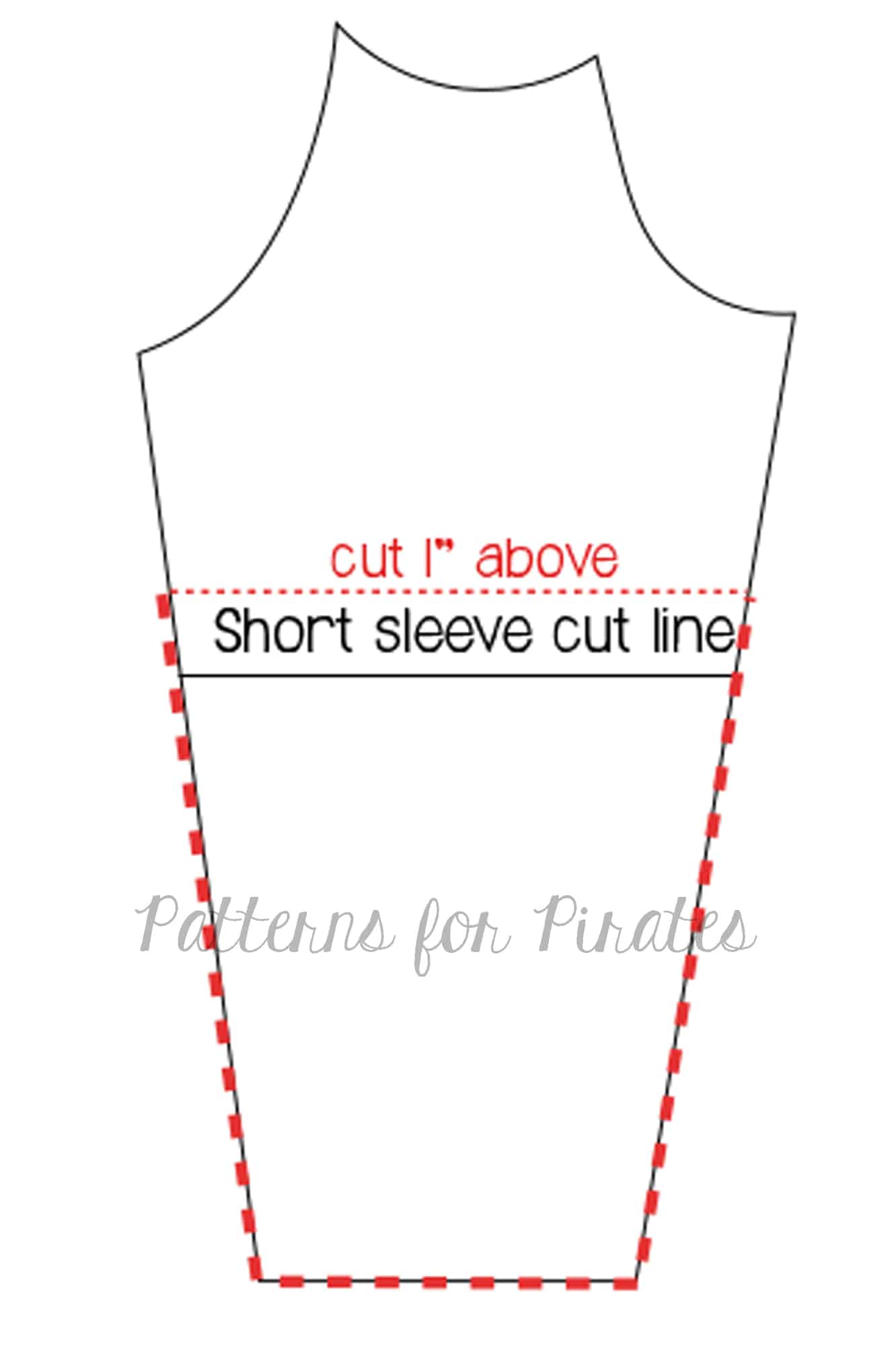
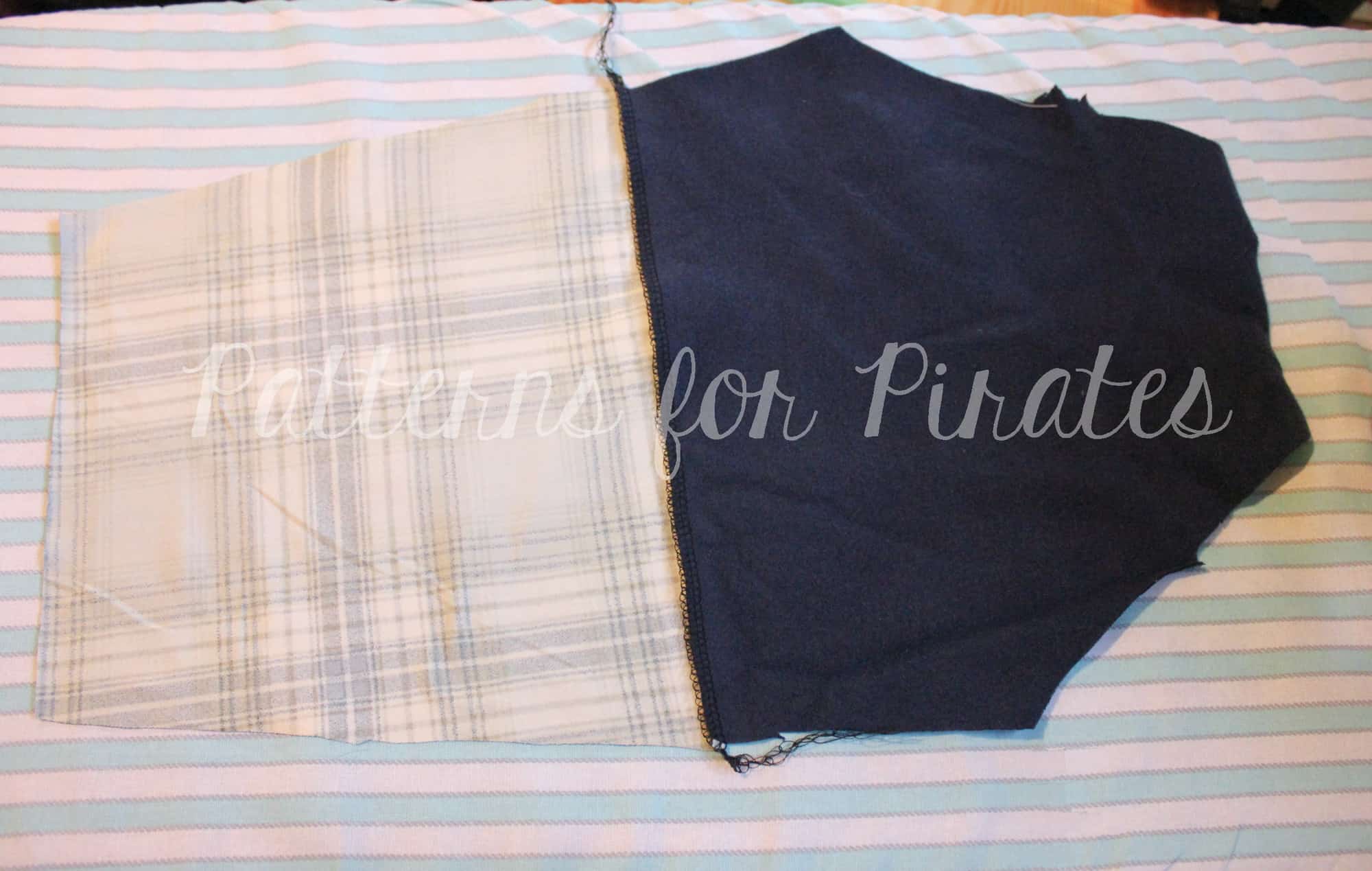
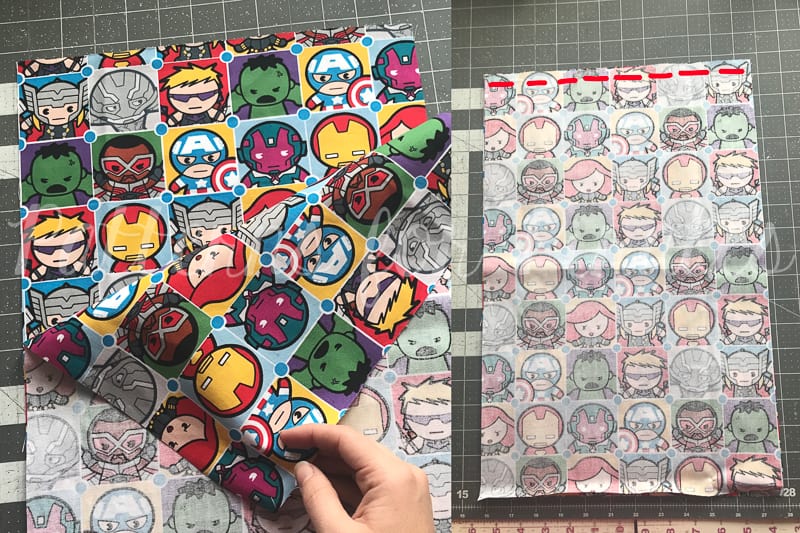
The first thing you will need to do is cut the upper sleeve piece. To do so, use the short sleeve cut line, however you will want to cut 1″ BELOW this line.  Don’t forget to cut two MIRROR image upper sleeve pieces! After cutting the upper sleeve pieces, you will cut out the bottom pieces. Using the same method, use the short sleeve cut line again, however cut 1″ above this line. Again, don’t forget to cut two MIRROR images. You will now assemble your sleeve pieces. Place right sides together and stitch using a 1/2″ seam allowance. Press your seam towards the upper sleeve piece.

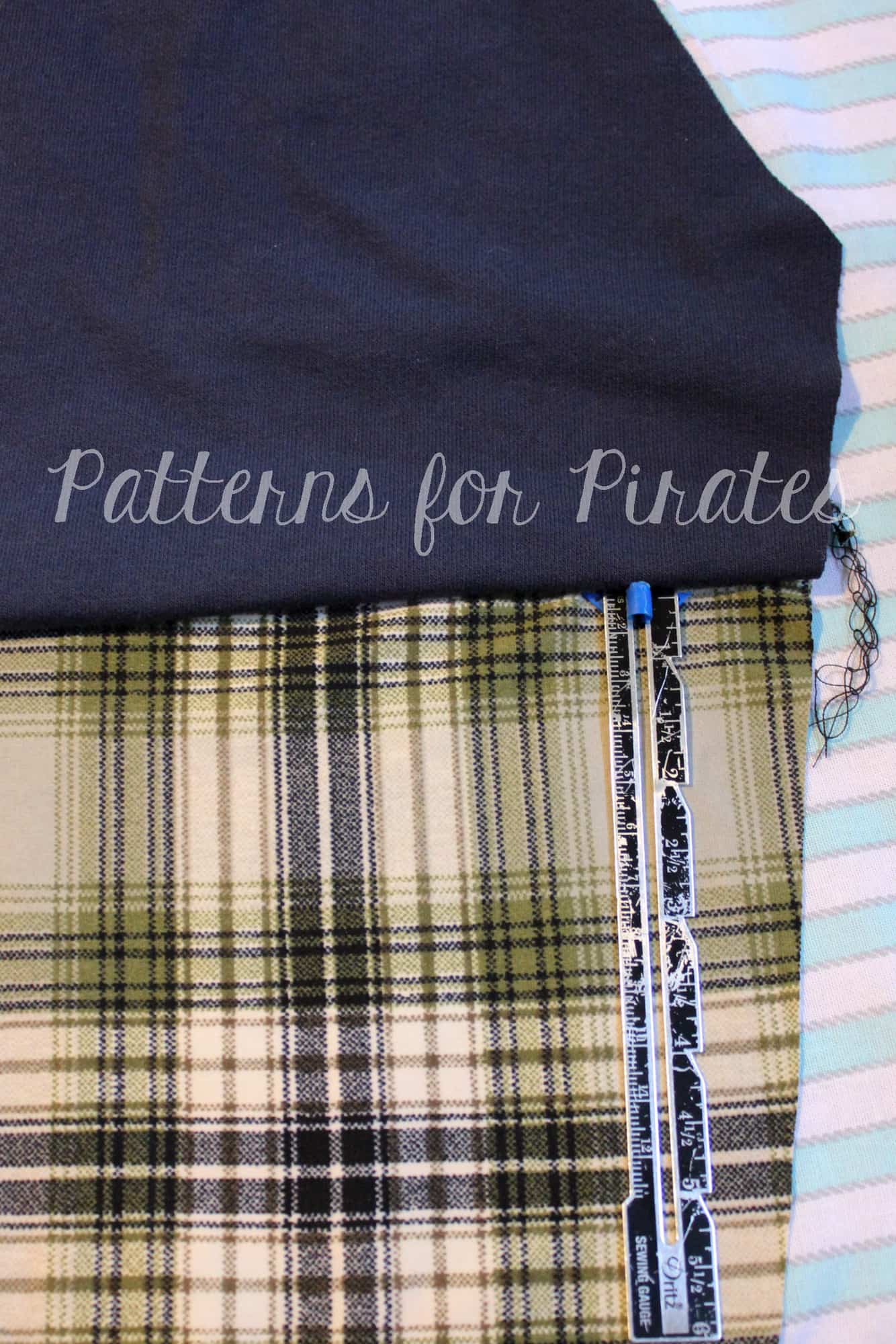
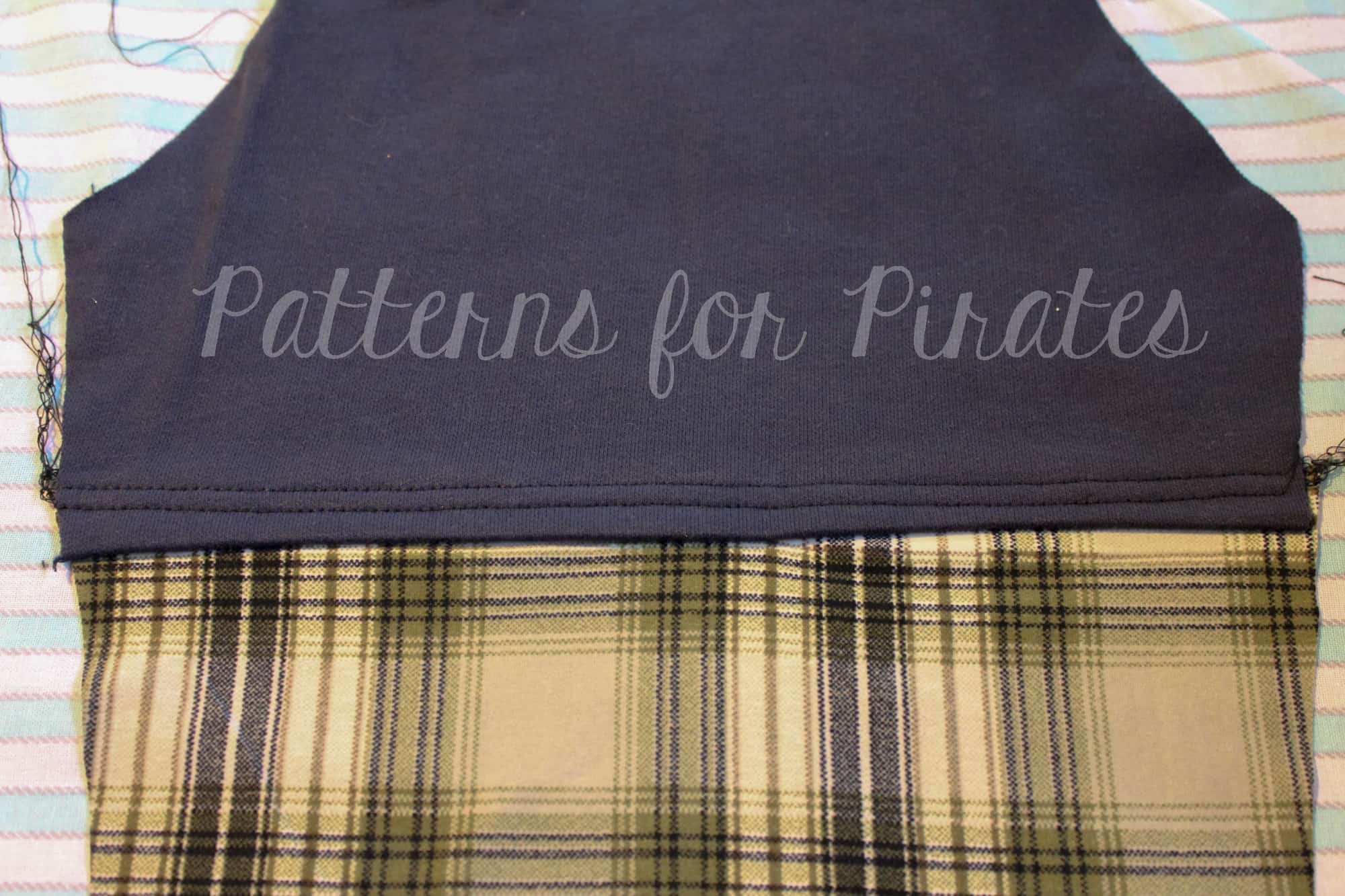
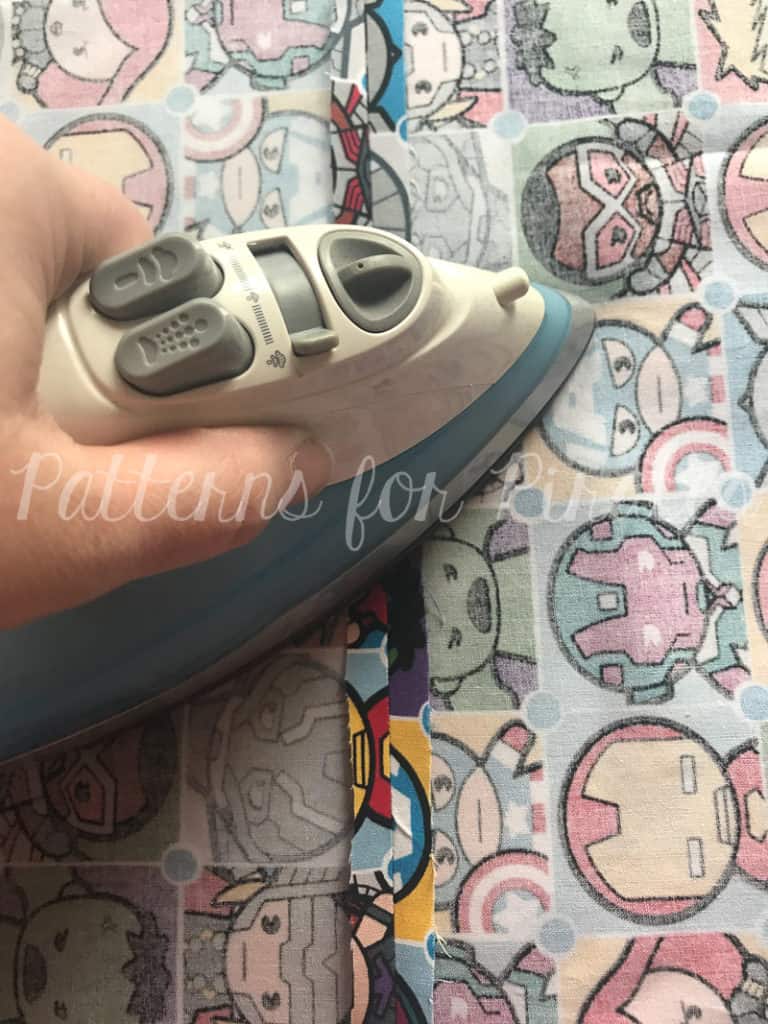
Lastly, you are going to create your faux hem where the two pieces are connected. Using a hem gauge, overlap the two pieces by 1/2″ to create the hem and press, press, press with your iron. 

Pin the hem in place, then stitch using your favorite hemming stitch. 

You will now complete the rest of your Jolly Roger Raglan (or other shirt) according to the directions. Make sure that when you are sewing the sleeve and side seam, to align the faux hem as well.

Be sure to share your creations with us in our Facebook group and I can’t wait to see what kind of fun layering ideas you come up with!
~Erinn

Filed Under: Pattern Hacks Leave a Comment

2017 Holiday Freebies: Easy Button Cowl

December 8, 2017

I’m back to gift you the final item for our 2017 Holiday Freebies!  Have you had fun with us so far this week?

In case you’ve missed the last four days, go take a look: Slouchy Headwarmer / Emoji Pillows / Clothing Size Tags / Camera Strap

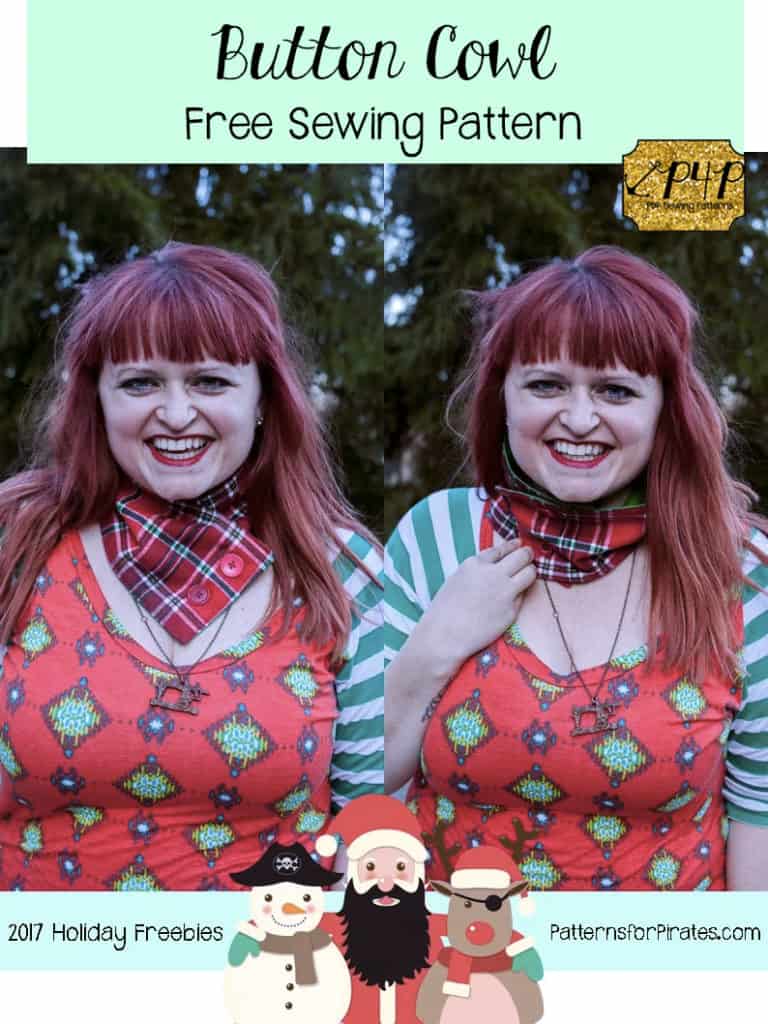
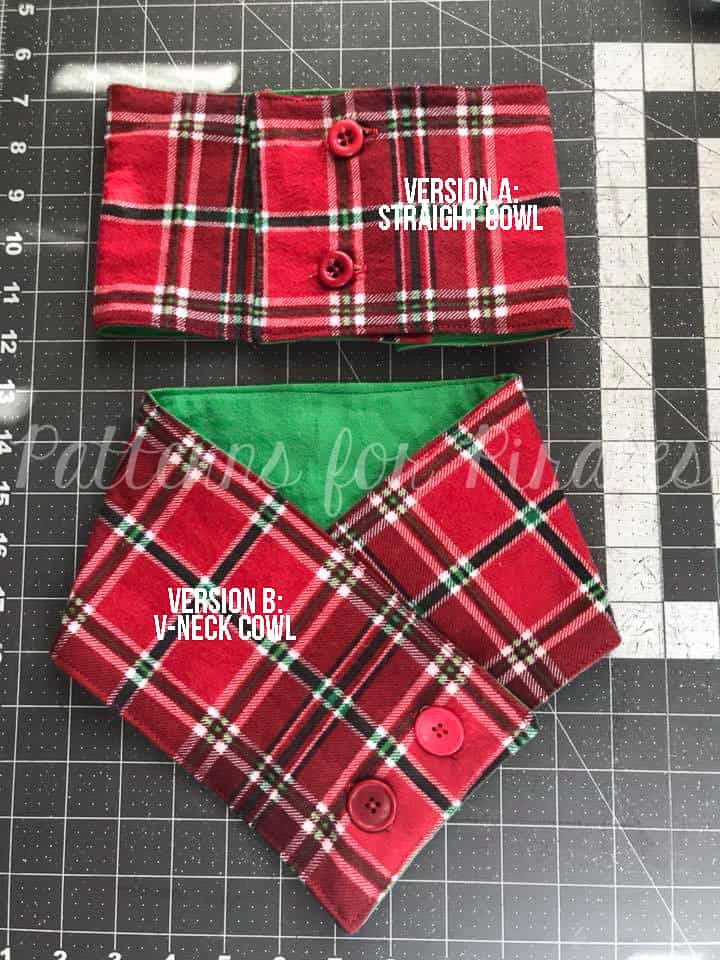
On the last day of our freebies, we are sharing how to make this super cute, quick, and easy Button Cowl.  We’ve even got two ways for you to wear it.  Are you ready?  Let’s get to it!


Materials needed:

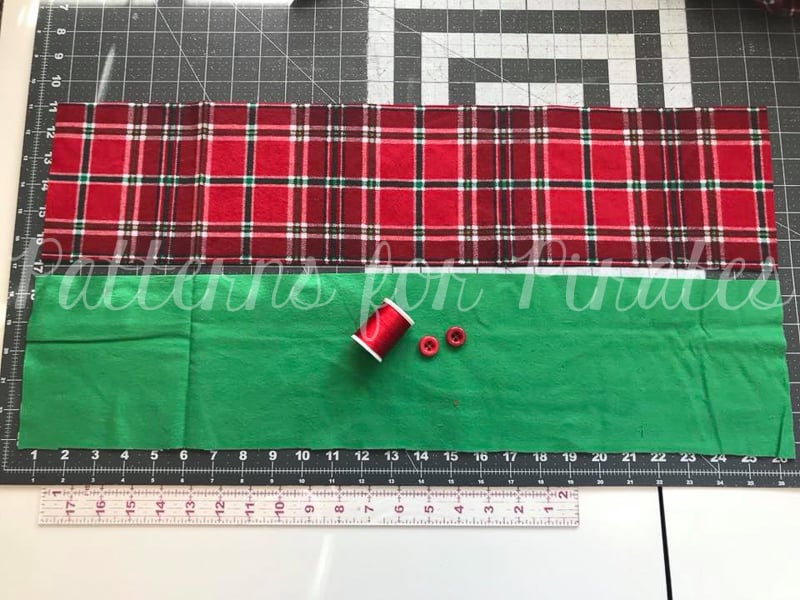
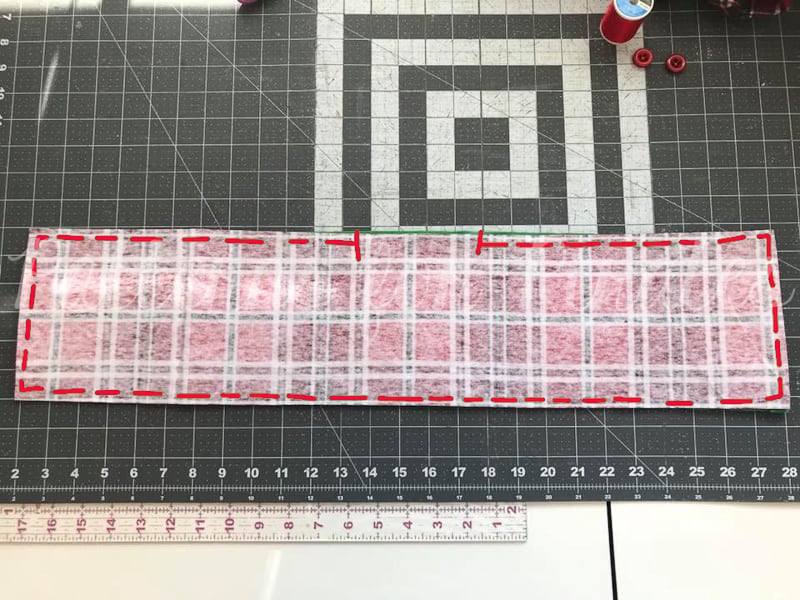
  • 2 – 26″ wide x 6″ long pieces of fabric (can be flannel, fleece, sweatshirt fabric, etc. Really anything will work, but obviously the cozier the better.)
  • 2 buttons / snaps
  • Coordinating thread

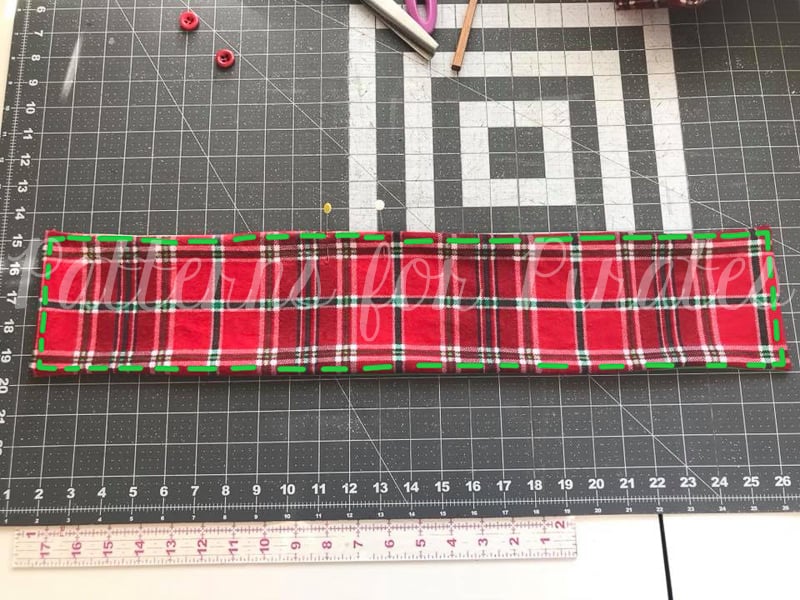
With fabrics right sides together, stitch around entire outside using 1/2″ seam allowance. Leave 3″ opening for turning.

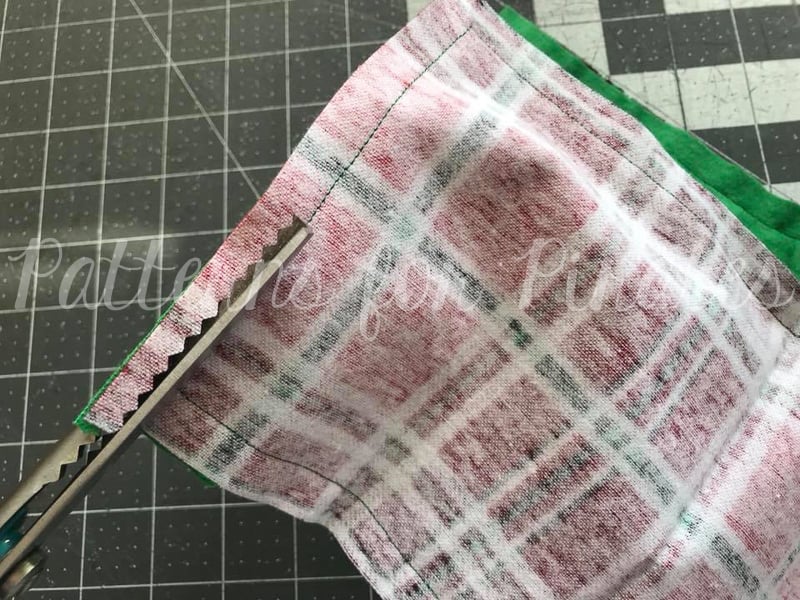
Trim away bulk, making sure not to snip through seams.

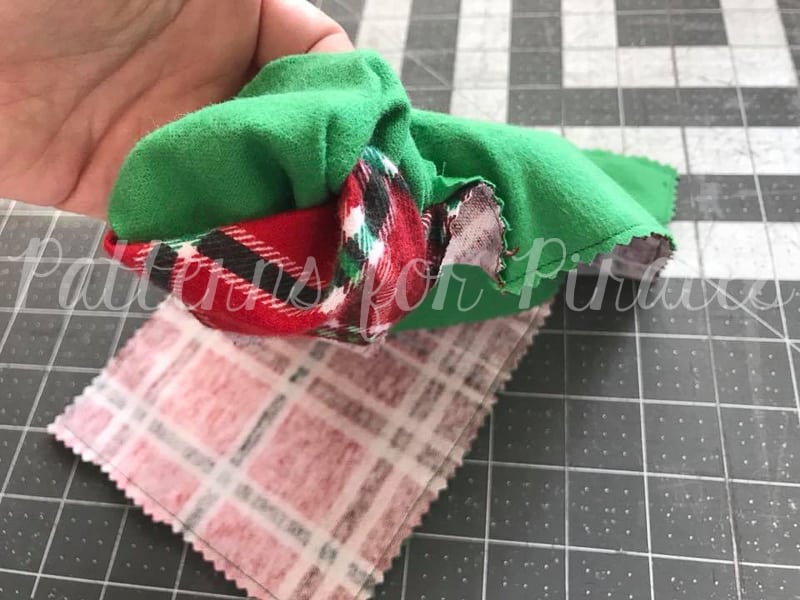
Turn right-sides-out, through the opening.

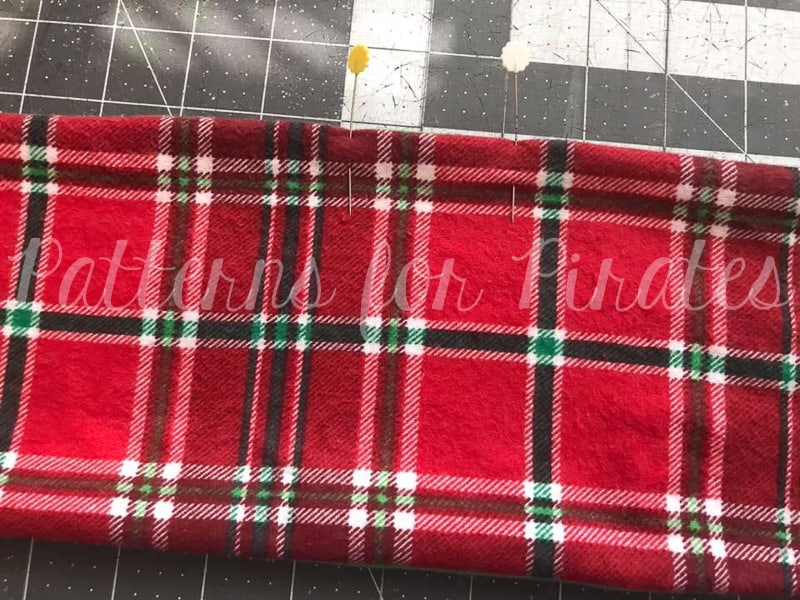
Tuck in your seam allowance, press.

Top stitch along entire outer edge, making sure to catch your opening in there.

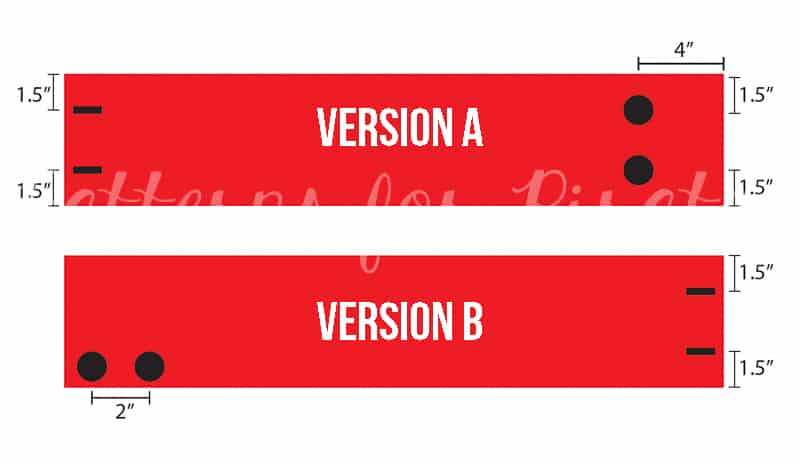
There are two ways you can add buttons/snaps to the cowl to create different ways to wear them.  I created an easy diagram to help you with placement for your buttons and button holes, depending on the style you’re wanting for your cowl.

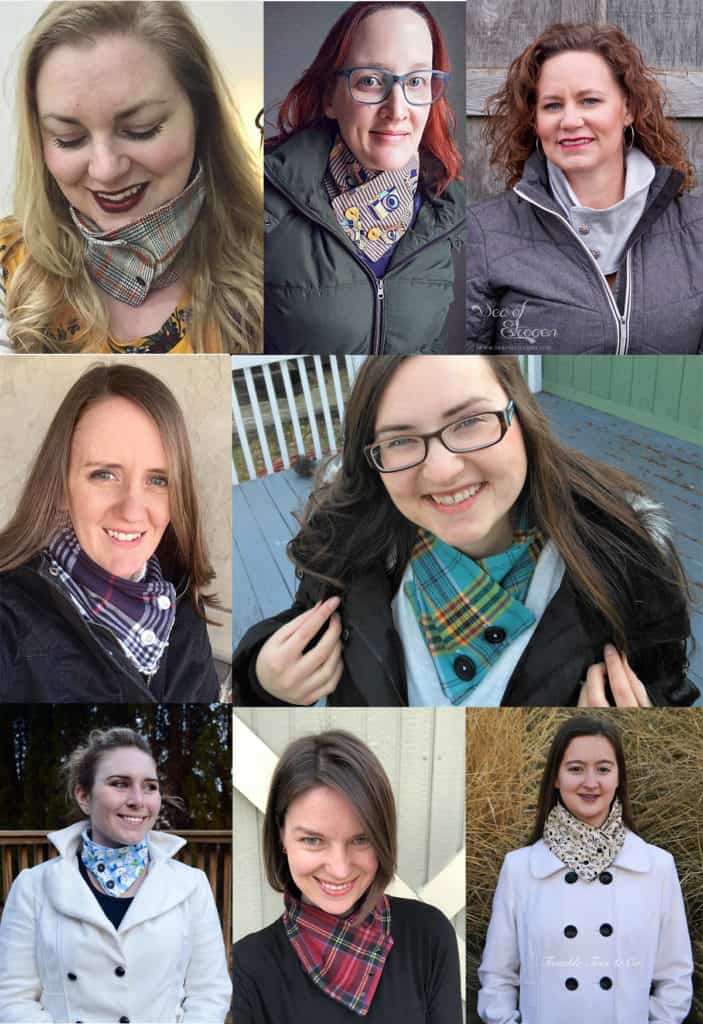
Here’s a quick peek at what some of our testers made for themselves with this pattern:

As always, we would love if you shared your creations with us!  Head over to the Patterns for Pirates Facebook Group and show us what you made!  Happy Holidays, friends!

Filed Under: Free Pattern 5 Comments

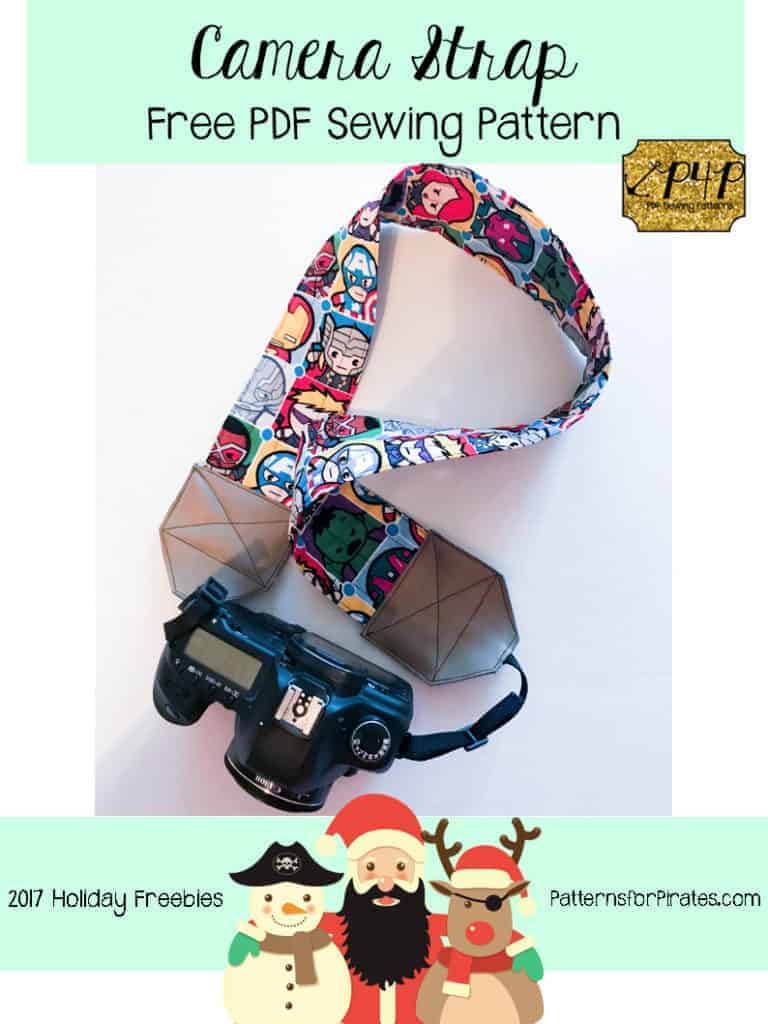
2017 Holiday Freebies: DIY Camera Strap

December 7, 2017

What?  We are on day four of the 2017 Holiday Freebies already?  I hope you’re having as much fun as I am!  If you need to back and review the past three days, I can wait!

Here are some links: Slouchy Headwarmer / Emoji Pillows / Clothing Size Tags

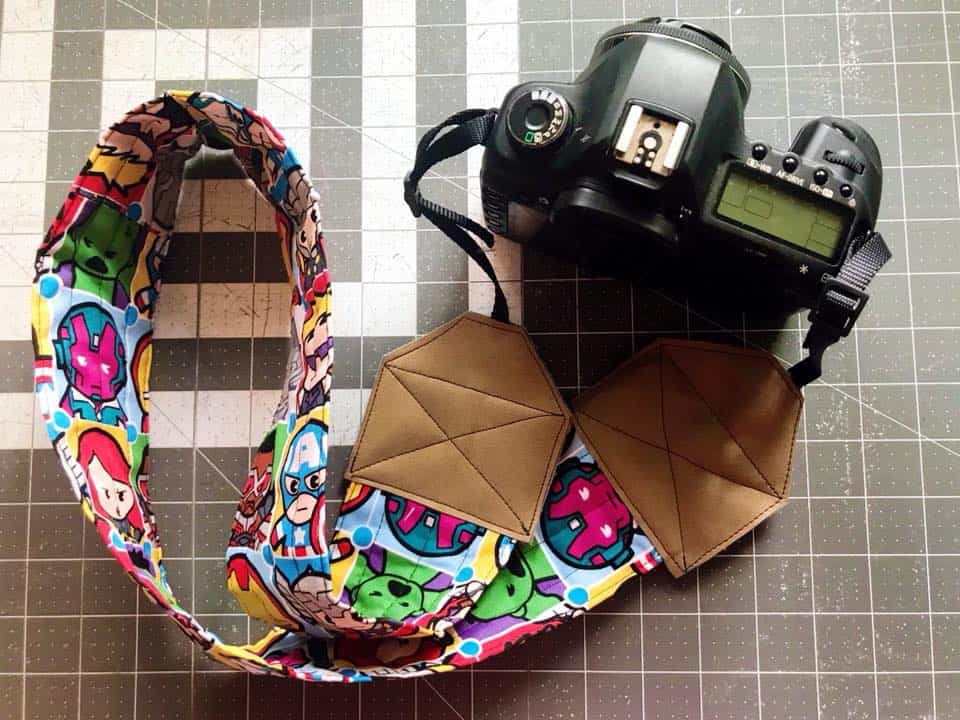
Now that we’ve covered that, let’s get to today’s free pattern!  Sewing and photography seem to go hand-in-hand more often, because we want to share what we’ve made with our sewing community!  Why not sew yourself a sweet little strap to wear while you’re using that camera of yours?  It’s super easy to do and way more fun than using what came with your camera originally.  Let’s get to it!

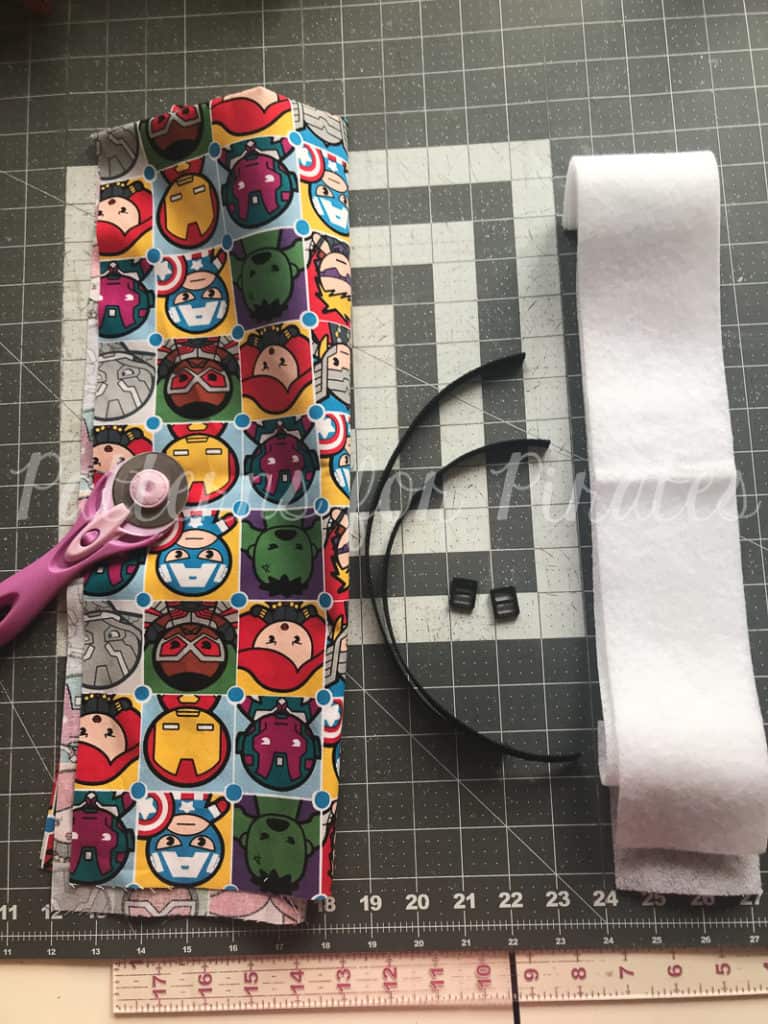
Prep your pieces, you will need:

  • Pattern Piece for Vinyl Ends
  • 36″ L x 12″ W Quilting Cotton
  • 2 – 12″ cuts of nylon webbing (1/2″ or 3/8″ both work) — I used THIS
  • 2 – 1/2″ or 3/8″ sliding adjusters — I used THESE black versions as well as THESE fun colored ones!
  • 36 L x 3″ W Fusible Fleece Interfacing
  • Small scraps of Vinyl/Pleather

**If you can’t find the nylon webbing / sliding adjusters in your local fabric store, a quick trick is to buy a small dog collar from the dollar store.  They tend to have the right width strap, and usually include the adjuster on it as well.

Important: The ends of nylon wedding need to be heat sealed to prevent fraying.  Make sure to do this before sewing it to your strap pieces!

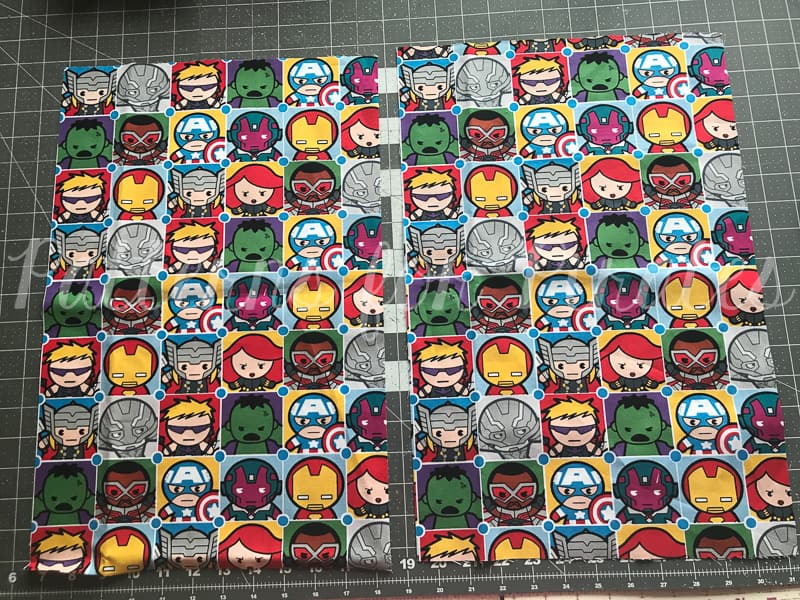
**If your fabric is directional, you will want to cut two pieces for your strap and then stitch them together. Cut two 18.5″ x 12″ pieces from your quilting cotton.

For directional fabric, place your pieces right sides together, and sew along the short edge, using 1/2″ seam allowance.

Press open your seam.

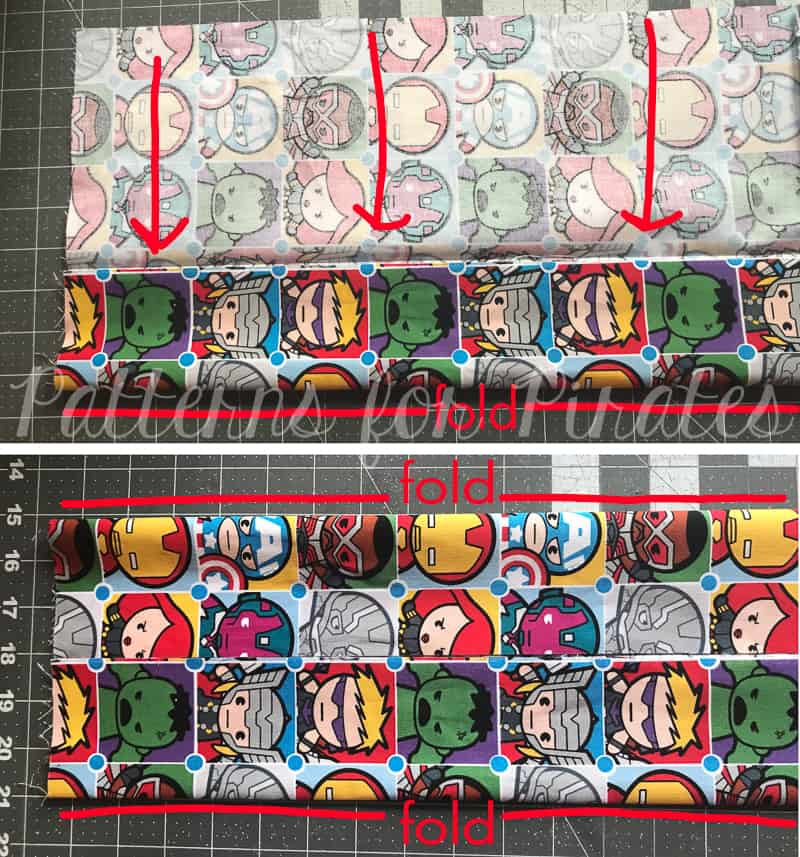
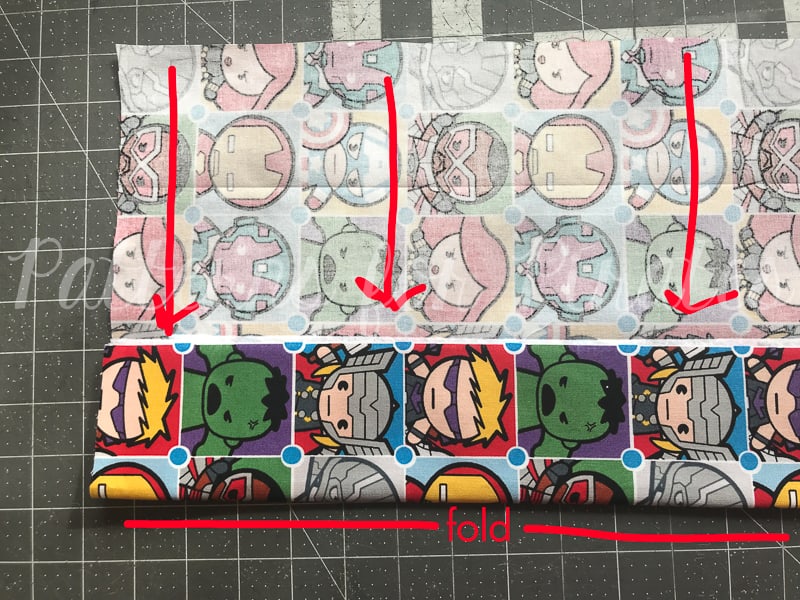
For all straps: Fold your main fabric wrong sides together, meeting the long edges to one another. Press.

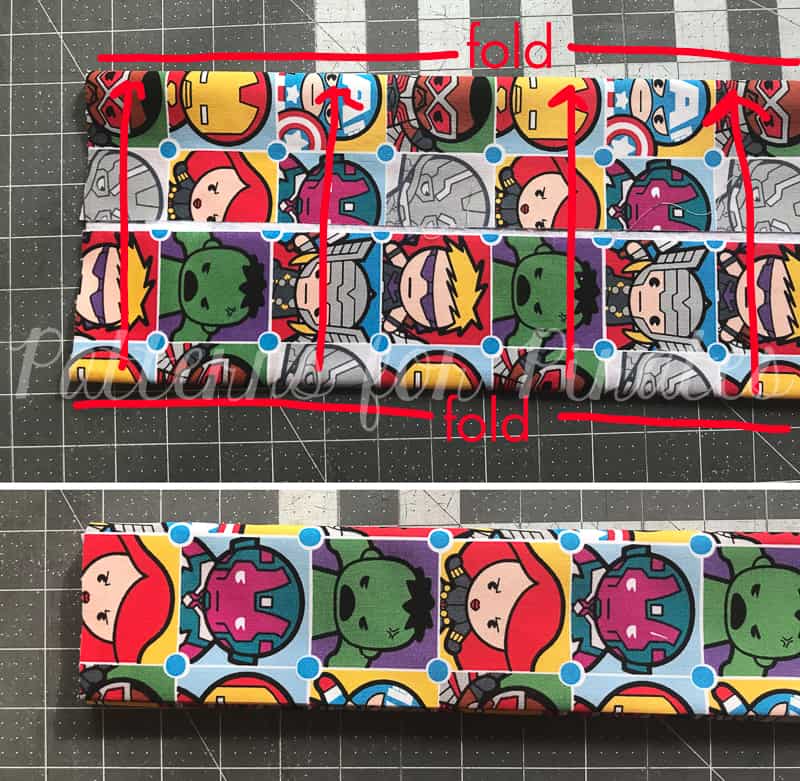
Open up your piece and fold one of the raw edges toward the middle crease you just made.

Repeat with the second raw edge. Press.

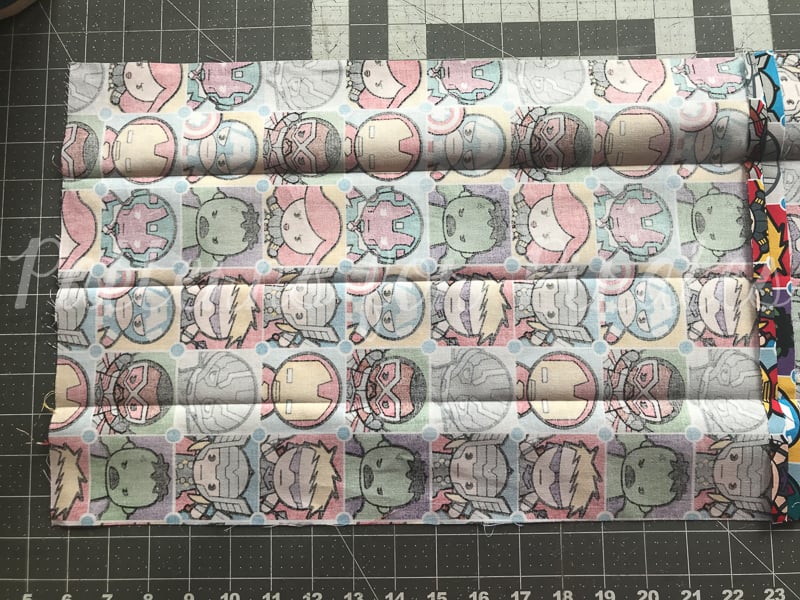
If you open your piece, you’ll now have 3 creases, spread evenly across four total sections.

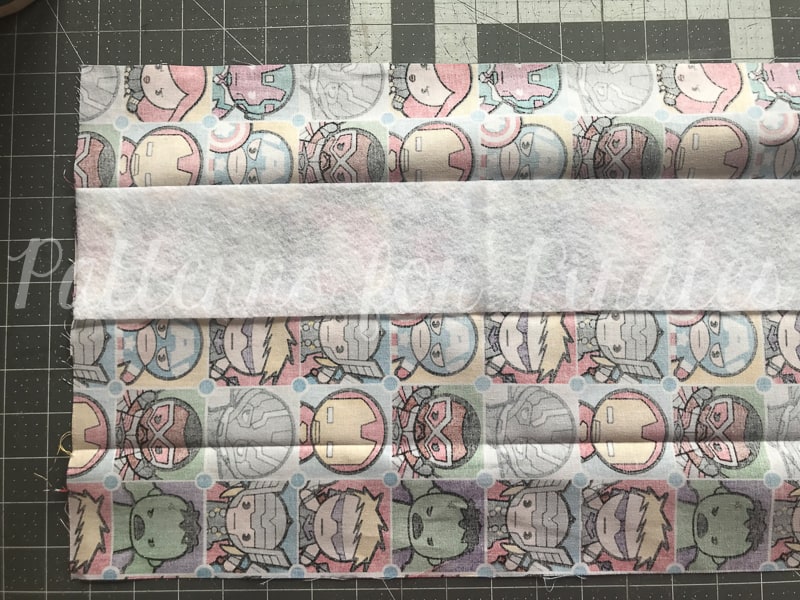
On one of the middle sections, following the directions provided by the manufacturer, iron your fusible fleece to your strap piece.

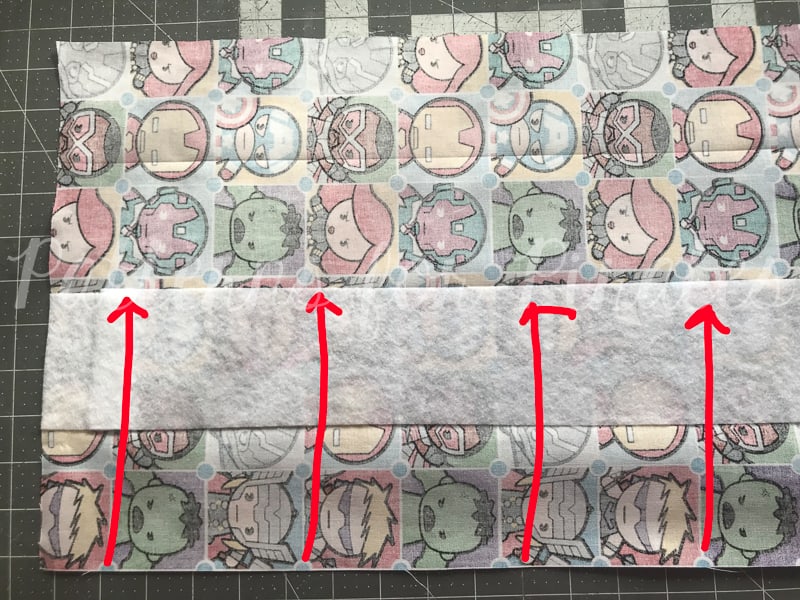
We will be refolding the strap in the same method as before. Take one of the raw edges and fold it toward the middle crease.

Repeat with other raw edge.

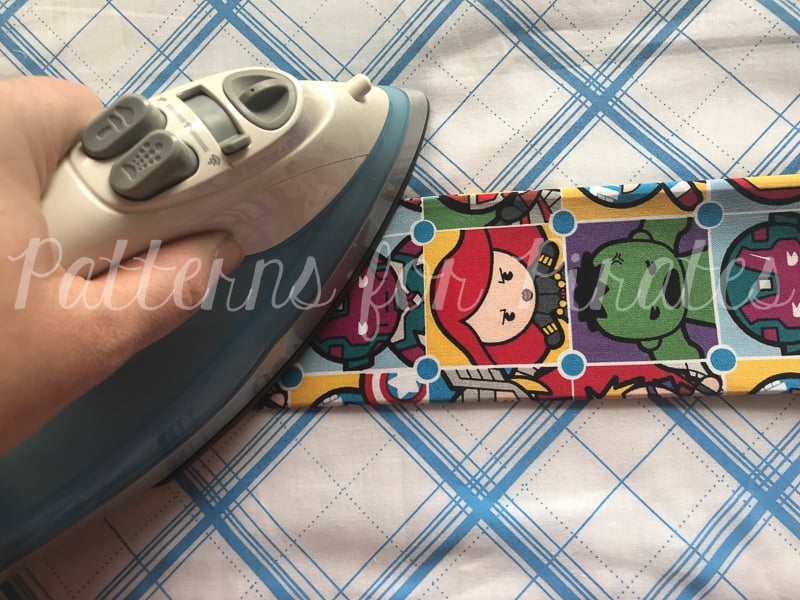
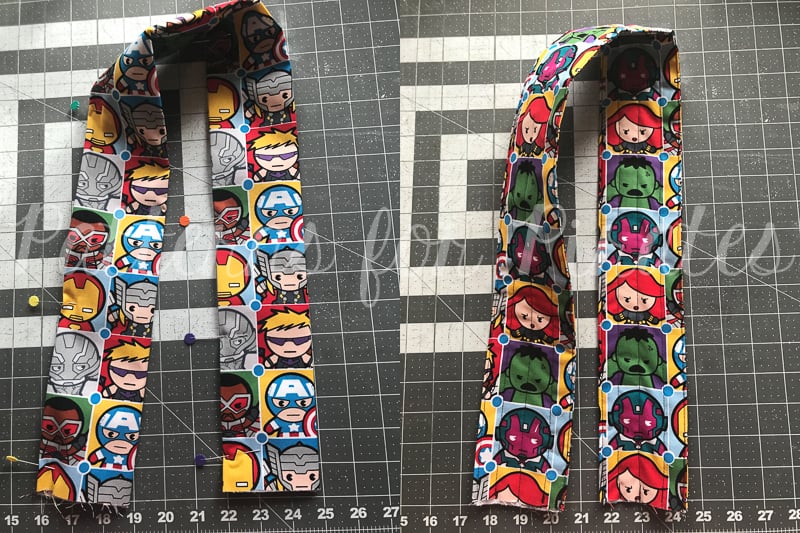
Fold along middle crease, meeting both folded edges. All of your raw edges will be fully enclosed now.

Press, press, press.

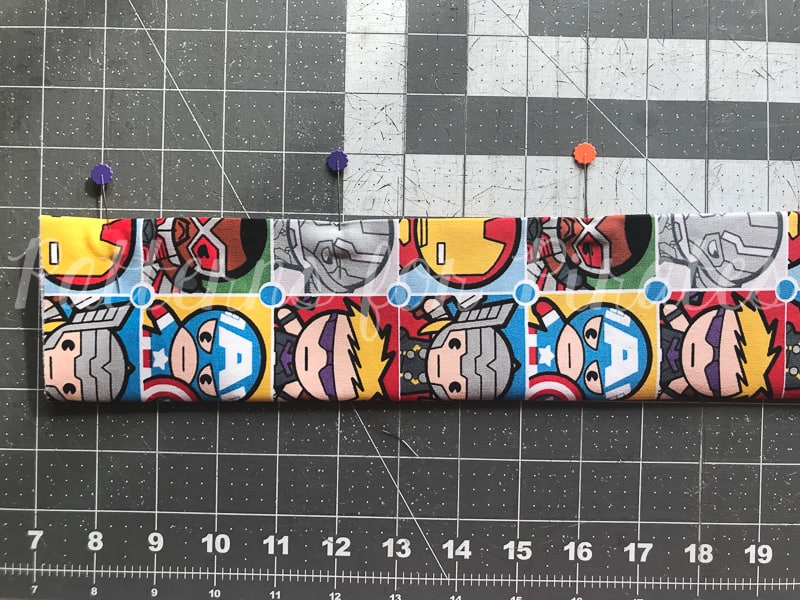
I like to clip/pin my outer edges together, to make sure they’ll align properly when I go to stitch them. Straight stitch along the entire edge you just pinned, getting as close to the edge as you can.

This part is up to you, and how fancy you want to get with your quilting. I like to run an edge stitch along the other long edge. And then three even lines across the rest of the strap. You can stitch as much or as little as you’d like!

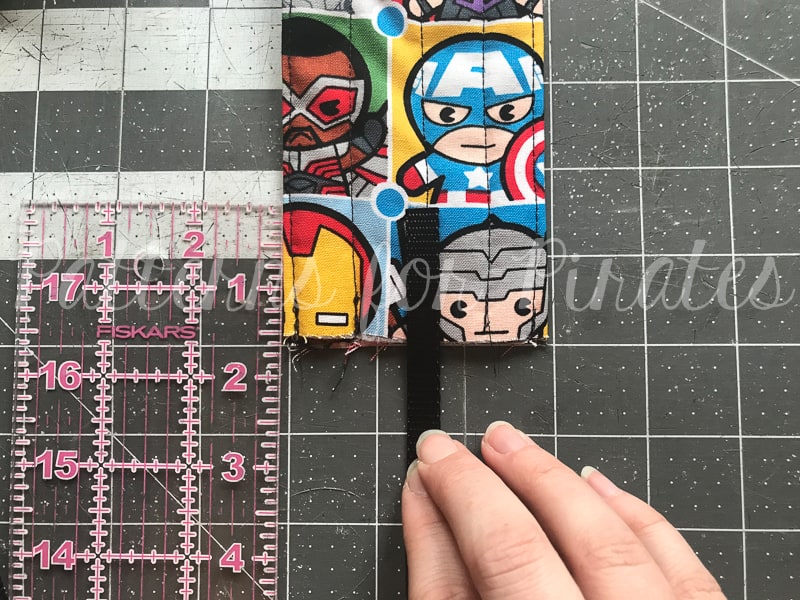
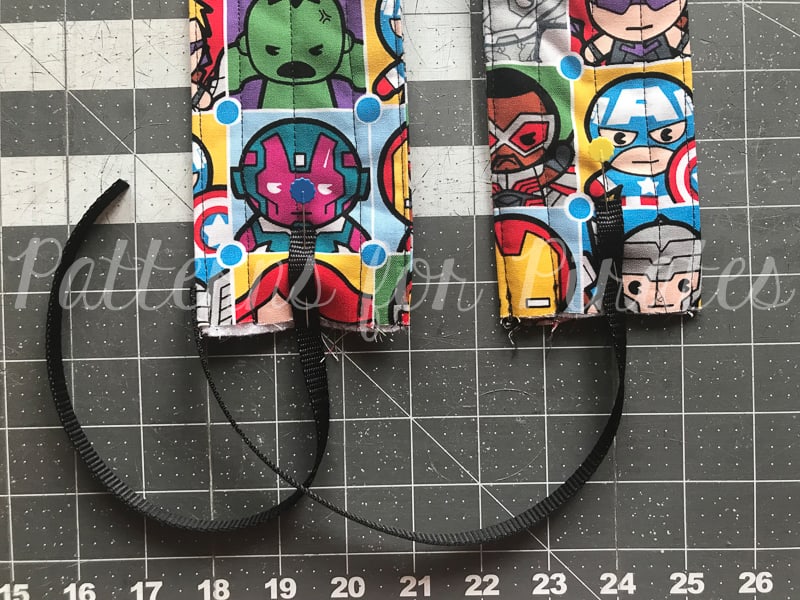
Take your nylon strap and overlap it 1.5″ from the edge of your strap, aligning it directly in the center of the strap.

Pin and repeat for the opposite end.

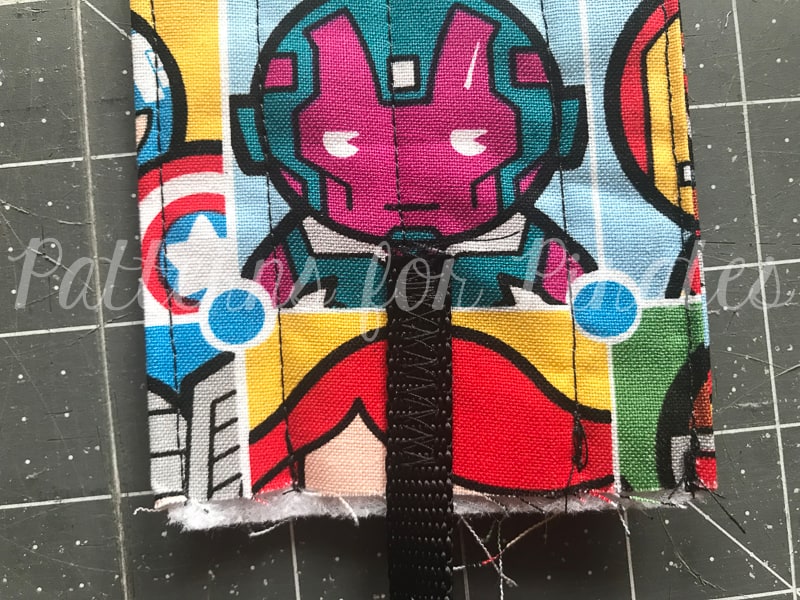
Using a wide zig zag stitch, secure your nylon strap to the end.

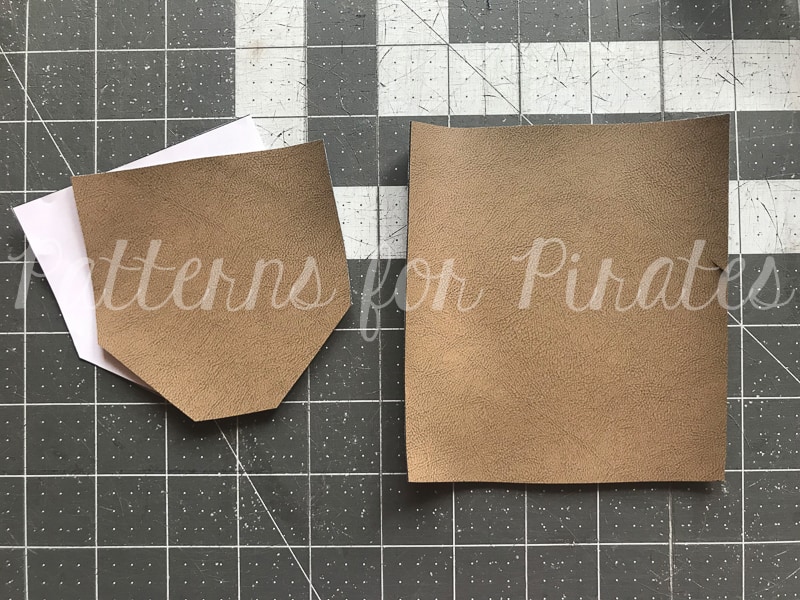
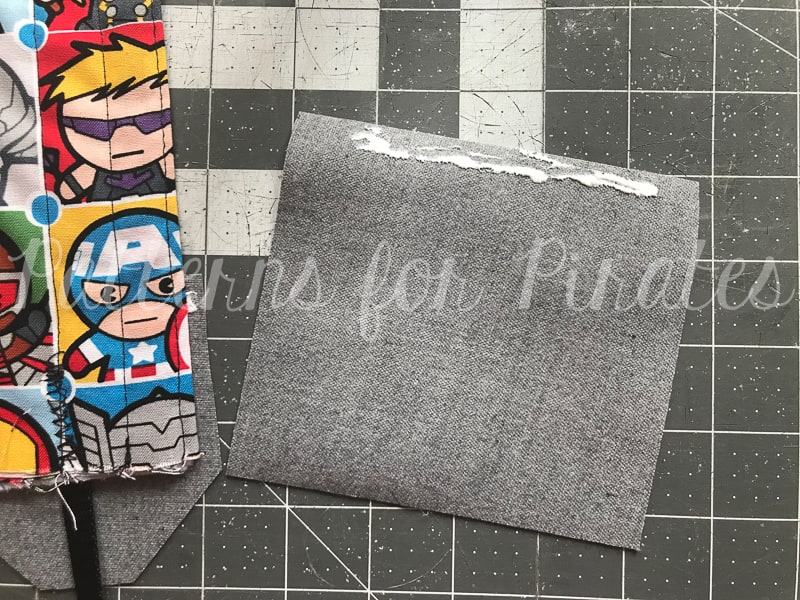
For the vinyl pieces, I recommend to only cut one actual piece — and to have an oversized rectangle for the other. It’s easier than trying to get them to line up perfectly. Especially since vinyl can be fussy to topstitch.

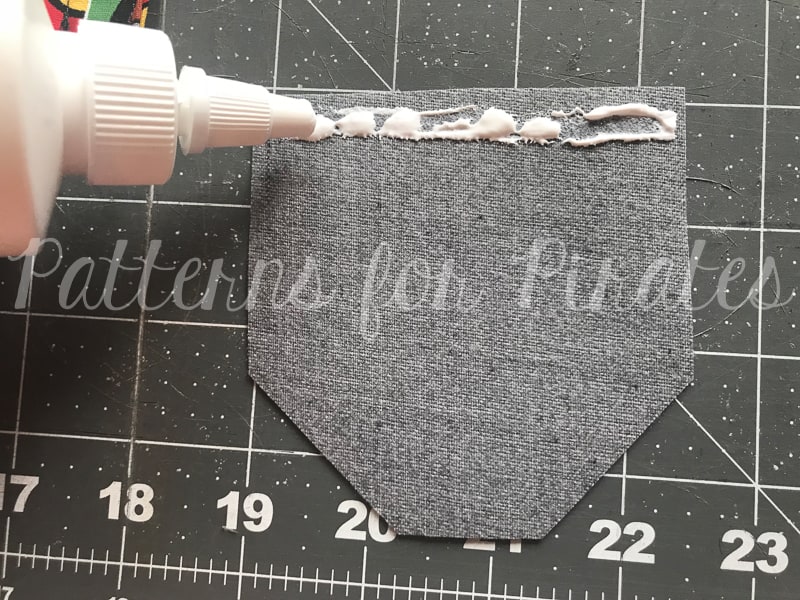
I like to run a line of fabric glue at the top of the vinyl backside. It helps keep it in place when sewing.

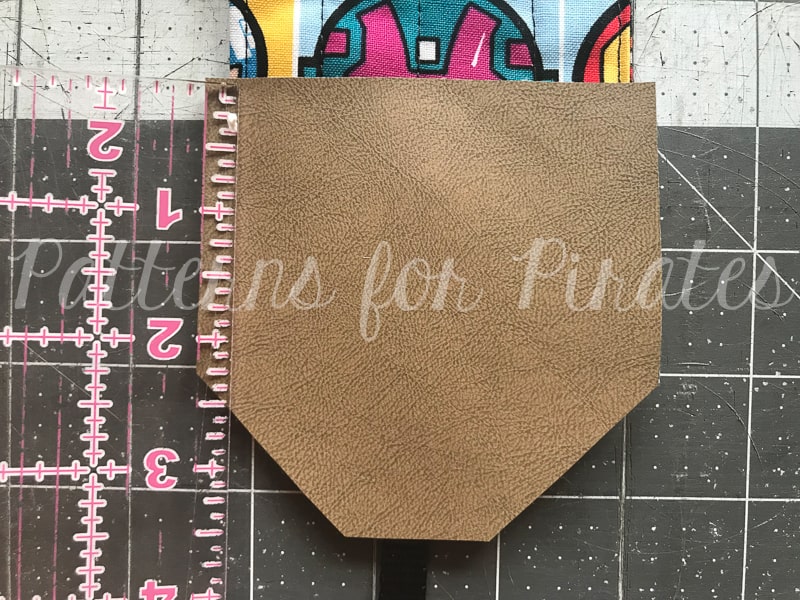
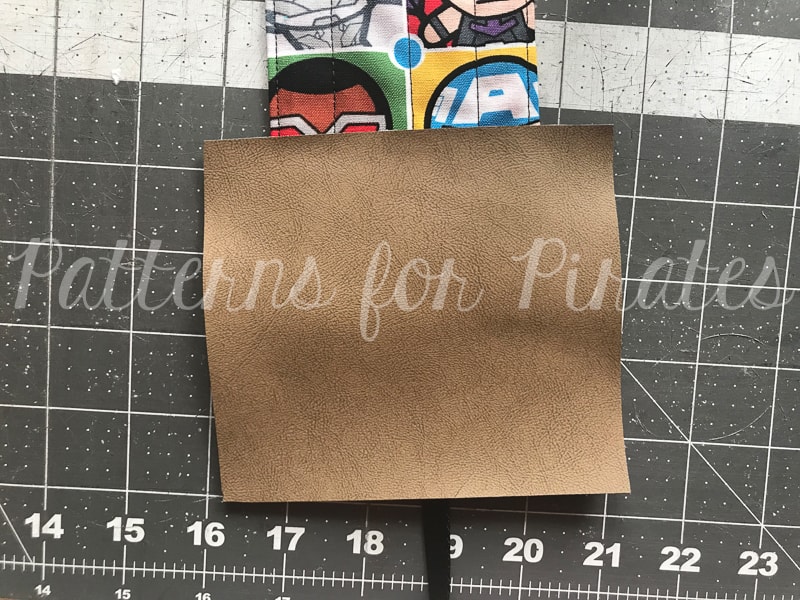
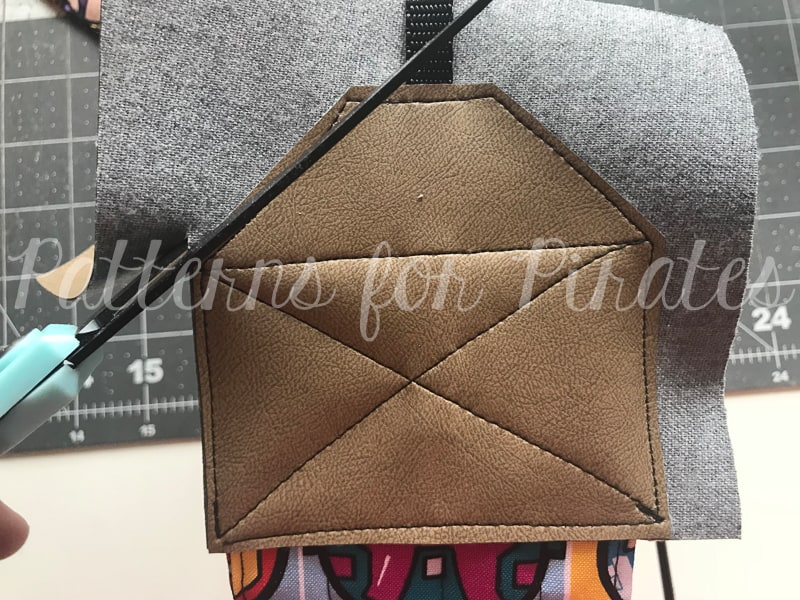
Two inches up from the bottom of your strap piece, lay out one of the vinyl pieces. The vinyl should be slightly wider than your strap.

Flip over your strap.

Throw another line of glue on the edge of your vinyl square.

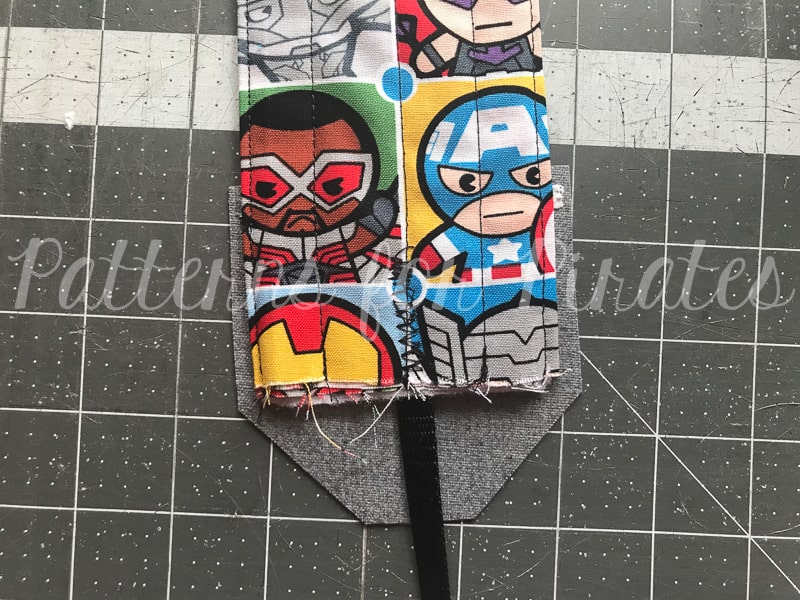
Place it 2″ up from the bottom of your strap.

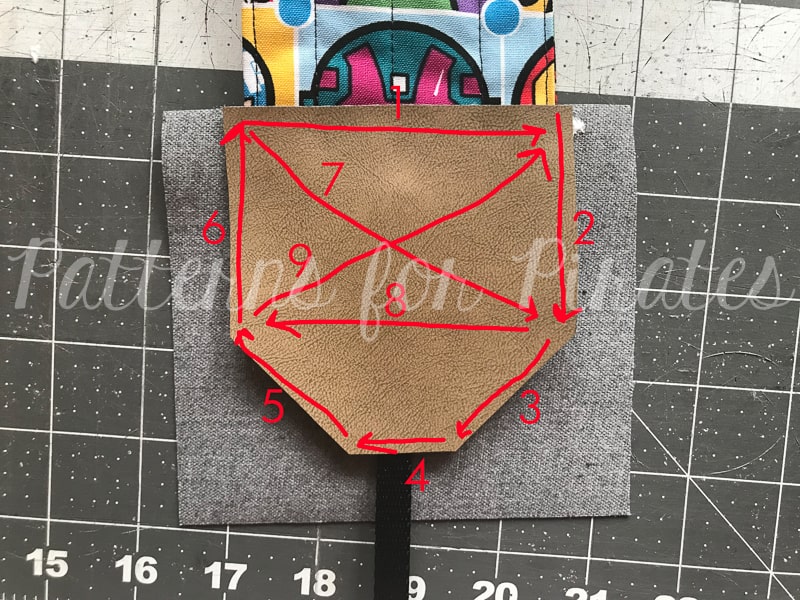
Flip your piece back over and stitch your vinyl on. This is the path I take and it allows for a continuous stitch. You can take whatever path you want. 😉

I HIGHLY recommend using a teflon foot for this. Vinyl can be a huge brat. I know they carry them at JoAnn Fabrics, or you can snag one on Amazon.

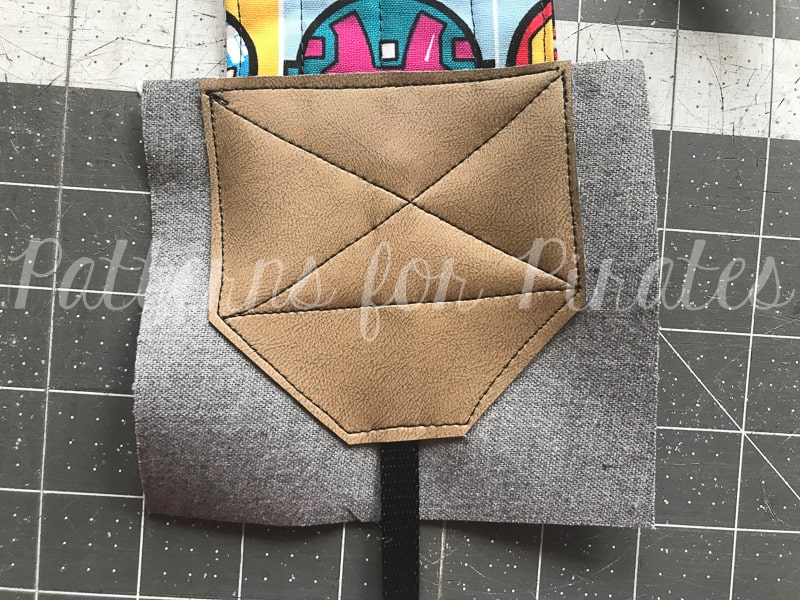
Finished stitches.

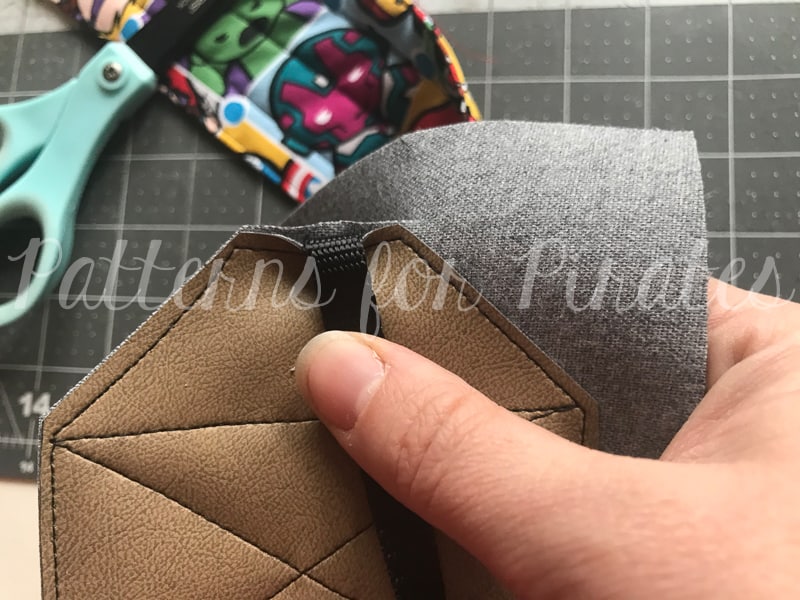
Trim the vinyl to match your other pieces.

Be careful not to cut off your nylon strap. Just tuck it out of the way when you’re trimming.

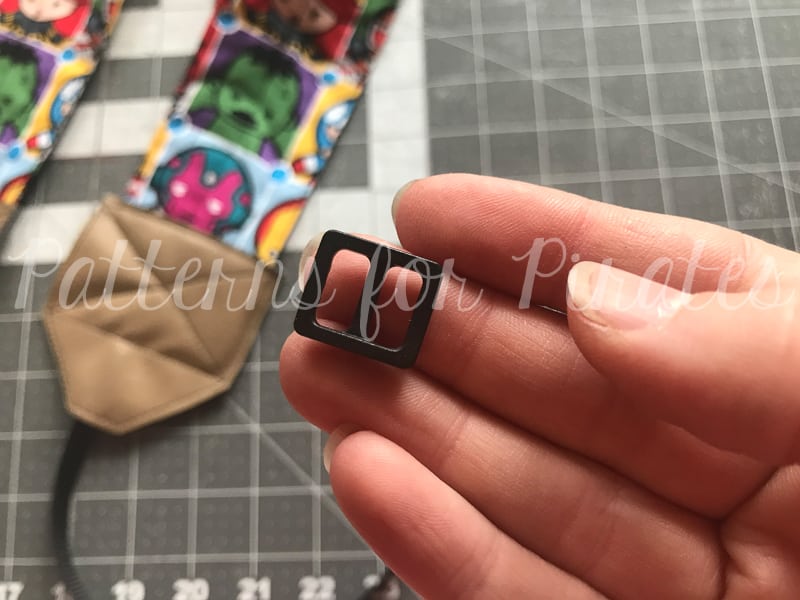
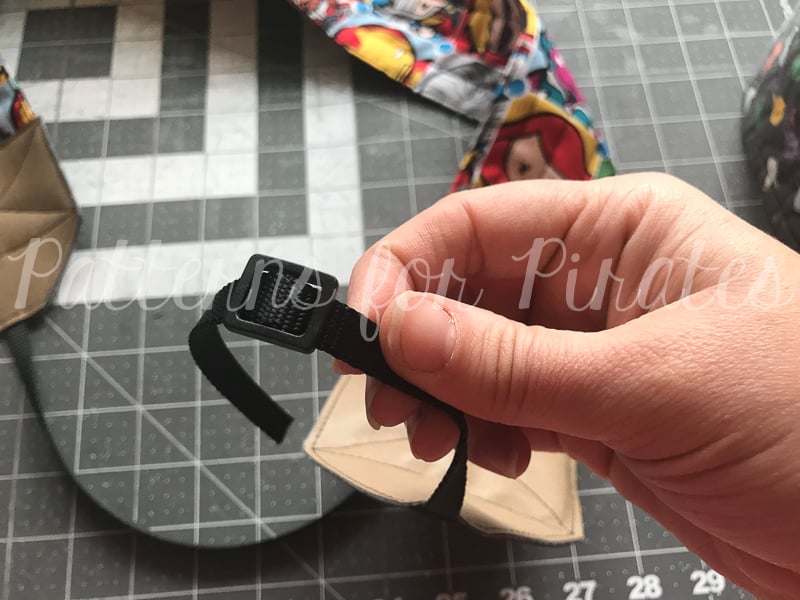
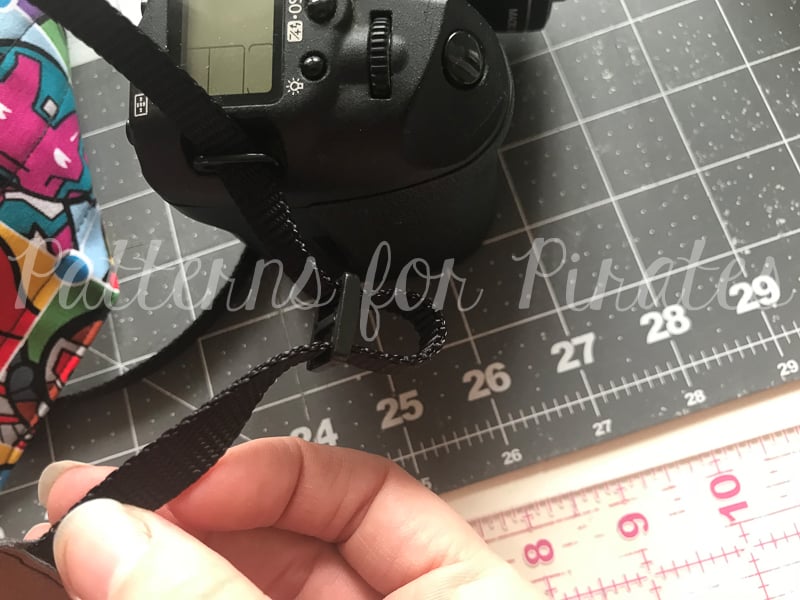
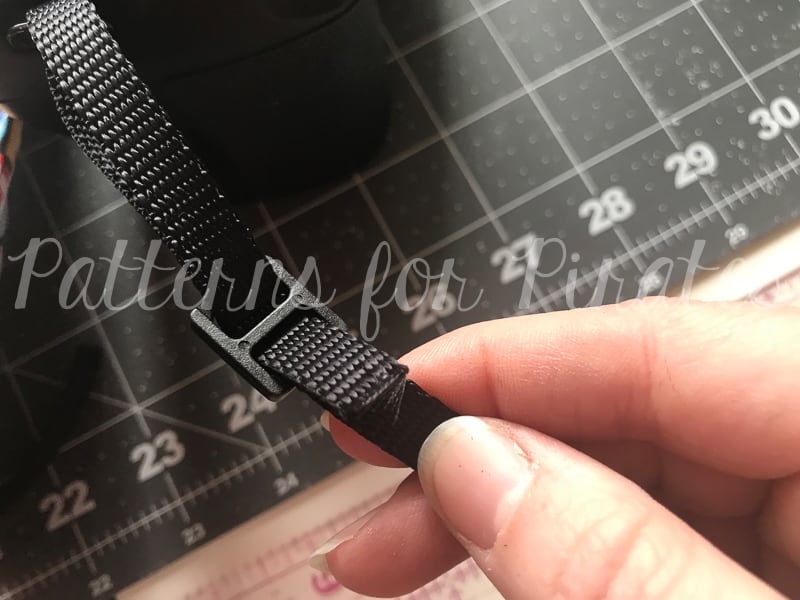
Take your slider.

Slide it onto your strap.

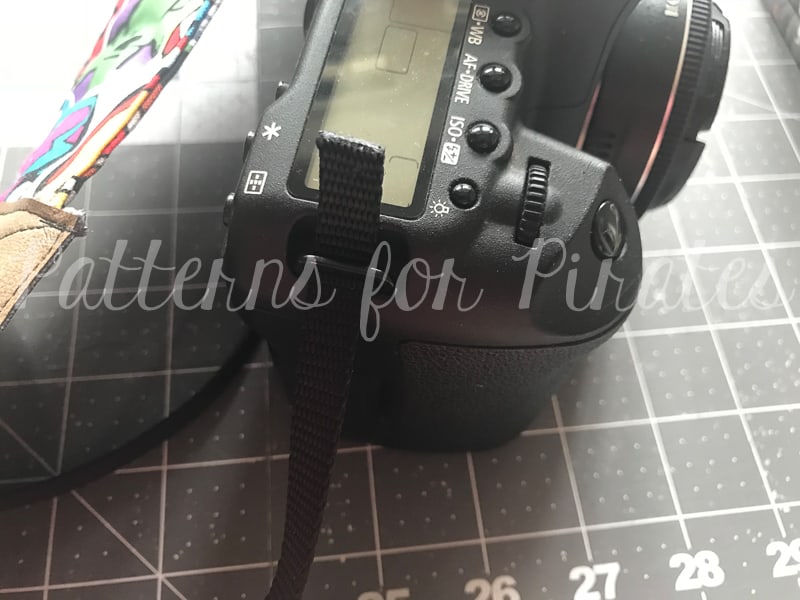
Put the cord in from the bottom-up on your camera.

Give yourself a little slack.

Run the cord back through the bottom and secure the strap to your camera. Easy peasy!


I am SO EXCITED to see your new, stylin’ camera straps!  I’ve been using my me-made strap for years now (so has my hubby) and we get compliments on it all the time.  I’m betting you will too!  Please, if you do make one for yourself, share it with us in the Patterns for Pirates Facebook Group!

**Also, as a quick note, there are some affiliate links scattered within this post.  I make a small commission for purchases made through those links, but I only link products that I’ve used and actually recommend myself.

Filed Under: Free Pattern 2 Comments

2017 Holiday Freebies :: Size Tags

December 6, 2017

We are back for more fun with day three of our 2017 Holiday Freebies!  (In case you missed the last two…check out our Slouchy Headwarmer + Emoji Pillows and then come right back!)

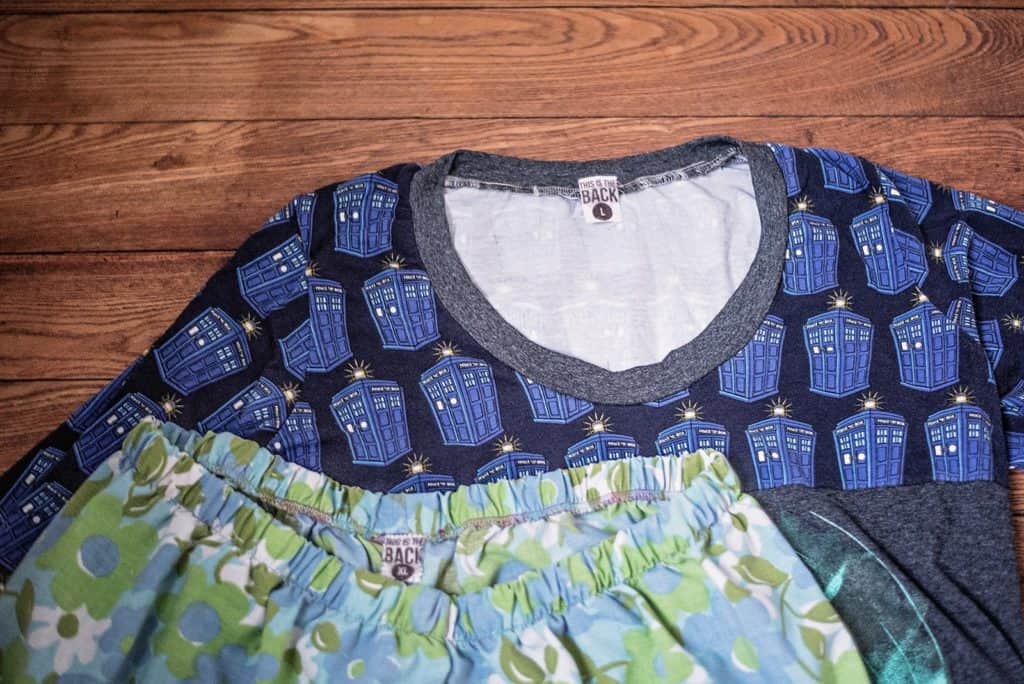
One of the only complaints I get in my household about the handmade clothes I make for my husband and son are that there aren’t tags.  Apparently it’s not as easy for everyone as it is for us to find the back of your shirt!  We are helping to change that with these cute clothing size tags, so now the only complaint should be that they don’t have enough of your handiwork hanging in their closets!

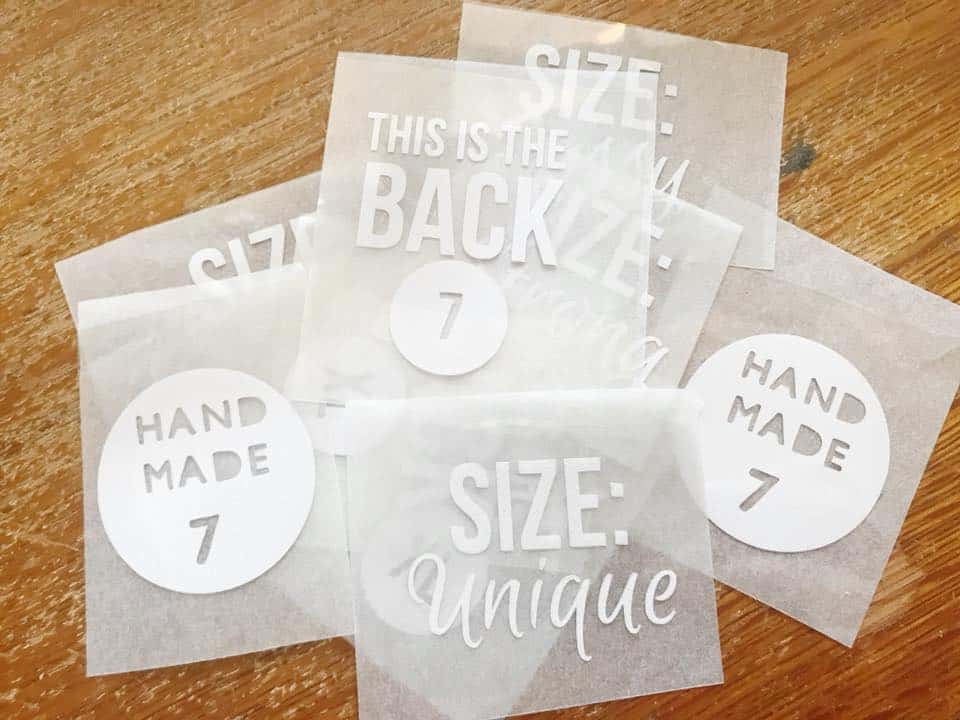
I made the “THIS IS THE BACK” tags for my own family’s use a while back and thought I might share it with my P4P friends!  And then we couldn’t leave you with just one (kinda snarky) design, so I whipped up two more styles to go along with it.  I think a favorite with our holiday help were the “Size: Unique” set.  Now you can label your clothing properly with things like: beautiful, sassy, strong, healthy, etc.  Kinda fun, right?

You can go pick up your copy of these designs right HERE.

Don’t own a die cutting machine like a Silhouette or Cricut?  No sweat!  We have included an extra file type (PNG) that will allow you to work with the designs however you’d like.  We even had someone print on fabric using their at-home printer and sewed the labels in that way.  Pretty clever, huh?

Here are some other ideas:

— Go old school and use an iron on transfer paper and your at-home printer.
— Use Heat Transfer Vinyl and your die cutter.
— Try your hand at Freezer Paper Stenciling.  (Dana from Made Everyday has a great tutorial HERE.)

And just as a handy little tip from someone who has been using tags like these for a while now, I like to cut a bunch of tags on my Silhouette, weed them, lay them on a piece of parchment paper and then cut them out. That way, they’re ready to go when I need them. No fuss!

As always, we love to see what you make from our goodies!  Please feel free to share with us over in the Patterns for Pirates Facebook Group!  And make sure to come back tomorrow to see what else we’ve cooked up this week for you!  Happy Holidays, Friends!

Filed Under: Free Pattern 14 Comments

2017 Holiday Freebies :: Emoji Pillows

December 5, 2017

We are back for Day 2 of our 2017 Holiday Freebies!  (In case you missed yesterday’s, head here to learn how to make this awesome Slouchy Headwarmer!)

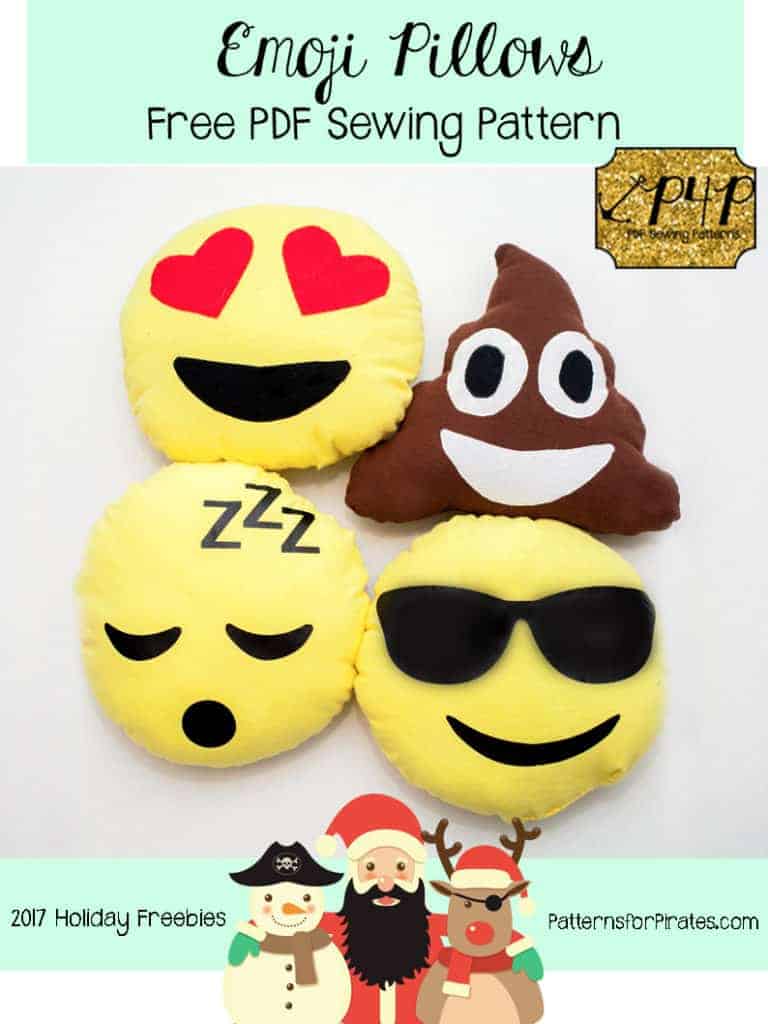
I don’t think you’ve braced yourselves enough for today’s freebie, though.  If you’ve got a kiddo (or a kid at heart!) on your holiday gift list, we just might have the perfect solution for you: EMOJI PILLOWS!

These pillows come out to be 12″ tall.
You will need:
— Emoji Pillow pattern pieces (found HERE)
— small amounts of yellow, red, black, and/or brown fabrics.
— fiberfill (aff link)

Recommended fabrics: flannel, fleece, sweatshirt fleece, kona cotton, quilting cotton, etc.

**Optional, but highly recommended for woven fabrics that can fray (affiliate links):
— If you plan on finishing your face pieces with stitching: Wonder Under Sewable or Heat n Bond Iron-On Sewable Adhesive, etc. are great because they are machine safe and won’t gunk up your needles.
— If you don’t plan on stitching the face pieces to the pillows: Heat ‘N Bond Ultra Hold Iron-On Adhesive, etc. are better since they tend to have a stronger hold.  You just don’t want to stitch through those!

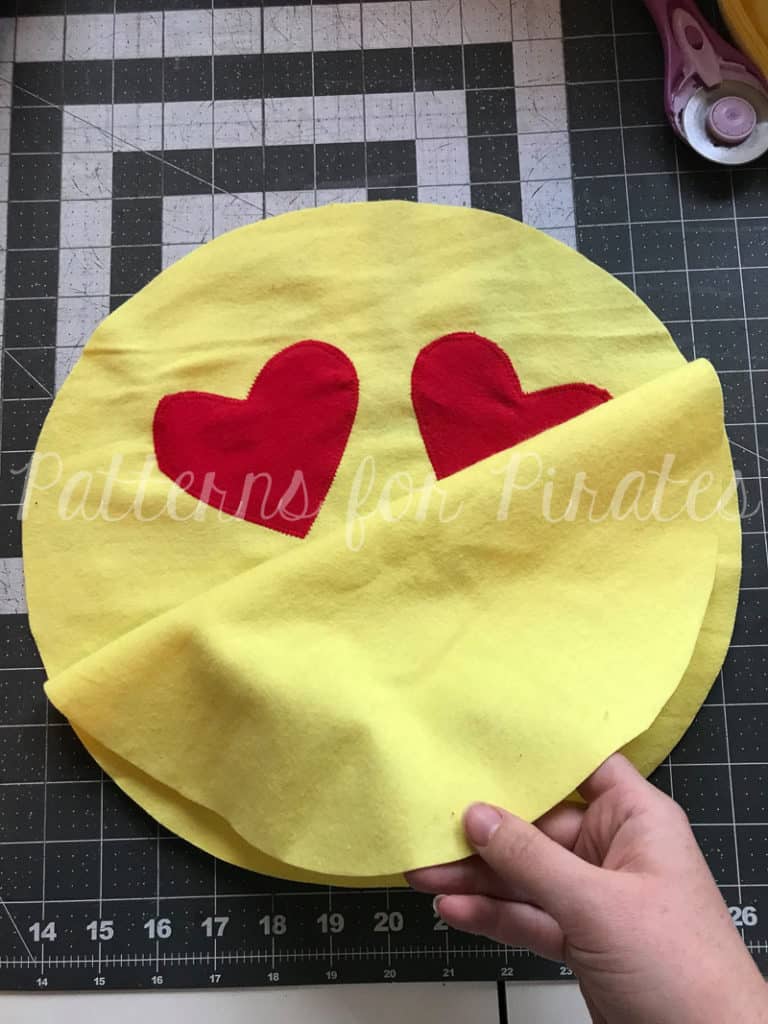
Heart Eye Emoji Pillow:

  • Cut 2 Heart Eyes
  • Cut 1 Mouth
  • Cut 2 Main Pillow Pieces

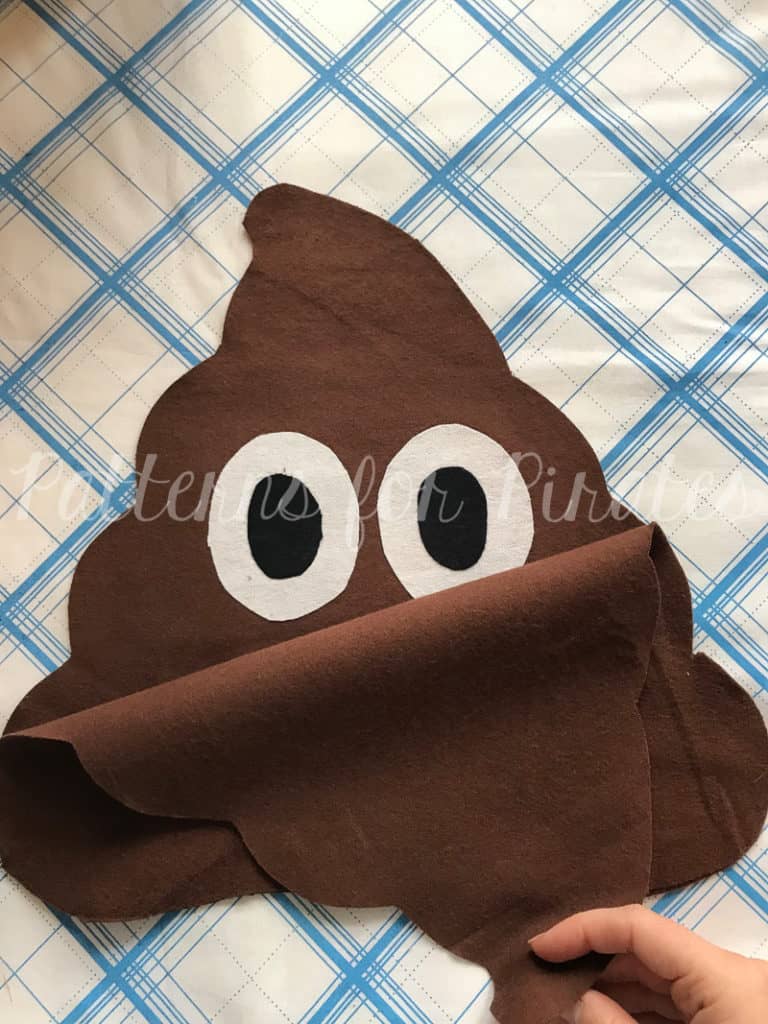
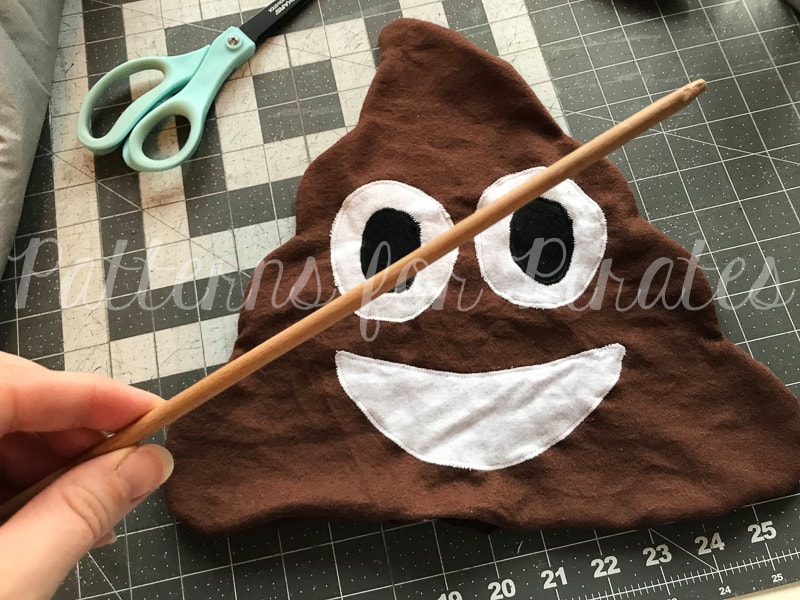
Poop Emoji Pillow:

  • Cut 2 Outer Eyes
  • Cut 2 Inner Eyes
  • Cut 1 Mouth
  • Cut 2 Main Pillow Pieces

Sleepy Emoji Pillow:

  • Cut 2 Sleepy Eyes
  • Cut 1 Mouth
  • Cut 3 Z’s
  • Cut 2 Main Pillow Pieces

Sunglasses Emoji Pillow

  • Cut 1 Sunglasses
  • Cut 1 Mouth
  • Cut 2 Main Pillow Pieces

ALL MAIN PILLOW PIECES HAVE 1/4″ SEAM ALLOWANCE.
**THERE ARE NO SEAM ALLOWANCES ON THE FACE PIECES, AS THOSE ARE ALL APPLIQUED OR IRONED ON.

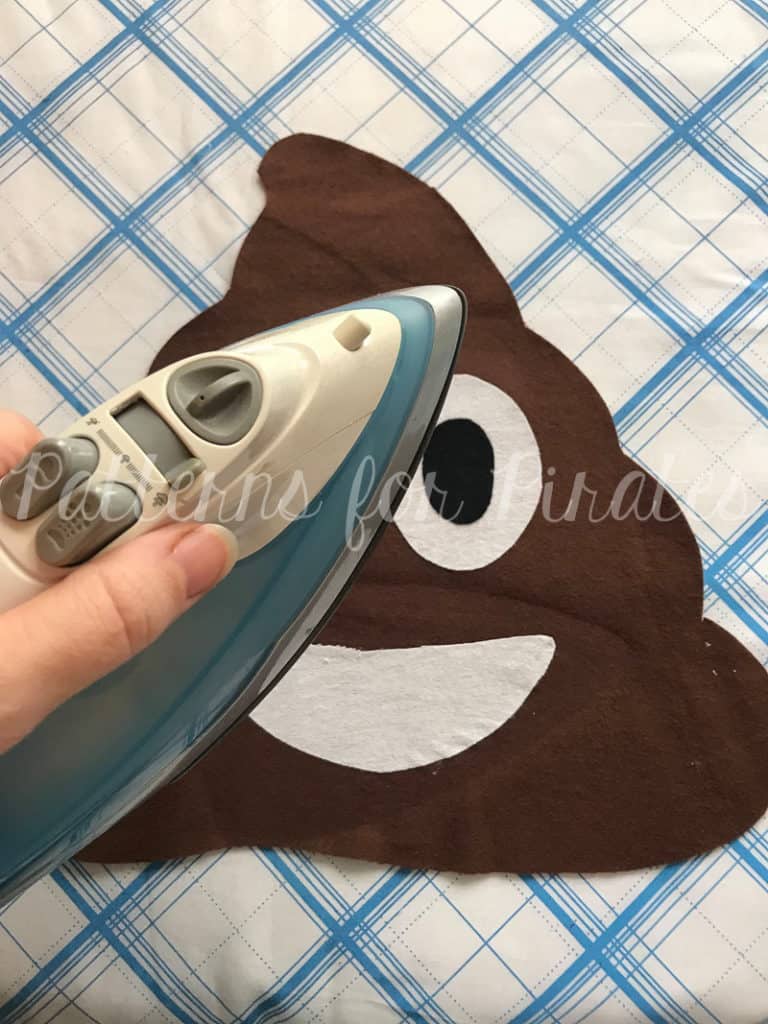
Iron pieces to interfacing according to instructions.  If using an iron-on method only, apply your face pieces directly to one main pillow piece.

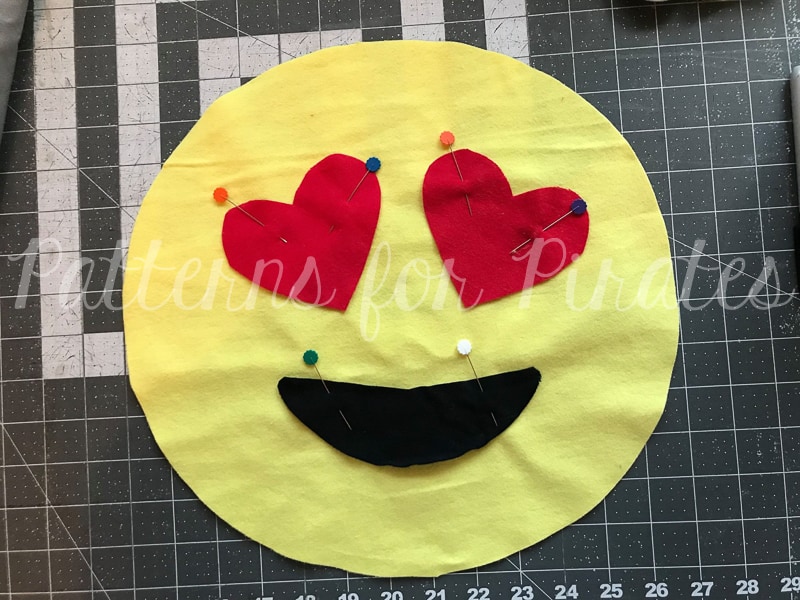
If using the applique method, pin your face pieces into place and zig zag stitch around pieces, securing them to the pillow piece.

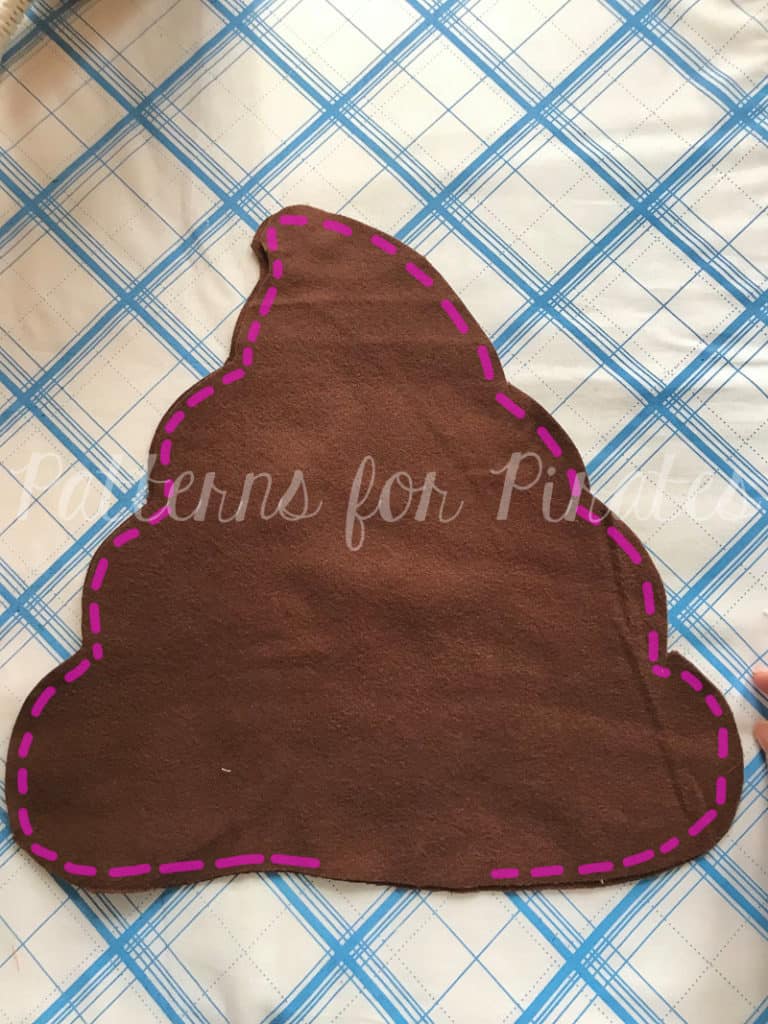
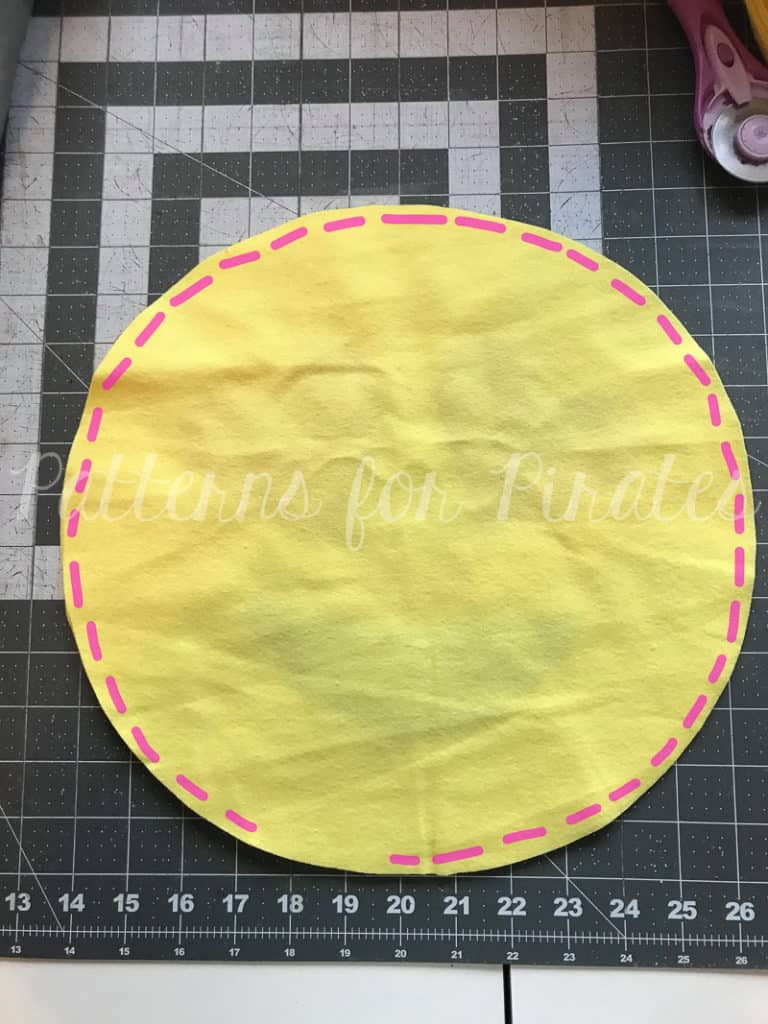
Lay your main pillow body right sides together.

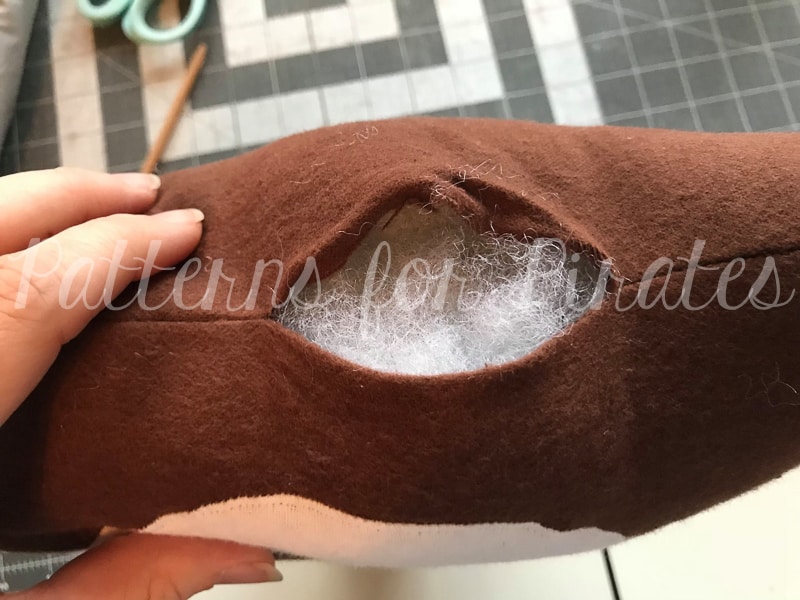
Sew around entire outside, using 1/4″ seam allowance. Leave 3″ opening at the bottom for turning.

Without clipping through seam, trim and clip corners for easy turning.

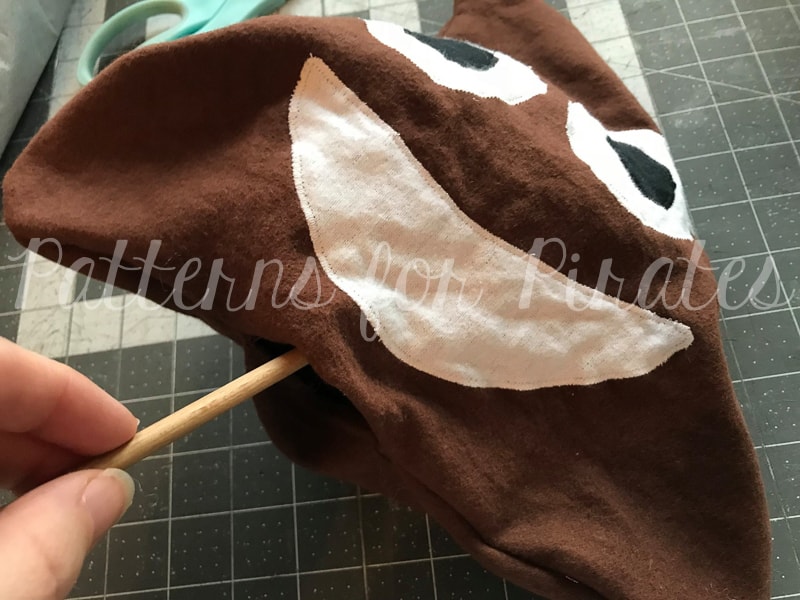
Turn pillow right-side-out, through opening you’d left in the bottom edge.

I like to use a wooden dowel to push out edges and make sure everything is turned properly.

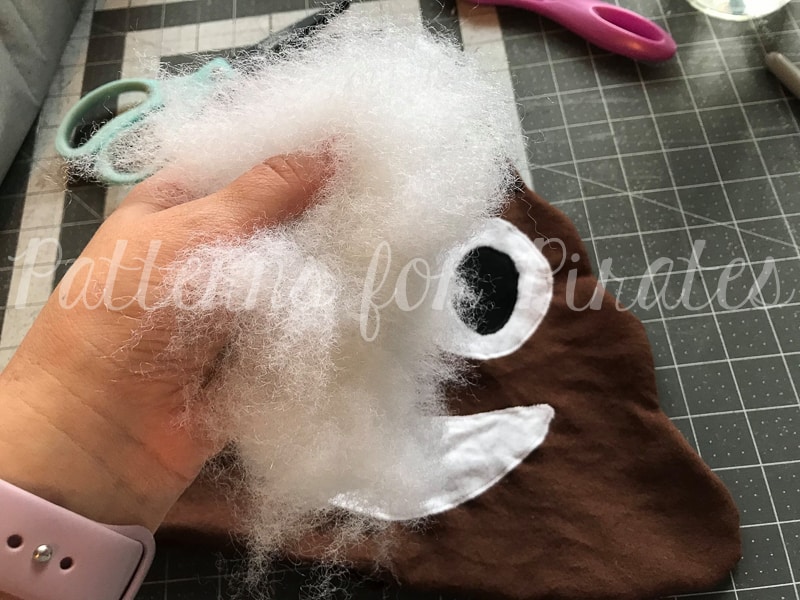
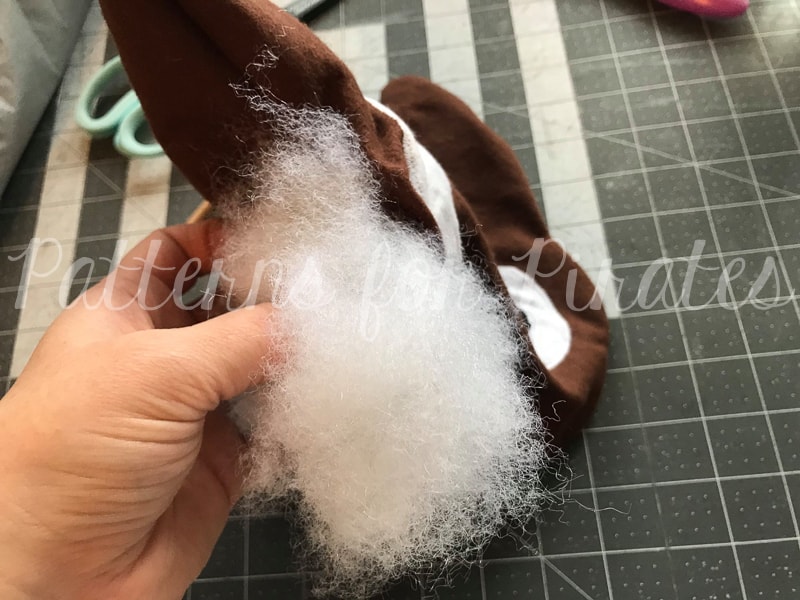
Grab your fiber fill.

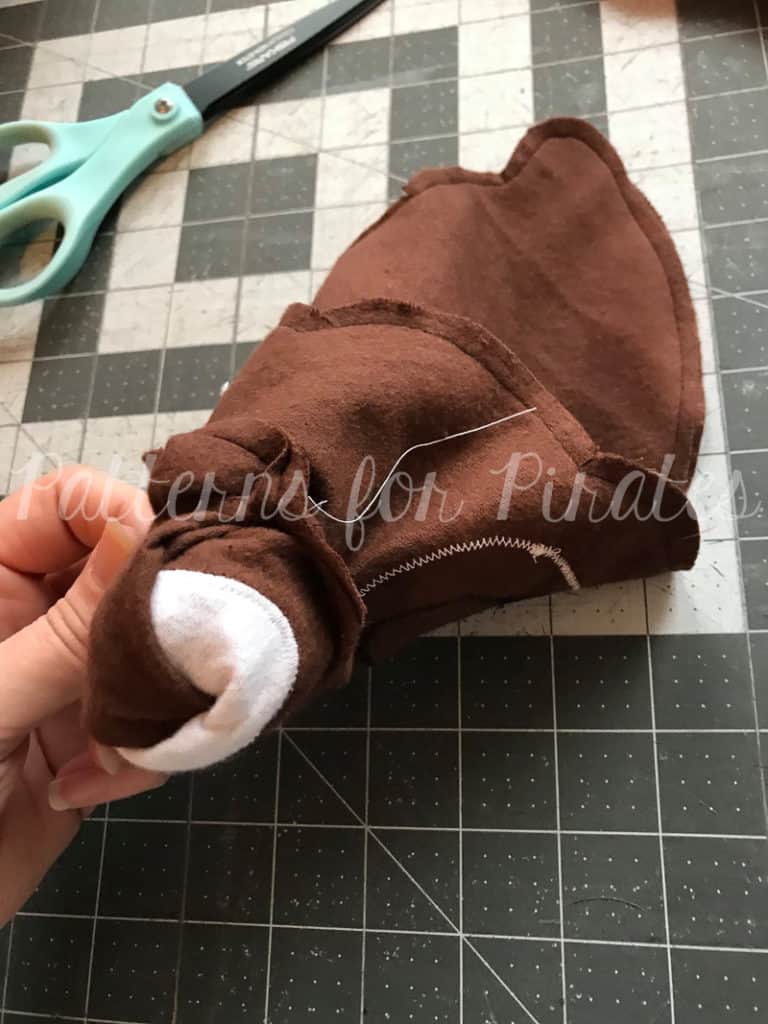
Start filling your pillow, through the opening at the bottom.  I also like to use the wooden dowel to help move the fiber fill around.

Fill the entire pillow, but don’t overstuff.

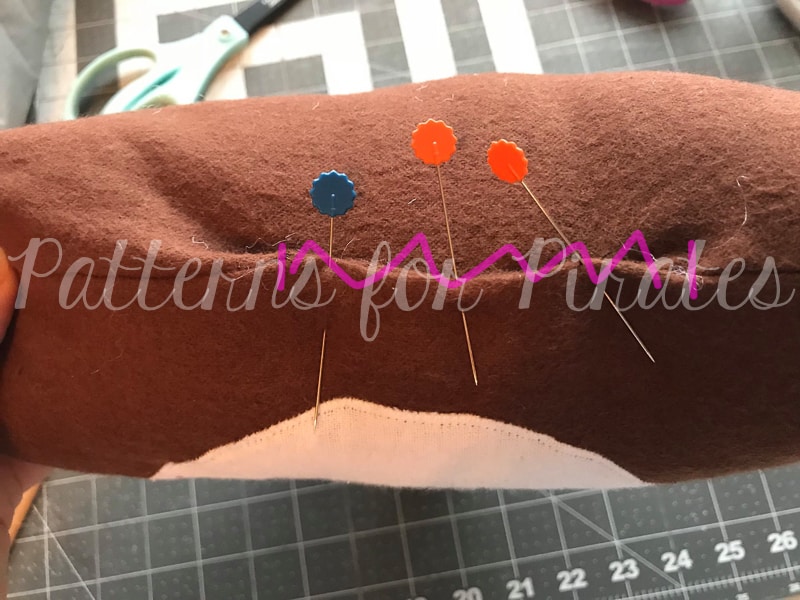
Pin and hand stitch the opening shut, using your favorite method.

You’re all done!  I cannot wait to see your versions of the Emoji Pillows!  Don’t forget to share your finished projects in the Patterns for Pirates Facebook Group!  (I have this strange feeling that my feed is going to be FULL of poop emojis soon, haha!)  Happy Holidays, friends!

Filed Under: Free Pattern 3 Comments

  • « Previous Page
  • 1
  • …
  • 47
  • 48
  • 49
  • 50
  • 51
  • …
  • 68
  • Next Page »

connect with me

  • Email
  • Facebook
  • Instagram
  • Pinterest
  • YouTube
Privacy & Cookies: This site uses cookies. By continuing to use this website, you agree to their use.

To find out more, including how to control cookies, see here: Cookie Policy
  • Privacy Policy
  • Refund Policy
  • Contact Us
  • About

Copyright © 2026 Patterns for Pirates

Copyright © 2026 · Genesis Framework · WordPress · Log in