Patterns for Pirates

P4P stylish, modern, wearable patterns

  • Home
  • Blog
    • Frequently Asked Questions
    • Pattern Releases
      • Free Patterns
    • P4P University
      • Fitting
      • Sewing with Stretch, Knit Fabrics
      • Sewing with Woven Fabrics
      • Sewing Machines
    • Sew-A-Longs
    • Fabric for Pirates
    • Pattern Hacks
    • Announcement
      • Blog Tours
      • Contest/Giveaway
  • Shop
  • Bundle Discounts
  • Flash Friday
  • Gift Cards
  • My Account
  • Cart

Free Spirit Tank – mash up & high low hem

August 30, 2016

IMG_0490

I’m sure by now we’ve all been invited to a least one “Buy these clothes” Facebook party and we’ve been tempted to buy some outfits only to think “nah…I can make it myself”.  Am I right? Well that was my thought when I saw one of this big online company’s newest relaxed fit dress that features a high low hem.

IMG_0556-1

Today on the blog I wanted to show you my version of this popular dress and teach you how to use your favorite P4P patterns to make yourself one. First you will need the Free Spirit Tank (which just got updated to include the Layer Feature!) and the Boyfriend Vneck shirt patterns, a ruler, markers, paper, your fabric of choice, a measuring tape and a French curve ,if possible (A great investment if you don’t have one!). Start by printing the patterns according to the instructions and then cut your size and the high low option.

Screen Shot 2016-08-26 at 11.15.13 AMScreen Shot 2016-08-26 at 11.16.06 AM

I used the sleeves and armcyce from the Boyfriend V neck shirt because it has a looser fit. If you are unsure how to mash the two patterns to add sleeves to the FST, use Judy’s Free Spirt Tank- Layer Me Up mash up tutorial. You would apply the same guidelines and tutorial. Even better, the Vneck Boyfriend tee includes a pocket piece too!

Now that we have the sleeves part covered, let’s move on the the high low hem. Grab your measuring tape because it’s time to take some additional measurement to create the above knee dress length. Measure the length from underarm to above knee, now measure the FST pattern piece from underarm to the hi low hem mark line. In doing so you’ll figure out how many inches you’ll be extending the side. In my case it was approximately 10 inches.

Attach some blank papers to the bottom of your pattern so you extend it. Using a straight ruler add the 10 inches side extension to both the front and back pattern pieces. Now we will create the front and back curved hems. The back curve will be a much more deep one than the front. Take the front piece and mark 12 inches down from the high low hem. Using a French curve draw a curve from the side point to the center seam. We will draft the back curved hem the same way only this time we’ll mark the extended center  mark at 14 inches and carefully draw a curve between the side mark and the center.P4PGRAPHIC

That’s all! You’ve now drafted your own “Carly” inspired dress. Cut out the pieces and sew them according to the pattern instruction.  The Boyfriend V neck shirt includes a pocket so I added it to the FST front too. Simply mark the pocket placement from the Boyfriend shirt on the FST pattern.

TIP: the bottom hem will have a pretty big back curved hem so don’t forget the tips I gave you in a earlier blog about hemming knits.

IMG_0541IMG_0561IMG_0544

Let me know if you have any questions by posting them in the comments below. As always, don’t forget to show off your creations in the group. I can’t wait to see your versions of this dress.

Alex

Filed Under: Pattern Hacks, Uncategorized 16 Comments

P4P: Now Offering Gift Cards!

August 25, 2016

You’ve asked and we are delivering: gift cards are now available via PatternforPirates.com !!

Patterns-For-Pirates-Gift-Cards2

One of our most requested features is the ability to purchase gift cards.  For yourself, your friends, your family, as a prize for followers with your business…you name it.  And now you can!

Currently, cards are offered in quantities of $5, $10, $15, and $2o.  Add us to your Christmas / birthday wish lists, and your loved ones will appreciate the ease of gift-giving from here on out.

HEAD OVER AND GIVE THE GIFT OF P4P TODAY!!


Filed Under: Announcement 2 Comments

Darts 101

August 10, 2016

13886338_10102825780914283_2473314520084428633_n

You may have already heard, but Patterns for Pirates has some ladies woven patterns in the works! Woven patterns tend to use a few techniques that are not often used in sewing knits.  One common technique on woven patterns are darts and I’m here to give you a few tips on how to make the perfect dart.  Darts are used to create contour and shape in your woven fabrics and accentuate your curves. You will find them quite often used in ladies patterns at the bust, and often on the back of pants or skirts.  Don’t be intimidated by darts as they are actually very easy to sew!

I am using the Everyday Elegance Pattern for my example today and we will be focusing on the front piece. The first thing that I like to do before I even start cutting out my pieces is poke a little hole right thru my pattern piece at the tip of the dart.  I usually just use a pen and make a hole big enough that I’ll be able to put the tip of my marking tool into it after I cut my pieces.dart

Once you have your front piece cut out you don’t want to remove your pattern piece from your fabric.  I’m going to show two ways that I like to mark the dart depending on the type of fabric that I’m using.  First, if I’m using something that is a bit more stable like a quilting cotton, chambray, or shirting fabric I will just take my marking pen (I use washable crayola felt pens or a disappearing tailors pen) I poke my pen thru the little hole that I made in the pattern piece. I then take a pair of scissors and make a 2 little snips in right where your darts end, on the side seam of your piece.  You will then flip your fabric over, still folded, and repeat the same process on the other side.

IMG_5014

IMG_5017

If my fabric is slippery or really lightweight and tends to slip I will mark where I made the little hole with a needle and thread. Yes, I said needle and thread but I promise that it is much easier then trying to flip your fabric over and lining it all up again with your pattern piece.  You are just going to make a little cross stitch with your needle and thread, keep it nice and loose and leave a long tails.  Then as above make your two little snips on the side seams.

IMG_5029

You’re now ready to remove your pattern piece.  If you used the needle and thread method to mark the point of your dart gently pull your fabric apart and snip the threads that connect the 2 sides.  Next we are going to connect the tip of the dart to where we snipped at the side seams.  I use a ruler and draw from my point to the side seam on both sides. I then like to draw a line from the point straight down the middle.  Now you are going to fold on that center line and press it with your iron making sure that your snips line up together.  I then secure my dart with a few pins.  Time to sew!

IMG_5018IMG_5021
I like to decrease my stitch length just a bit, usually I sew at a 2.4 stitch length but for darts I go down to a 2 stitch length, this is just to make sure that when you press it after you’re done none of your stitches show.  We are going to start at the side seam and sew right on the line that we drew earlier.  When you get to the tip of the dart, DON’T BACK-STITCH!  You want to sew right off the end of the dart, leave long thread tails.  You can back-stitch at the side seams but never back-stitch at the tip of the dart.  You want to tie off the end of the dart and then trim your threads.  I usually knot my threads 3 times.  This helps keep the very tip of your dart nice and clean/crisp.

IMG_5025

Now we are done sewing the dart we want to press it.  I like to use something that curves to press my dart.  I have this little pressing tool that is used to press sleeves but it works great for darts to, you could also use a tailors ham.  Don’t have anything? You can roll up a bigger piece of fabric you have in your stash.  You want to press the dart down towards the bottom of the top from the wrong side.  Then I flip it over and press it from the front and you’re all done!

IMG_5033IMG_5035IMG_5036
Not that bad right?!  Take the time to be accurate and press well.  If you try to rush or skip out on the pressing you’ll be sorry!

Now go and practice your darts and get ready for the new woven patterns coming really soon!


Filed Under: Frequently Asked Questions, P4P University, Sewing Techniques, Uncategorized 1 Comment

Pattern Testing: How to become part of the Crew

August 6, 2016

P4P-Pattern-Testing


So you want to be a Pirate?

“Ooooo! I would love to test for you.” and “How do I become a tester?” are frequent posts in the P4P Facebook Group.  We are constantly on the look out to add talented ladies to our testing pool so we thought we’d give you the nitty gritty of what it takes to be a pattern tester and how to get picked.

Why do we need Pattern Testers?  All patterns are drafted based on average body measurements but we need people to sew them up and try them on to ensure the proper fit.  We also want to be sure that the instructions are not only grammatically correct but understandable by all levels of seamstresses.

The Pattern Testing Process:

  • Pre-testing: Once a pattern has been drafted, it is pre-tested.  Before we even send out the pattern to our testers, we sew them up to determine if the fit and ease of the pattern is what we are looking for. We usually sew up one of each of the options to be sure to work out any issues before it goes in to live testing.  In some cases, we will modify a pattern numerous times before deciding on the final versions.  This is also where we really hash out what options, finishing methods, fabric suggestions we will include in the pattern.  Our phones are filled with tons of pre-test and fit pics so we thought we’d share a few!  😉
    pre-test
  • Tester Call: We are ready to do a full test on the pattern.  We post a call in our tester pool and our testers sign up for the size and options they’d prefer.  Our testing period usually runs about 1 week, unless we find there are issues and it needs to be extended.  It is crucial to be sure that the deadlines are able to be met as well as having updated and current measurements.  We rely on feedback from the testers regarding fit so is very important to be testing the item in the proper size. We usually have 20-40 testers per pattern depending on the options and size range.
  • Testing: Sizes and options are assigned to testers.  This is when all fit issues and edits to the tutorial are completed.  Testers are to provide feedback about the the overall tutorial as to if its understandable and concise as well as any fit issues. Some fit issues that we may run into are too low of an armscye, too much or not enough ease, gaping armholes and necklines, etc. so some patterns will require multiple revisions.   Although a tester is only required to complete one full item, many decide to sew up the revised and final versions during the testing week.  This means, the pattern pieces are printed multiple times and lots of fabric is used.  Any photos that will eventually be used for promotion (listing pictures, pattern covers, Facebook and blog posts, etc.) are typically only the final version, or one that reflects the final version of the pattern.  This was not quite the norm for us, but the slim fit raglan went through close to 5 versions in testing and 7 in pre-testing.  Not everyone sewed up all versions but we did have a few that ended up making more than 5 shirts that week.  During the testing week we have two deadlines; one for fit and one for feedback and final styled photos.   Fit pictures are basic photos of the garment being worn and point out any issues one may have. We ask for at least 5 final styled photos that showcase the front, back, side and any details of the pattern (like pockets).   These do not have to done by a professional photographer or taken with a high end camera but clear photos of the item and model are a must. We also like clean editing, so no over the top filters or photo-shopping.  An example of fit and styled photos are below.    P4P pattern testing photo example
  • Pattern Release: All fit issues and tutorial edits have been addressed, testers final pictures have been submitted and we are ready to release to the public.  We work behind the scenes to get the pattern files ready, website listings and round up blog posts and then we release.  A new release is usually on sale for a week and we ask testers, if they love the pattern to share it.  Some have their own blogs and will provide their own “review” and write-ups and other simply post their pics in our Facebook Group as well as other sewing groups.  Final photos are also posted in an album in our Facebook Group for inspiration and promotional purposes that the members can access at any time. Check out some of our awesome testers from one of our last releases. Essential Tank Facebook Photo Album.
  • Celebrate:  We wouldn’t be able to get this point without all our awesome testers!  Testing is voluntary and not a paid position.  Upon completion of the test, the tester will receive the final pattern and a big thank you.


So now that you see what we do in testing, you ask, “How can I become part of the testing pool?”

  • When a new pattern is ready to go in to testing, we do a call in our testing pool first.  Sometimes we fall short on volunteers so will do a wide spread call in our Facebook Group to fill in where we need.  This is rare, but has happens a few times and if the test is successful, we add those ladies to the testing pool.
  • Facebook Members are given the first opportunity to test. We hand pick a few ladies from the group and ask if they would like to test the next pattern.   We “get to know you” by your posts in the group.  We are constantly looking for familiar faces that show off their P4P items in the group to add to the group! We look for the following:
    • Active group members who are familiar with our patterns and help out in the group by answering questions (Why? Testers are often asked a lot of questions about the new release and we love for the testers to be available and active in the group!)
    • Posting pics of their completed P4P projects
    • Ladies who are in the size range that we need to fill-in

Check out some of the gorgeous ladies we recently hand picked to test for us from our Facebook Group!!

13391387_10156987531095282_9212836292458574362_o 13717189_10207102251900050_8188682876773372792_o 13403763_10100540252776242_6199973707243297559_o 13723870_10103163709956739_3747945316400350143_o 13734906_10100188299473497_1585660700122181296_o  13698299_10157292206150599_225019478249495708_o


We currently have over 100 ladies in our testing pool so I asked them to share a few things about what they felt anyone that has never tested before should know. Here’s some of  what they had to say:

  • You’re going to use a lot of fabric, ink, tape, and paper. You’re going to take 10000000 pics that you hate and settle on 3.
  • It costs the tester quite a bit. It’s not just a time commitment, but a financial one as well. Also, MAKE THE PATTERN AS-IS. Its impossible for a designer to test their pattern correctly if the actual pattern is never actually tested. It doesn’t matter if you’re afraid that you or your child will grow out of it in a few months. You are testing and that’s a sacrifice you have to make.
  • People will expect you to know everything about the pattern. All the options, best fabric to use, where to get fabric, how it fits on various sizes etc. Sale info.
  • You can’t be shy! If you see a fit problem you have to say something. I know when I first started testing I felt bad saying something that might come across negative but had to get over that fast! 
  • Remeasure for EVERY test. 
  • Don’t wait until the last minute to make your garment. You never know which kid will start puking, which needle will break, or when the power decides to go out. Start ASAP and get it done on time. When in doubt of time, opt out of volunteering. There are many people that would love to take your place for that test. Making a commitment you can’t keep is way worse than politely declining and maybe trying again next time.
  • You need to sew step by step with the tutorial steps as written. It takes me 10x longer than if I were sewing on my own but you need to be as precise & exact to what’s instructed & as the pattern prints.
  • Get a remote clicker for your camera or find a buddy because most husbands don’t understand this process!
  • Most patterns are not perfect the first run, so patience with fitting and adjustments are a must. You are a tester… Testing by trial and error. Take it for all the pain and glory.

Pattern testing is a lot of WORK, but it is also fun and can be so rewarding! Our testers agree.

  • I enjoy testing because having a deadline really helps to motivate me to sew!
  • My absolute favorite is being a part of the team that helps these fabulous mamas succeed in their dreams!
  • Pros: making friends all over the world, being part of the design process, sharing and being proud of your work, learning new techniques and improving my sewing and photography skills
  • I think the biggest thing to realize is that it’s not about the “free pattern” or getting it first- testing for me is truly about being a part of the process! It is so much fun to see the behind the scenes, how much work it takes to get the pattern perfect (which often means a lot of fabric, printing, taping= $$ which counteracts the notion of a free pattern!), learning from all of the amazing women in the group, but most of all- getting to know all of the amazing women!

Phew! So there you have it!  Are you ready to join the crew?  Show us what you got and share you creations in the P4P Facebook Group. You might just be the next member to be given a chance. Happy Sewing!


Filed Under: Frequently Asked Questions, Uncategorized 6 Comments

Sunshine Dress- A Mash made in heaven

July 28, 2016

mashes

Some patterns are a mash made in heaven 😉

Here are some of our favorite mashes with the new Sunshine Dress pattern!

adding sleeves promo pic

Adding sleeves is an easy hack! You will need your Sunshine Dress bodice pieces and  a bodice and sleeve from another pattern you like.  Here I used the Layer Me Up Shirt, because I thought the tight fit sleeve would look great with this bodice.

You will trace the shoulder and armsyce of the sleeved shirt (Layer Me Up here) onto the bodice of the Sunshine Dress.  Aline your shoulders and trace your new armsyce (in yellow).

adding sleeves 1 adding sleeves 2

Cut out the sleeves from the Layer Me Up Pattern in whatever length you’d like and attach in the flat after attaching neckband on Sunshine.

Sew down side seams and along sleeves layering the Sunshine the same as the original tutorial.

IMG_7740

Now you just need to finish your sleeves. You can hem or band according to the Layer Me Up tutorial.

Wah-lah… now you can take your Sunshine Dress into the colder seasons easily!

IMG_8567-2


sweetheart

Here is a super simple mash! Nothing but taking the skirt of the Sweetheart Dress and attaching it to the Sunshine bodice! Easy, peasy, lemon squeezey!

13700985_10154366193649666_8034708204045006946_o 13710656_10154366193669666_7520341654172218256_o 13717360_10154366193644666_4270184735177396283_o


boundless

Did you see the SUNSHINE dress that just released? The dress not only featured 3 bodices but the skirt is perfect for a mash up with other P4P patterns. In the blog today I’ll show you how I made myself a Boundless dress with a Sunshine skirt.

Start by printing and cutting the Boundless top according to your measurements. Use the waist cut line and not the empire one. If you use the empire cut line your sunshine skirt pockets will be too high on your torso. If you like the sleeveless look be sure to add lining too. For my dress I preferred to add short sleeves and not line the bodice. My dress is 100% cotton lycra (95%/5%) so it’s pretty thick. Plus this 100 degrees weather we’ve been having would not work well with a lined top. Am I right? ☺

IMG_9629

For the Sunshine skirt I used the above knee cut chart. The length is very similar to the Boundless knee length so the look would not change. I don’t know about you but I am a big fan of pockets…inseam pockets, outside pockets, welt pockets….you name it…I love it! So when it came time to make the Sunshine skirt the choice was obvious, I cut my pockets with a coordinating fabric so they pop.

Sew your bodice according to the pattern and your choice of style (sleeveless, short sleeve, long sleeve etc). Since I did not line my bodice I just hemmed my neckline with ½ inch fold. Remember the tips I gave you in my last blog?  Pin,pin, pin and iron your fabric and you will have a perfectly looking neckline for your unlined bodice.

IMG_9630

When making your Sunshine skirt, be sure to follow the instruction in the Sunshine pattern. I like to use the elastic gathering method shown in the Boundless pattern but if you add pockets to the Sunshine skirt then that would not work well. You want to avoid gathering your pockets so just use gathering stitches.

IMG_9631
If you did not add pockets to the skirt then the elastic gathering method will work great for this skirt too. Once you gathered the skirt to fit the width of your bodice you can go ahead and attached the two.

Tadah! You now have your very own Boundless/Sunshine dress perfect for year round wear. I hope to many, many Sunshine dresses and Sunshine mash-up dresses in the group (insert link) so be sure to show them off. Sew like a Pirate!


IMG_9654

IMG_9644

Filed Under: Pattern Hacks 11 Comments

Sunshine Dress- Hacks

July 28, 2016

hacks

You know we love to show you how to take your P4P patterns that are filled with options and stretch them even further!

Here are a few easy hacks to the newest P4P pattern the Sunshine Dress!

IMG_36084

Hello there! For those who don’t know me, my name is Erinn and I have a confession to share with you… I love dresses! Ok, truth: I love them September through June when I have to wear “real clothes” for my job as a teacher and not live in my comfy summertime clothes! So when the Sunshine Dress came out, the first thing I thought of was, “How can I make this work for a teacher?”. I absolutely love the cross-over bodice, but knew I would need to wear a cami under it for work, which would just mean more laundry (another confession: I hate laundry!). So, I give to you my friends- the modesty panel! It provides you with the extra coverage of a cami, minus the bulk of layering (again, not to mention the extra laundry of one more shirt- isn’t that reason enough to make one?).

IMG_3571

What You’ll Need:

  • Partially finished cross-over bodice (Complete through attaching the neckband)
  • Pattern piece for Strapless liner (front only)
  • Coordinating fabric

Creating Modesty Panel

Modpattern2First up, you will need to create your modesty panel. To do this, you will need to make a few quick changes to the strapless liner piece. Cut along the armscye line that would have be used for the halter version. Next, remove 1” from the bottom of the pattern- there is already a lot of layers once the skirt is attached, so this will allow you to reduce some of “extra bulk”- nobody wants that!

Cut out your modesty panel using your new pattern piece as well as the binding for the top of panel. For the binding, you will want to cut a strip that is 2” wide and long enough to go across the top of panel.
panel3

Fold binding in half and iron, then attach to the top of the panel- make sure to stretch slightly as you attach. Trim the excess binding to align with your armscye.  Press seam down.

Attaching Modesty Panelattaching2

You should have your cross-over bodice finished through attaching the neckband. Layer pieces in order according to pattern, then place the modesty panel as the top layer. Pin in place (no one will judge how many you use- that’s a lot of layers to keep in place!). Run a basting stitch down both sides- be careful on armscye, making sure to not baste all three layers together. Check the fit/placement of your panel and once everything looks good, sew your side seams together.

IMG_3584Voila! You have now created your modesty panel. All that’s left to do is attach the armbands and skirt, then enjoy your Sunshine dress… with a little added coverage.


Bodice with No Ruching:


no ruchingThis is a SUPER simple hack! All you need is your Sunshine pattern, no measurements, no guessing and just one quick change! For halter and strapless instead of cutting 1 main fabric bodice (front and back) simply cut out 2 lining pieces front and back.

IMG_7743

Assemble exactly the same skipping the ruching steps in the tutorial. Done! For cross over bodice just cut out 2 under/not gathered front pieces, making sure to make them mirror image. Skip ruching steps and assemble normally. 🙂 Was that the easiest hack or what?!?! Now you have 3 more bodice choices with this already option packed pattern!

IMG_8683-2


Making a separate skirt from the Sunshine pattern: 

Maxi skirts are all the rage right now and with this simple hack, you can use the Sunshine Dress Skirt portion to create your own.  (of course it works great for the other lengths too!)


13717335_10154373393944666_3392408374222849681_o


Cut 1 waistband and 2 skirt panels. Construct the skirt in the same manner as the tutorial.  Instead of attaching to a bodice, you will attach to the waistband.  To create your waistband, sew short ends together, creating a circle then fold in half with wrong sides together.  Find the 1/4 points of both the waistband and skirt and match skirt side seams to the waistband.   I like to gather my skirt while it is pinned to the waistband to help ensure even gathers along each of the 1/4 points.   Your skirt will be gathered to the same width as the waistband.  Stitch with 1/2″ seam allowance.  Pull basting threads.  All finished!


Sunshine Skirt waistband P$PP4P Sunshine Skirt Hack

Filed Under: Pattern Hacks 2 Comments

Sunshine Dress | New Pattern Release!

July 28, 2016

Happy Release Day!  After teasing you relentlessly with sneaks of the Sunshine Dress, it’s finally here!  (Insert happy pirate dance here.)

Slide1

Don’t worry, the Patterns for Pirates crew would never leave you short on options.  The Sunshine Dress is an endless amount of style options, neatly packaged in one pdf pattern download.

The pattern is drafted for sizes XXS – Plus 3X.  There are THREE hem lengths (above knee, below knee, and maxi), THREE bodice types (halter, cross-over tank, and strapless), and optional pockets!  On top of all of that, we have also included a  PDF layers feature for printing.  Want to learn more about how to measure yourself for this pattern?  We’ve got you covered with an in-depth blog HERE.


Slide35sunshine-features

Are you sold on the Sunshine Dress pattern’s versatility yet?  Here are some ideas, showing that you can truly make this pattern fit so many different style needs:


Go grab yourself a copy of the Sunshine Dress.  It will be discounted through the end of the weekend, no coupon needed.

Hoping for more inspiration?  Head over to the Sunshine Dress Album on Facebook for more photos from our fabulous testers.  Happy sewing!

Filed Under: Pattern Release 7 Comments

5 TIPS for successfully hemming knits

July 28, 2016

IMG_9357

We have seen a lot of questions in the group about getting the perfect hem on your knit outfits. Most hems are sewn perpendicular to the grain and on the bias in the case of curved hems…this makes hemming sometimes appear stretched out, puckery or wavy.

I needed to sew a shirt to showcase this fabric so the first pattern that came to mind is the Women’s Henley. The only modification I did was to shorten the neckline placket so it would not interfere with the design of the fabric.listing pictures

I will give you my 5 best tips for avoiding stretched out hems (especially curved hems) and getting the perfect finish.

1. You IRON is your best friend!

Always have your iron hot and with plenty of water in the steamer. Iron your hem before your sew it, it will make hemming easier! This process is called a memory hem. Be sure to follow your pattern’s directions for the amount of fabric that needs to be folded. Pressing and steaming the seams once sewn will also remove the puckering and waviness back and make them look beautifully finished. Ironing and steaming your garment every step of the way is one of the most important parts of sewing. While steaming your hems may not fix all issues it will definitely fix most of them.

IMG_9203

Before pressing and removing excess fabric.

IMG_9210

After a good steam and press.

2. CLIPS and PINS galore!

When hemming, I clip/pin my fold over fabric almost every two inches. Having a stable seam will make sewing it a breeze. Whether you are using your coverstitch machine or your sewing machine having your fabric pinned every inch and a half or so will make your hemming experience much more pleasant. Sewing clips vs. pins is a matter of personal preference. I like sewing clips best because I find them to help me secure my hems faster than pinning used to. So, are you a “pin-er” or a “clip-ser”? 🙂 – insert pictures of the clipped hem

IMG_9197-1

3. HEMMING TAPE is magical!

Stitch Witchery or Easy Knit Tape will become your go to notions for hemming. Stitch Witchery is great for stabilizing and fusing together knit fabric. Simply lay the tape inside the memory hem and press it. This will not only fuse it but it will also give it more stability, making sewing so much smoother and hassle free. It is very important to make sure that the hemming tape you use it’s sew-able. Some no-sew tapes may leave a gooey residue that will damage your needles. Insert photo of hemming tape and photo of ironing it.

I also like to spray Best Press when I press my hems. The starch in it makes the hem more stable so it becomes easier to sew.

IMG_9193-1

Hemming tape can be transparent or opaque.

IMG_9196-1

4. Length of the STITCH and TENSION matters!

Whether you are using your sewing machine or your coverstitch machine, you must remember to adjust the stitch length and tension according to the type of fabric you use. Some coverstitch machines will adjust the tension automatically but most of them will not, so be sure to test your hemming on a scrap piece of fabric. It’s imperative that the scrap fabric you use is the same as your project. Usually hemming knits will require you to lower the tension and length the stitch. Some machines will prefer a longer stitch, some will work great with just a 3.0 length.

IMG_9199-1

If your machine will allow you to set up the stitching speed, do it!

IMG_9207-1

I tend to coverstitch at about 1/2 to 3/4 inches away from the fold so I remove the excess fabric with my applique scissors. You can use your regular scissors too, just be careful not to snip your stitches.

5. Last but not least, have PATIENCE! Go slow!

We all know that rush feeling we get when reach the hemming part of the project…one more step and then it’s ready!! Well, last thing you want is for this last step to ruin your hard work. Take a little more time and go slowly when hemming. Coverstitch machines sew pretty fast so remember to slow down and guide your fabric through.

IMG_9339-1

IMG_9211 IMG_9213-1

I hope you find my tips helpful and that you will tackle your next P4P project with more confidence. Don’t forget to post your creations in the group. Sew like a Pirate!

Filed Under: P4P University, Sewing Techniques, Sewing with Stretch, Knit Fabrics, Uncategorized 8 Comments

Pivot and Slide FBA Method`

June 22, 2016

fba header picture

We get a lot of questions about Full Bust Adjustments.  Since I draft for a true hourglass, curvy figure lots of our ladies have bigger busts. So here is a quick and easy method for knit tops if you need a FBA.

Do you need a FBA?

I see a FBA suggested A LOT in sewing groups, even though it’s not always the problem/solution for ladies (Especially for a P4P pattern that already drafts for a bigger bust.)

So, how do you know?  I began putting both upper/over bust and full bust in my measurement charts to help! (Need a refresher on these measurement terms? Here is our How to Measure Yourself post explaining them.)

If your upper bust is a size smaller than your full bust- you need a FBA.  If you don’t have those measurements on your pattern then you will have a neckline and shoulder fitting too large when choosing your size from your full bust measurement.

I do NOT advise “choosing your size based on your upper bust measurement” and doing a FBA for that many inches.  Indie patterns like mine are much more “true to size” than traditional paper patterns that tend to have a lot more ease built into them. With traditional paper patterns it is often very easy to size down 1-2 sizes on them and still have enough wearing ease.  Most indie patterns are not drafted with that much extra ease.  I draft my patterns right from that measurement chart meaning if I picked my size based on my upper bust (34.5) I would choose a size small, but I don’t need a small! Both my upper and full bust fit into a medium on the full size chart.  I do not need a small with a FBA becuase my frame/upper body isn’t a small.  It’s a medium 🙂 This is why I began adding the upper bust measurement into my patterns, to take out that guess work when I saw this recommendation quite a lot.  And while it might work well for those traditional paper patterns with more ease- I do not suggest using this method for P4P patterns-or most indie patterns in general.

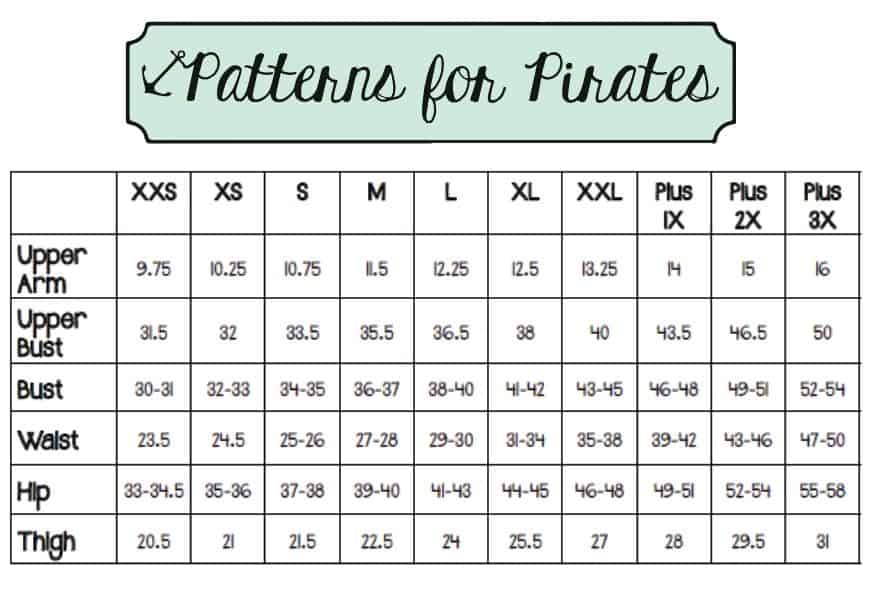
Here is my size chart with both upper/over bust and full bust.

listing pictures3

Got some wrinkles on the full bust area? A FBA is NOT always the answer 🙂 There are a lot of other reasons you might have some wrinkling there!

Both raglan and dolman style sleeves will naturally have some wrinkling there. No matter who that pattern designer is, who is wearing it, fabric choice, or even gender wearing it! The drafting of these two sleeves lay flat when arms are out, which means when arms are down it naturally creates some wrinkling in the armpit area. No biggie 😉

IMG_0238 IMG_0413 IMG_9552 IMG_3842 IMG_4147 IMG_4387

Length is the armsyce is another reason one might have some gaping or pulling.  If you are shorter or taller then the height the pattern is drafted for (P4P drafts for average 5’5″), or if you happen to have a different proportion there. You might need to adjust the length of your pattern from the top of shoulder to the armpit rather than needing a FBA.   This is difficult to tell just from a picture.  It is however much easier in person to see.  If you’re not sure try pinching at the shoulder seam to take out some length if you think it might be too long.  If it is too short you will feel like the entire shoulder area is too tight and that armpit seam will be up touching your armpit too tightly.  For both it is easy to see if you try on the shirt prior to putting the sleeves in.  If it is a tank, remember the bands will pull the armysce in though.

Here my lovely tester and model has a little wrinkling because she is a bit shorter than the drafted height. She would benefit from taking just a touch of length from the armsyce.

11036978_10207178765452450_6301409831053611894_o

Here my lovely tester would benefit from the opposite, a bit more length in the armsyce.

11807358_10207360915846870_5189633883074489071_o


You might have some issues with fit through the armsyce and bust if you are wide chested/through the upper back.  You would find your upper bust measurement in a bigger size than your full bust.  You would need a Small Bust Adjustment (follow the same method just pivoting and tracing to the smaller full bust size).

Here is a gorgeous tester of mine who has begun to trace off a size larger through the neckline and shoulders and adjust down to her smaller bust. This is prior to doing so. You can see it is a bit tight across her shoulders and upper chest area. but fits well in her full bust.

12512545_10156480108785282_629169134466680487_n12669689_10156480108610282_565742808129966782_n


The last reason you might be having fit issues through the bust is not using the appropriate fabric for the top.  If your pattern suggest 50% and you sew up a cotton jersey with only 20% you might have pulling at the chest.  The opposite problem would be using a very stretchy fabric like a lightweight rayon spandex with a lot of horizontal and vertical stretch making the armsyce droop lower or even gape.

Here I am in the exact same size, but the feathers are a more stable cotton jersey with very little stretch and the grey is a rayon spandex with a ton of stretch and drape.  The armsyce is an 1-1.5″ lower in the drapey, stretchy rayon spandex.

IMG_7635 IMG_7920

One more thing I see sometimes is the drag lines from bust to waist.  This is something you will get naturally with an hourglass figure. You have a large difference from your full bust to waist.  If your shirt/dress is semi-fitted then you will see those drags pulling into that smaller measurement at the waist.  This isn’t asking for a FBA, it’s asking for a dart 🙂 But, most knit shirts don’t have darts, just curves along the side seams. You can’t get as drastic of a change from full bust to waist without a dart.  But that’s okay! It’s the nature of a semi-fitted knit top.  It doesn’t mean it is ill-fitting.  Here are some pictures showing those drag lines, but I have room for my bust and the armsyces are fitting perfectly for my frame.  My side seams aren’t pulling drastically to the front of my body on my bustline and it isn’t too tight across my back at the bustline.  I don’t need a FBA for my patterns (yay! I do need them on patterns drafted for a more rectangular figure like traditional paper patterns! Just one reason why I love drafting for a curvy figure).

IMG_7564 IMG_7753 IMG_1758 IMG_1791 IMG_1804

Okay, now if you’re still with me 😉 and you need a FBA here is my favorite, quick and easy method for a knit top. This only adds a bit of width right at the bust.  It doesn’t add length.  For most women and most knit tops this is sufficient.  If you have 2 sizes difference in your upper and full bust you might also add some length to the front center at the bust line and ease it back into the side seam (making the front center curve down). To give your bust some extra length as well.

Here is one of my favorite testers.   She has a smaller size upper bust than full bust.  Here she did not do a FBA.  You can see she has a bit of pulling pointed right to the apex of her full bust. She is your classic case of needing a FBA 🙂 Her side seam will be pulling towards the front of her body instead of laying more evenly along her side.

12109259_10156165083900790_2794494373974819072_n  12094846_10156165083630790_3745559963982436088_o


Here is the “Pivot and Slide FBA Method”:


Step 1: Choose your sizes based off the measurement chart.

z

Step 2: Pivot

fba pictures-02

Step 3: Trace

fba pictures-03

Step 4: Slide back

fba pictures-04


Now you have a new armsyce that goes wider at the bust, but the same smaller neckline/shoulder fit as the smaller size.

I hope this helps those out there needing this fit adjustment! Once you’ve got it down it really is a very quick and easy method to adding a bit more room for the ladies 🙂

Filed Under: Fitting, P4P University, Uncategorized 35 Comments

P4P University:: Grading Sizes

June 20, 2016

grading sizes

Patterns for Pirates grades to a true curvy, hourglass, 5’5″ frame.  Often times, one’s measurements may not fit within one size for bust, waist, and hip and in order to keep the intended fit of the garment, grading sizes is needed.  Is it always necessary to grade sizes? No, but depending on the fit and ease of the item, it may be worth taking the extra step to custom fit it to your measurements.  Unsure if you want to grade?  Check out the Shirt Fits Explained post and our post about Ease as they may help you decide if you are comfortable with a different fit.  For some of the looser cut tops like the Everyday Elegance and Relaxed Raglan, grading up a size for the waist is likely, not necessary as they are straight cuts from the bust down.  But a top like the Layer Me Up, that is very fitted to the body would fit the best if graded to your measurements/size.  Be sure to measure yourself prior to sewing!  Our measurements tend to fluctuate without us really noticing, so I try to measure myself every couple of weeks to be sure I am still sewing the same size my measurements put me.  Not sure where to measure? Read this: How to Measure Yourself.  Below is the size chart for reference.


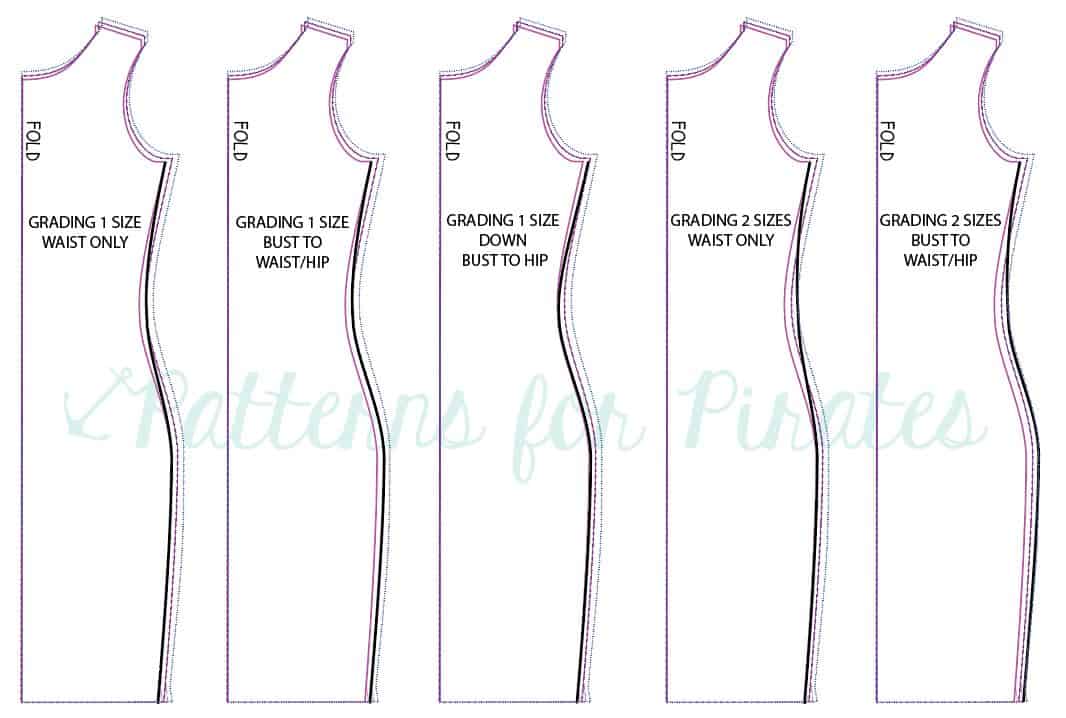
Now that you have determined your size and if you’d like to grade, how do you do it? Below are a few examples of grading for a larger waist and hip size.  Any adjustments should be made to both the FRONT and BACK pieces.  Do not be discouraged if your measurements put you within different or larger sizes than ready-to-wear store-bought clothes as pattern sizing does not translate the same.  Our bodies come in all shapes and sizes, and we are all uniquely beautiful.  The beauty of sewing for oneself is the ability to create an item custom fit to you.

P4P grading sizes, pdf patterns

Still need help or have more questions about P4P patterns?  Join us over in the P4P Facebook Group and get to sharing!


Filed Under: Fitting, P4P University, Uncategorized 19 Comments

  • « Previous Page
  • 1
  • …
  • 60
  • 61
  • 62
  • 63
  • 64
  • …
  • 68
  • Next Page »

connect with me

  • Email
  • Facebook
  • Instagram
  • Pinterest
  • YouTube
Privacy & Cookies: This site uses cookies. By continuing to use this website, you agree to their use.

To find out more, including how to control cookies, see here: Cookie Policy
  • Privacy Policy
  • Refund Policy
  • Contact Us
  • About

Copyright © 2026 Patterns for Pirates

Copyright © 2026 · Genesis Framework · WordPress · Log in