Patterns for Pirates

P4P stylish, modern, wearable patterns

  • Home
  • Blog
    • Frequently Asked Questions
    • Pattern Releases
      • Free Patterns
    • P4P University
      • Fitting
      • Sewing with Stretch, Knit Fabrics
      • Sewing with Woven Fabrics
      • Sewing Machines
    • Sew-A-Longs
    • Fabric for Pirates
    • Pattern Hacks
    • Announcement
      • Blog Tours
      • Contest/Giveaway
  • Shop
  • Bundle Discounts
  • Flash Friday
  • Gift Cards
  • My Account
  • Cart

Walk the Plank – easy hacks

September 27, 2017

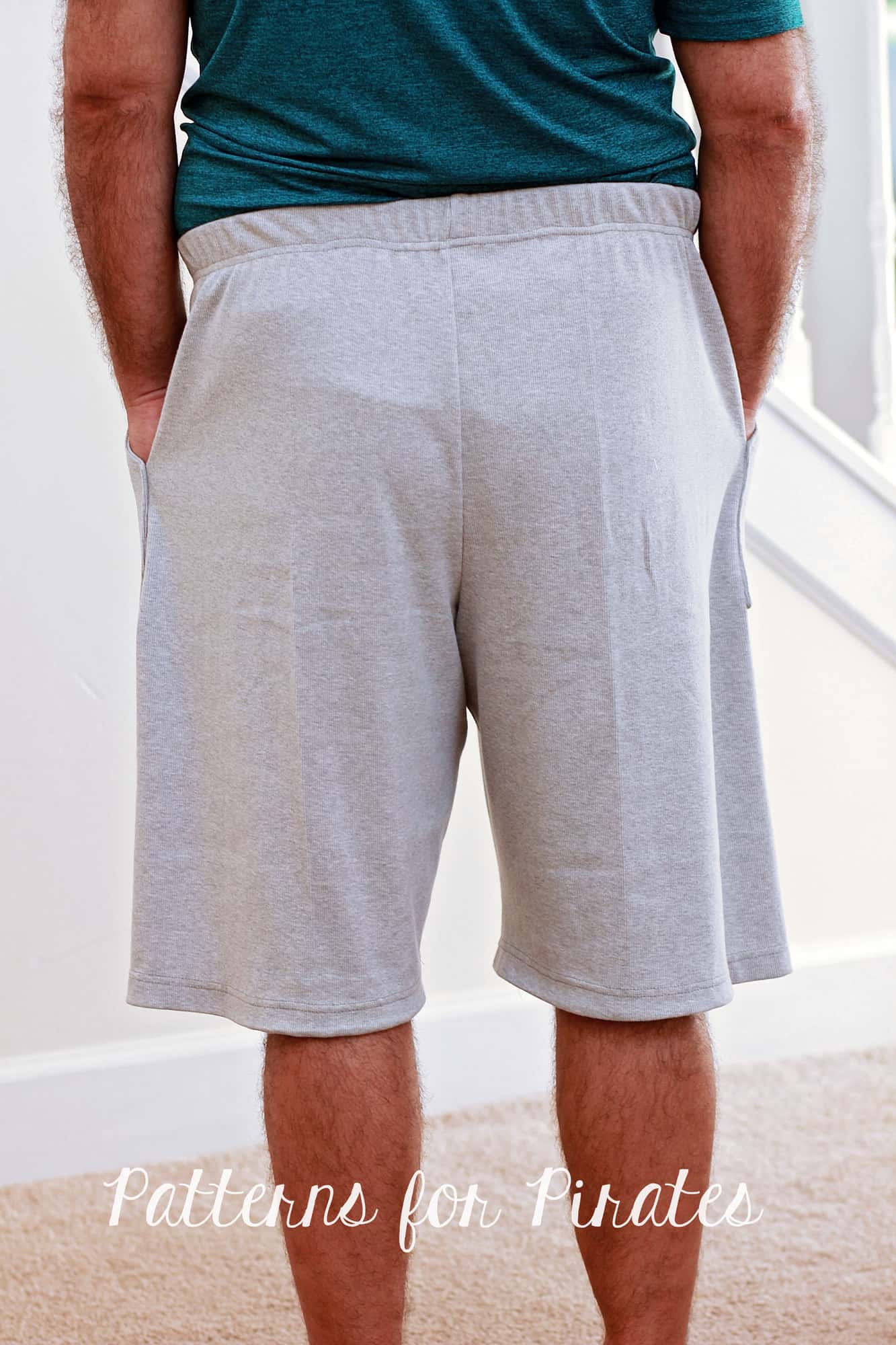
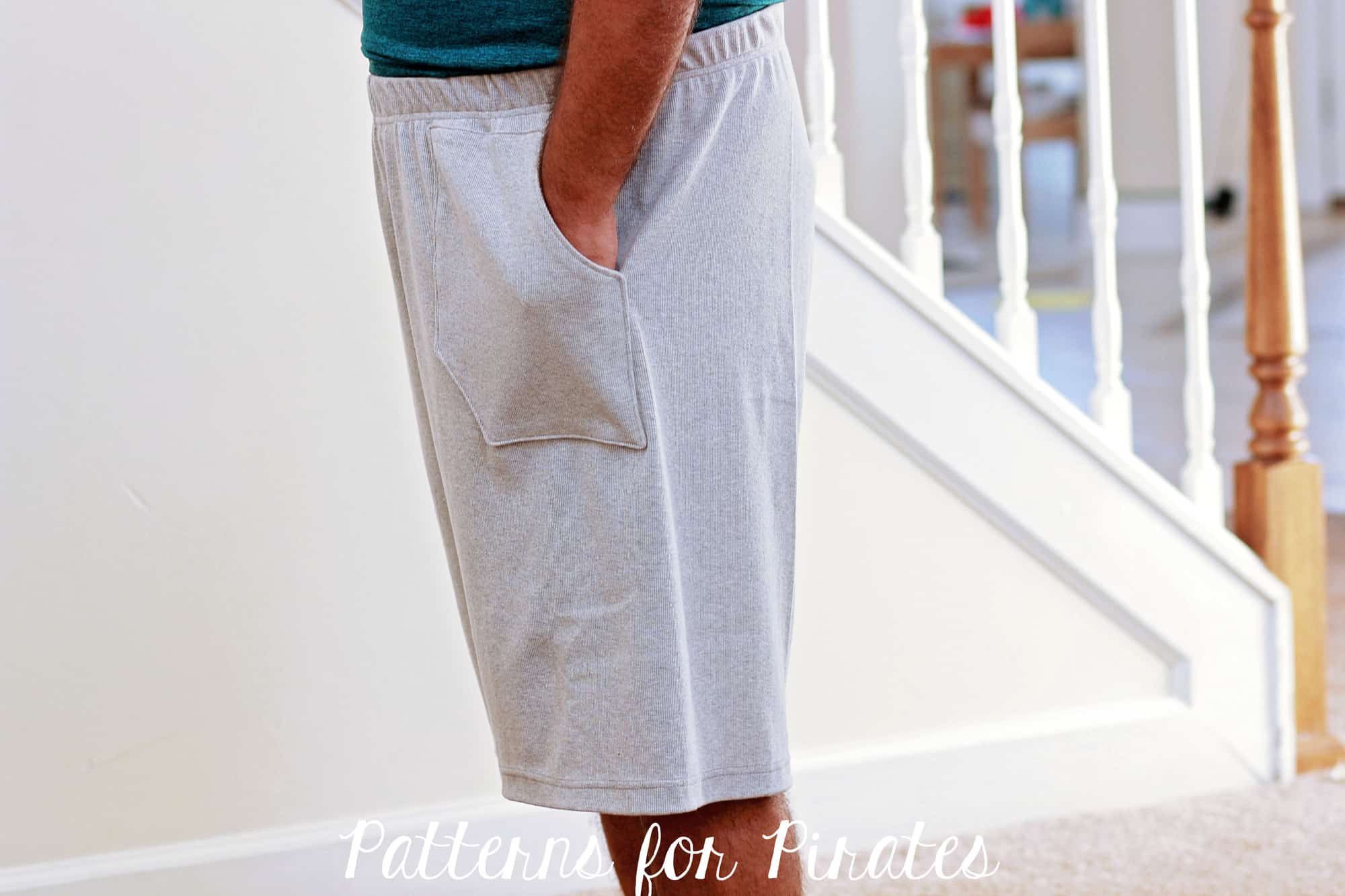
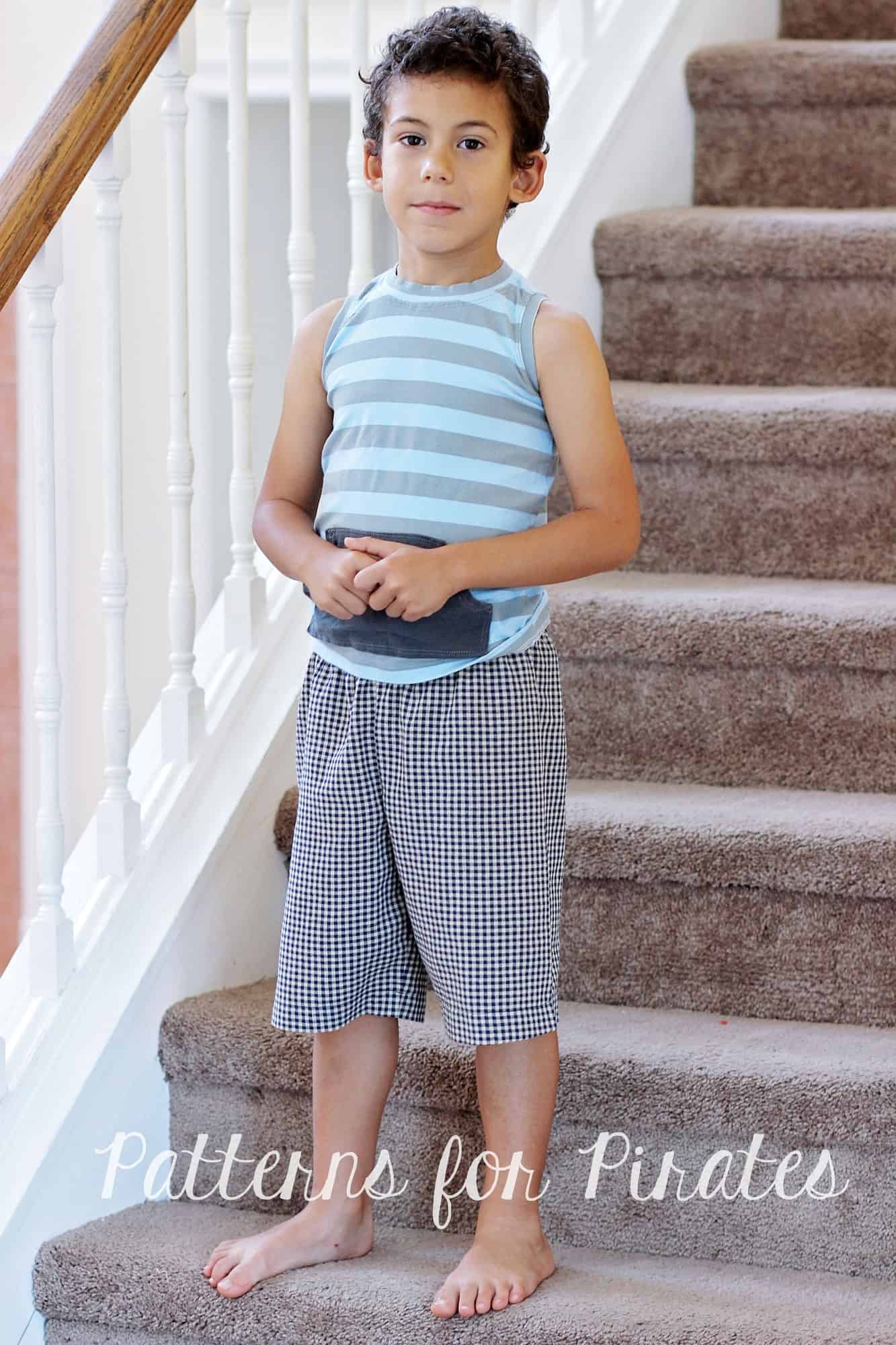
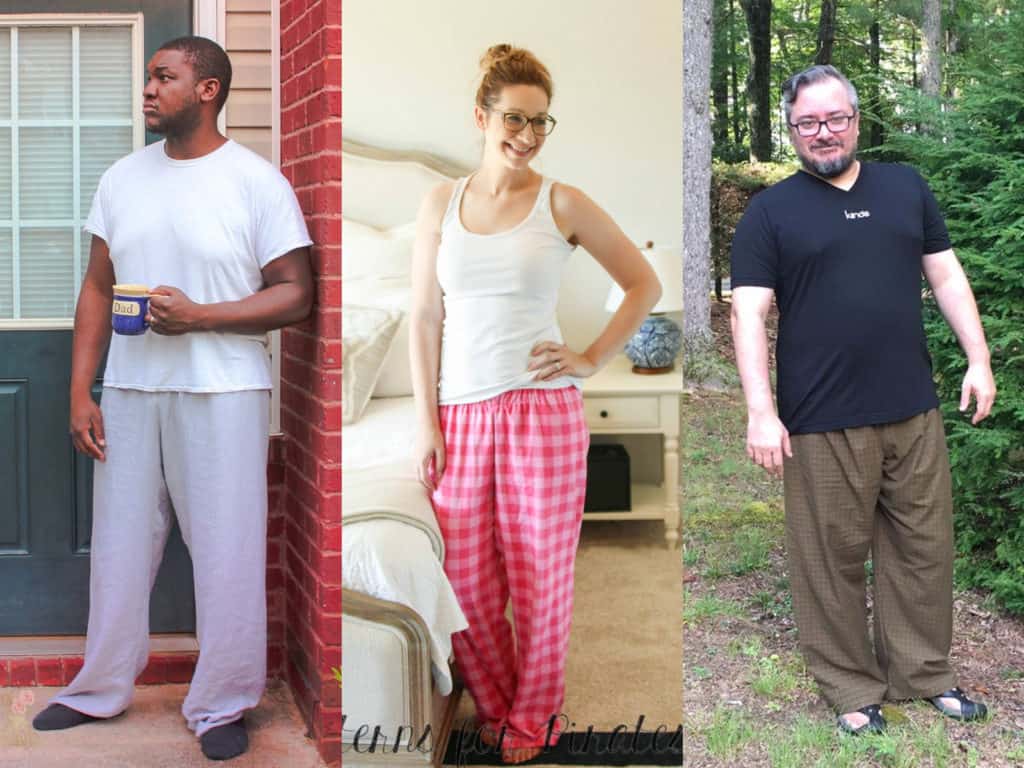
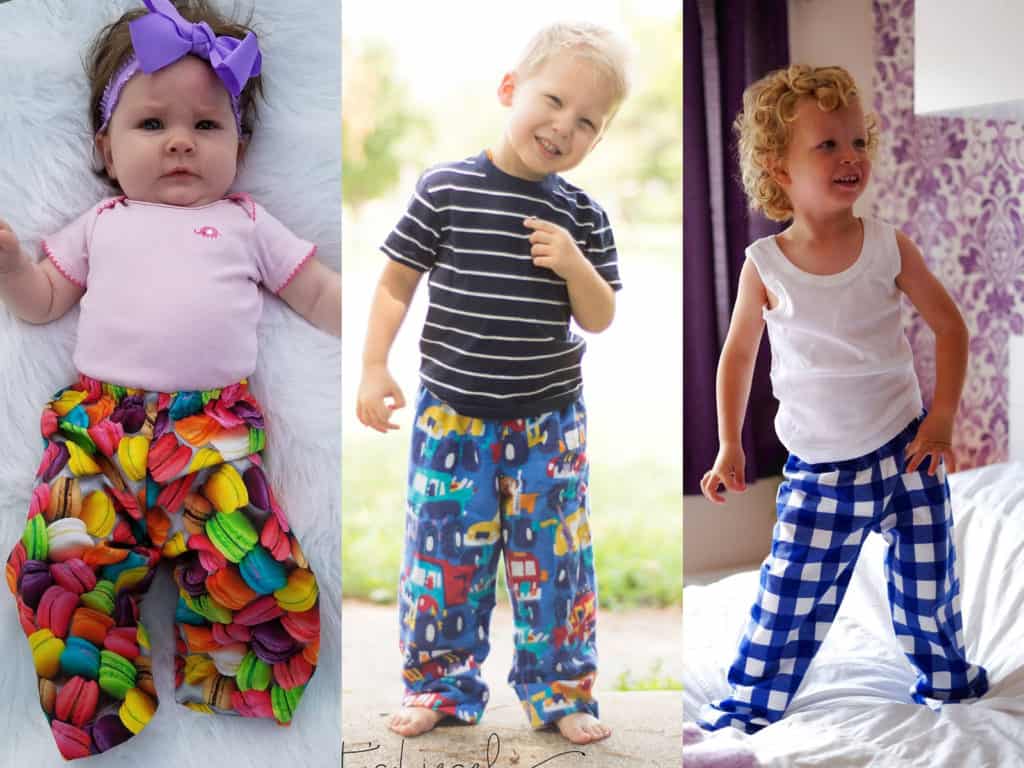
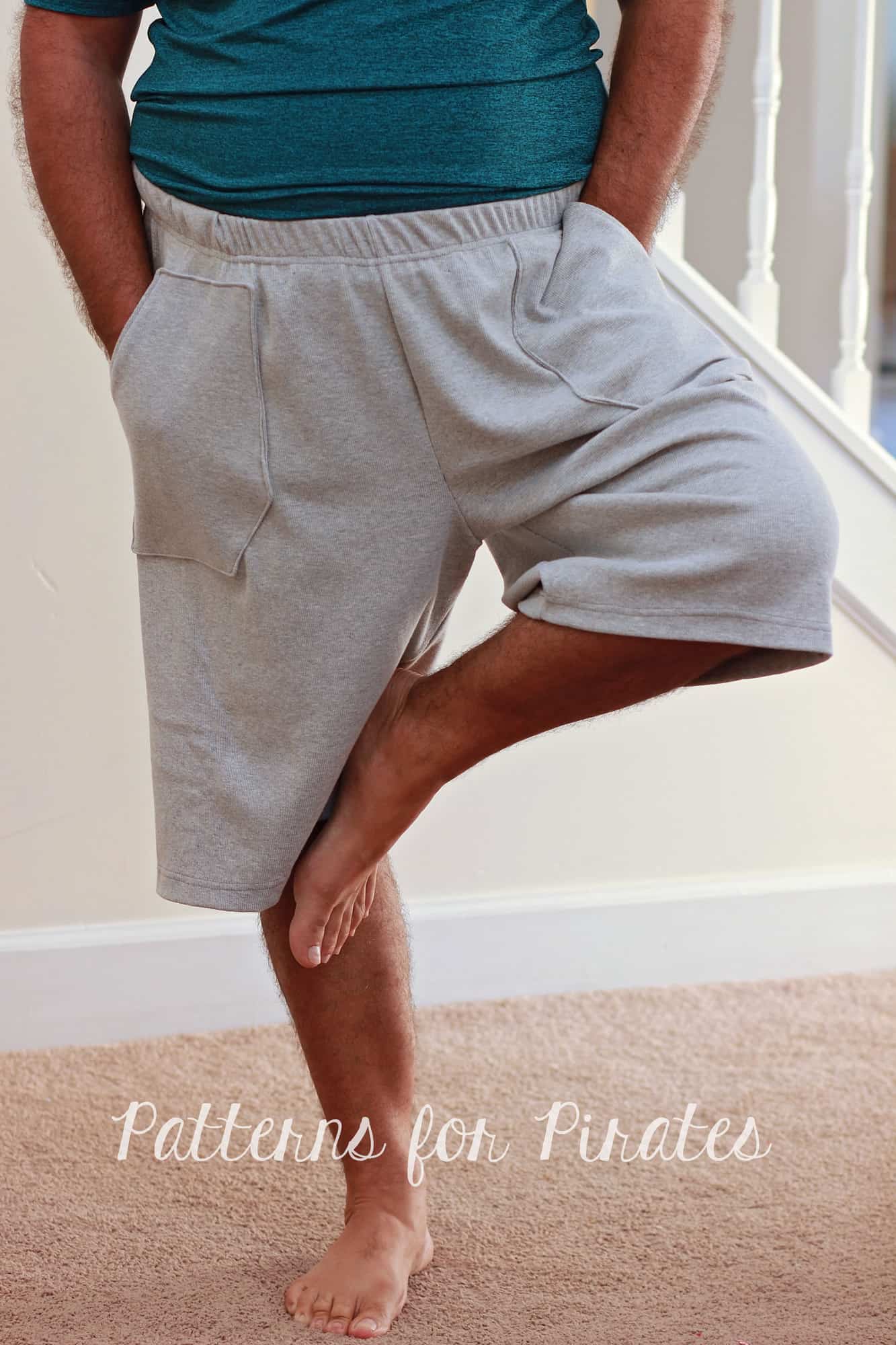
Ahoy, pirates! Hope you grabbed your FREE Walk the Plank pajama pants patterns by now. If not you can get them here. Today I wanted to show you how easy it is to add patch pockets to the pattern so all those husbands, boyfriends and sons of ours will be even happier with their new PJ pants. I’ll also show you how to enclose the the elastic in the seam.

. . . . .

Front patch pockets
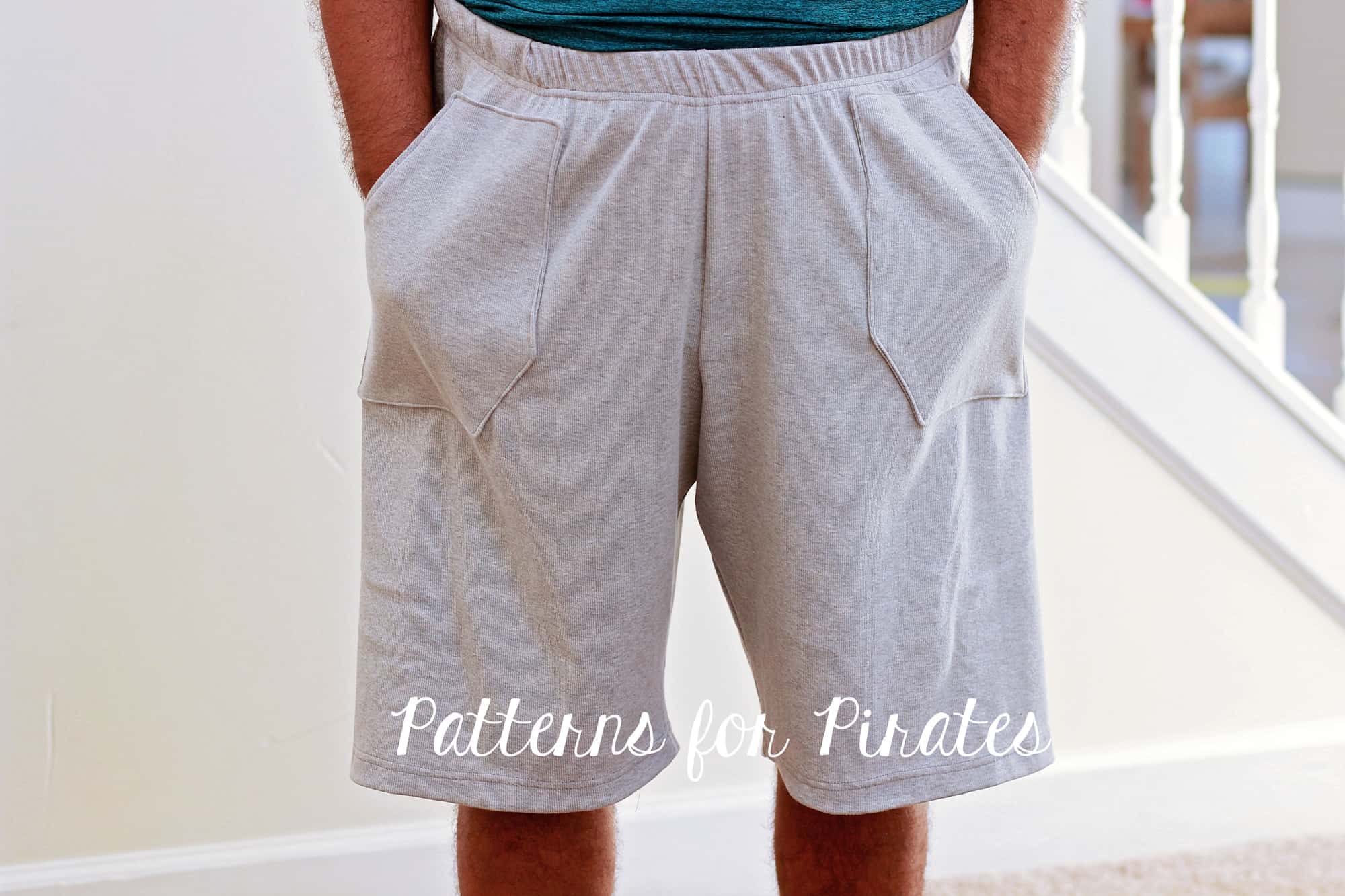
Start by printing the WTP pattern piece in the size needed. Now grab your Papa Bear Joggers (Mama Bear or Baby Bear) pants pattern and print only the page(s) that include the Patch Pocket. You now have two pattern pieces, the pants and the pocket. Cut the leg fabric (two mirrored images) and 4 pocket pieces (2 mirrored images for the main and 2 for the lining). The PJ pants pattern is drafted for woven fabric. I did use knit instead…you can do that too if you want!
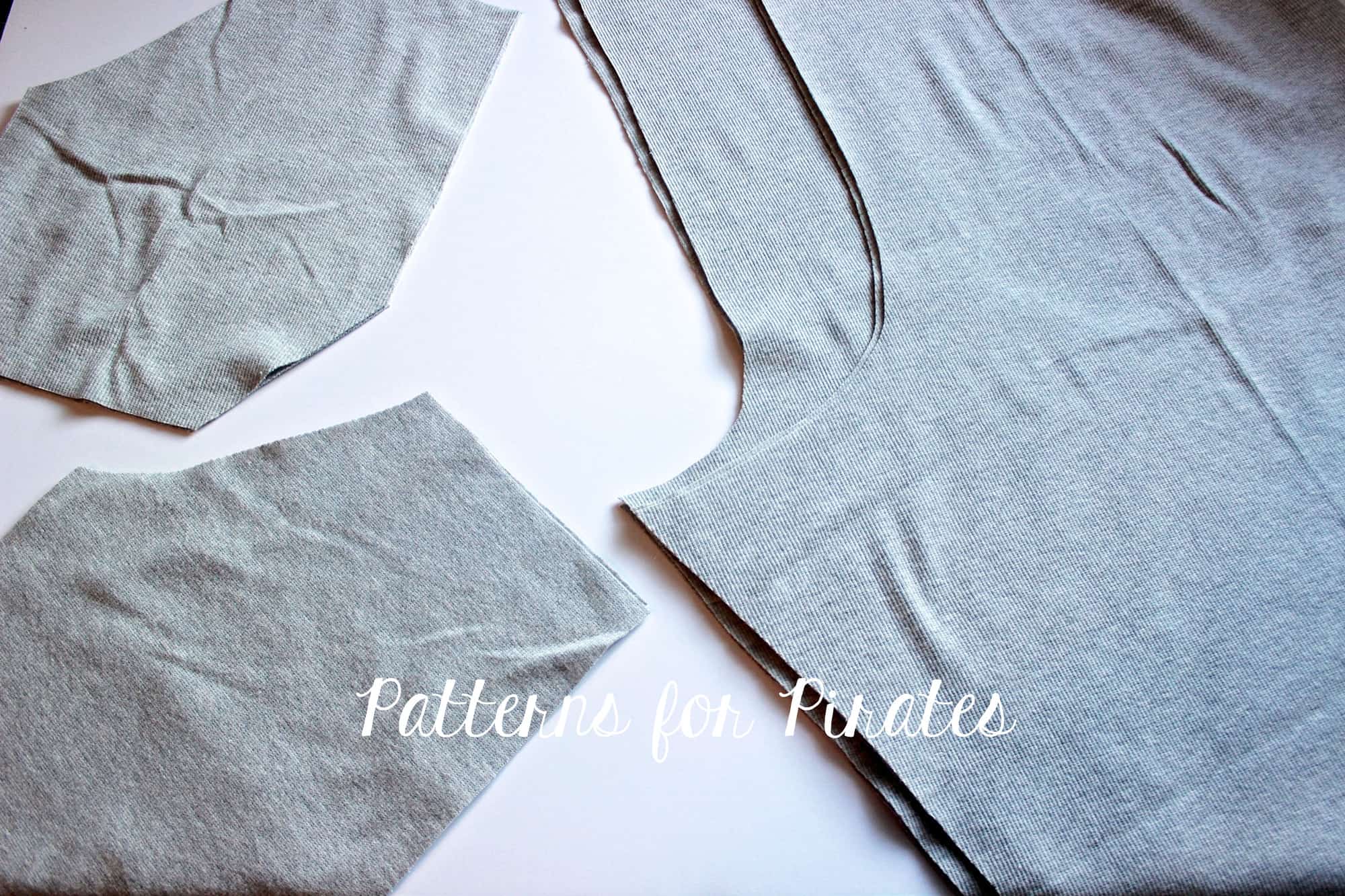
Take your pockets and place them right side together. Sew around the edge with a 1/2″ seam allowance, leaving 2-3″ opening so we can turn the pocket.
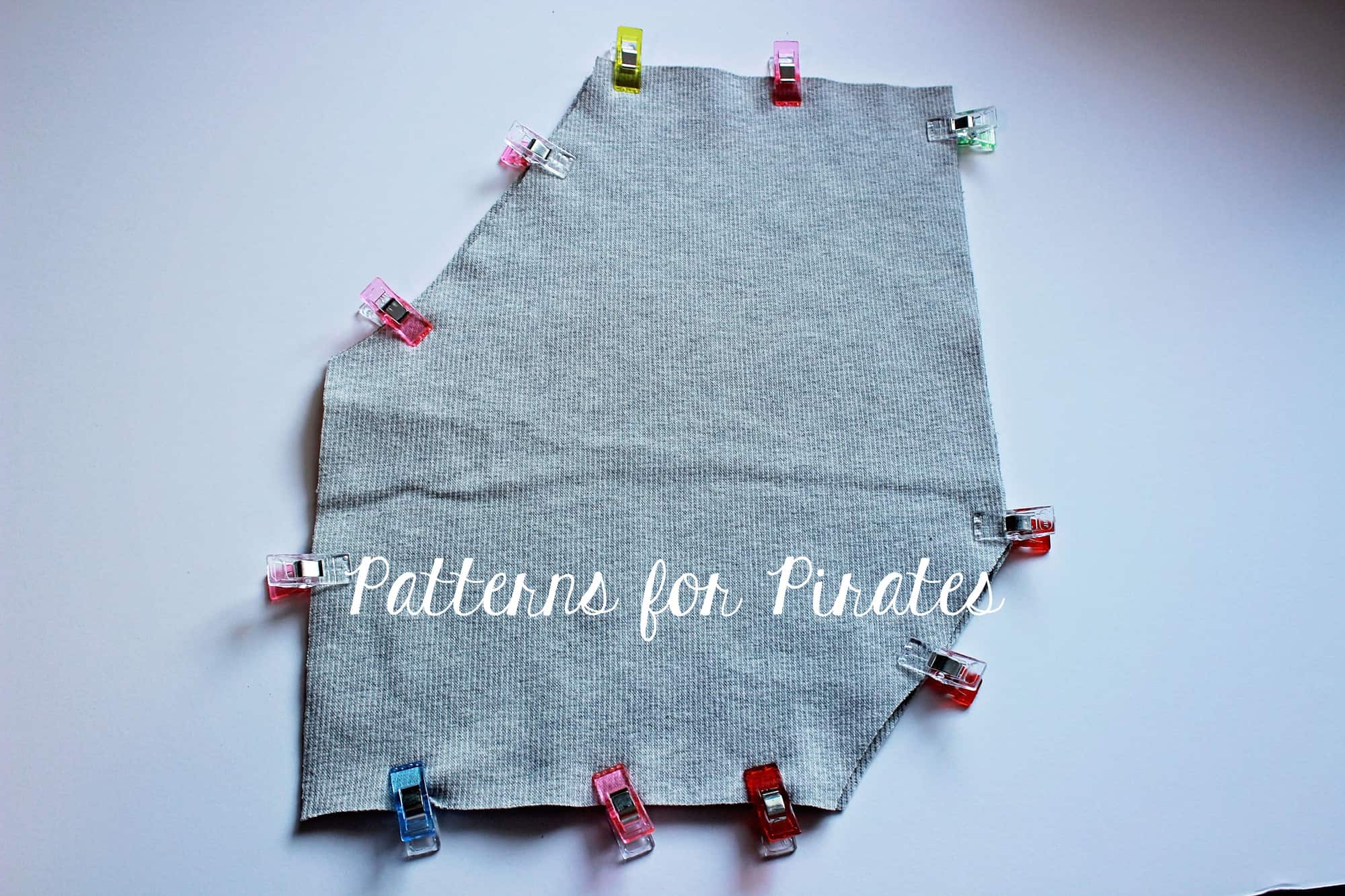
Clip the corners and snip the curve of the pocket as close to the seam as possible (without clipping the stitch). Turn your pocket inside out a press very well. Repeat with the other pocket.
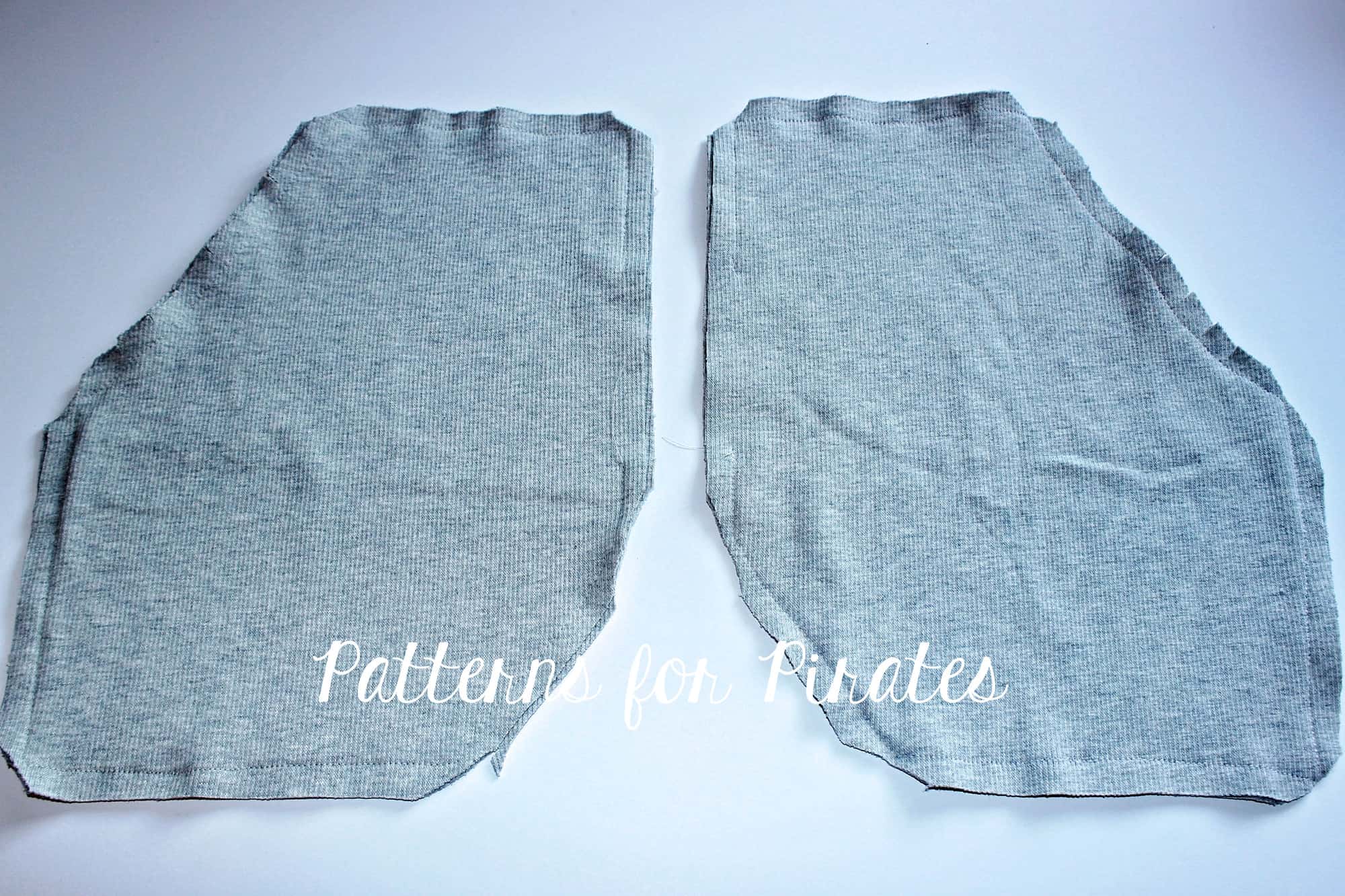
Top stitch only the pocket curve opening.
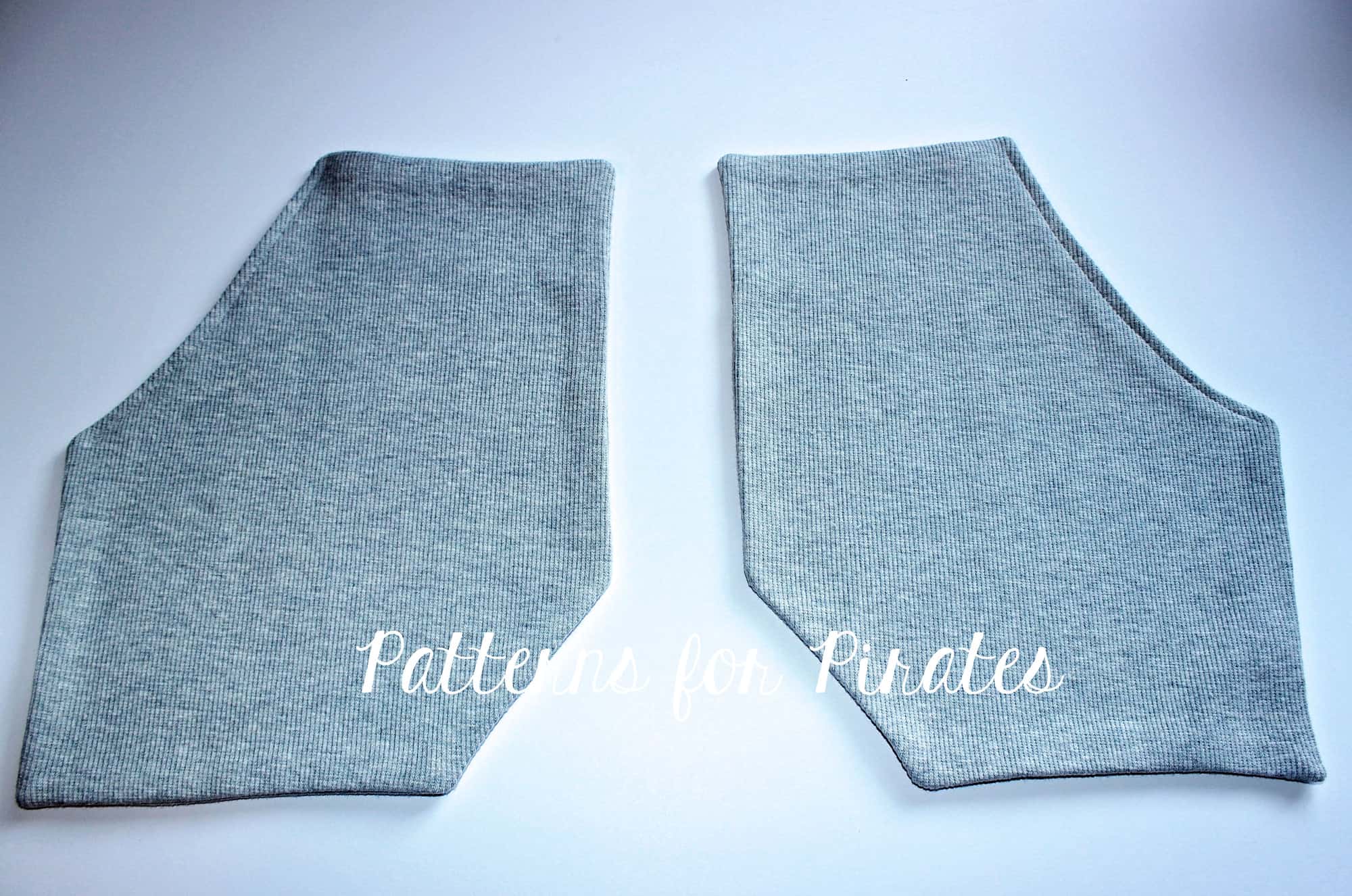
Take the pants pattern piece and place it right side up. Fold the pants so the inseam matches making sure the front is on top. Measure 4″ down from the waist edge and 1 inch away from the side fold. Place the pocket as in the picture below and pin in place.
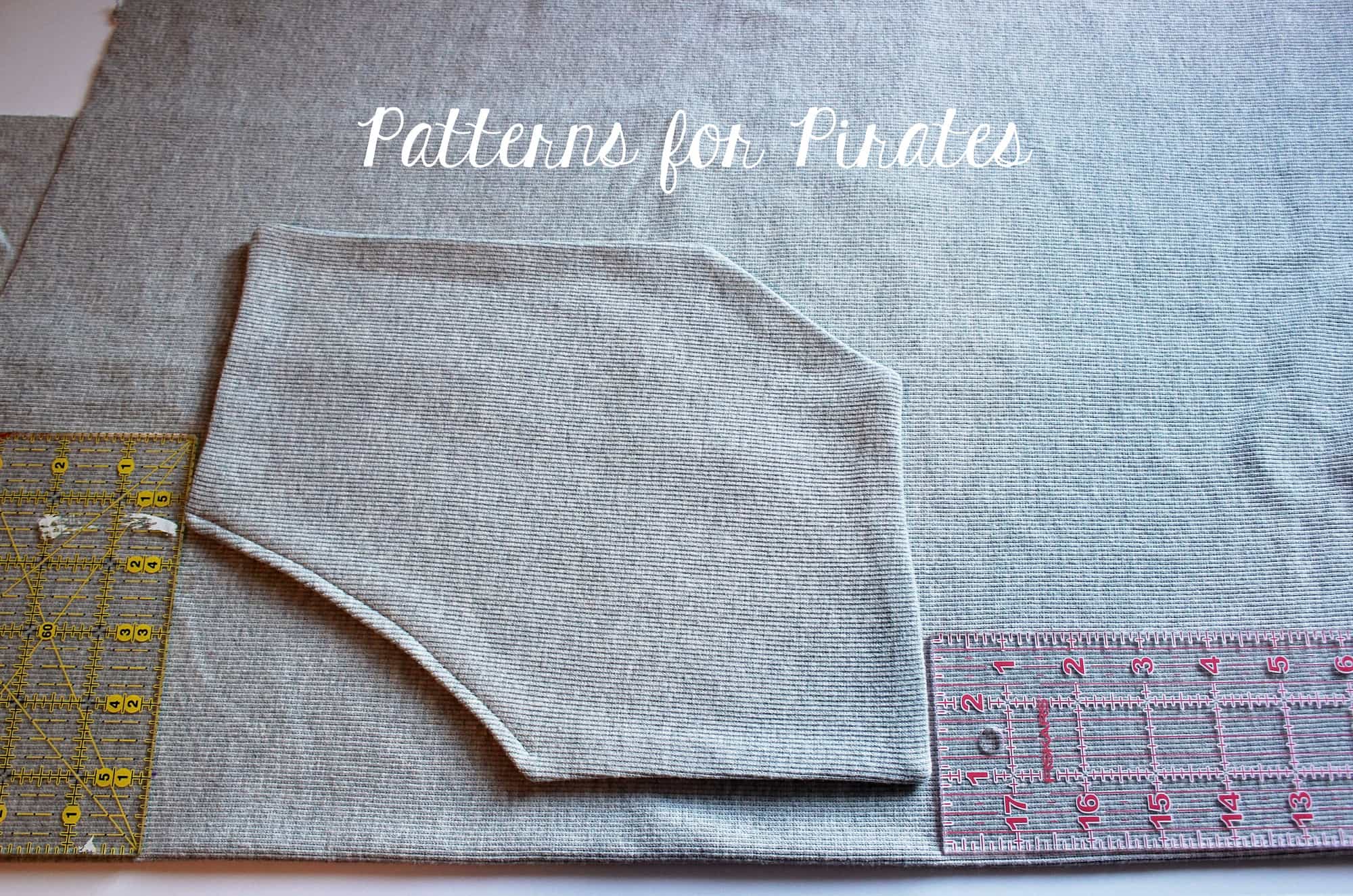
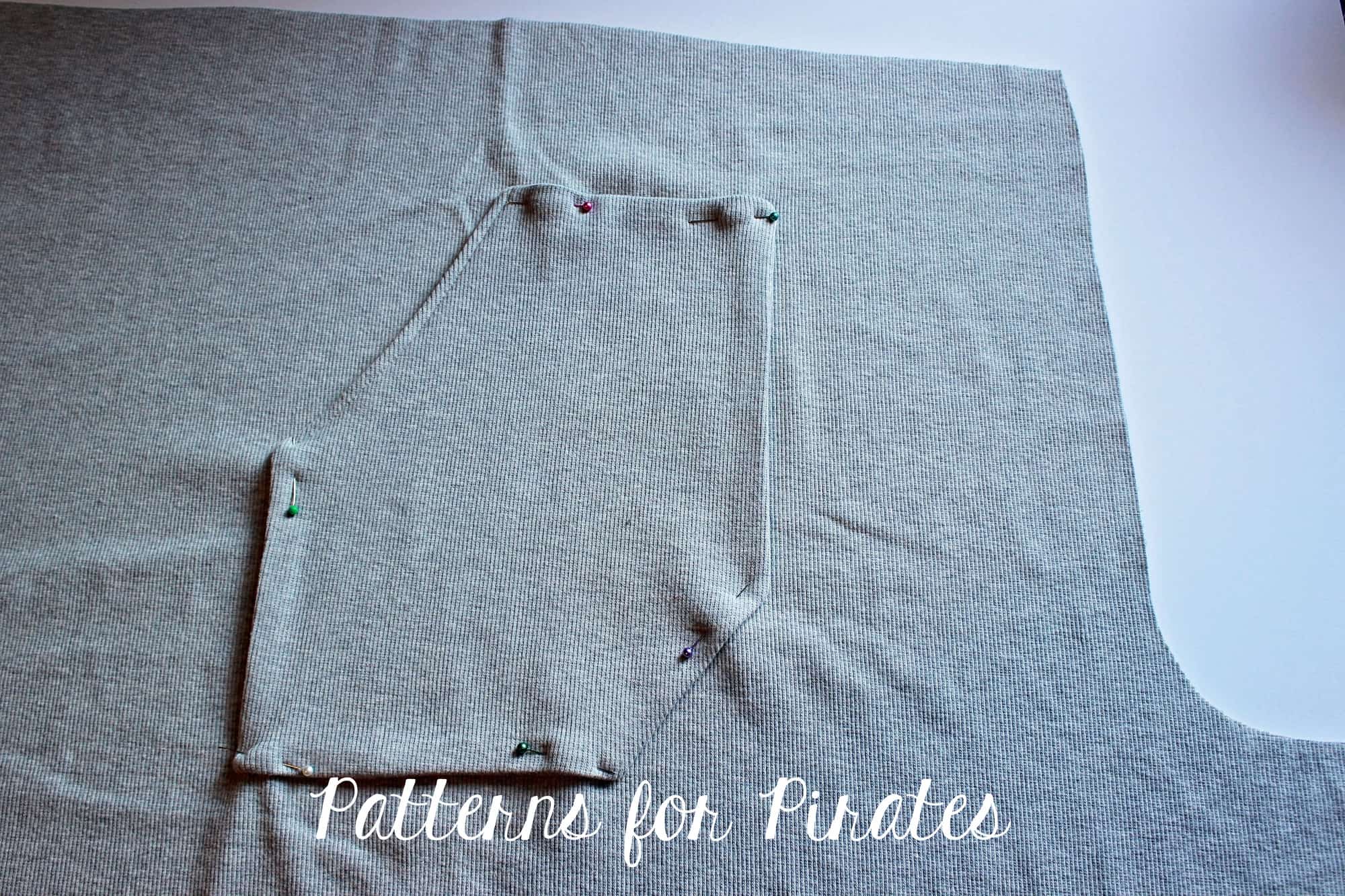
Note: you will need to adjust these measurements if you are making the kids Walk the Plank pj pants.

Sew the pocket to the pants making sure you leave the pocket curve open. You will only be sewing around the 5 straight edges. Repeat for the other leg.
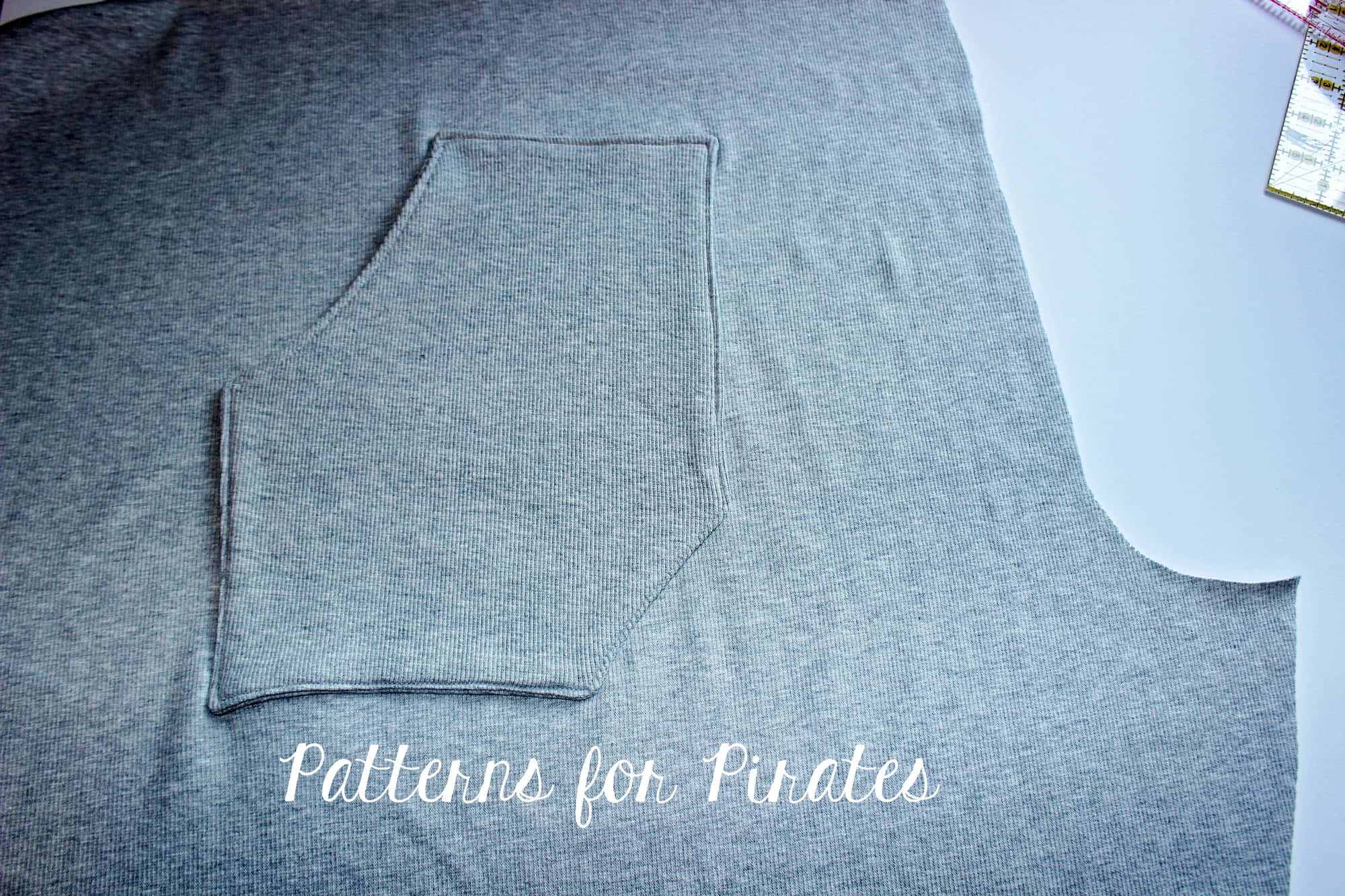
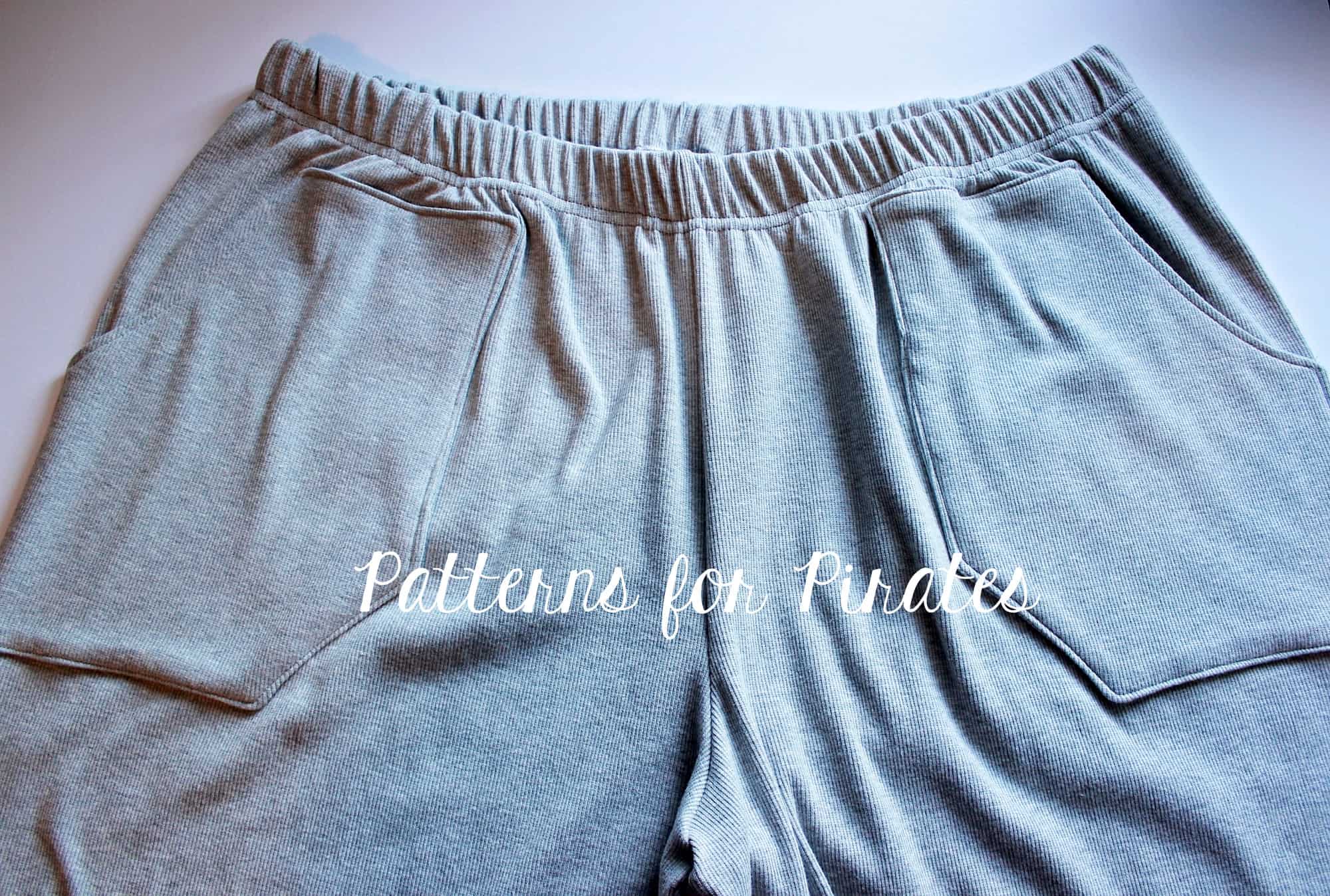
That’s it! You added patch pockets to the pajama pants. Simply continue to construct the pattern as per the tutorial and enjoy a new pair of PJs WITH POCKETS!


. . . . .

Back patch pocket

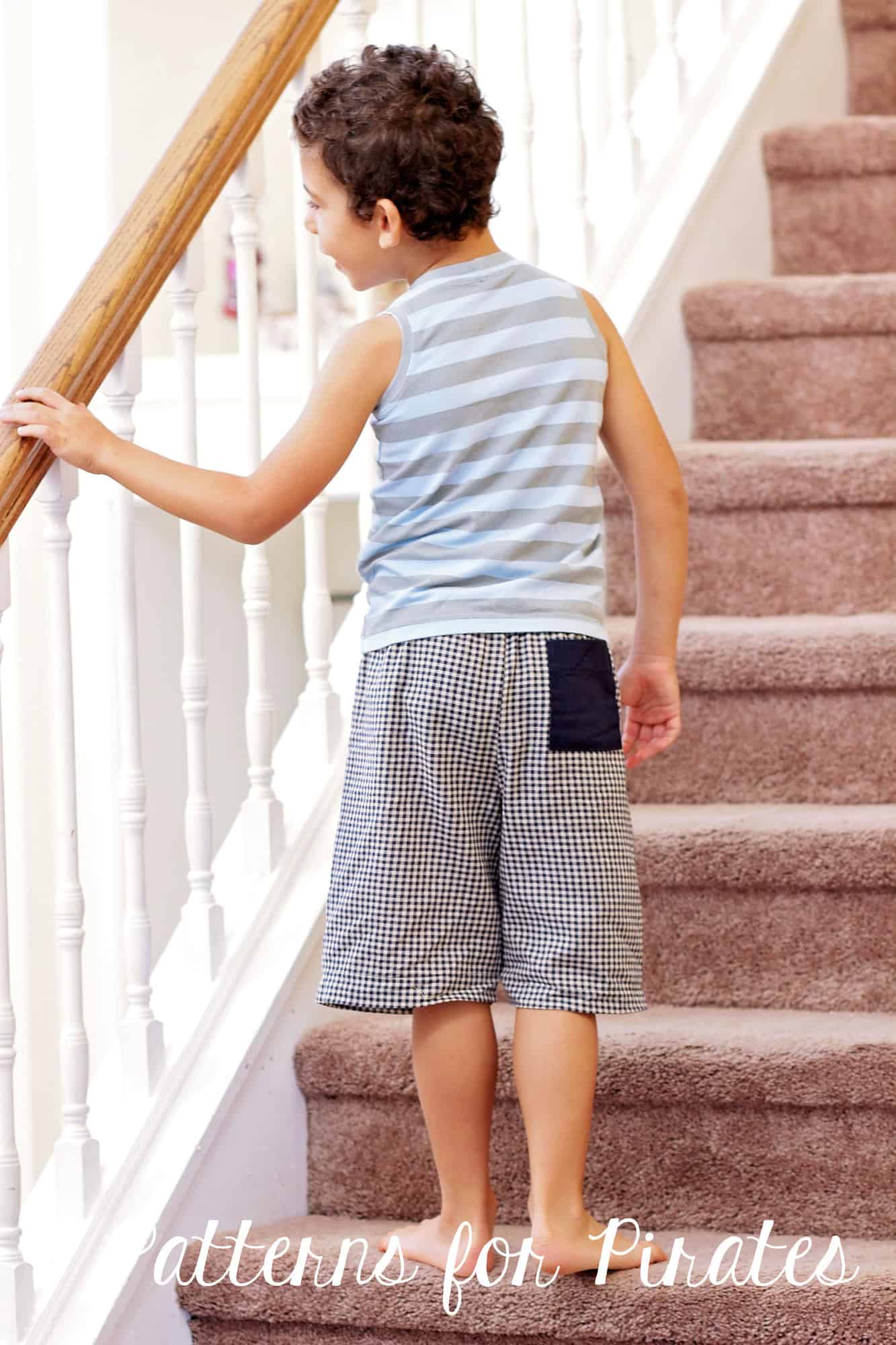
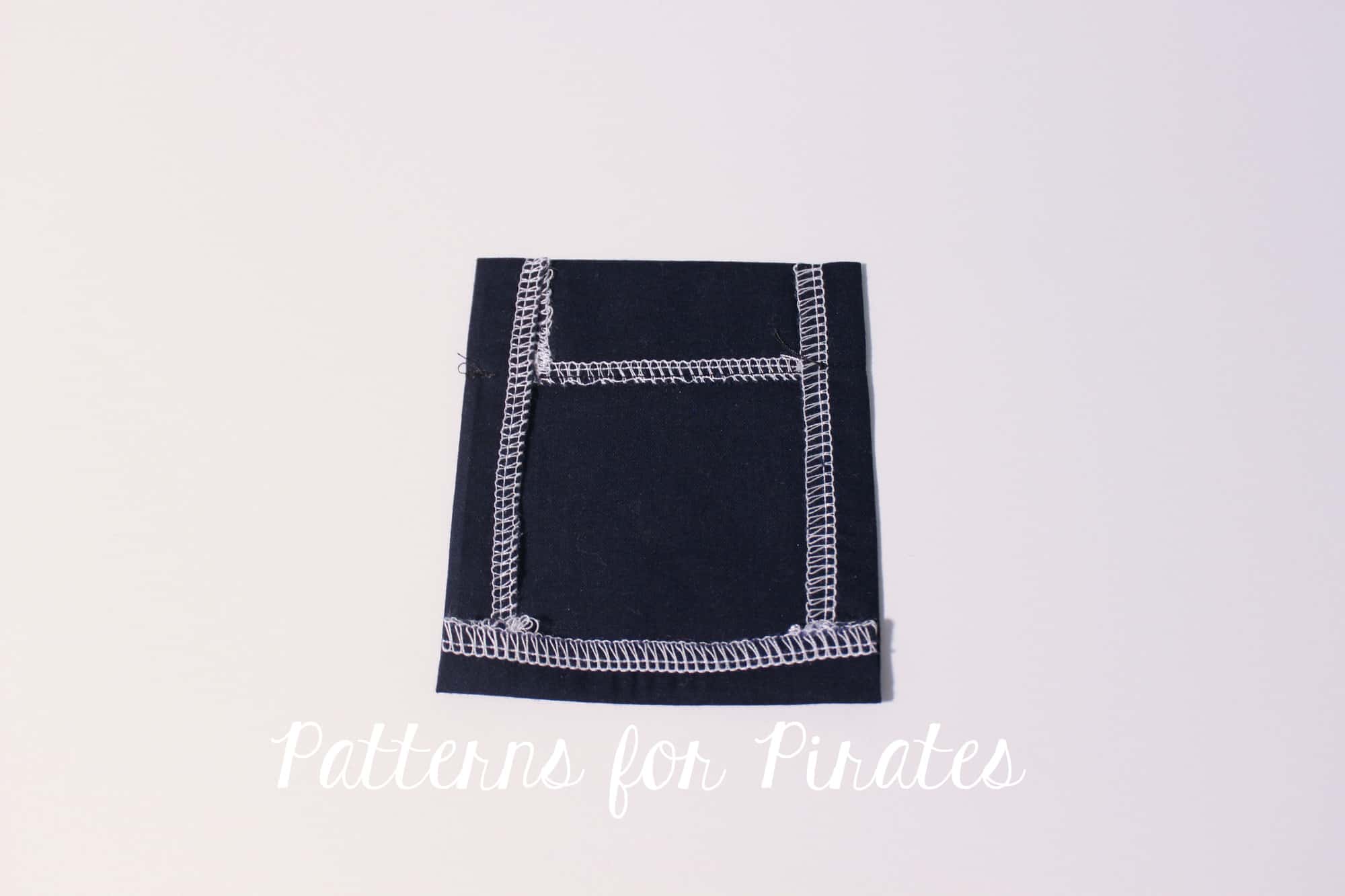
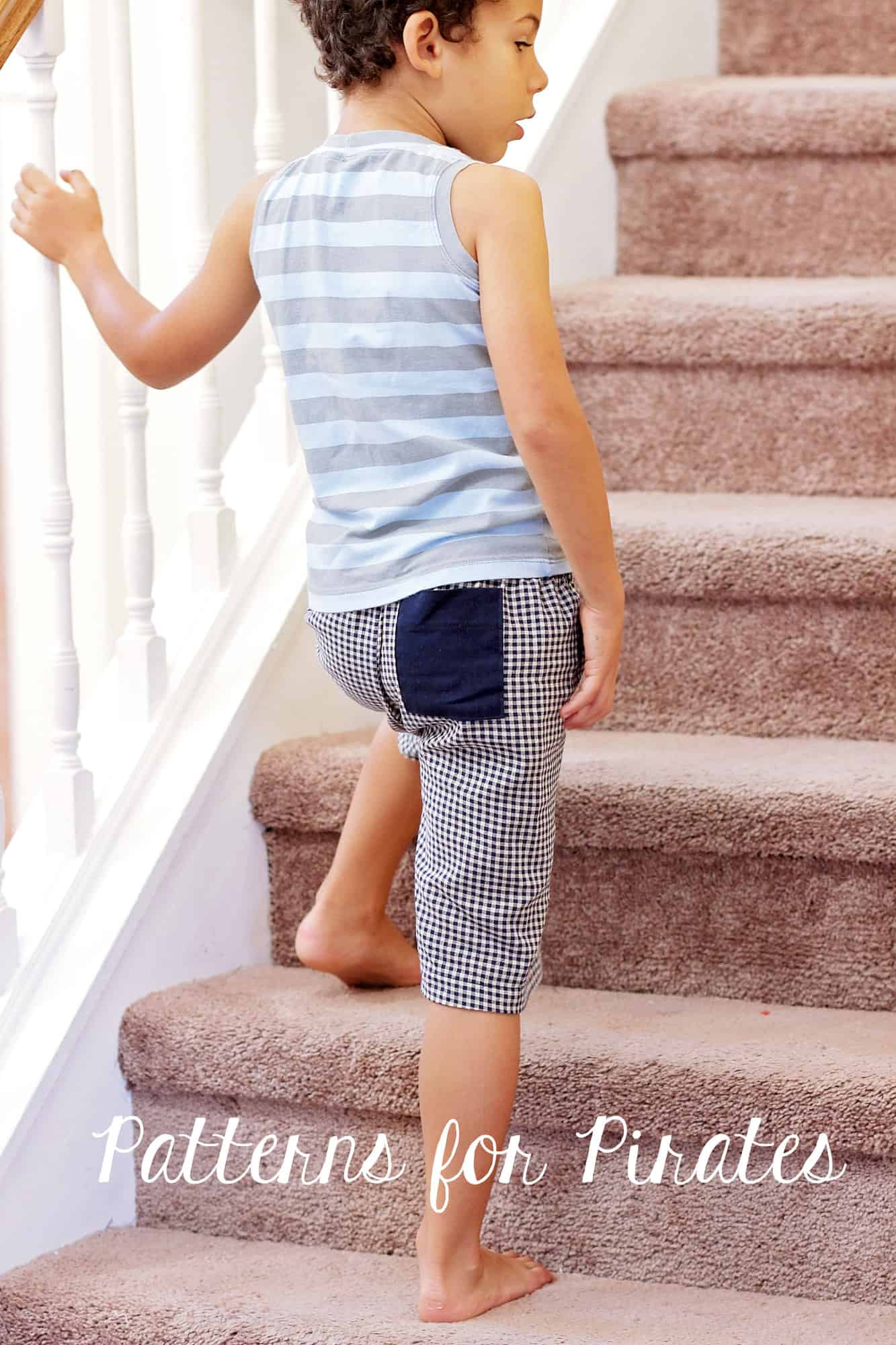
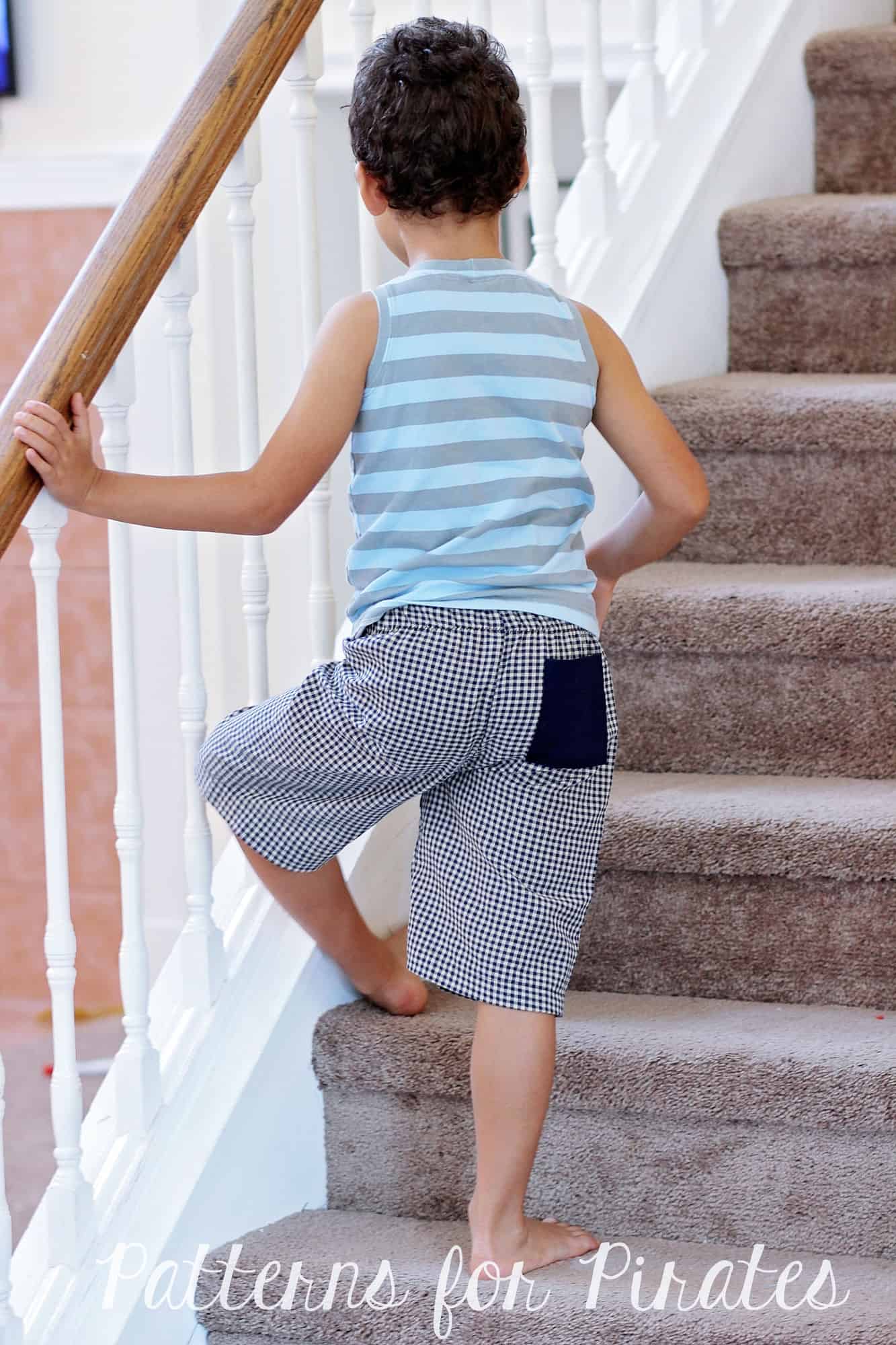
Next I want to show you how to add a back pocket to your Walk the Plank PJ pants. This hack is even easier and it does not require any additional P4P patterns. Simply cut one rectangular piece of the same fabric or a coordinating one. The size of the rectangle will vary depending on how big you would like the pocket. I cut my piece 5″ wide by 6″ tall and I am making a size 6 PJ pants.
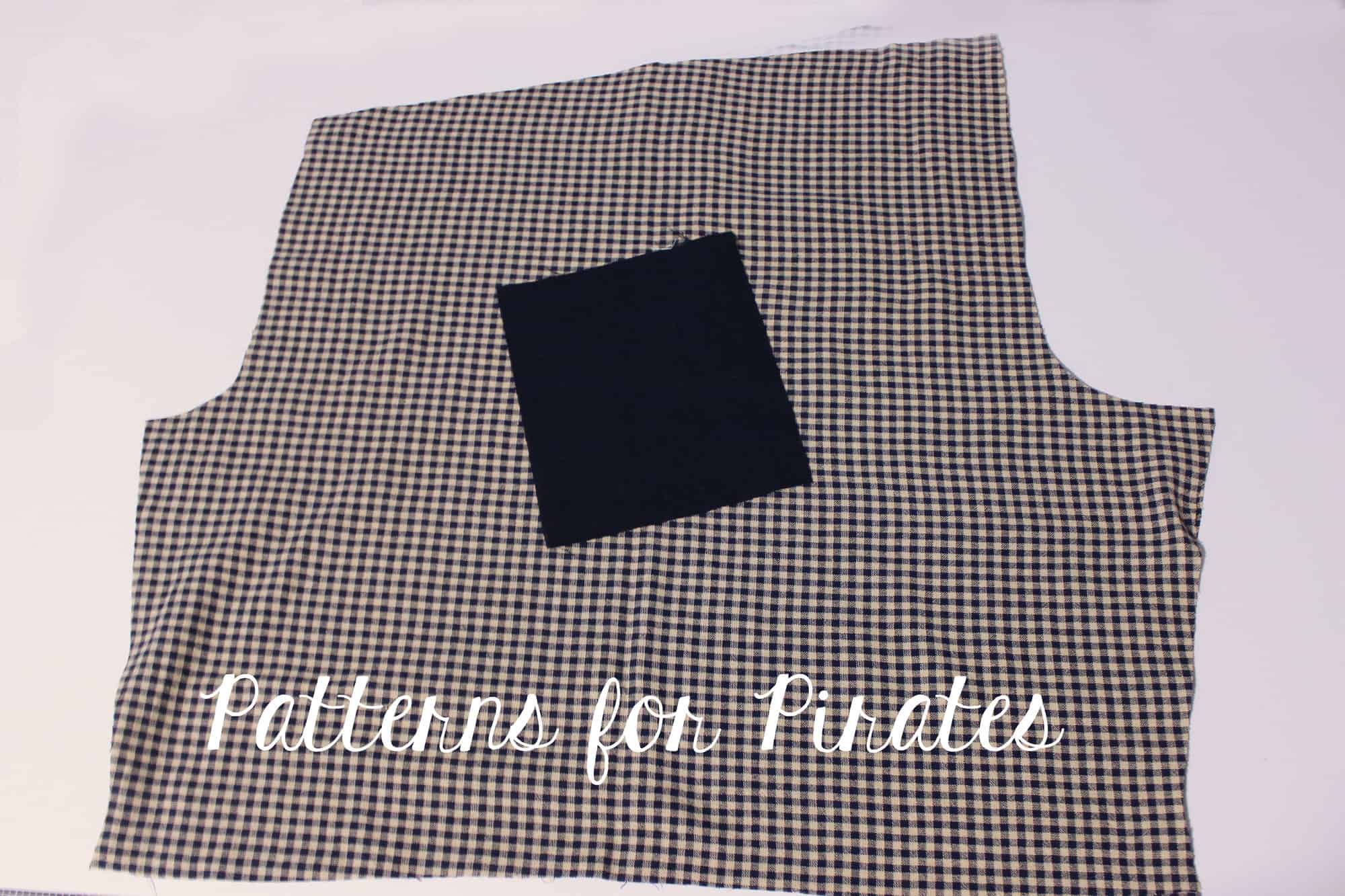
Optionally, you can serge around the edges to prevent fraying in the wash.
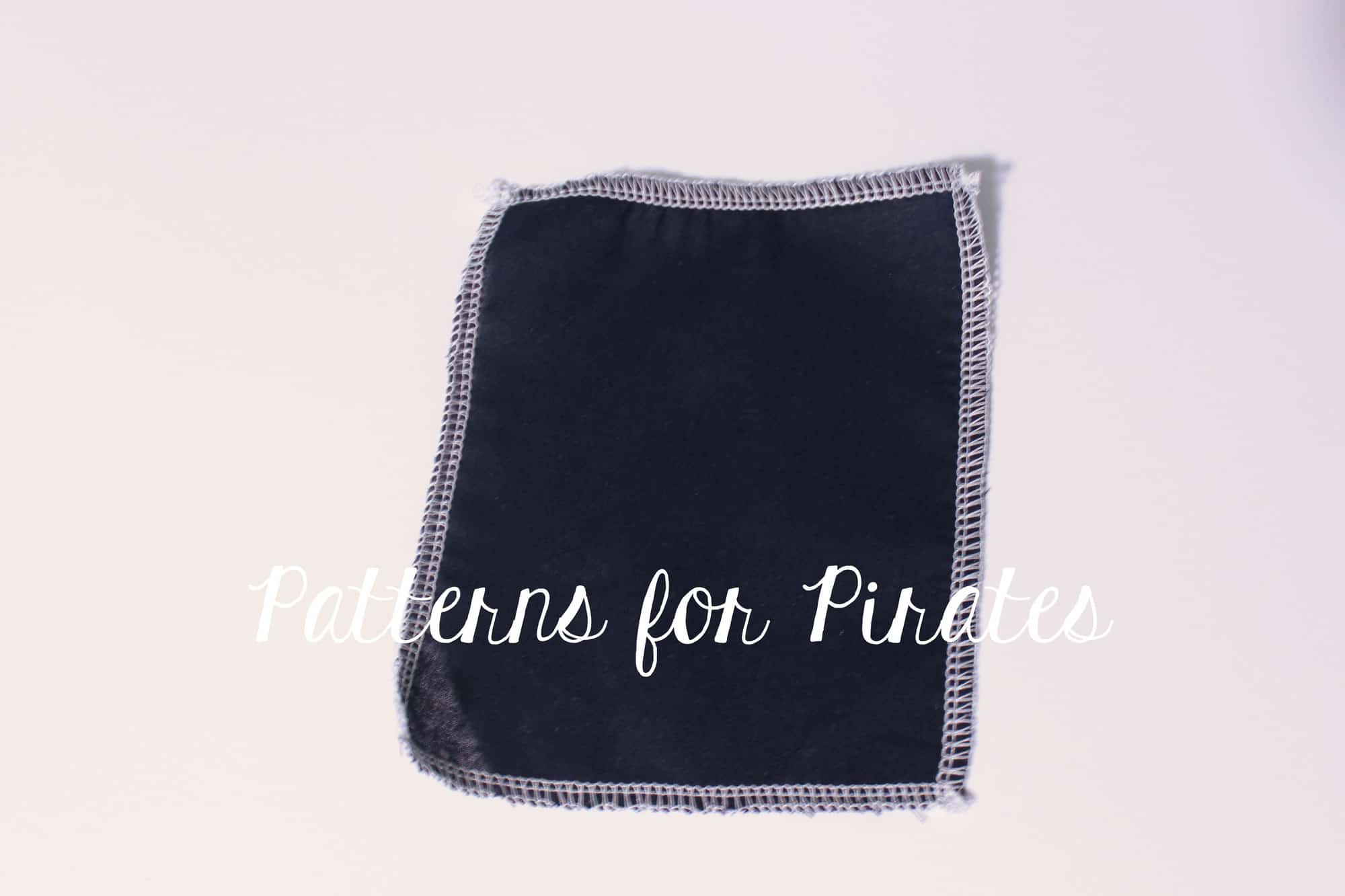
Fold the top of the pocket 1″ down, press and sew in place.
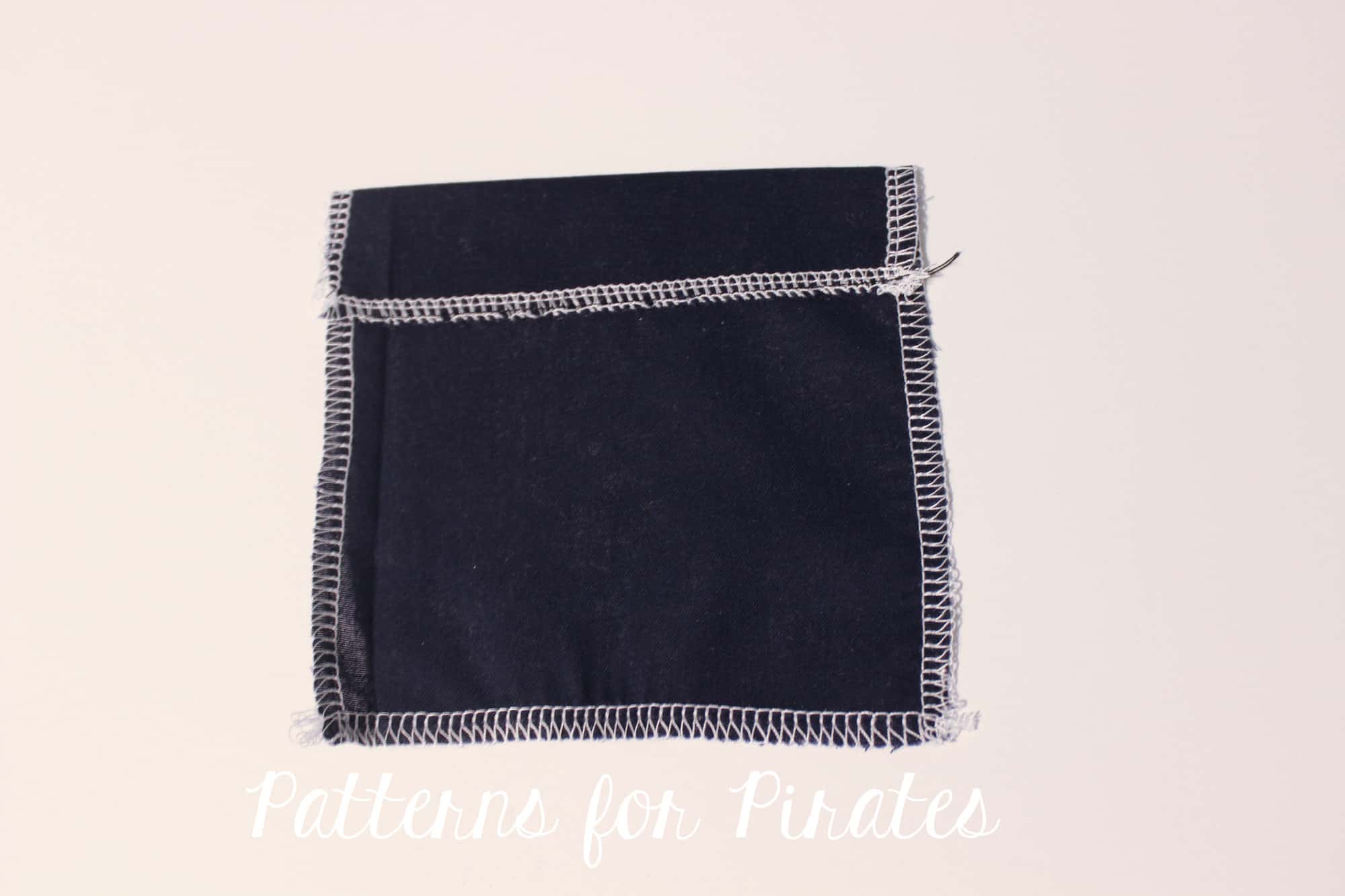
Now fold the other three sides 1/2″ and give it a good press. Do not sew them just yet.
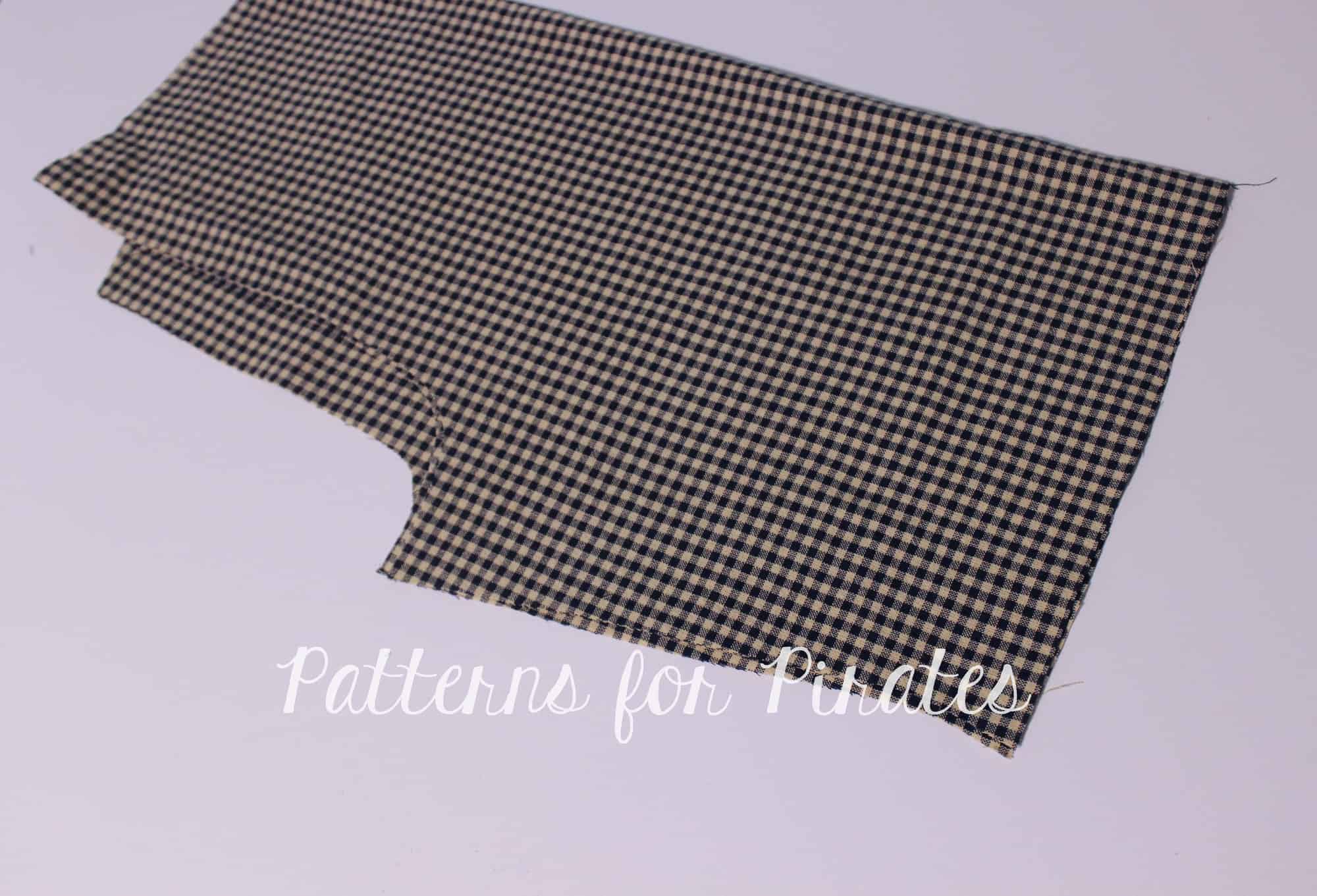
Take your pants pattern piece and with the right side out, match the inseam. Place it on the table with the back facing up. The back part of the pants is the one with the higher rise.
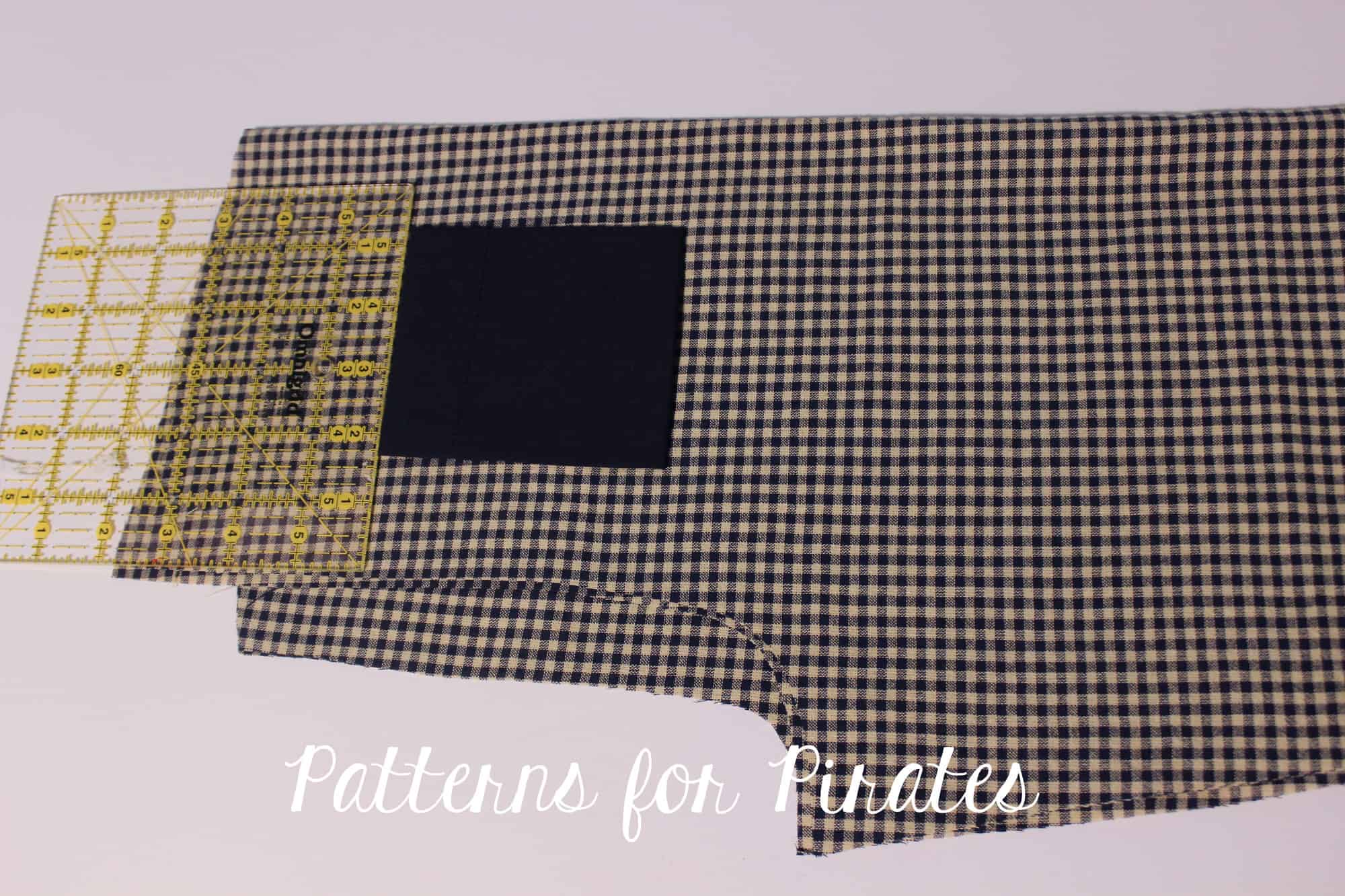
Place the pocket approximately 3″ down from the rise. Note that this placement will vary from size to size so I encourage you to baste in place insead of sewing in place if you are not sure if you’ll like where the pocket sits.
Edge sew the pocket to the pants (or baste) making sure you do not sew the top but only the bottom and the sides of the pocket.
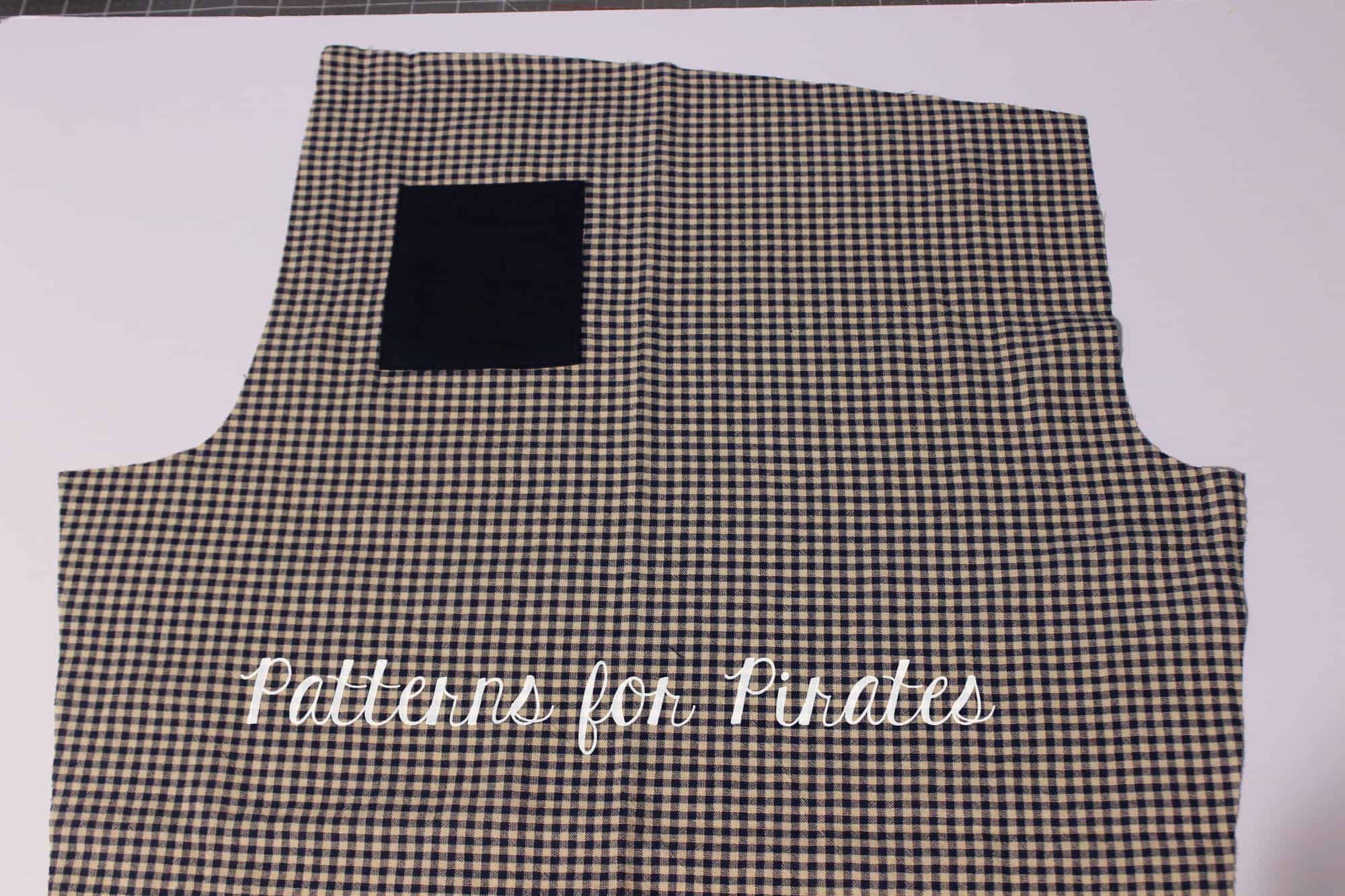
Continue sewing the PJ pants as per the pattern tutorial and enjoy you new pair of back pocket Walk the Plank pants. 🙂

NOTE: If you basted the pocket, try the pants on! If you like where the pocket sits, stitch it in place. IF you don’t, you can easily remove the pasting stitches and relocate the pocket before you sew it in place.
. . . . .

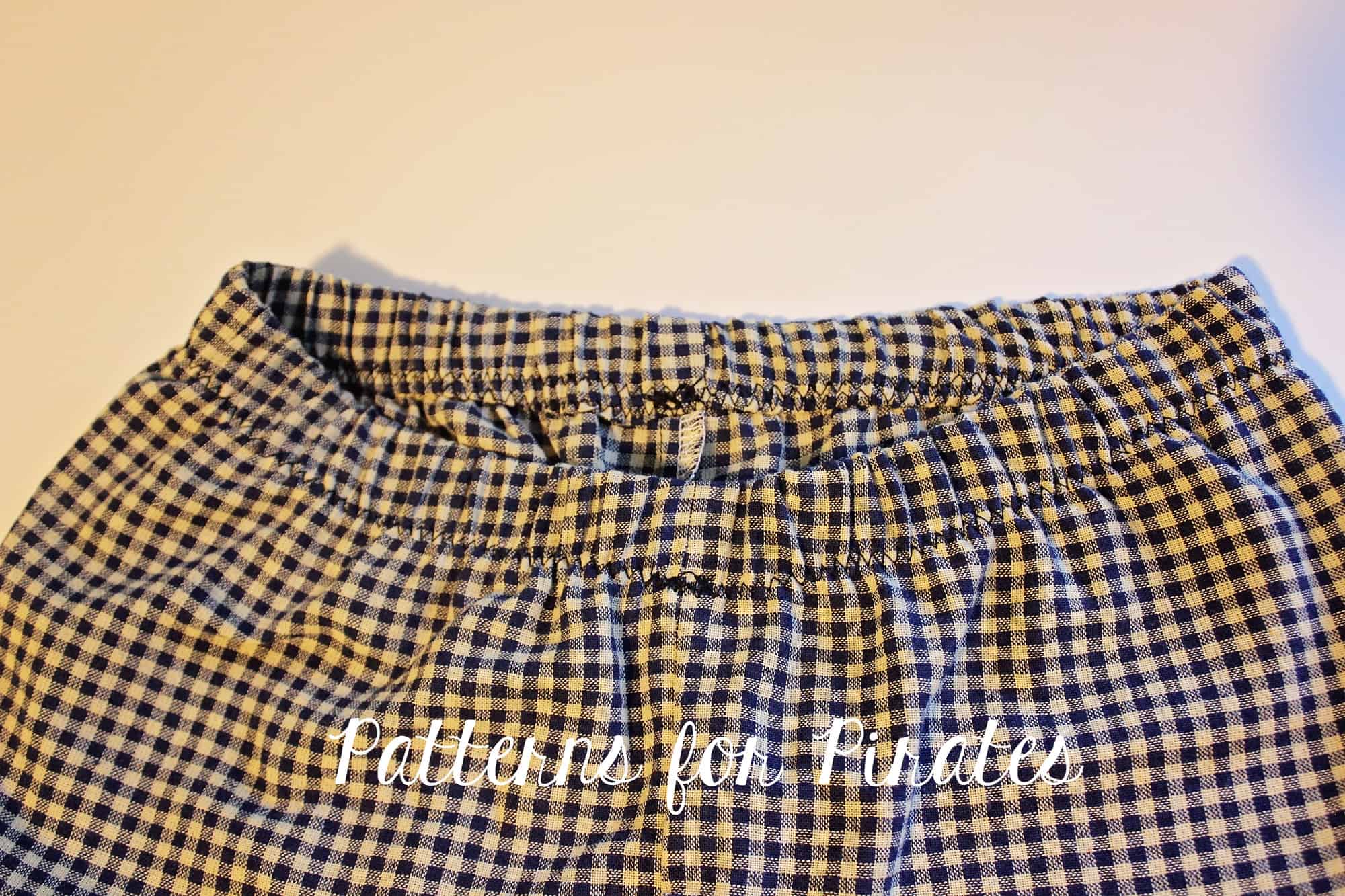
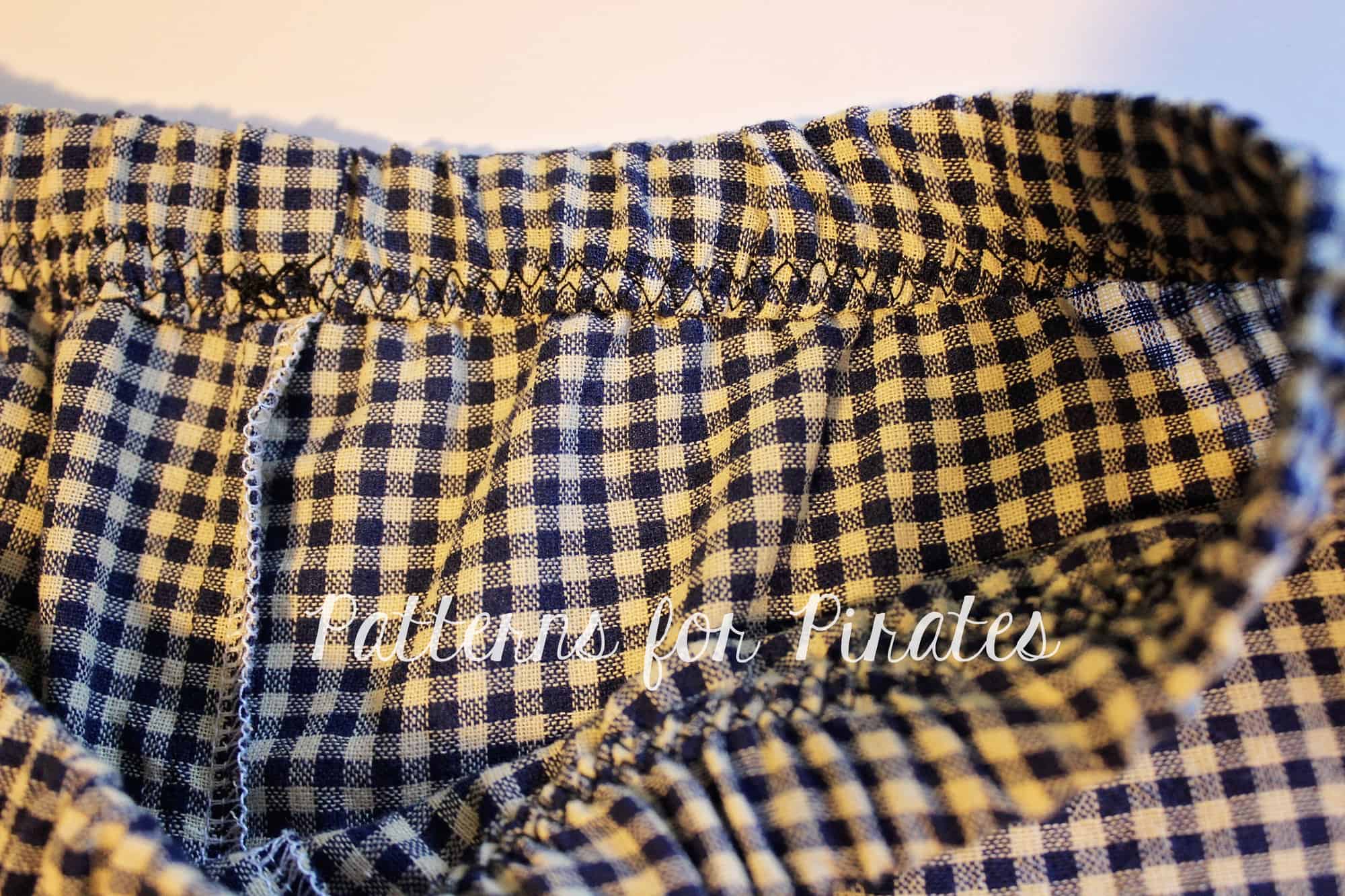
Enclosed elastic waistband

Next up I would like to show you how to enclose the elastic in the waist so you do not have any visible serged edges. Sew your PJ pants as indicated in the tutorial. Press the top of the pants 1/4″ down in order to create a memory hem.

NOTE: this method will yield a rise that will be 1/4″ lower than the original pattern.
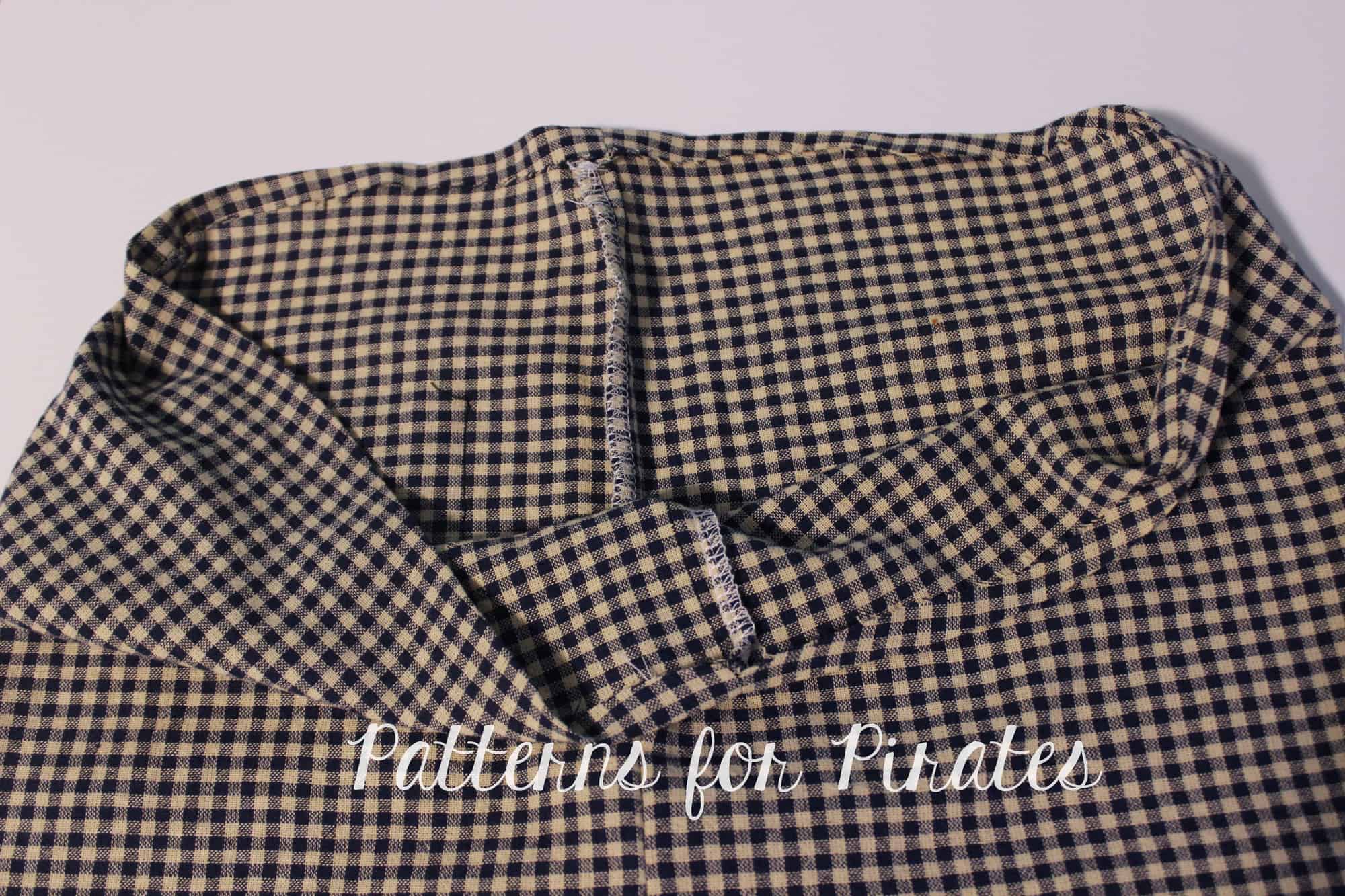
Sew the elastic in a loop (as per the pattern) and mark the quarters with pins or clips. Find the quarters of the waist opening and match the elastic quarter points to them, placing the top of the elastic 1/4″ of an inch down from the top of the pants. Use the memory crease mark as a guide.
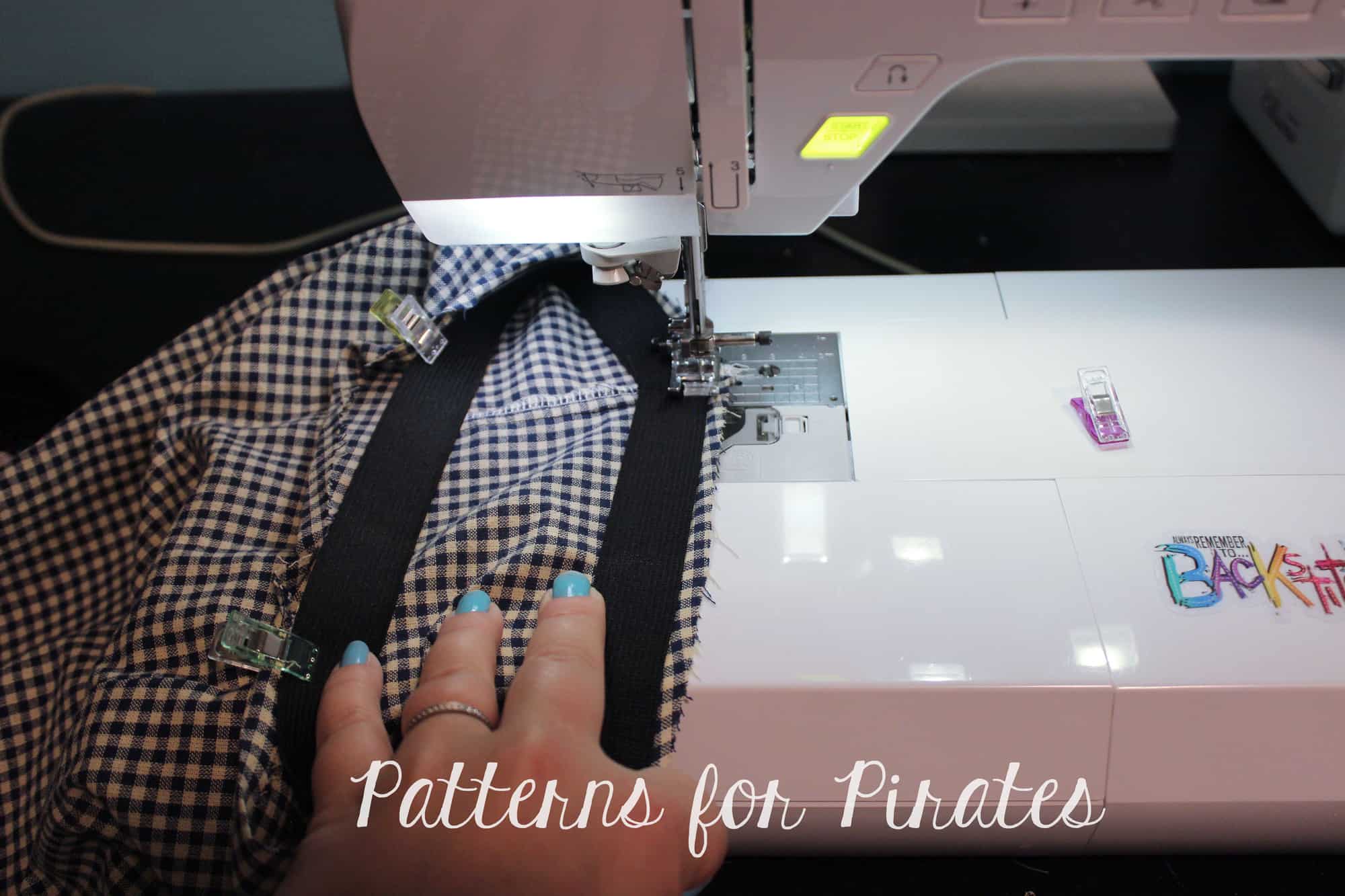
Sew the elastic with a a zig zag stitch.
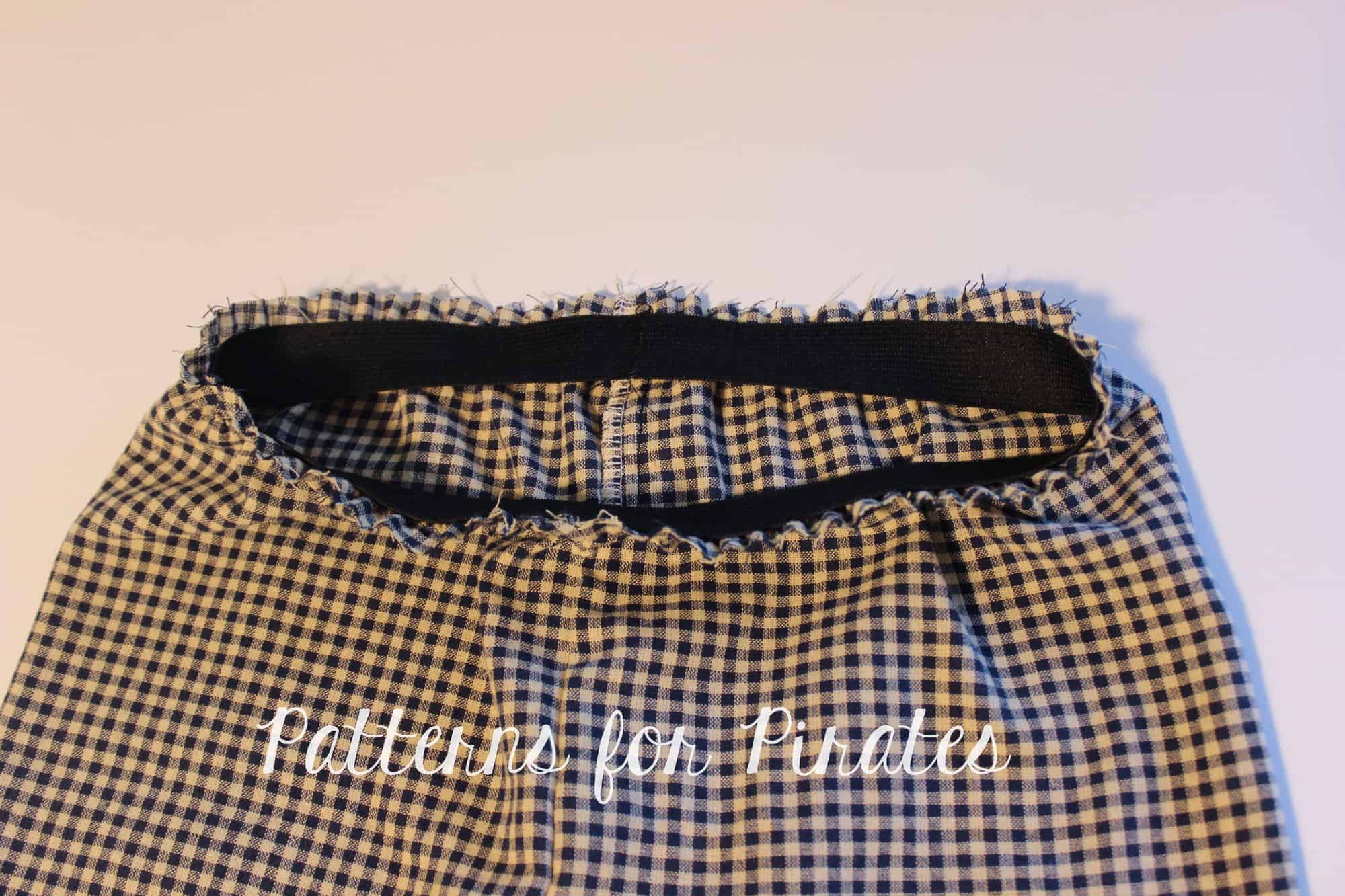
Fold the top top of pants down. This may be a tricky process since you will have to stretch the elastic as you go. Take it slowly and press!
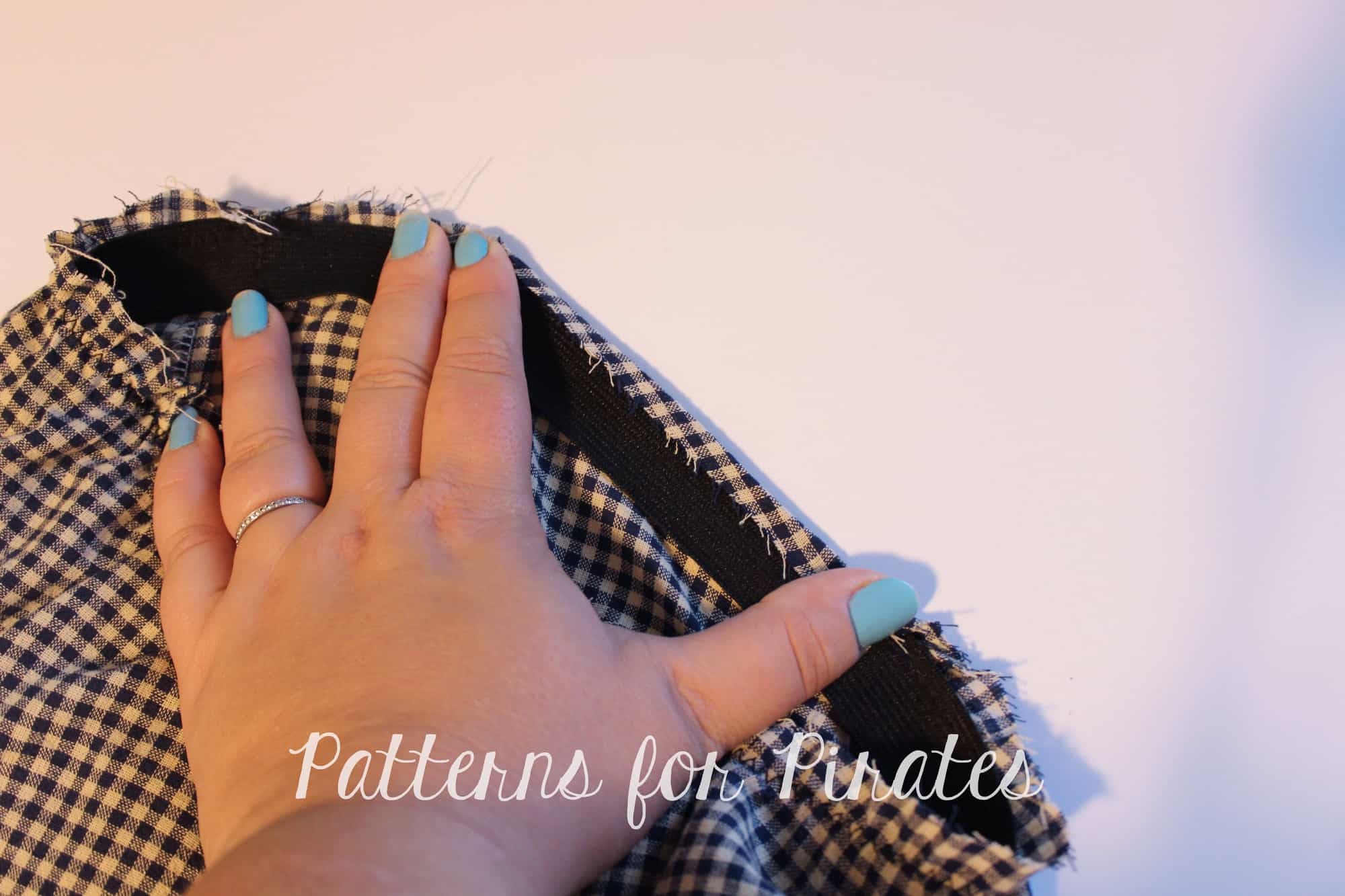
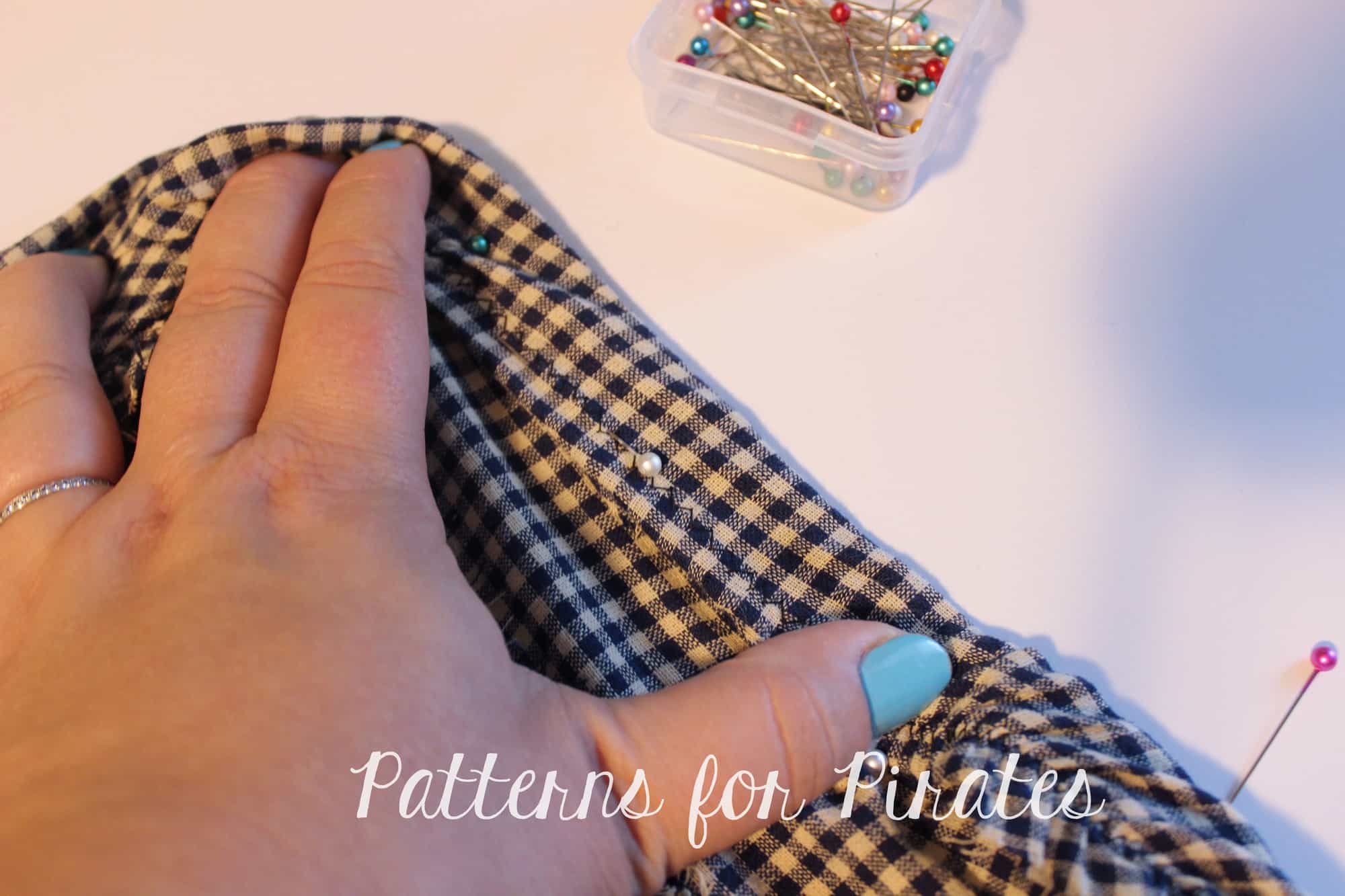
Fold the elastic down and pin in place. You will again need to stretch the elastic so you might find it easier to skip pinning and just use your hand to hold it in place when you sew.
Sew as close to the edge as you can, stretching the elastic  to make sure the fabric lays flat when you stitch it.
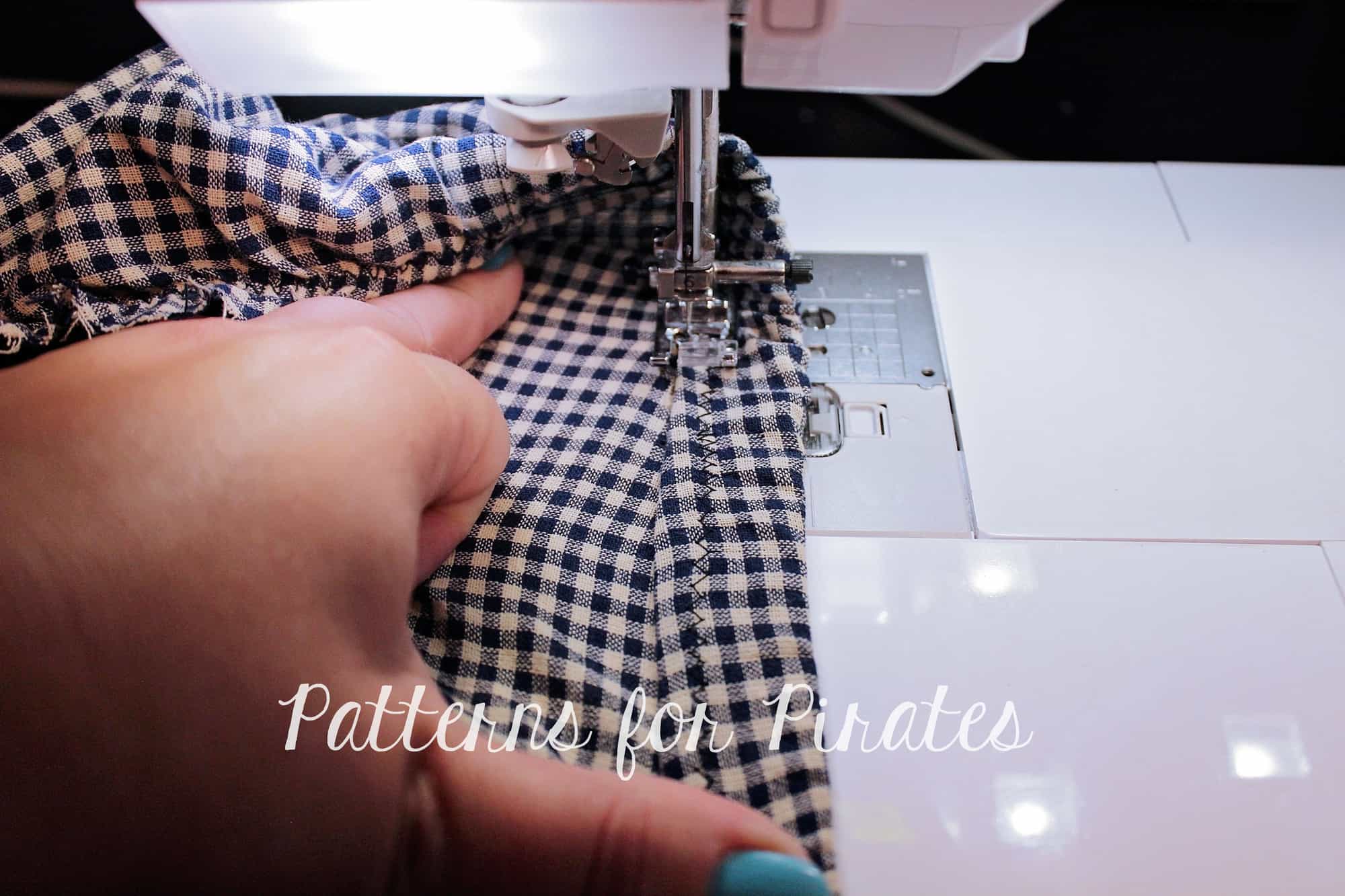
There you have it…. an enclosed elastic for your new PJ pants!
Hope you found these easy hacks helpful. Don’t forget to show your creations in the P4P group! We love to see what you make for you and your loved one.
Filed Under: Free Pattern, Pattern Hacks, Pattern Release, Uncategorized 12 Comments

Goodbye Summer, Hello Fall

September 27, 2017

With the first day of fall come and gone it’s time for us to say goodbye to summer, and the Summer of Wovens here at P4P.  It has brought us many blogs, patterns, updates all for you woven lovers.

It brought you a few new woven releases:

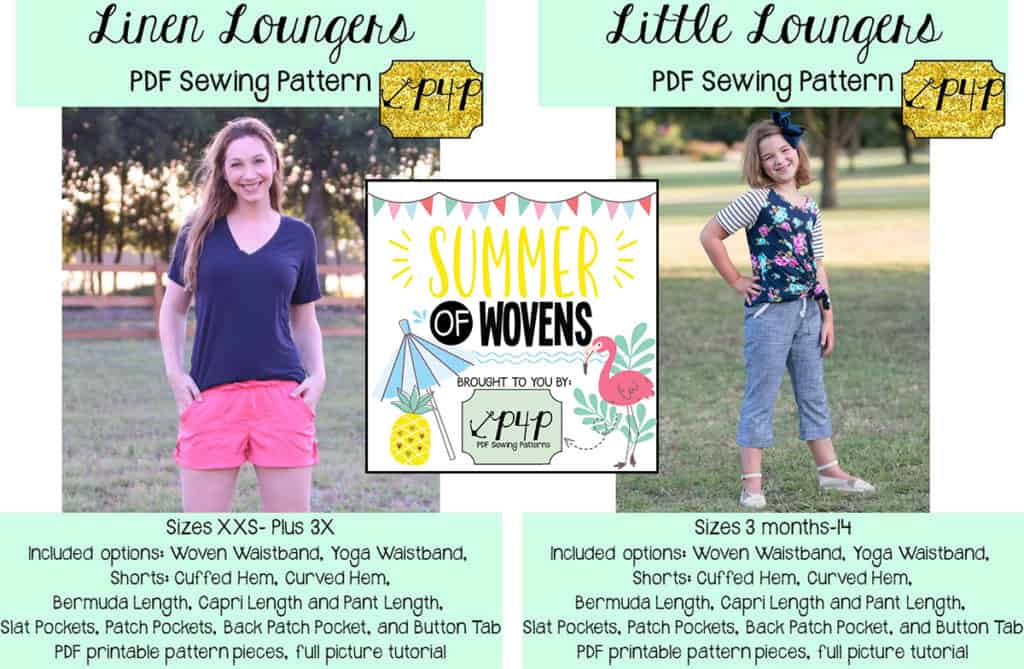
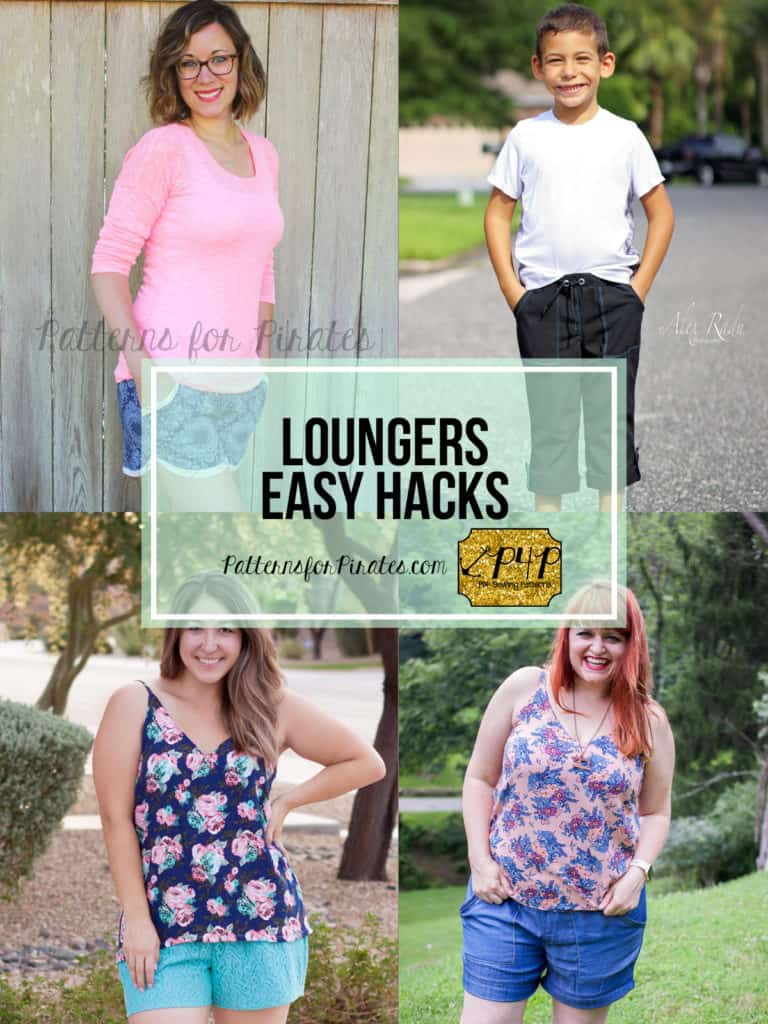
Linen Loungers | Little Loungers | Loungers Bundle

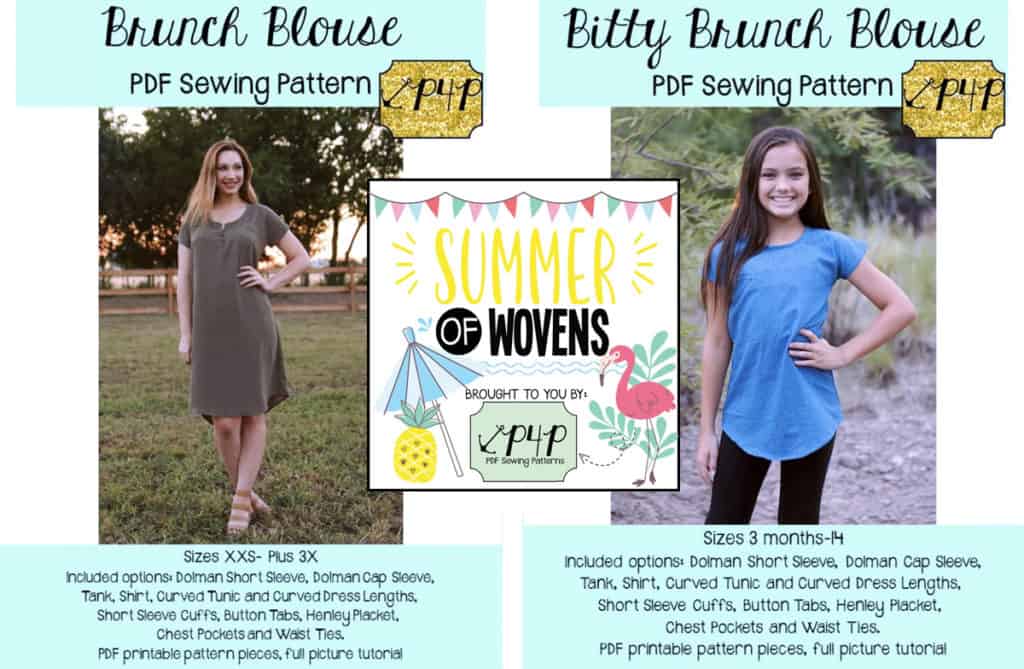
Brunch Blouse | Bitty Brunch Blouse | Brunch Blouse Bundle

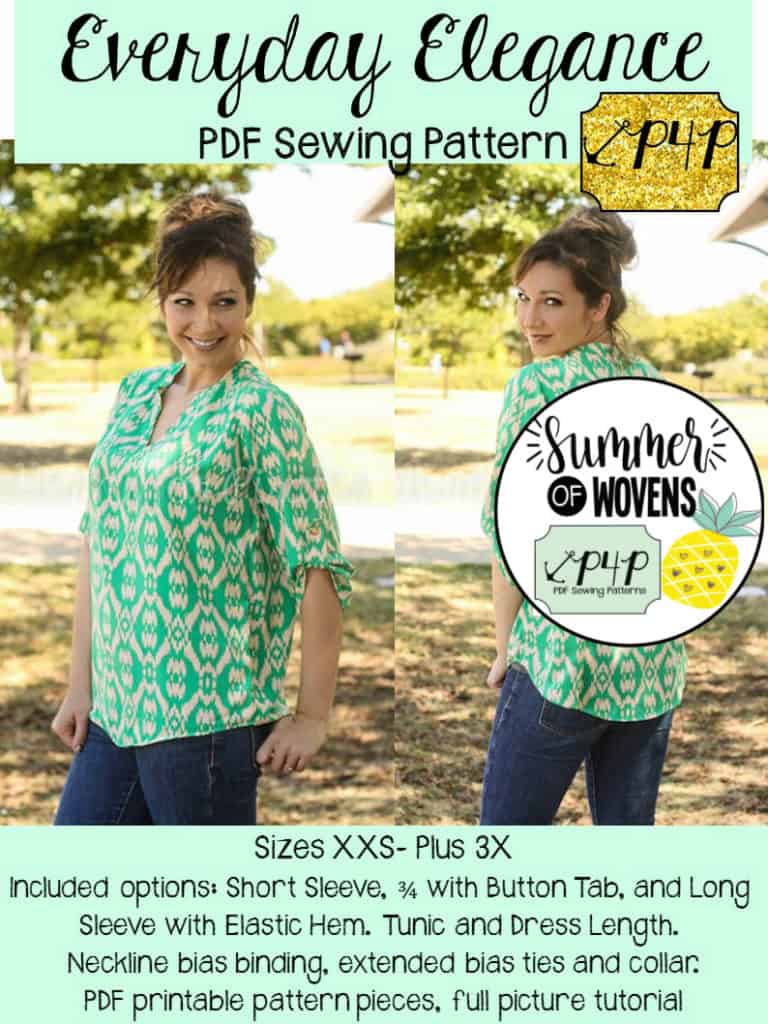
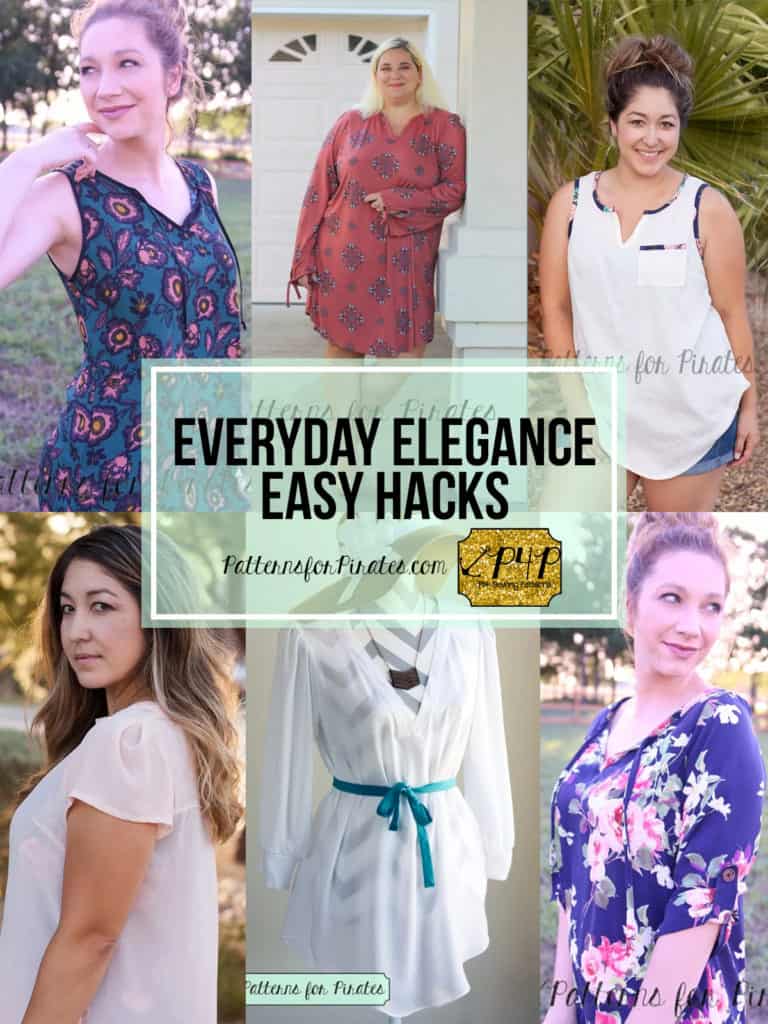
We took the time to update a few woven patterns that were already in our collection.  The Everyday Elegance and Sweet Bow dress had their size ranges updated, the layer features added, and also included the A0 copy shop print size as part of the PDF pattern package.


Everyday Elegance | Sweet Bow Dress

We also geared our blog tips, tricks and posts all about sewing with woven fabrics! If you missed them here are the blogs we did through the summer of wovens (click on picture to go read that blog!):


But we’re ending with MORE!

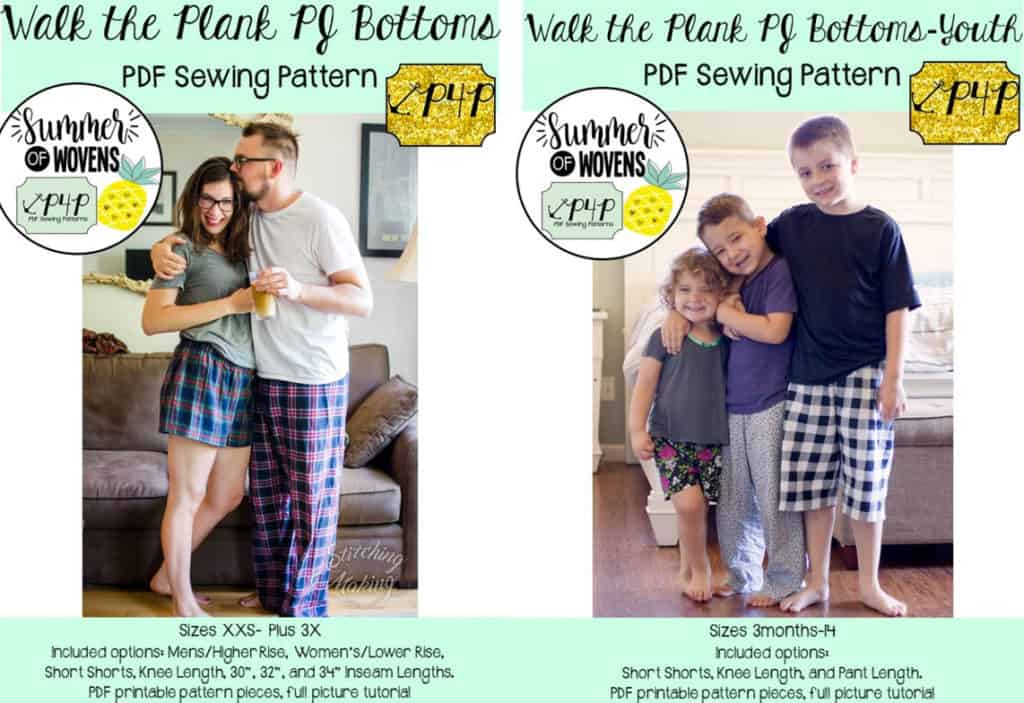
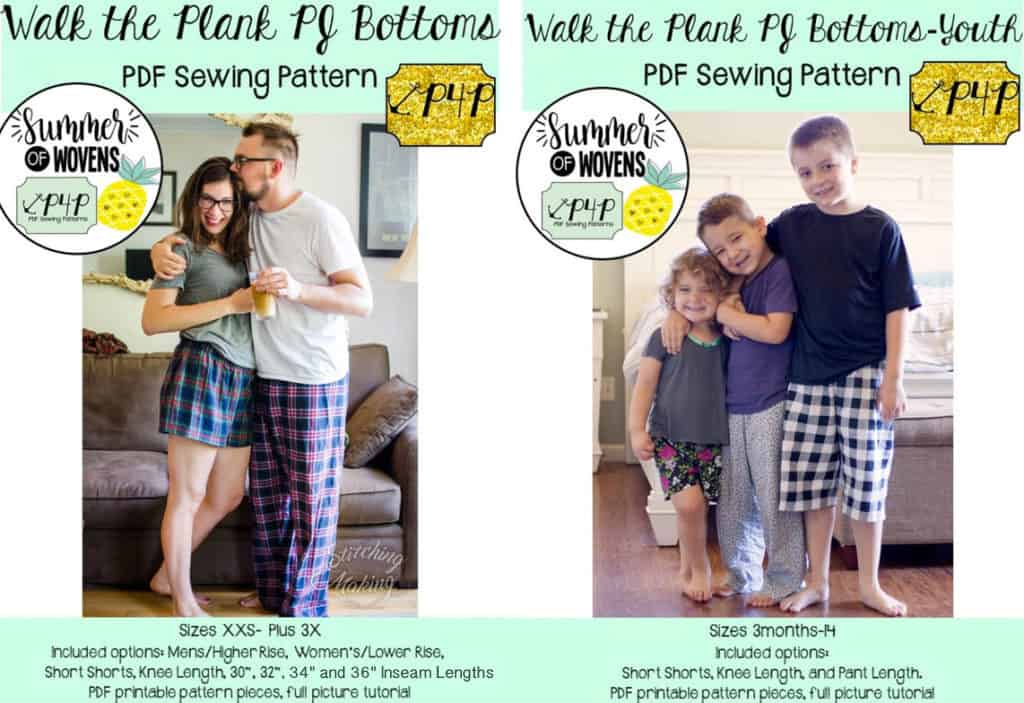
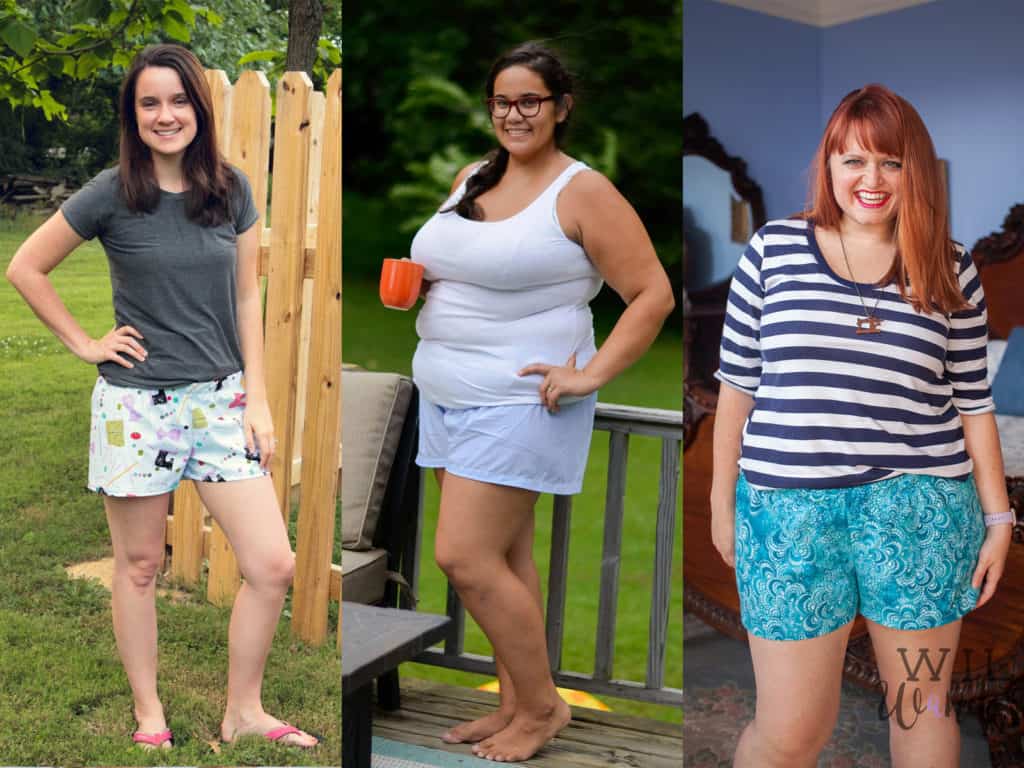
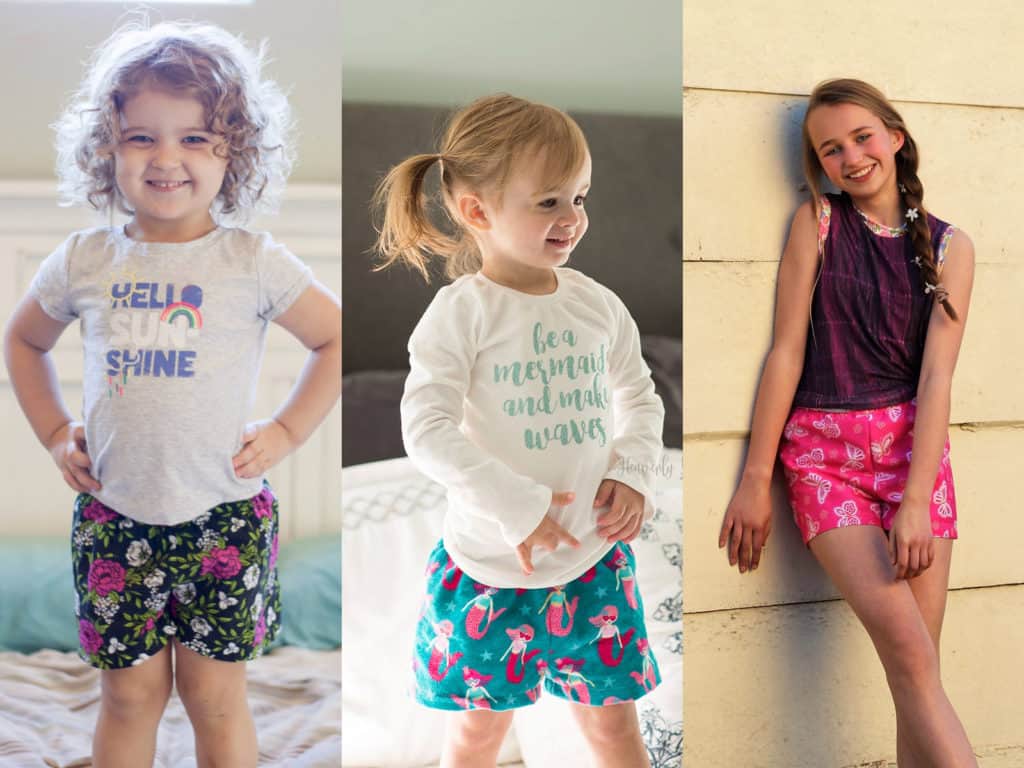
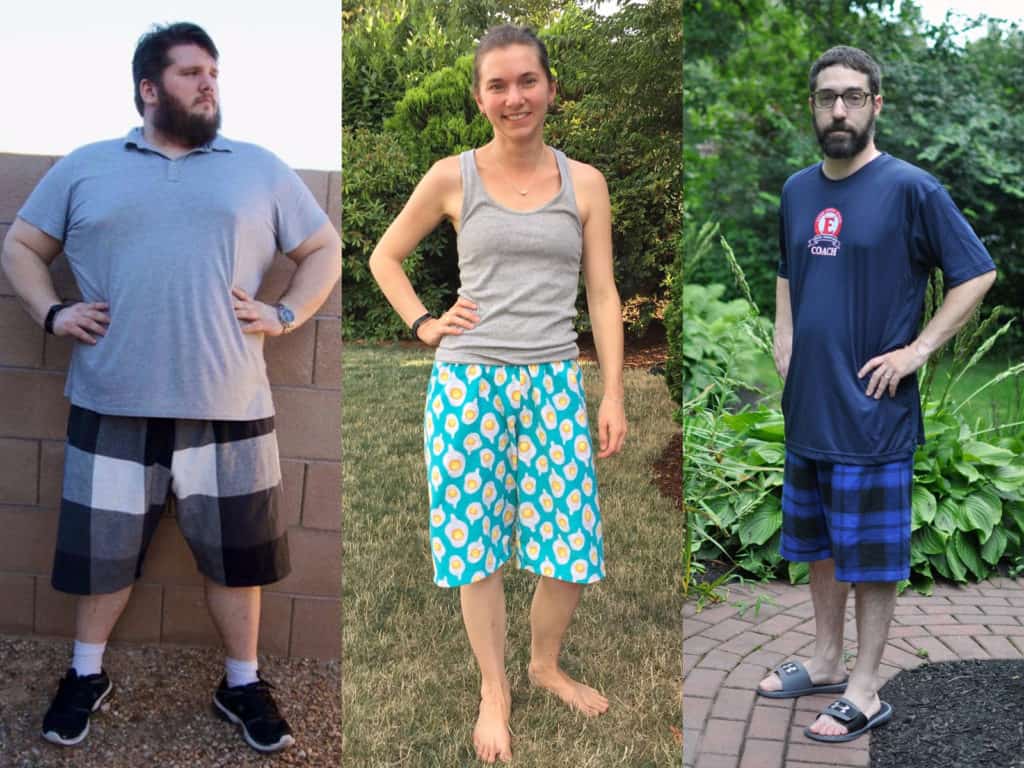
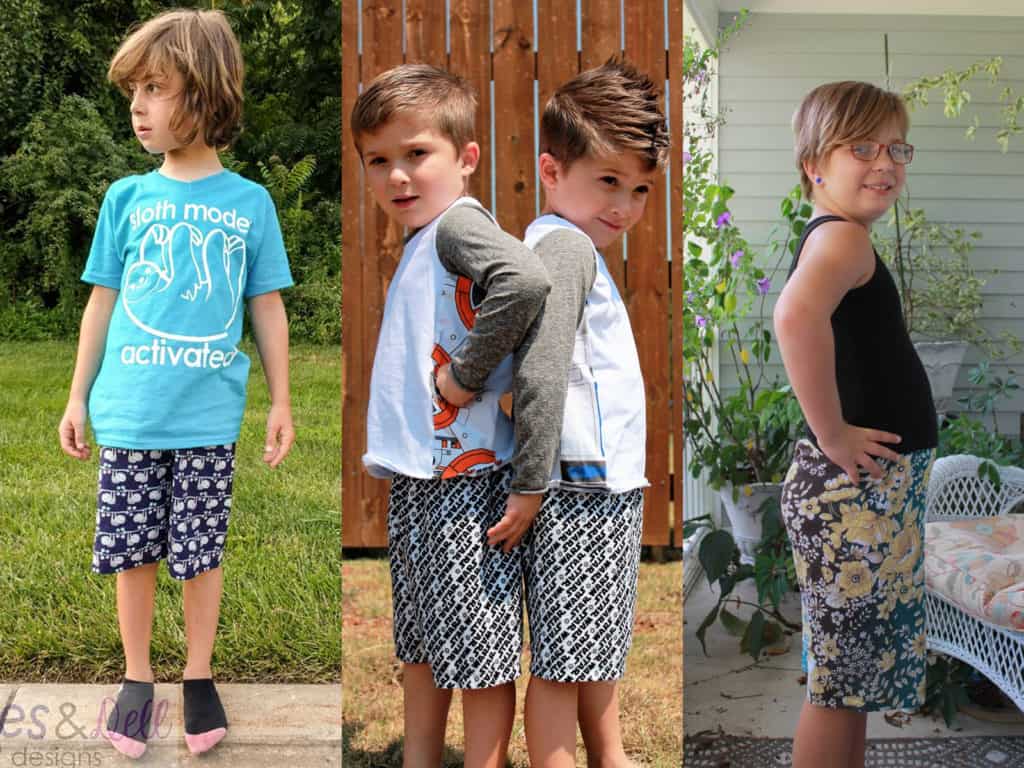
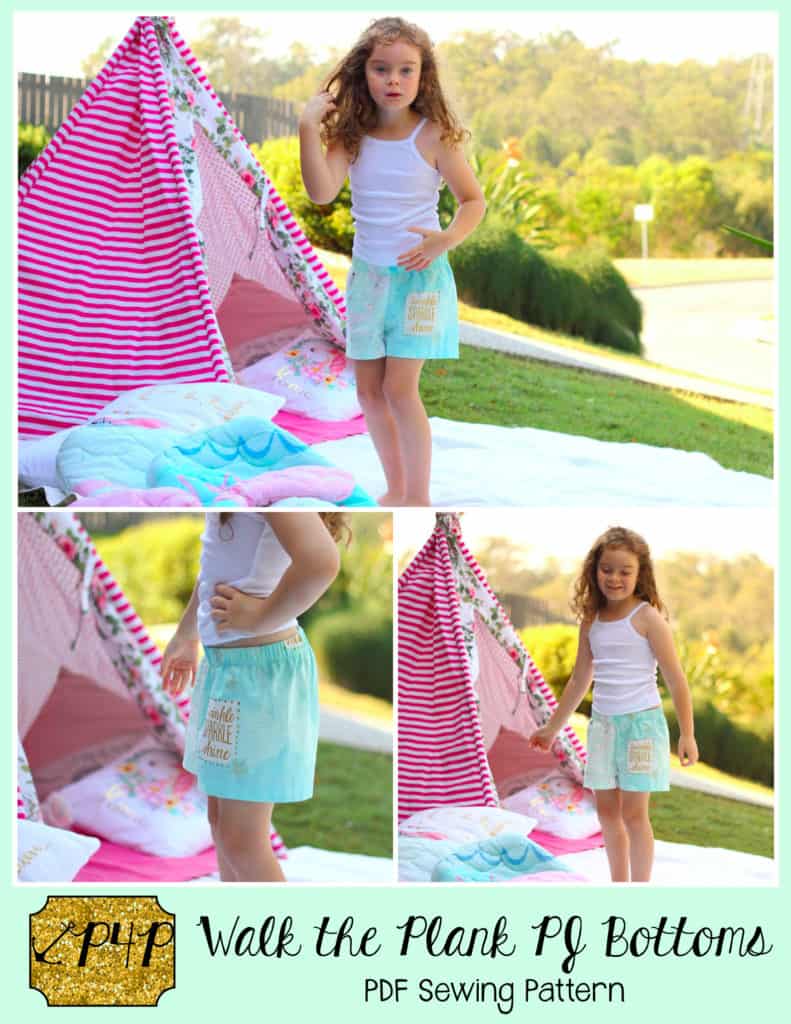
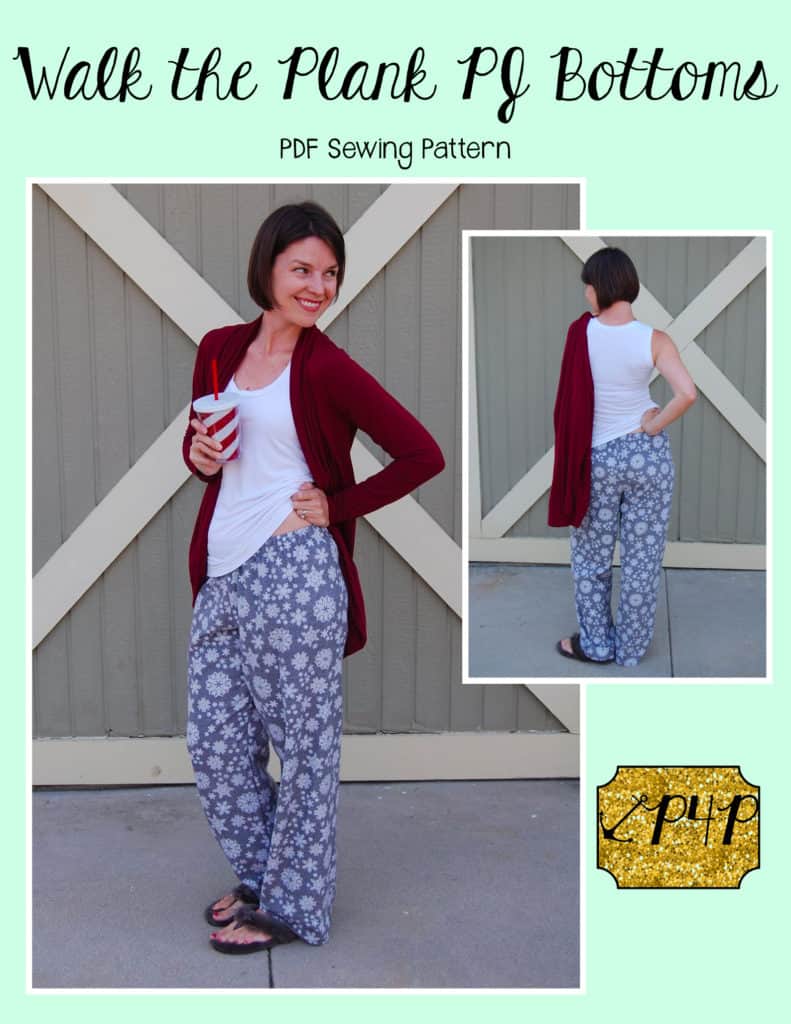
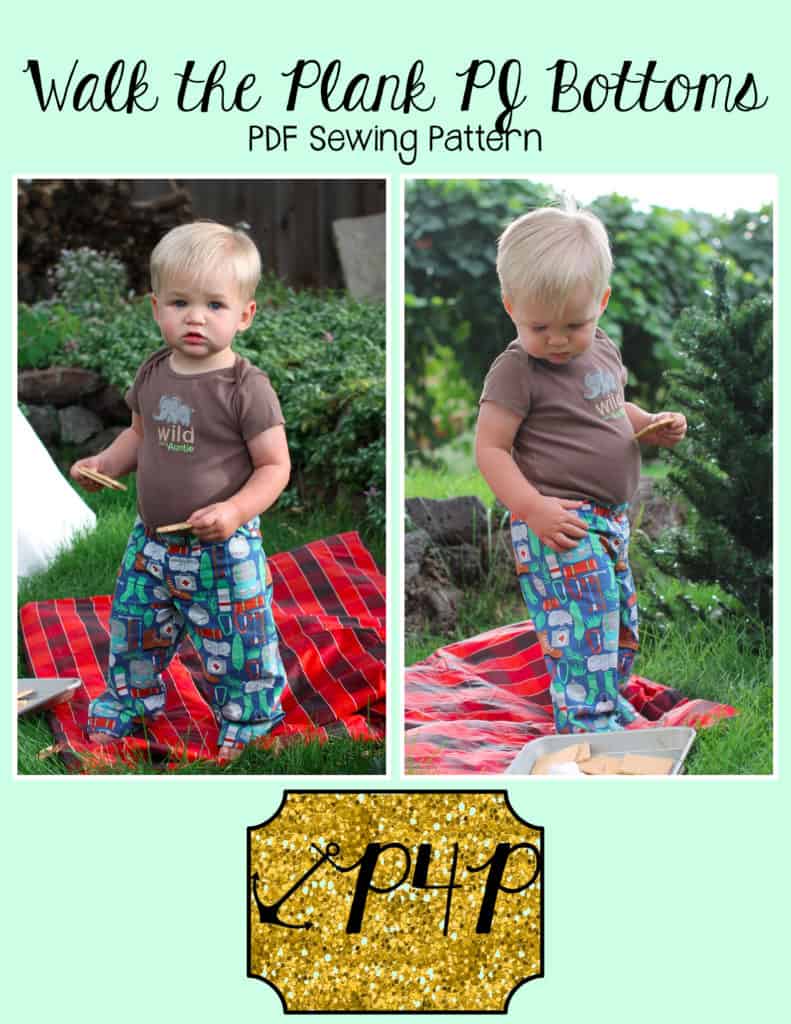
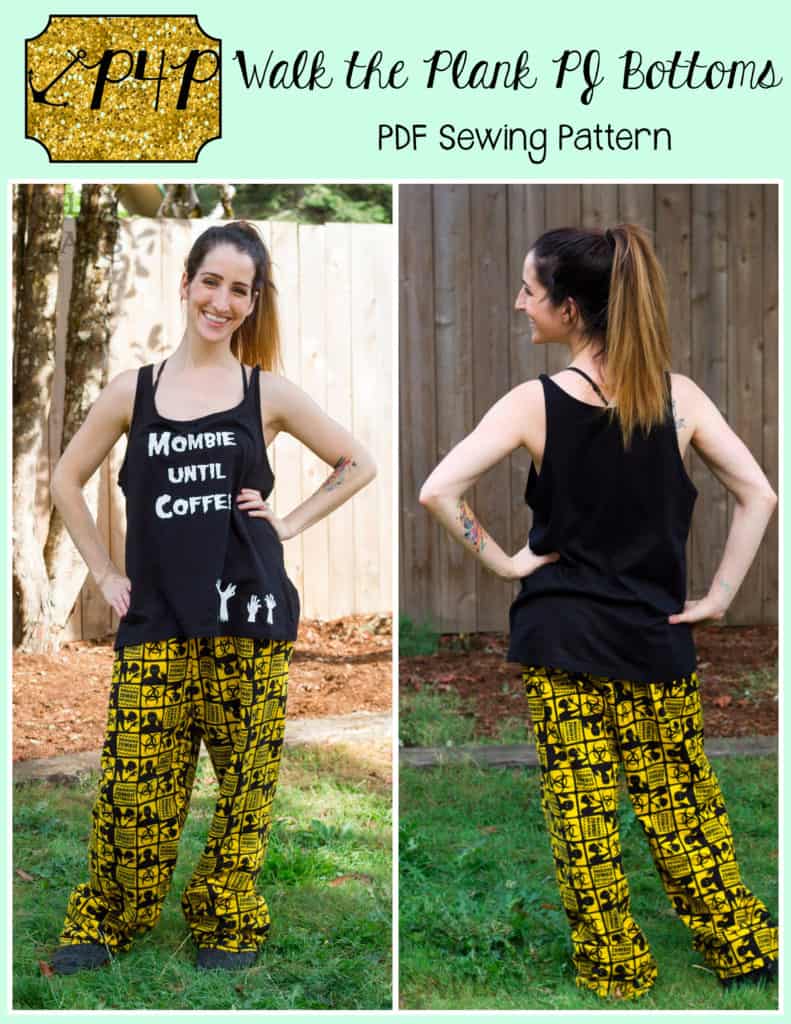
We have a new freebie to add to your collection.  The Walk the Plank unisex PJ Bottoms will be perfect for all that flannel and cotton you have that you have in your stash! These are the QUICKEST, easiest pj pant which will help you to whip out a whole stack for any season and have it checked off the to-do list in no time at all!  No side seams + no waistband piece = no extra time. They are a loose fit for growing room and extra comfort. Walk the Plank PJ Bottoms are a wider leg pj pant with three lengths: shorts, knee, and pant. The unisex adult pattern comes with a few inseam lengths and a mens/higher rise and women’s lower rise option. Both adult and the youth come with short shorts, knee length and pant length options to cover you for all seasons of PJ needs. You can check out our album full of pictures and our roundup blog post with more details too!


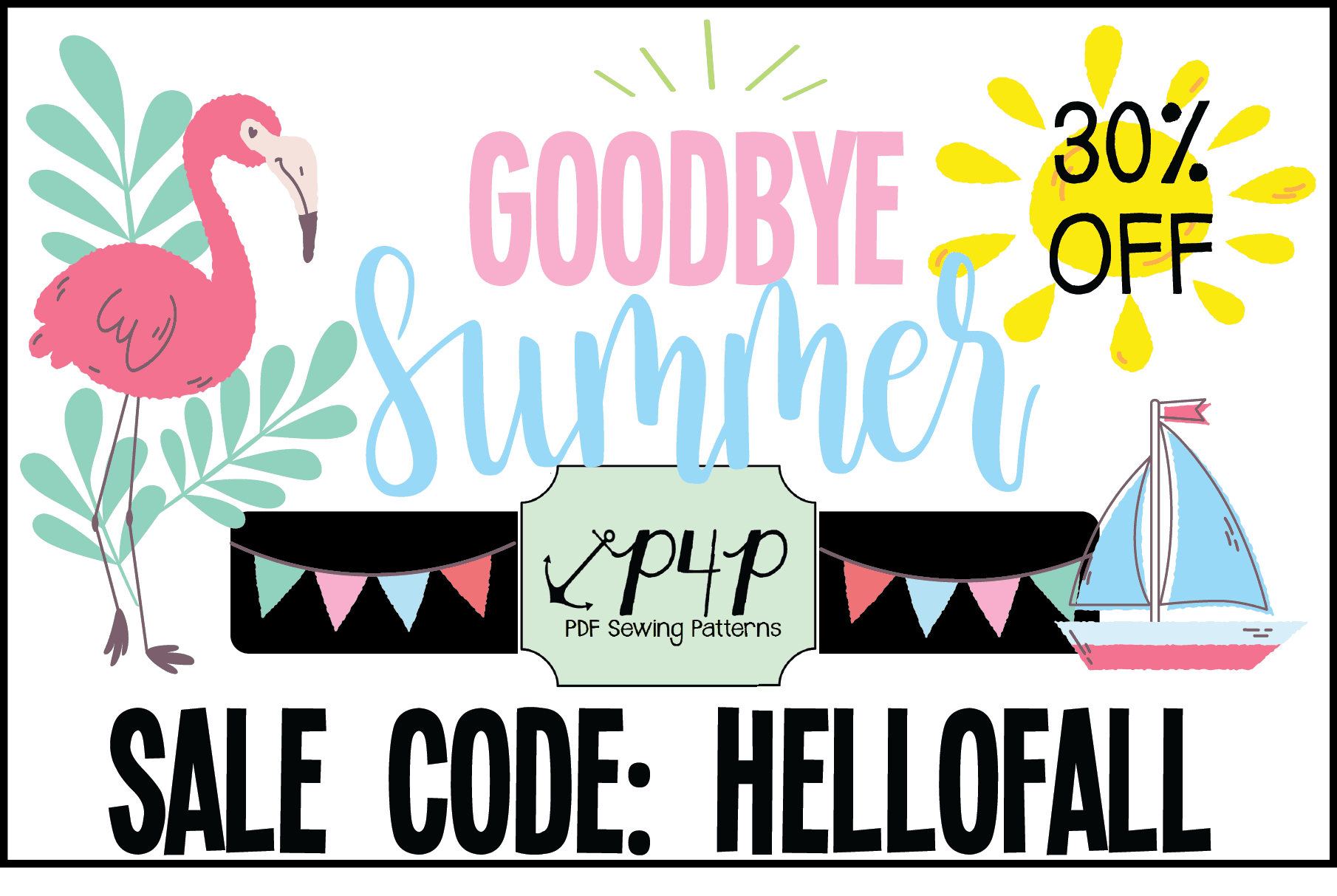
We are also celebrating wrapping up a great Summer of Wovens and start to Fall by having our last SITE WIDE SALE this year! The sale will end October 4th. (Sale times are based on US Central time zone) Get 30% off your total purchase with code: HELLOFALL

We hope you loved exploring sewing with wovens this summer as much as we did.  It was a challenge to step out of the “knit only” comfort zone for some but we loved seeing what everyone was able to create along with us!

Filed Under: Announcement, Pattern Release 2 Comments

Walk the Plank PJ Bottoms :: New Pattern Release!

September 27, 2017

Oh man.  Not only is today a release day, but it’s also a day that I get to make a fun announcement.  Or rather, TWO fun announcements!  Are you ready for this?

First, let’s talk about our newest pattern, and the final pattern in the P4P Summer of Wovens.  The Walk the Plank PJ bottoms are super easy to make, even easier to wear, pajama bottoms that are a unisex pattern and available in sizes 3M – adult Plus 3X.  Both the adult and youth patterns include three lengths (short shorts, knee length, and pant length).  The adult sizes have a differing mens and womens rise, as well as varying inseams (30″ / 32″ / 34″ / 36″ ).

The Walk the Plank pant truly is a quick sew!  All sizes were drafted to fit on a 44″ wide fabric, so you can easily use your favorite flannel or quilting cotton.  The patterns feature no side seam, and no waistband piece, as well as a quick elastic installation.  **Plus 3X were drafted with an extra side seam, so those sizes can use 44″ fabric as well.

Here’s a quick peek at the lengths:

SHORT SHORTS

KNEE LENGTH

PANT LENGTH

We have been running a contest over the last week.  You can read up on P4P’s Next Top Tester HERE if you’re interested in the process.  We had 650 (give or take) applicants that we invited into our Top Tester group.  These ladies went through some work for us!  They didn’t know what they were signing up for, but we had them all test the Walk the Plank PJ Bottoms for us!  Everyone did amazing, even amidst all of the chaos that testing in a group that size can bring.  And guess what?  We have a winner!

Well, we have four winners.  These testers did an incredible job, on all levels of testing.  It’s not just about taking pretty pictures.  It’s about providing feedback, supporting fellow testers, being around to ask/answer questions, and help with marketing.  We are so happy to have them on board with us!

Congratulations to our first ever Patterns for Pirates’ Next Top Tester: Amber Jones Zelenay 🎉🎉🎉
Our Second Place winner is: Karen Grimshaw
AND congratulations to the Runners Up: Bethany Tolman and Michelle Tobey


Want to know the best part about this pattern?  It’s FREE!!  We wanted to have a little end-of-summer celebration and thought this would be a fun way to party with you all.  Plus, it’s perfect timing with the holidays right around the corner.  Family Jammies Photo Op?  I think so!

Grab your copy of the Walk the Plank PJ Bottoms in UNISEX ADULT or UNISEX YOUTH today!

**Want to learn more about how to measure yourself for this pattern?  We’ve got you covered with an in-depth blog HERE.  And in case you’re new to Patterns for Pirates and PDF patterns in general, we have a great blog full of new user tips HERE to help you get started!  And, as with all of our current releases and updates, the pdfs now include our layers feature and can be found in Letter, A4 and A0 sizes.

If you’re still needing more inspiration, be sure to head over to the Patterns for Pirates Facebook Group Albums for the Walk the Plank PJ Bottoms to see what our amazing testers have sewn for themselves.  Don’t forget to tag us on Instagram (@patternsforpirates | #patternsforpirates) and to share your finished items over in our Facebook group!  We love to see what you make!

Happy sewing, friends!

Filed Under: Announcement, Contest/Giveaway, Free Pattern, Pattern Release 23 Comments

P4P University- Ease

September 23, 2017

Ease is a term using to describe how much extra fabric there is around your body after the garment is sewn up. In sewing and pattern groups you often see the question, “Does this run big/small/true to size?”  And most the time the same pattern and size will have an array of answers! Confusing right?  The truth is the pattern is designed with a certain amount of ease the designer has picked based on the size chart.

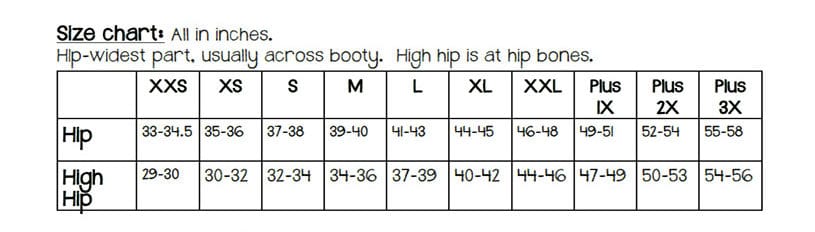
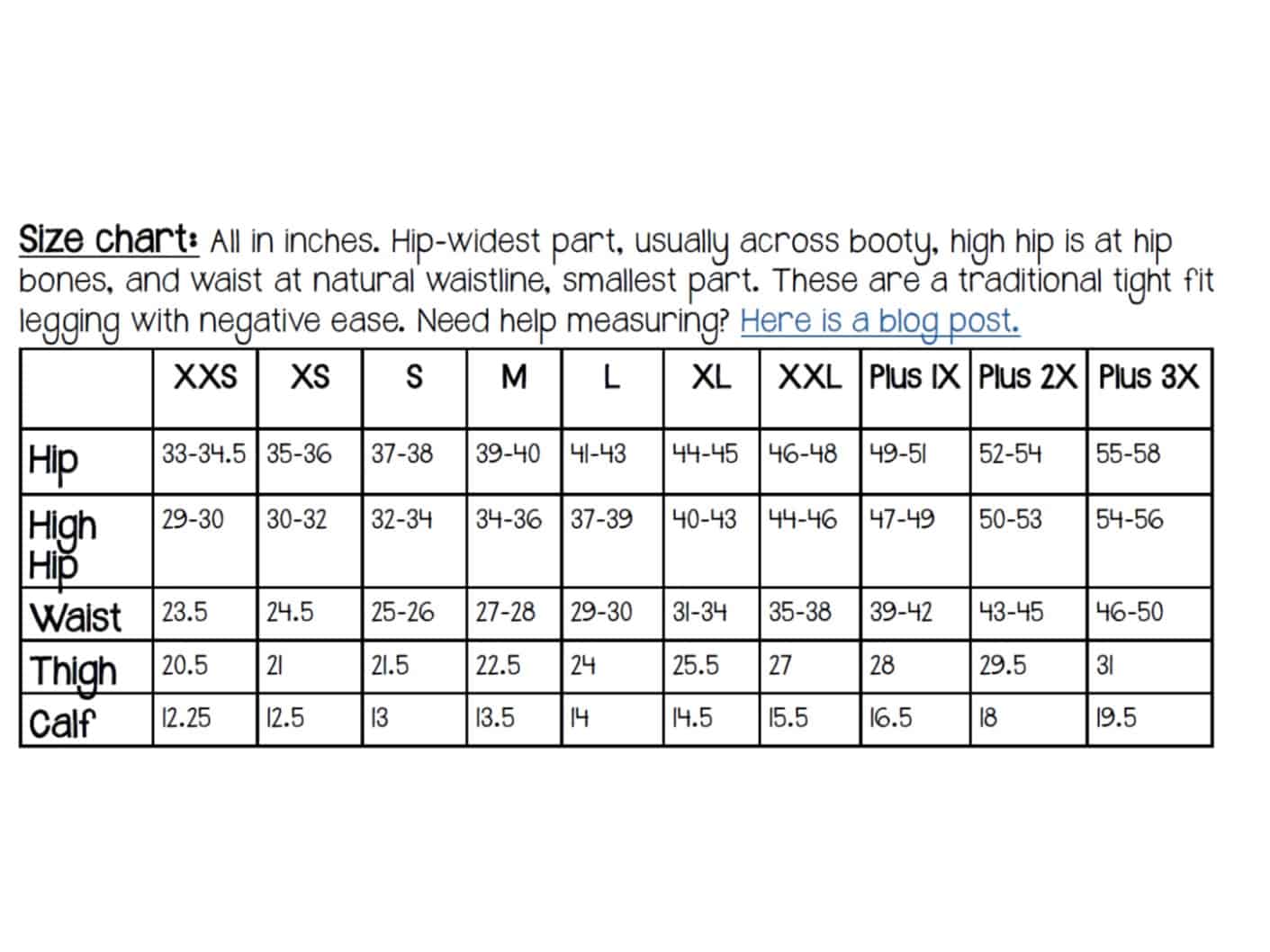
So, when the designer like me drafts a pattern they decide how much ease they want for the intended fit.  They use not only the listed body measurements, but an entire book of standard/average measurements for each part of the body to give the pattern a certain amount of ease everywhere along the body.  I try to give the most important measurements in the measurement chart and finished measurements to help you pick the perfect size for your preference of fit.  I usually have more measurements in the tutorial than on the listing pictures so that when you’re ready to pick a size for that certain garment you can see if you need to modify, grade between sizes on that particular pattern. Here is the size chart within the tutorial for the Peg Legs:

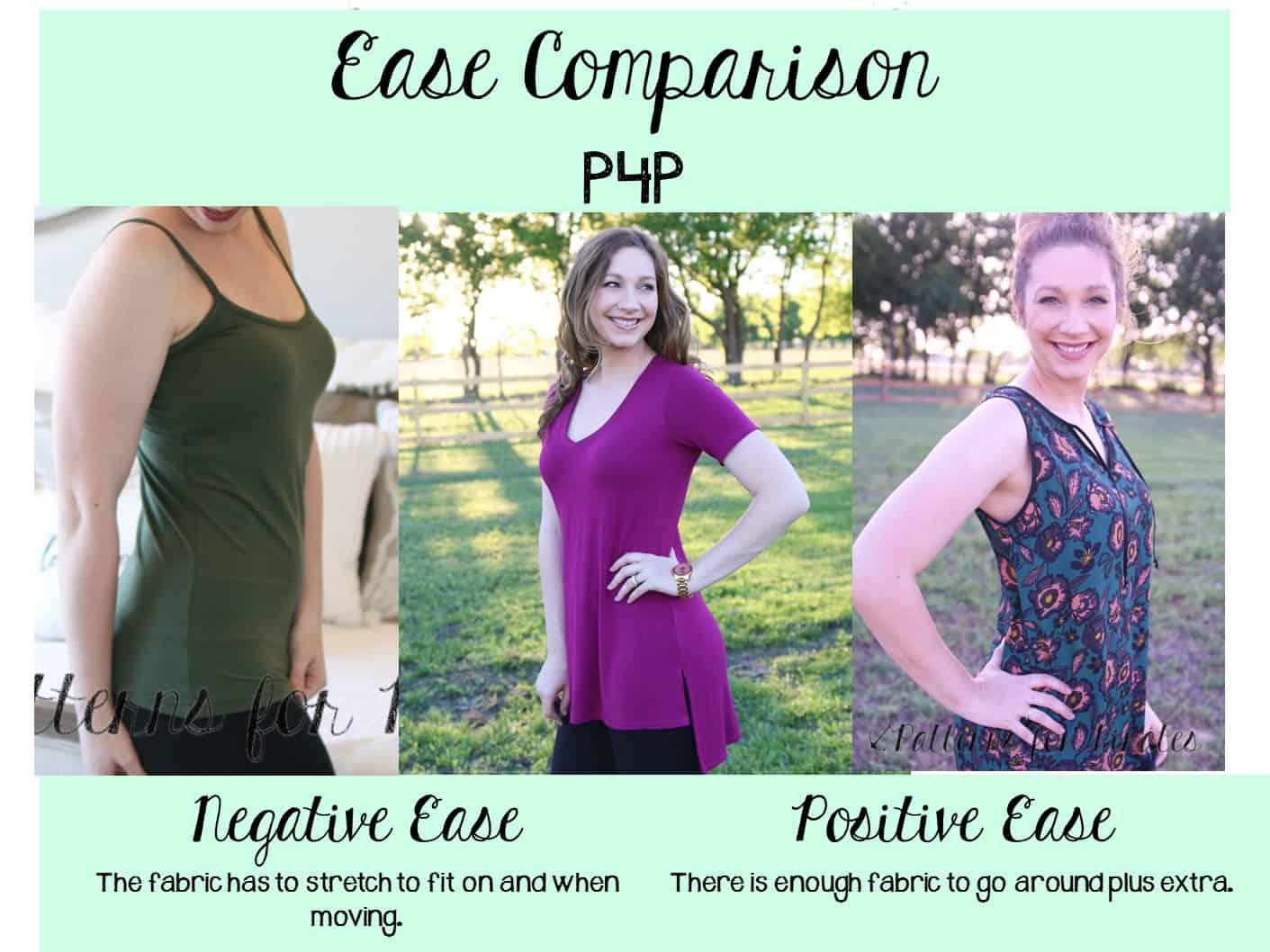
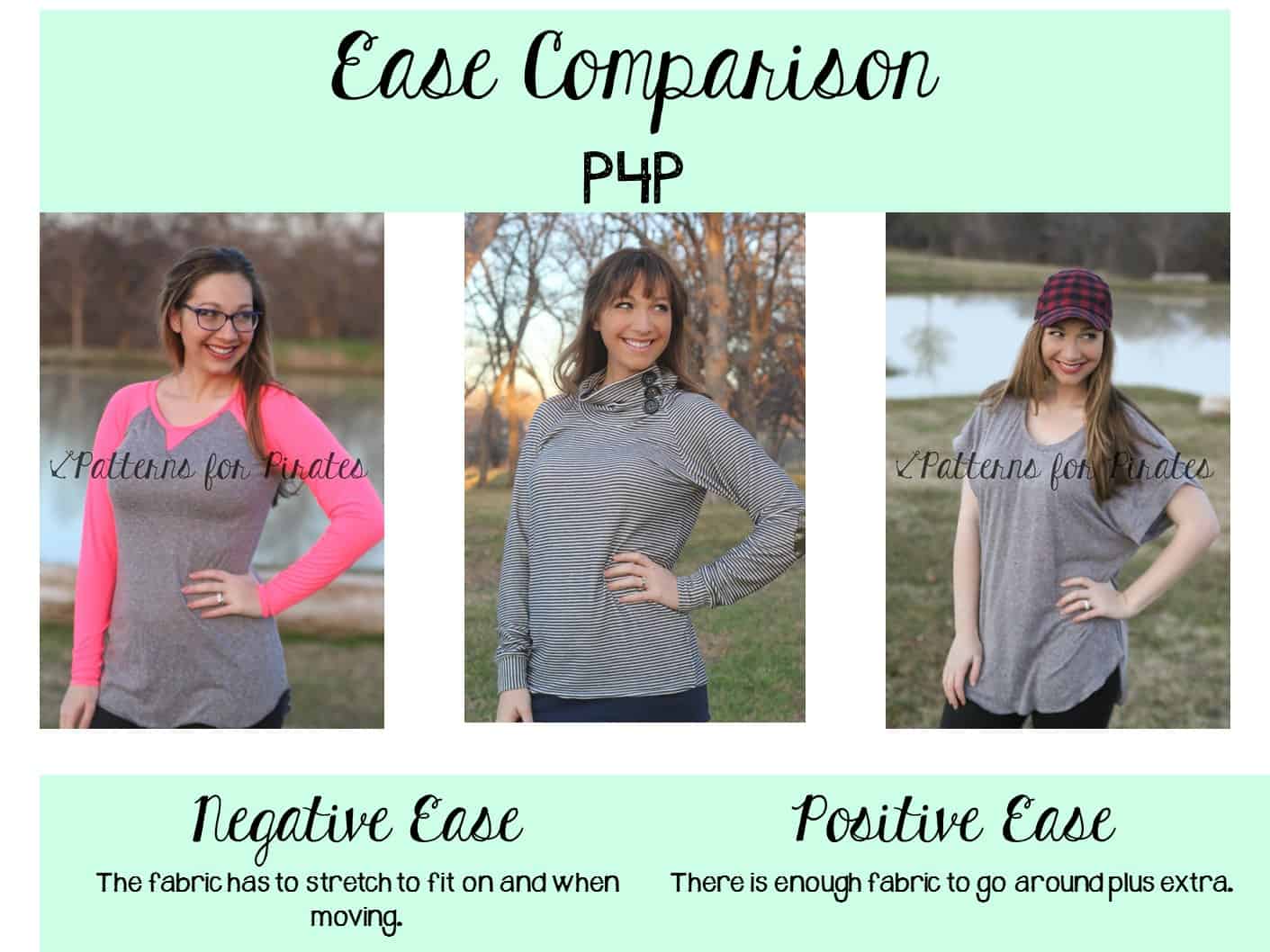
Some ease is needed for certain garments.  Woven/non-stretch fabrics require much more ease since they don’t stretch.  A body requires ease to move, bend, breathe, etc comfortably.  Designers use the recommended amount in general for guidelines and can add more if they want a looser fit.  Knit garments can, and often do have negative ease.  Negative ease means the garment finishes smaller than your body and much stretch to fit on to your body as well as when you move.

There is a very wide span of “what fits” within a single garment.  For a knit shirt using a stretchy fabric- lets pick cotton spandex with about 75% stretch) you can have up to about 50% negative ease and still move and breath, this would be what most would call “skin tight”.   You can also have a few inches of ease for a looser fit, what most would call relaxed or baggy. And within that range, everything technically “fits” because you have enough ease for movement.  The rest is up to the designer to create the design ease they have in mind.  When the question is asked, “Is it true to size?” it really can’t be answered.  It is true to the designer’s intended fit with the amount of ease they drafted into the garment.  Whether it is how much ease you prefer personally for that garment depends on if your personal preference is the same as the intended fit.  I’m always surprised to see someone post in our FB group “this is huge” or “it’s too tight”, I try very hard to show intended fit through listing pictures, use the best describing words in the listing and give a good description in the tutorial along with the measurements.  But, what one person with the exact same measurements and fabric choice finds “too snug” another might describe as “huge”.  It’s all personal preference!

Lets think about what a big range that is… I’m going to go down to 30% negative ease since this is a pretty tight standard athletic/swim amount of ease, most clothes wont be tighter unless we’re going to add in compression fit/slimming undergarments.  I will do hips at 40 (top end of the medium).  So you could easily have a well drafted pant pattern with a finished full hip measurement of anywhere from 28″ all the way to 45″ depending on the intended fit and suggested fabrics.  Most knit pants can easily range from 28″-42″ depending on the kind of knit they’re drafted for.

Woven pants don’t have quite the range, since you take away the option of having negative ease and using stretch for the movement ease needed.  But, A woven pant for a 40″ full hip can still range from about 42″ up to 46″ depending on the intended look of the design.  We very often get the question if you can sew a knit pattern with a woven non stretch fabric.  The answer is mostly no.  Most knit patterns depend on the stretch of the fabric to give some, if not all, of that movement ease you HAVE to have for your body to comfortably move, bend, breathe, get the garment on and off, etc.  If you would like to know how much wearing ease you need to get the slimmest possible woven garment there are ways to measure that.  For your full hip you can place the measuring tape around your full hip-mine is about 40″.  Keep the tape carefully in place, but loosen your grip at the front.  Very slowly sit down, or bend/squat.  You will notice that the tape will pull and need more room.  This is called your “sitting spread”.  Lovely name right 😉 , but it is how much you “spread” when you sit/squat.  You need this much ease or extra fabric around your hip in any woven garment to be able to move comfortably.  There are tighter dresses out there with less ease there, but you aren’t sitting cross legged on the floor in that tight woven pencil skirt.  You probably aren’t even sitting comfortably in it.  The hip is the easiest measurement to check your ease need.  But, the same concept can be a check for bust, arms, thighs, etc. putting the tape measurer around and moving and breathing, letting the tape slide to the biggest range you use while moving.  If you check this sitting/moving measurement against the finished measurements of the pattern you will know if you can use a non-stretch fabric and still move comfortably.

I did a quick video about measuring your needed “wearing ease” here:

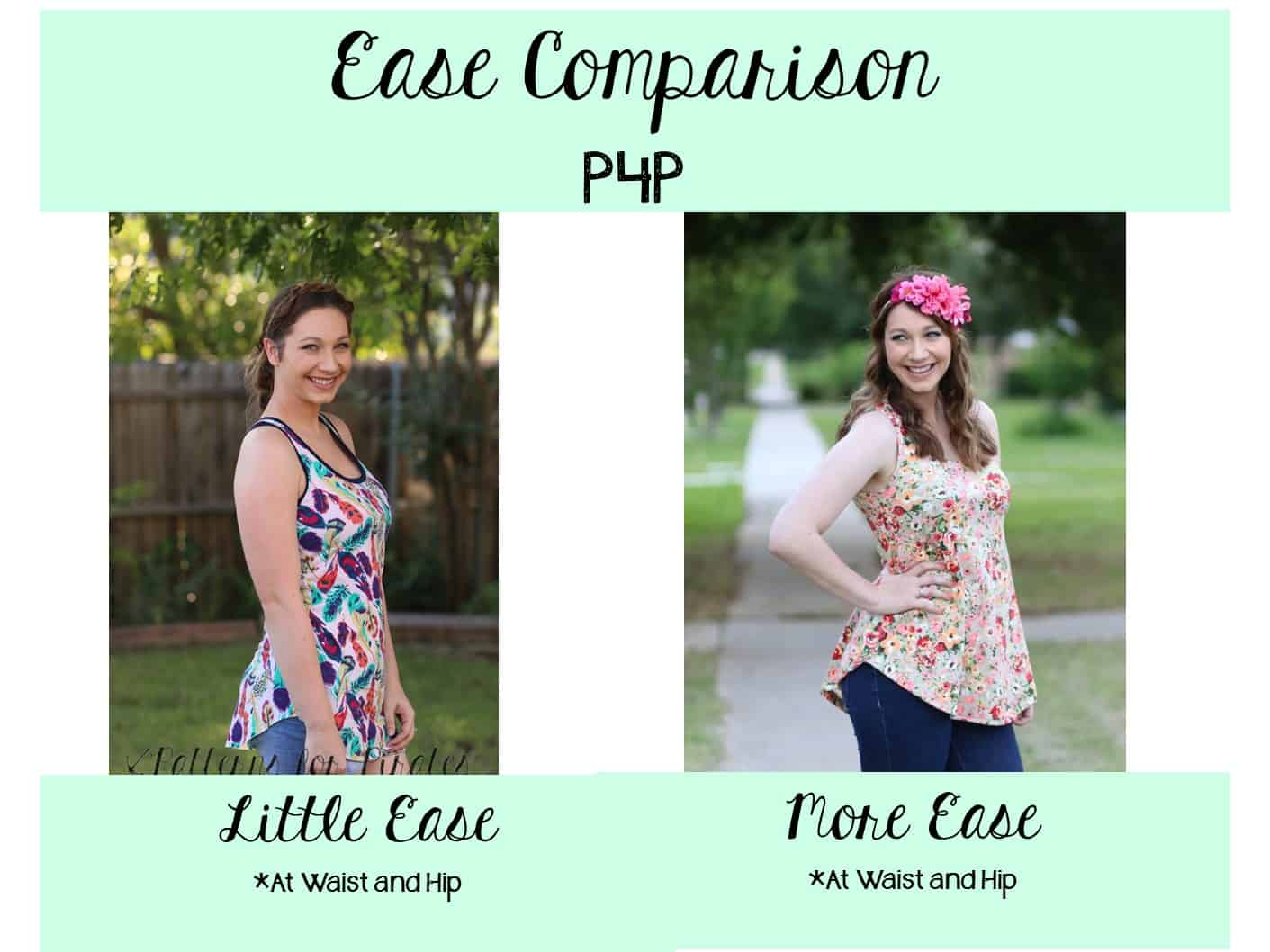
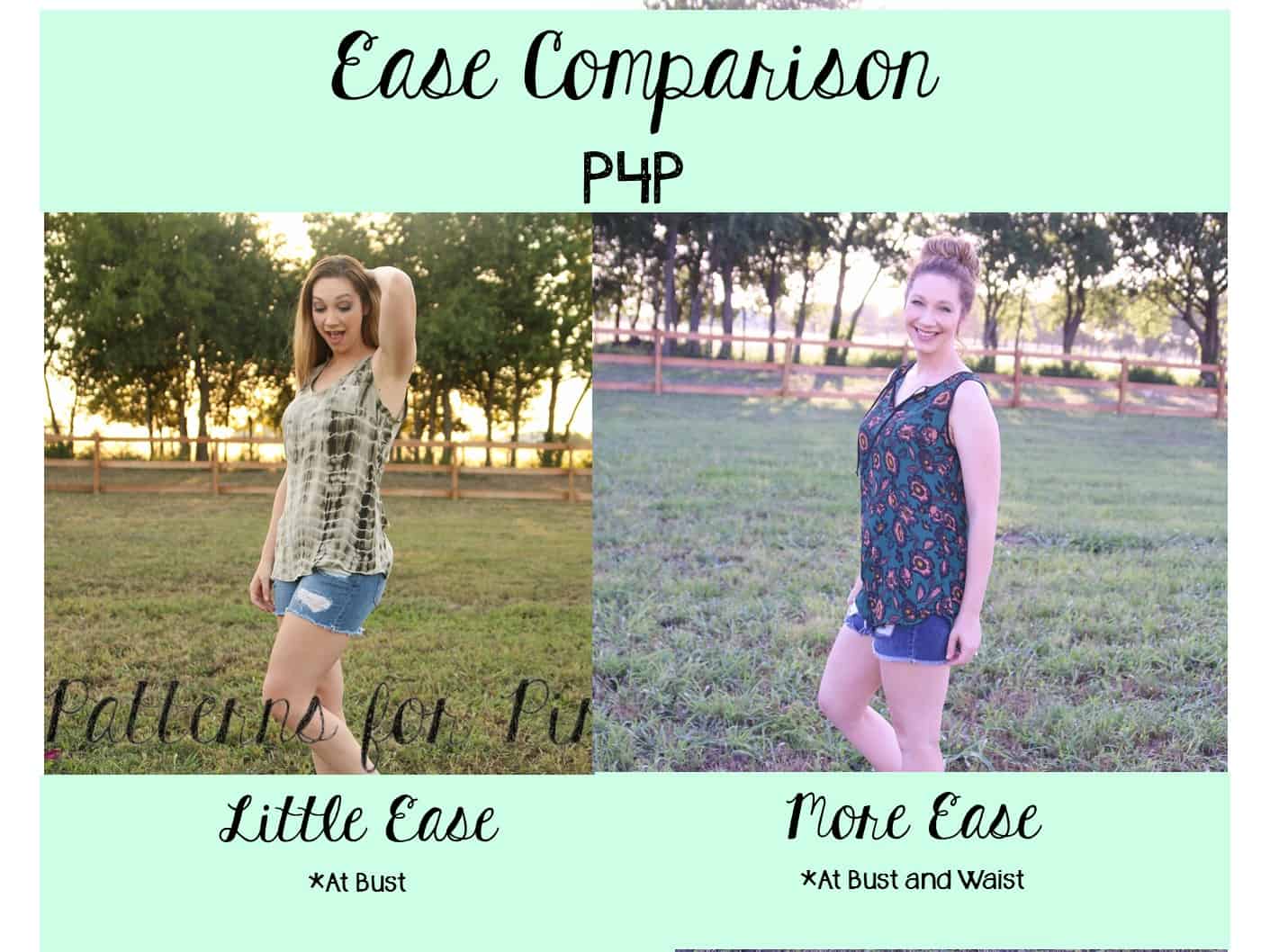
A designer’s job is to choose how much ease they want for a certain intended fit and look.  Lets take one of my patterns The Pumpkin Spice Dolman.  It is a looser cut with a quite a lot of ease through the bust and about 0 ease at the full hip.  I intended it to be a loose, slouchy fit and works best with fabric that has a soft drape.  Some might find the design ease I added too much if they don’t like the loose, slouchy look.  It doesn’t mean the pattern “runs big” since that is exactly the amount of ease intended for the look I was after.  It just means you prefer a tighter fit that intended.

A slimmer cut shirt like the Slim Fit Raglan or Layer Me Up has negative ease at the best and less ease through the body.  Again, this doesn’t mean the pattern “runs small” it is meant to be smaller and tighter as designed.

Lets take another pattern, this time a fitted one, the Peg Legs.  The Pegs are a traditional tight fit legging with negative ease.  The standard ease used in athletic wear is usually 20-30%.  The Pegs are right in the middle through legs and up at the higher end at 30% at full hip and high hip.  Since they do not have elastic I preferred the tighter end of normal to help them from inching down.  We’ve seen them compared to others with less negative ease and neither are wrong, just a different preference on how fitted the designer had in mind.

Now lets talk about how you can use this knowledge to your advantage in sewing for yourself!  Once you understand ease and fabric choices you can essentially make the perfect garment fit you every time before even cutting! WHAT? I know, amazing right?  Now, this doesn’t happen overnight.  It’s something you will come to learn about your preferences over time and experimenting.  But, the more you pay attention to both your fabric choices and the design ease the faster you will get there!

Take all the clothes you love and look at them, study them! For that matter take the ones that you think are a little tight or loose too.  How much ease does it have to your body? On the bust, waist, hip?  What fabric is it made out of (this doesn’t have to be exact, but “thin and drapey or thick and stable categories work well).  Now you can apply this to your sewing choices.  You will learn if you like a looser fit with those thinner drapey knits- or a tighter fit with those.  Maybe you tend to always love thicker stable knits with you do have a more fitted garment.  Whatever you find in your “research” try to apply that to your pattern, fabric, size choices.  If you know you tend to like at least 2″ of ease at your waist you can know if you want to grade in or out at a waist on any t-shirt pattern.  Maybe you only like knit pants with some negative ease on the booty… When you open up a new knit pant pattern you can pick your size off that finished measurement chart and know for certain you’ll like the fit on the booty.  If you are just beginning it’s something you will want to make an effort to pay attention to.  Eventually it will become second nature 🙂 You’ll be able to open up a new pattern and know just how to use it to create YOUR OWN intended fit if you happen to not love the designer’s intended fit.

Filed Under: Fitting, Frequently Asked Questions, P4P University 8 Comments

Woven Apparel Fabrics

September 22, 2017

Since we did the blog post about Knit Fabrics and included a printable cheat sheet for those diving into the world of garment sewing- we’ve been asked to do a Woven Apparel Fabrics one as well! As part of our Summer of Wovens I’d like to present

I worked hard on a Woven Fabric Cheat Sheet that you can download and look through when trying to pick the perfect fabric to pair with your woven patterns.

I also did a show and tell with the woven apparel fabrics I had in my stash in our Facebook Group. But you can watch it here as well:

I hope this helps you pick the perfect fabric for the P4P patterns drafted for woven fabrics!

Filed Under: Frequently Asked Questions, P4P University, Sewing with Woven Fabrics Leave a Comment

P4P’s Next Top Tester

September 16, 2017

“How do I become a P4P tester?”  It’s a question we’ve heard a million times.  We even wrote a blog post all about how to get noticed by the Pirate Crew.

But friends.  Listen up.  Because next week, we are bringing you a special opportunity that just might fast track you into our tester group.  Allow me to announce:

That’s right!  We are doing an open call for a FULL BLOWN pattern test for P4P, and you’re invited!  Be sure to check the Patterns for Pirates Facebook Group on Monday, because we will posting a tester call.  And we are taking EVERYONE.  It’s going to be a wild ride and I couldn’t be more excited!

Top Tester will be putting you through the ringer.  You will be taking on a pattern test, and you’ll be doing all of the steps that we do for any of our normal tests.  Which means we will have size assignments, fit pictures and feedback, final photos, tutorial feedback, and promoting of the pattern when it gets released.

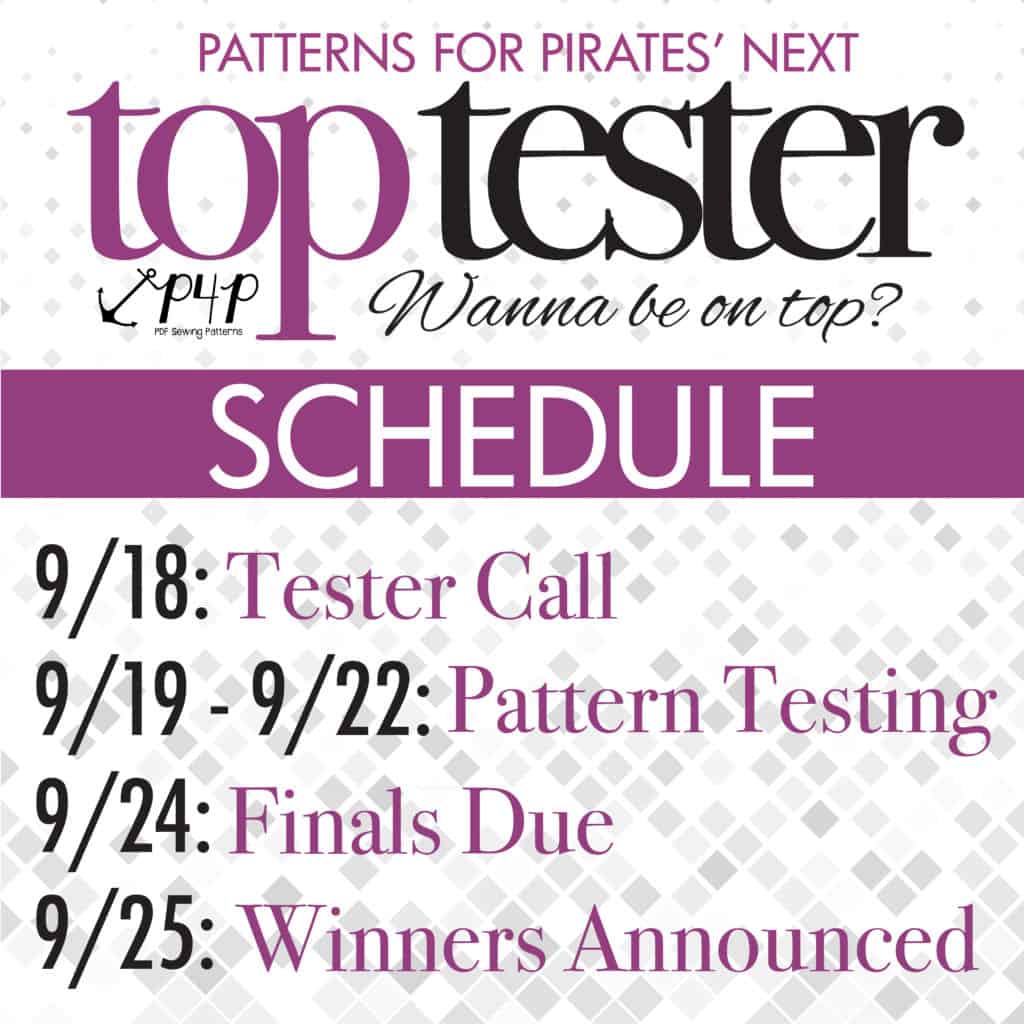
#P4PNTT will result in two official winners: a Top Tester and the Runner Up.  But first, let’s talk schedule.

Tester Call!
Monday, September 18, 2017

I will post a “Tester Call” for the challenge in the Patterns for Pirates Facebook Group. You’ll need to sign up with your size and information in the form we will be sharing with you.  There area actually two unisex patterns, and we are looking for men, women, boy, and girl models.  Everyone is welcome to join!

Measure, measure, measure!! Kids grow fast and weight/size fluctuates weekly.  Make sure you have the most up-to-date measurements so you can make the appropriate sized garment.  Knowing your actual measurements and not what you’d pick up in a store is SO IMPORTANT for testing.  We want to put out a pattern that is drafted for the proper sizes.  (Need help measuring?  We’ve got a post HERE all about it!)

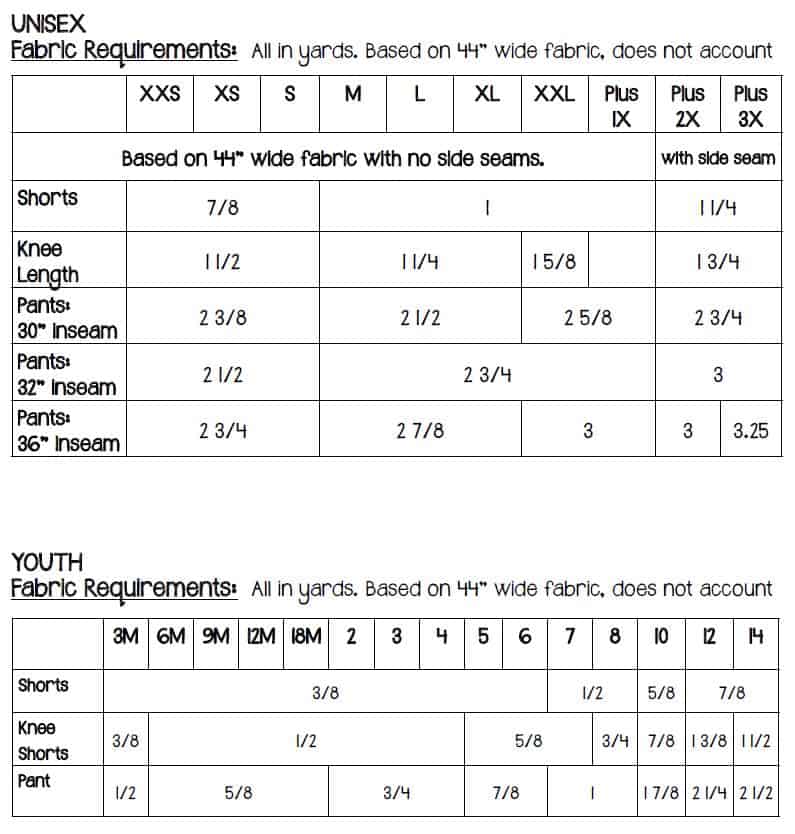
We aren’t telling what the pattern is until you’re in the group (since we’d like to keep it a surprise) but we didn’t want to leave you scrambling for fabric this week.  Here are the fabric requirements, based upon 44″ wide WOVEN fabric.

Print, Sew & Fit Feedback + Tutorial Edits/Feedback
Tuesday, September 19 – Friday, September 22, 2017
All participants will be added to a private Top Tester group on Facebook. (Remember to check your emails on Tuesday for the invites!!)

Print, assemble and cut your pattern.  Select your fabric.  Sew up your garment.

This portion of the process, we ask that you make your assigned version first, and you make sure to only print the pattern right before you’re about to sew — since we can make several changes to the patterns during the process and we want people sewing the most recent update.

Show us “fit” pictures with feedback.  This is a huge step in getting our patterns just right.  These do not need to be professional pictures.  They can be cell-phone shots or selfies, but we need to see how things are fitting in the size you signed up for!  It helps us identify any fit issues throughout the testing process.

We will also be posting the tutorial for the pattern(s) for you to edit.  The PDF will be located in the files within the Top Tester group and will have spelling mistakes, typos and maybe some construction errors.  Put on your “editing eyes” and catch the problem areas and provide us with revisions.

Final photos
Sunday, September 24, 2017

Take your photos and load them into the Top Tester group.  We prefer natural, outdoor photographs but understand completely that the weather doesn’t always cooperate.  You will need to provide at least 5 pictures showing fit from all angles. Think front, back, side shots, close up on details, etc.  You may style them as you like, but remember the focus of the picture should be the garment and it should make sense for the item you’ve sewn.  **You do not need to have a fancy DSLR camera and photo editing software to produce clear, beautiful tester photos.**


All of these tasks must be completed by their respective deadlines in order to be in the running for Patterns for Pirates’ Top Tester title.  Most of our testing periods last 4-7 days.

Winners will be announced on Monday, September 25, 2017!  Here are the prize packages:

Top Tester- 1st Place
Guaranteed testing spot for next 3 patterns
3 P4P pattern pack of choice
Pattern of Choice from Cole’s Creations and Made for Mermaids
LFRB Fabric Bundle from Sly Fox Fabrics

Runner-up
Guaranteed testing spot for next pattern
3 P4P pattern pack of choice
LFRB Fabric Bundle from Surge Fabric Shop

*Note: while only 2 winners will be selected, depending on your performance and effort, you may be invited to join our testing group!!! Bring your A-Game, P4P Fans!

**Winners will be chosen by the Patterns for Pirates Team**

Are you ready to party?!  Make sure to tune into the P4P Facebook Group on Monday, so you can join the tester call!!

Filed Under: Contest/Giveaway, Frequently Asked Questions, Uncategorized 11 Comments

Brunch Blouse:: New Pattern Release!

September 14, 2017

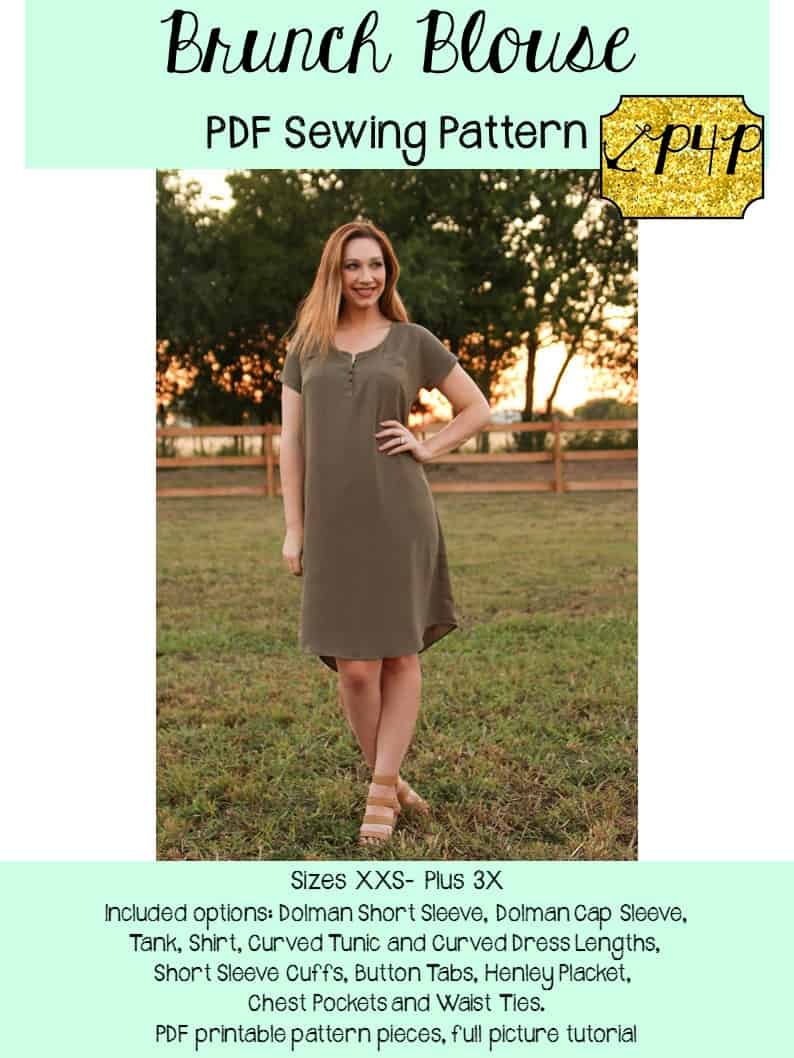
The Summer of Wovens has brought some pants with the Linen Loungers, an updated Everyday Elegance Top and Sweet Bow Dress… and now we give you the perfect top for your apparel wovens, the Brunch Blouse!

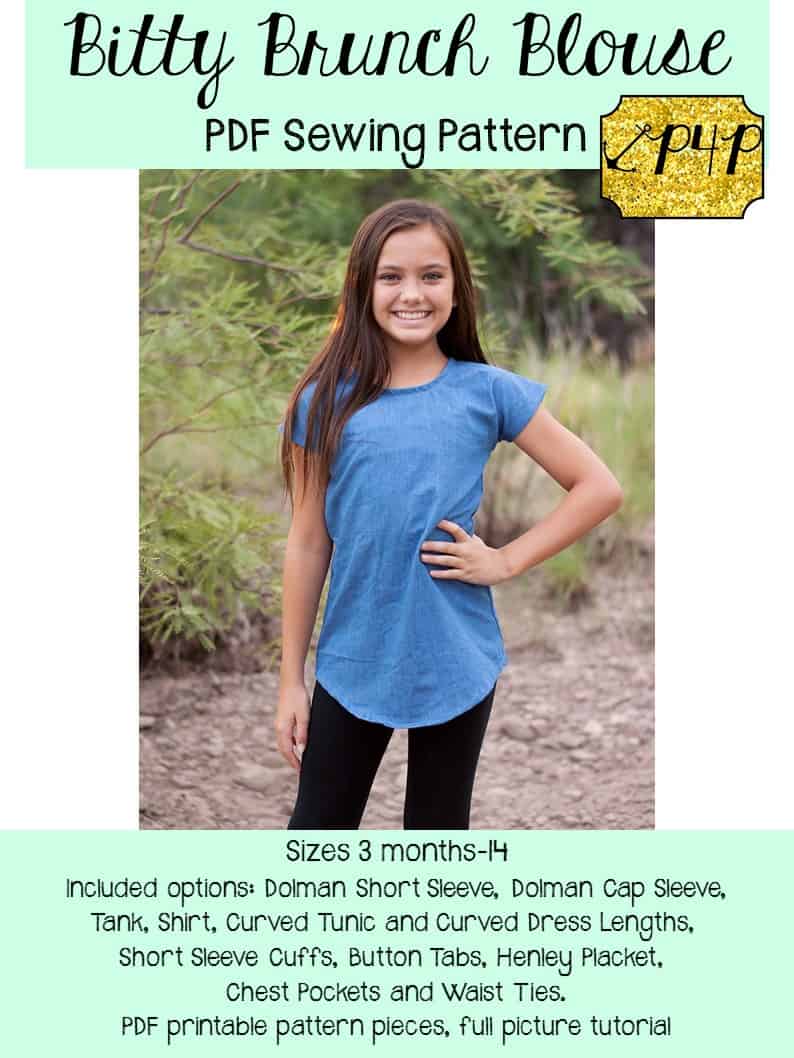
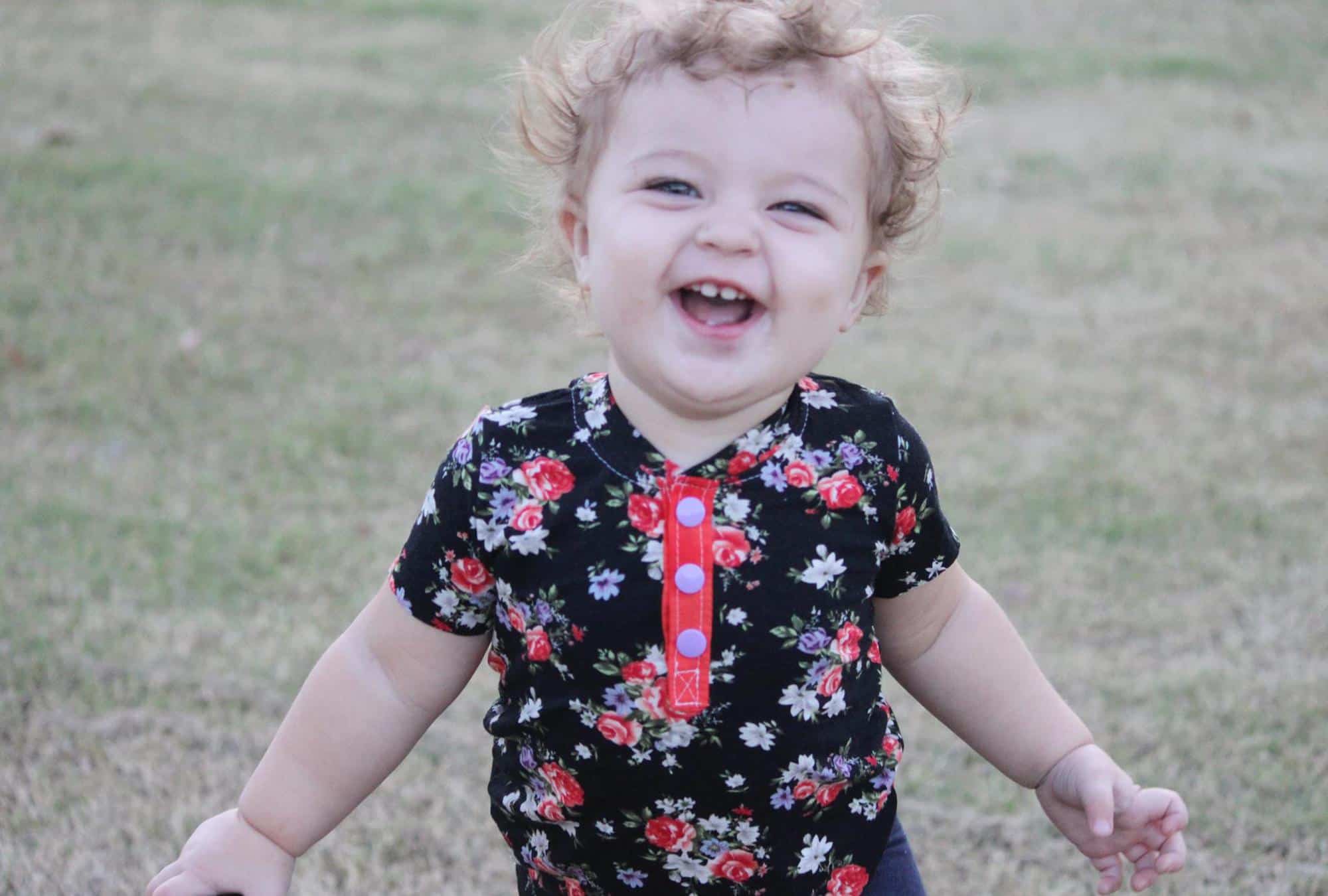
We also did it in youth for those with littles.

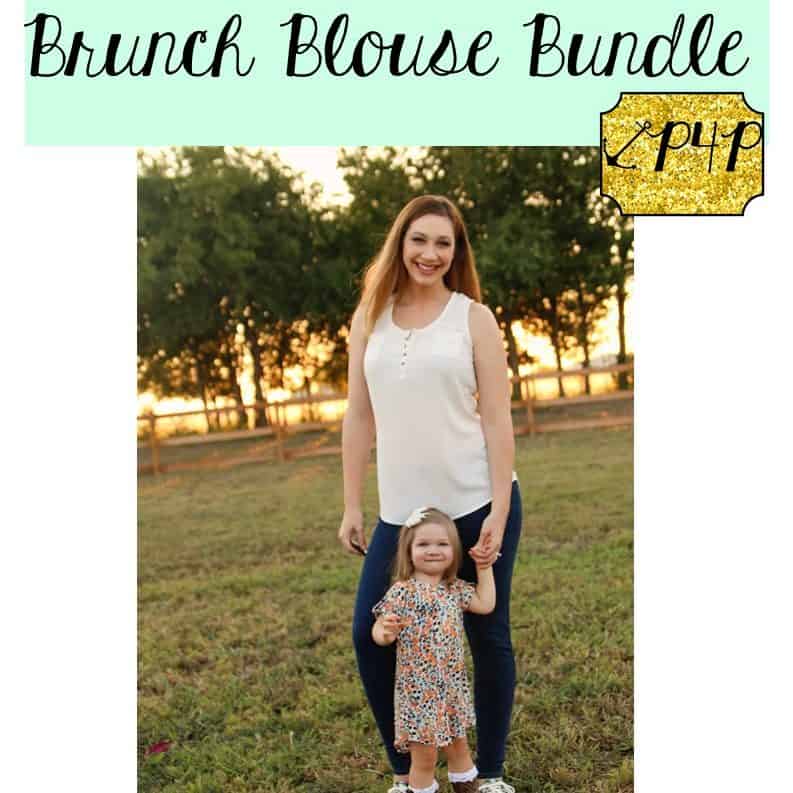
And, as always we gave you a deal if you wanted both in a bundle listing!

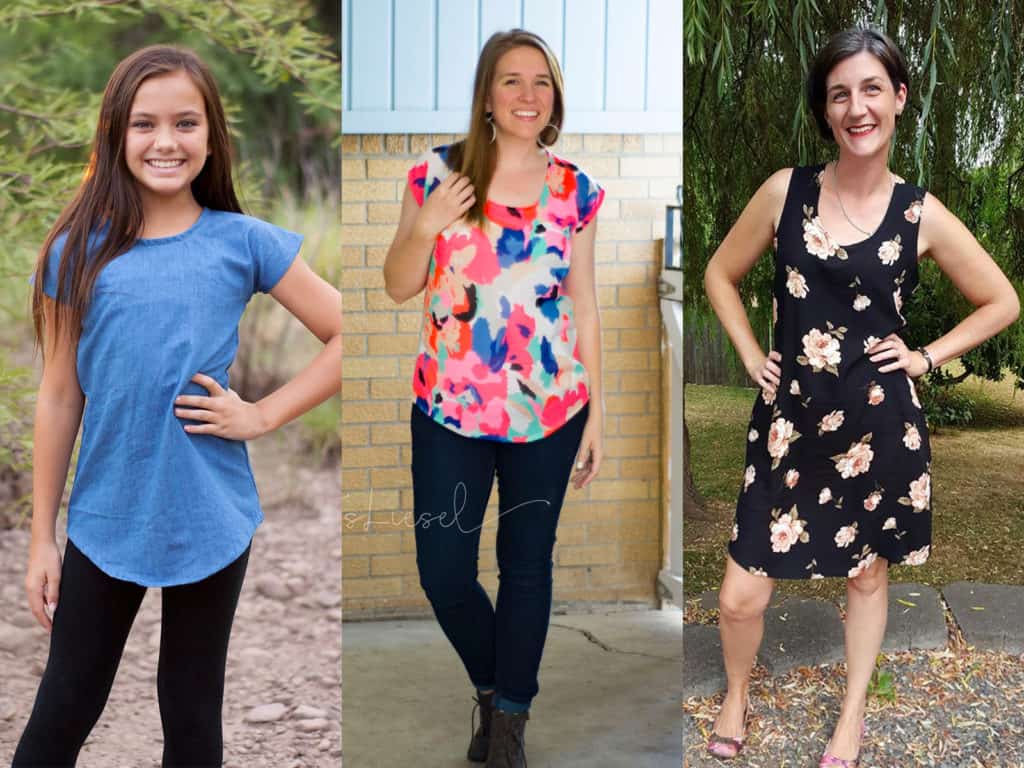
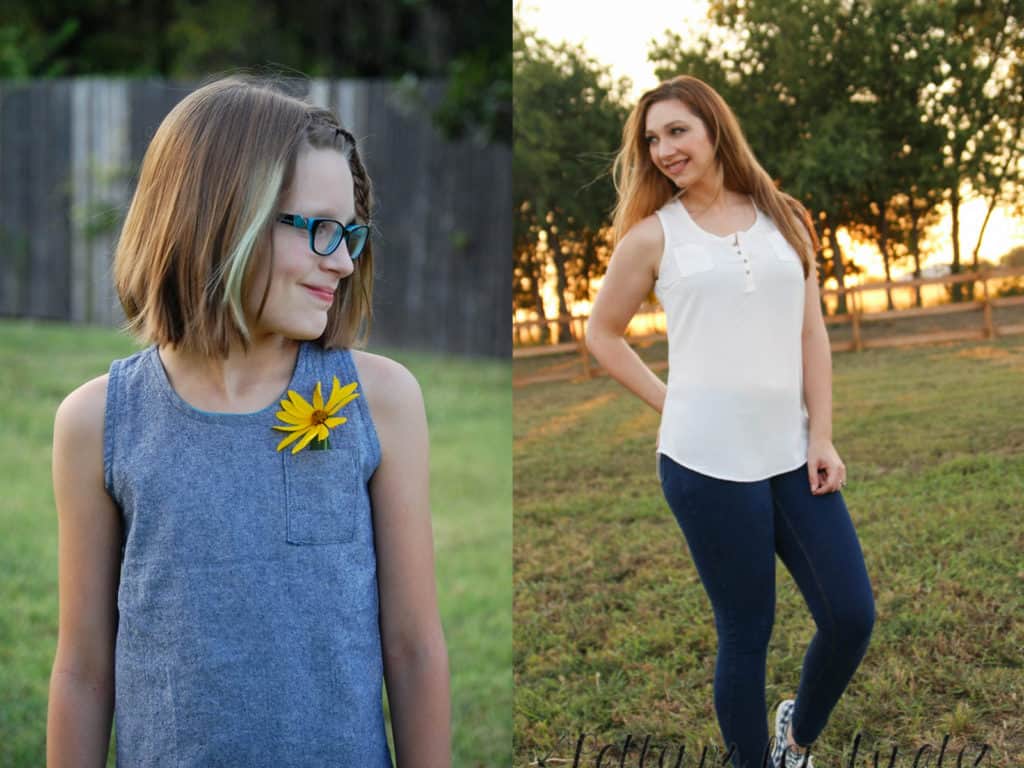
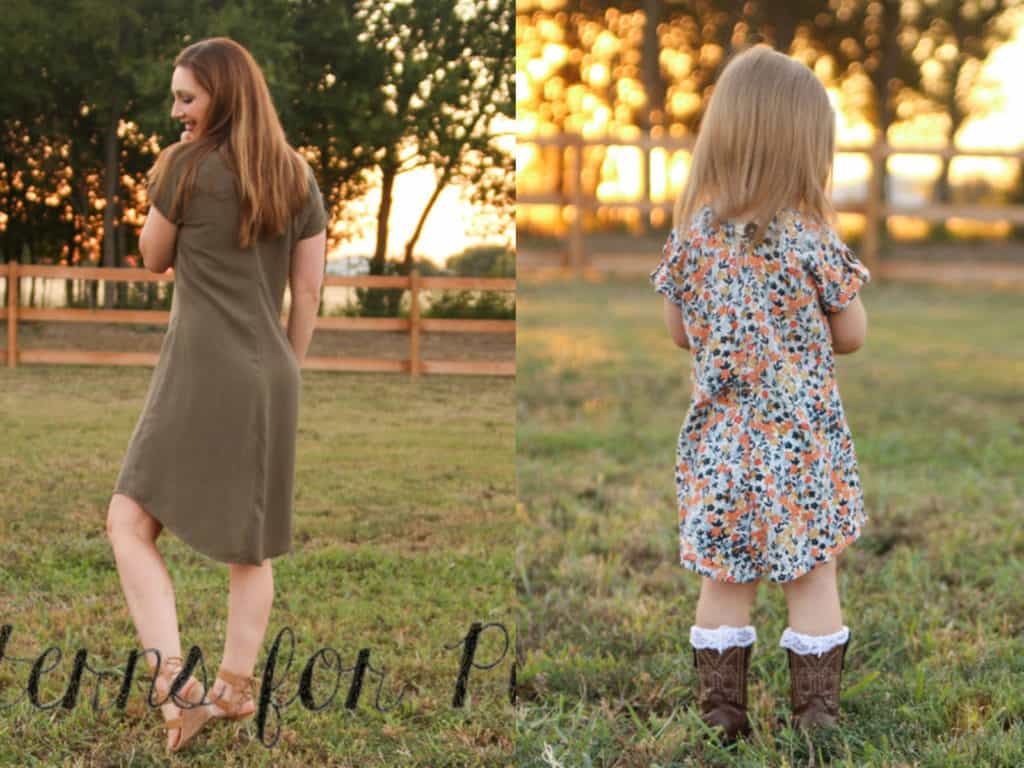
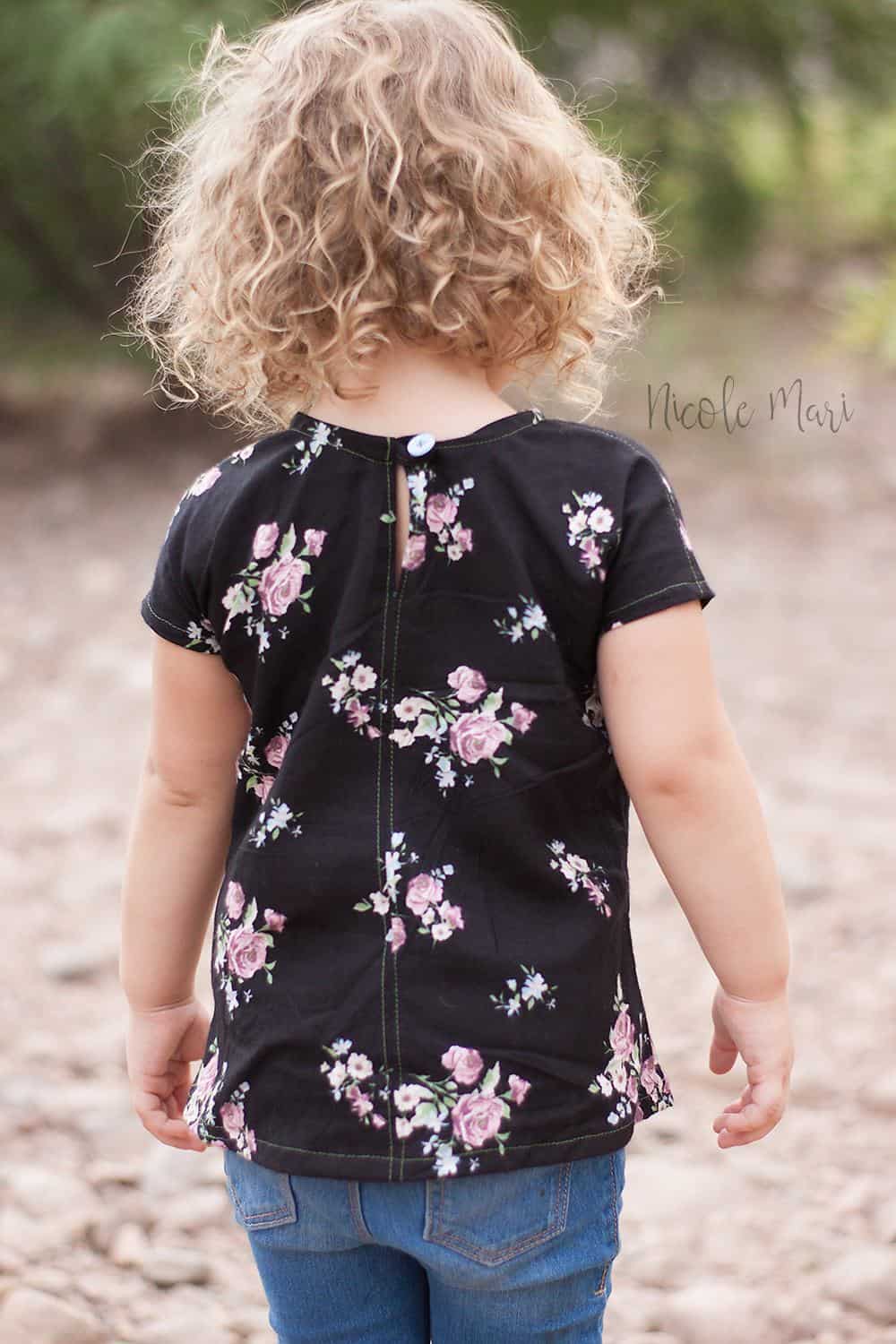
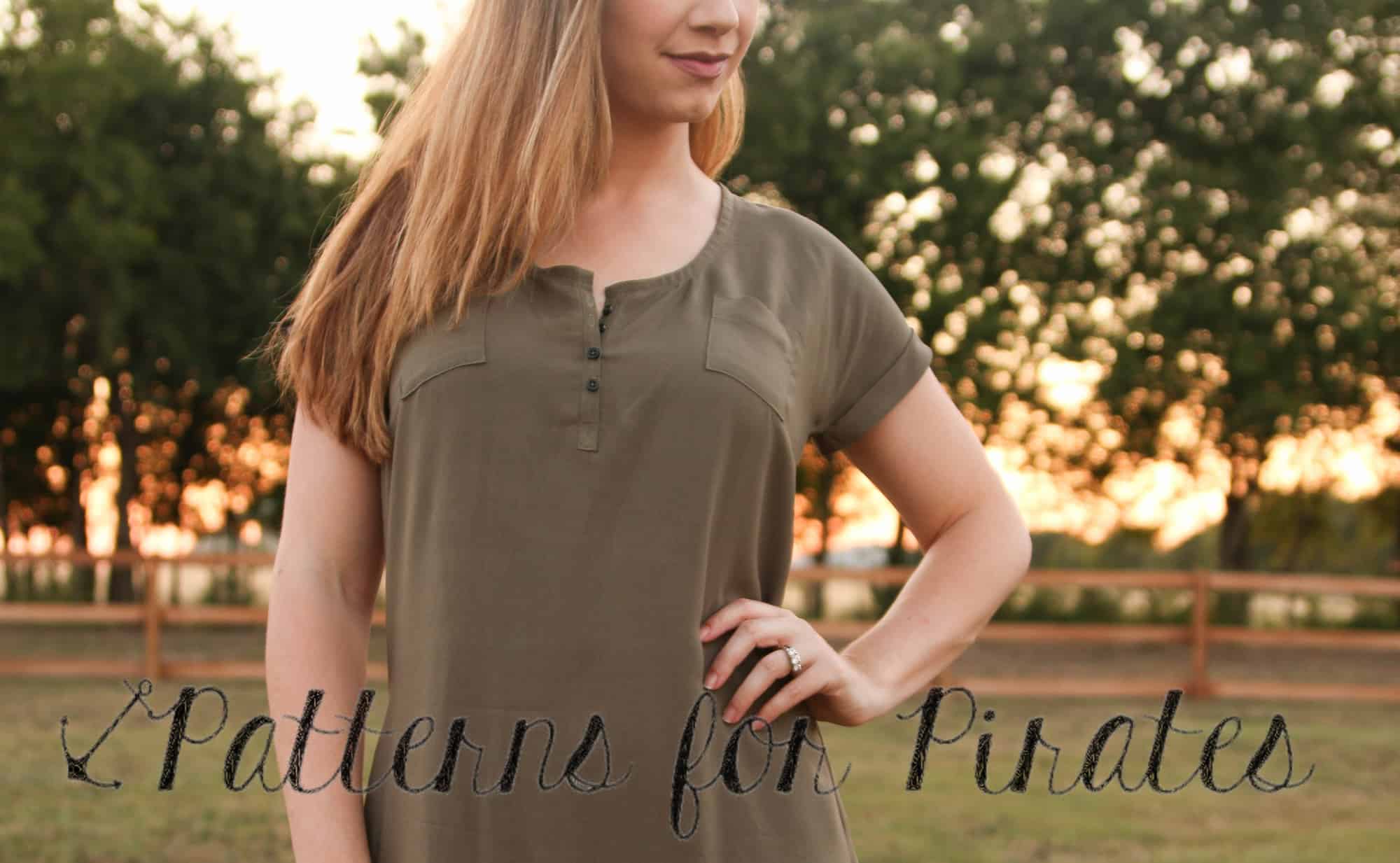
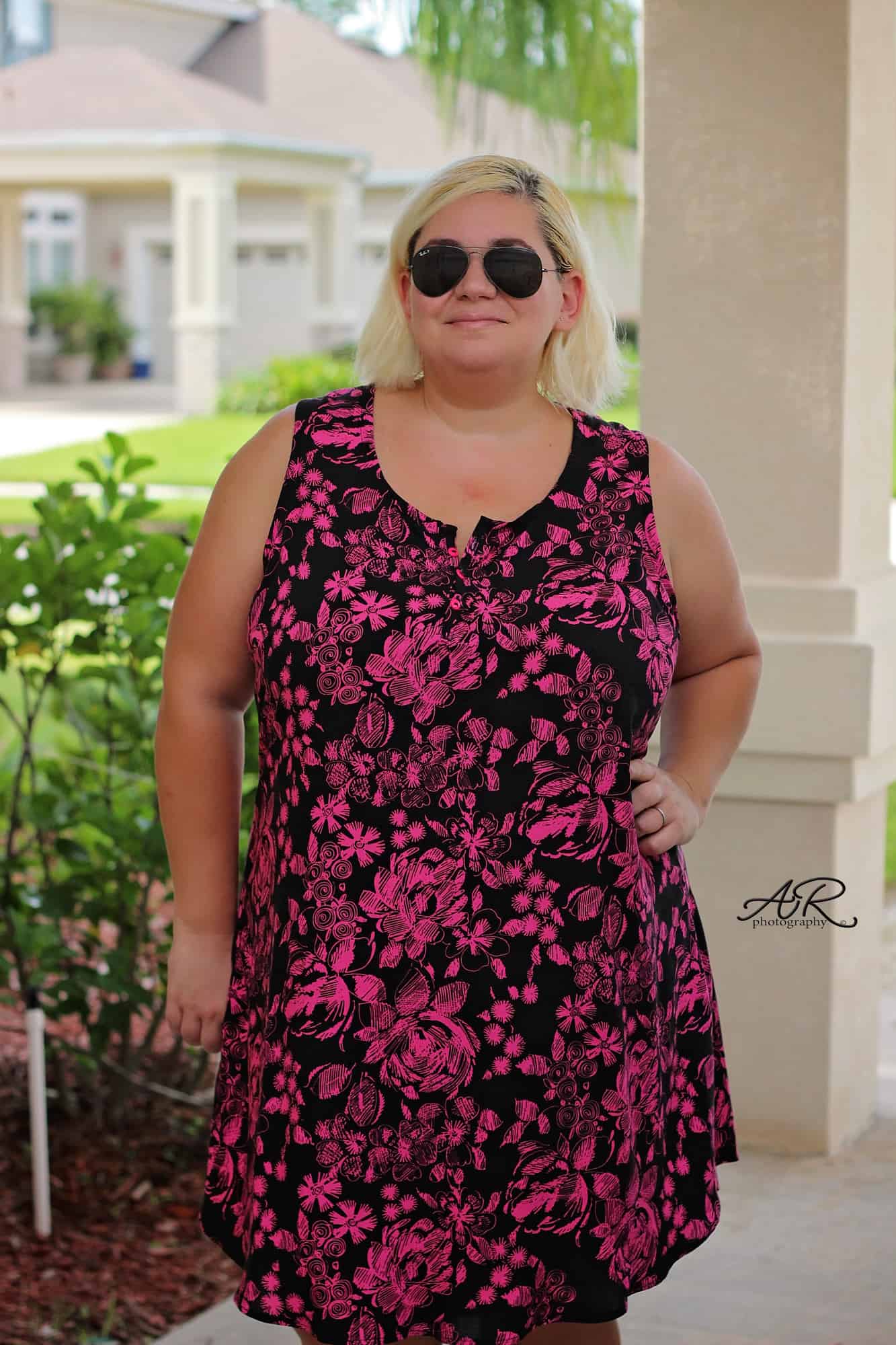
They are both fitted through chest/bust and looser through waist and hip.  They are the perfect casual event top and dress! Use up those gorgeous wovens in your stash or you see at the store and have the perfect thing for that next baby shower, birthday party, brunch with the girls…it even works great for your work or church rotations.

**Want to learn more about how to measure yourself for this pattern?  We’ve got you covered with an in-depth blog HERE.  And in case you’re new to Patterns for Pirates and PDF patterns in general, we have a great blog full of new user tips HERE to help you get started!  And, as with all of our current releases and updates, the pdfs now include our layers feature and can be found in Letter, A4 and A0 sizes.

Lets go over ALL the options!

They include a dolman style short sleeve, cap sleeve and tank.

Shirt length:

Tunic/Curved Hem:

And Dress Length:


They both include a henley option:

Chest Pockets:

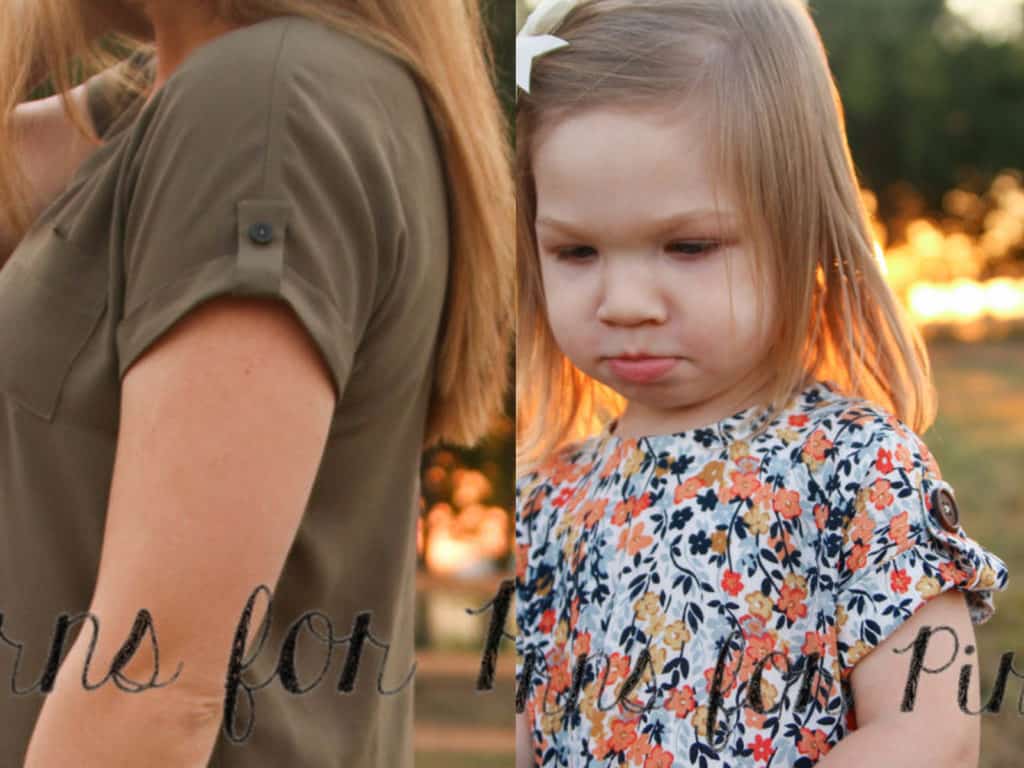
Short Sleeve Cuffs and Button Tabs:


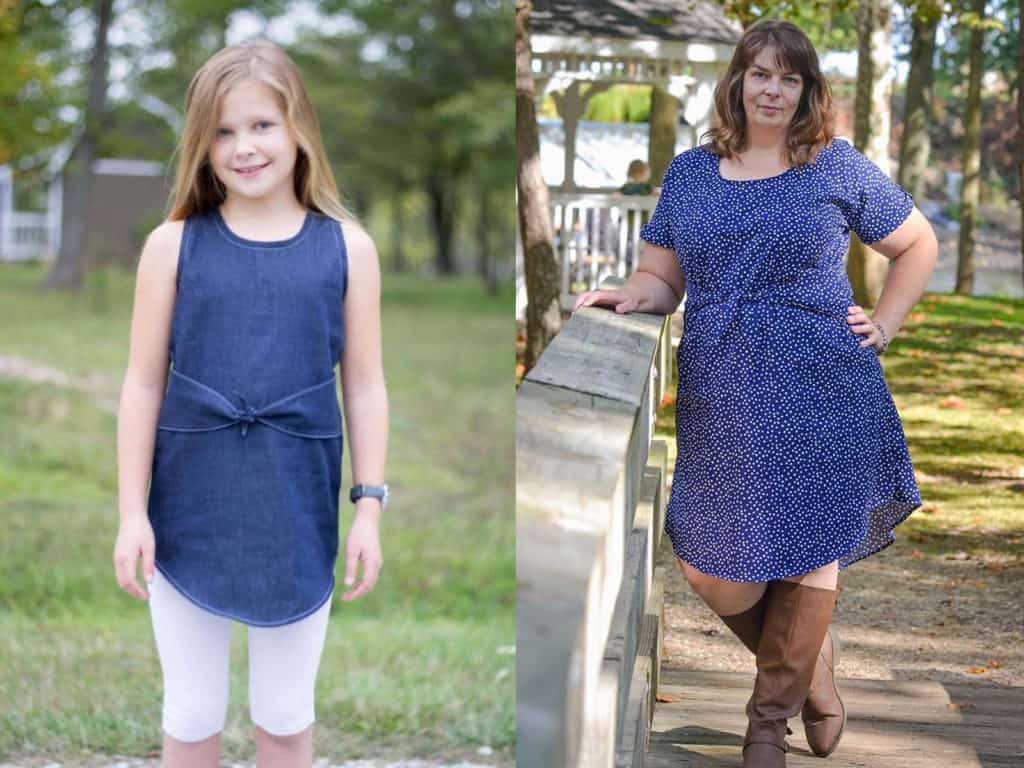
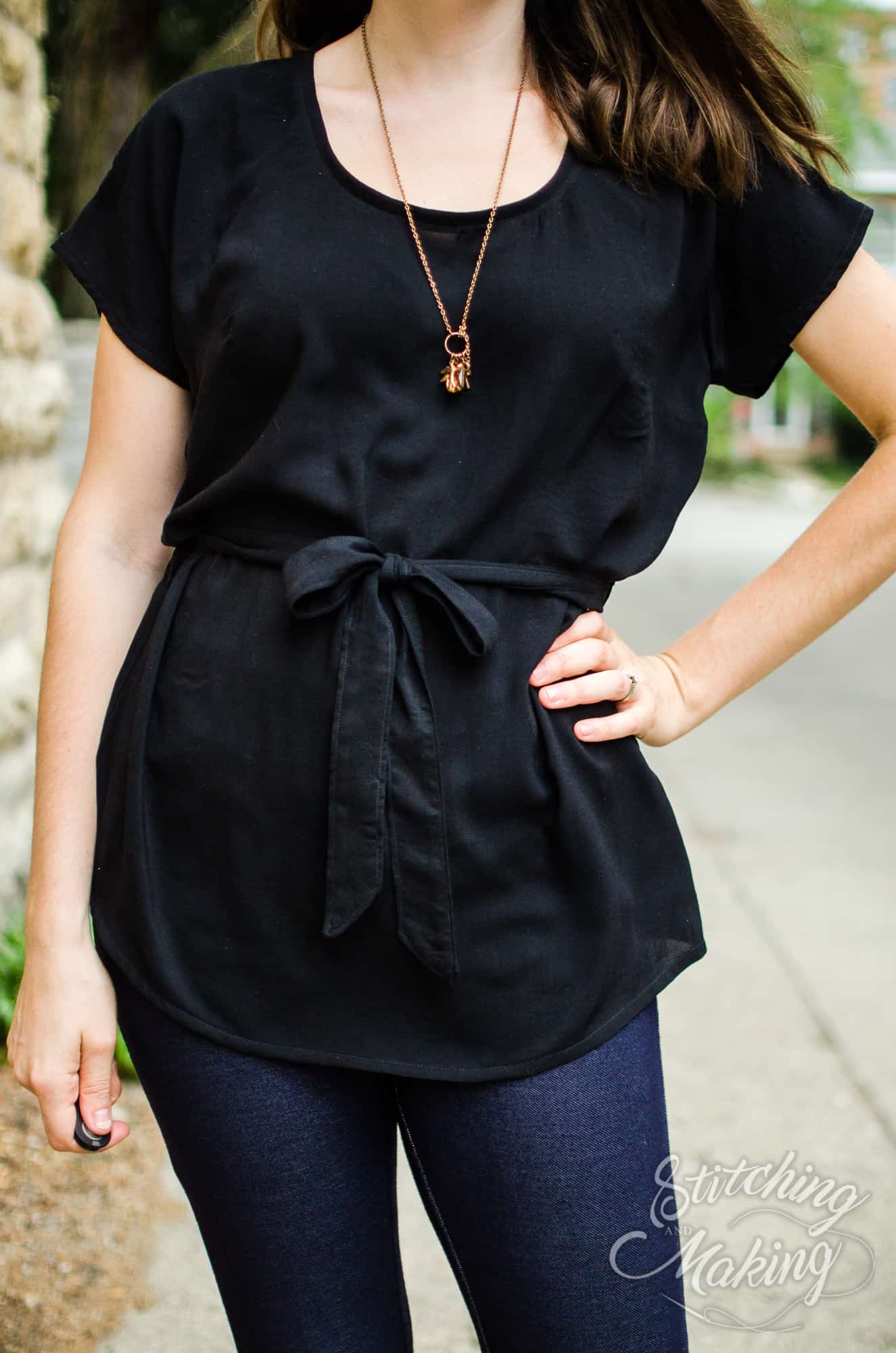
Waist Ties:

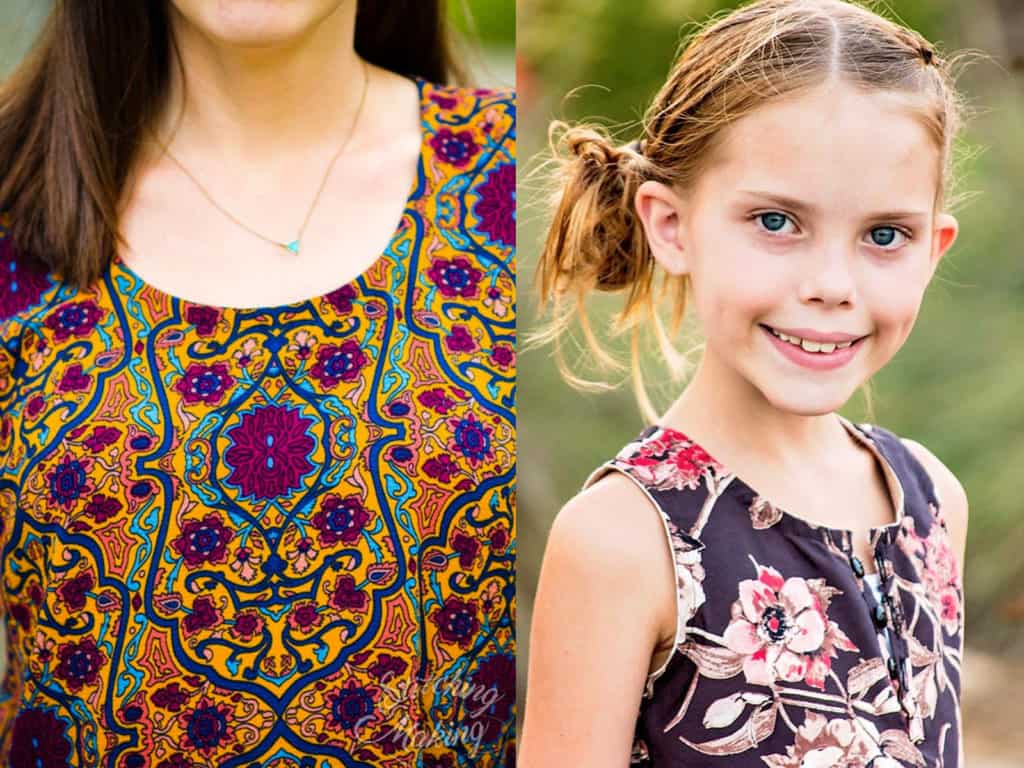
The neckline and  tank are finished with single fold bias binding to the inside:


Both have a center back seam:

Youth has a button and loop closure on the back while women’s is a simple pull on with no closure.

Don’t forget you can check out this pattern on all shapes and sizes and get a look at more examples of all the options in our albums in the P4P Facebook group! Here is the women’s Brunch Blouse Album and the youth Bitty Brunch Blouse Album.

The sale price will last through Sunday September 17th (midnight US Central time zone) so grab it while you can get that awesome price!

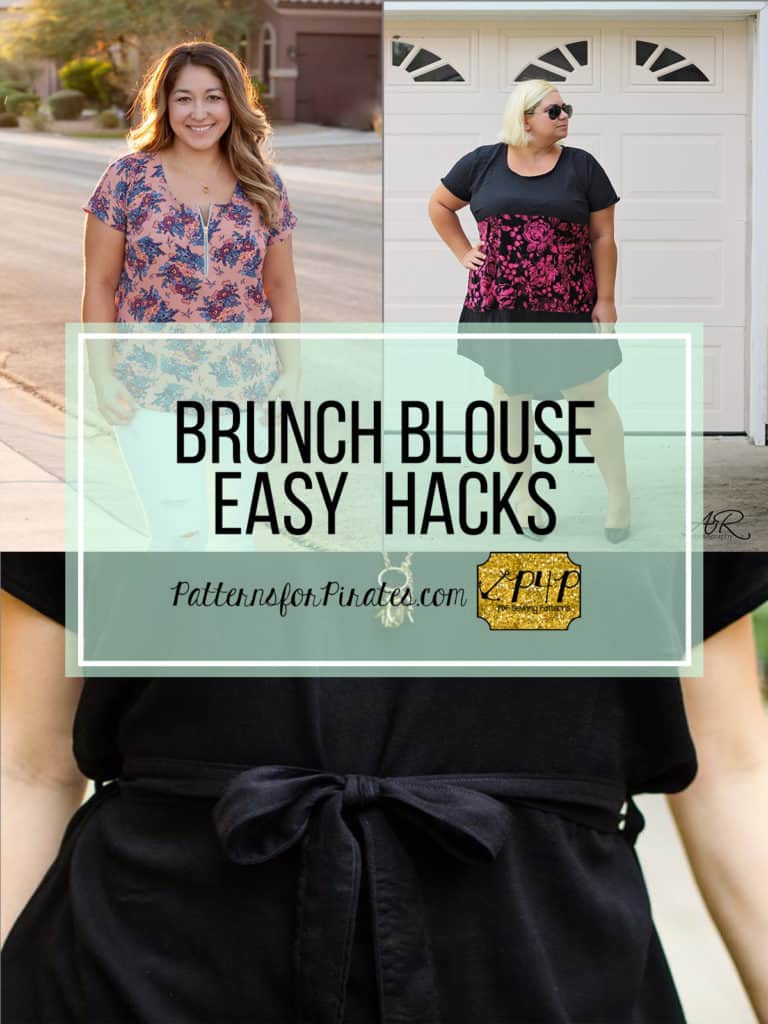
And if that wasn’t enough options, be sure to check out our Brunch Blouse Hacks HERE.

Filed Under: Pattern Release 3 Comments

Brunch Blouse – easy hacks

September 14, 2017

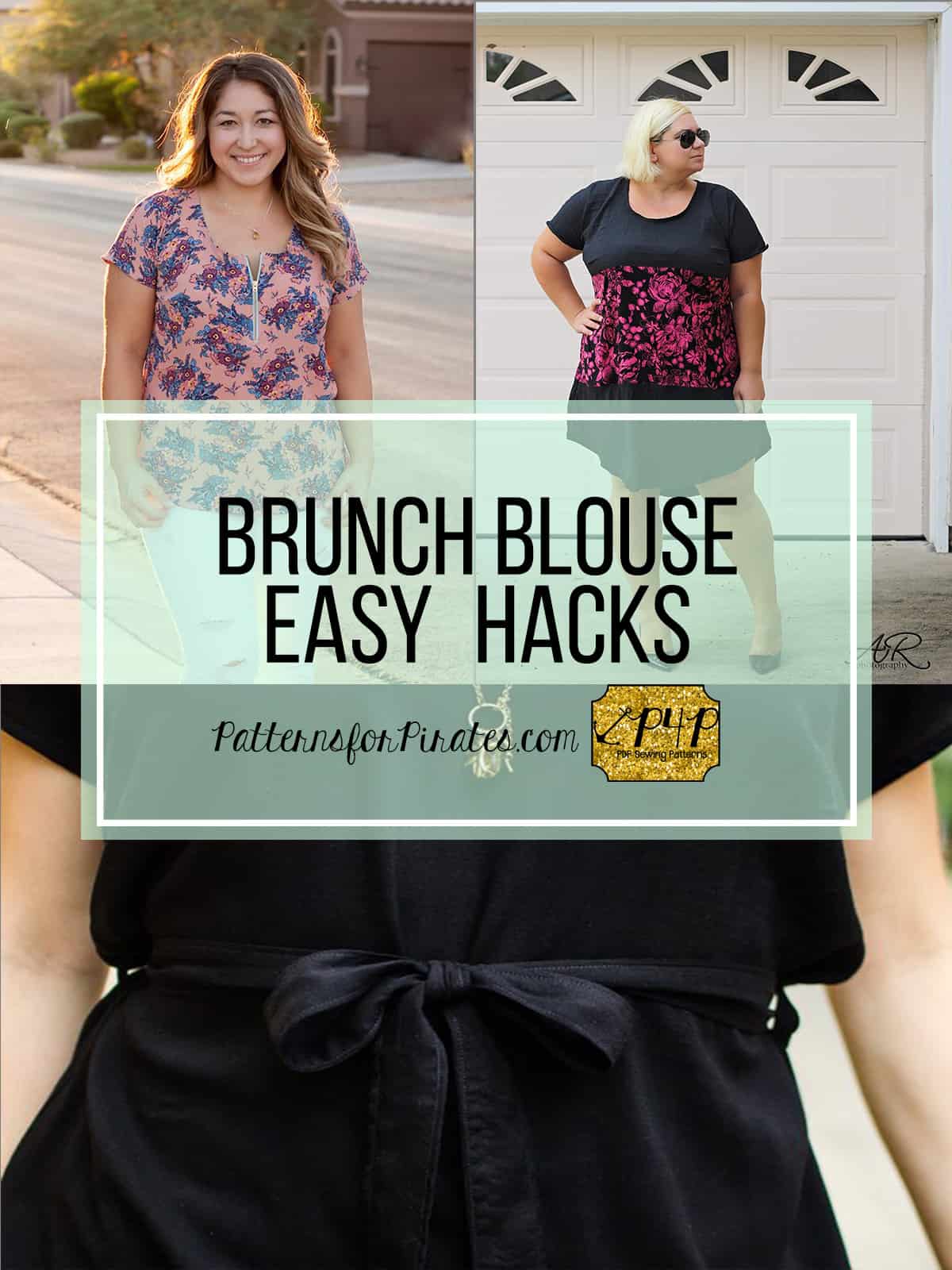
In true P4P fashion, we have a few easy, fun hacks for the Brunch Blouse. Grab the pattern here and get creating!

. . . . .

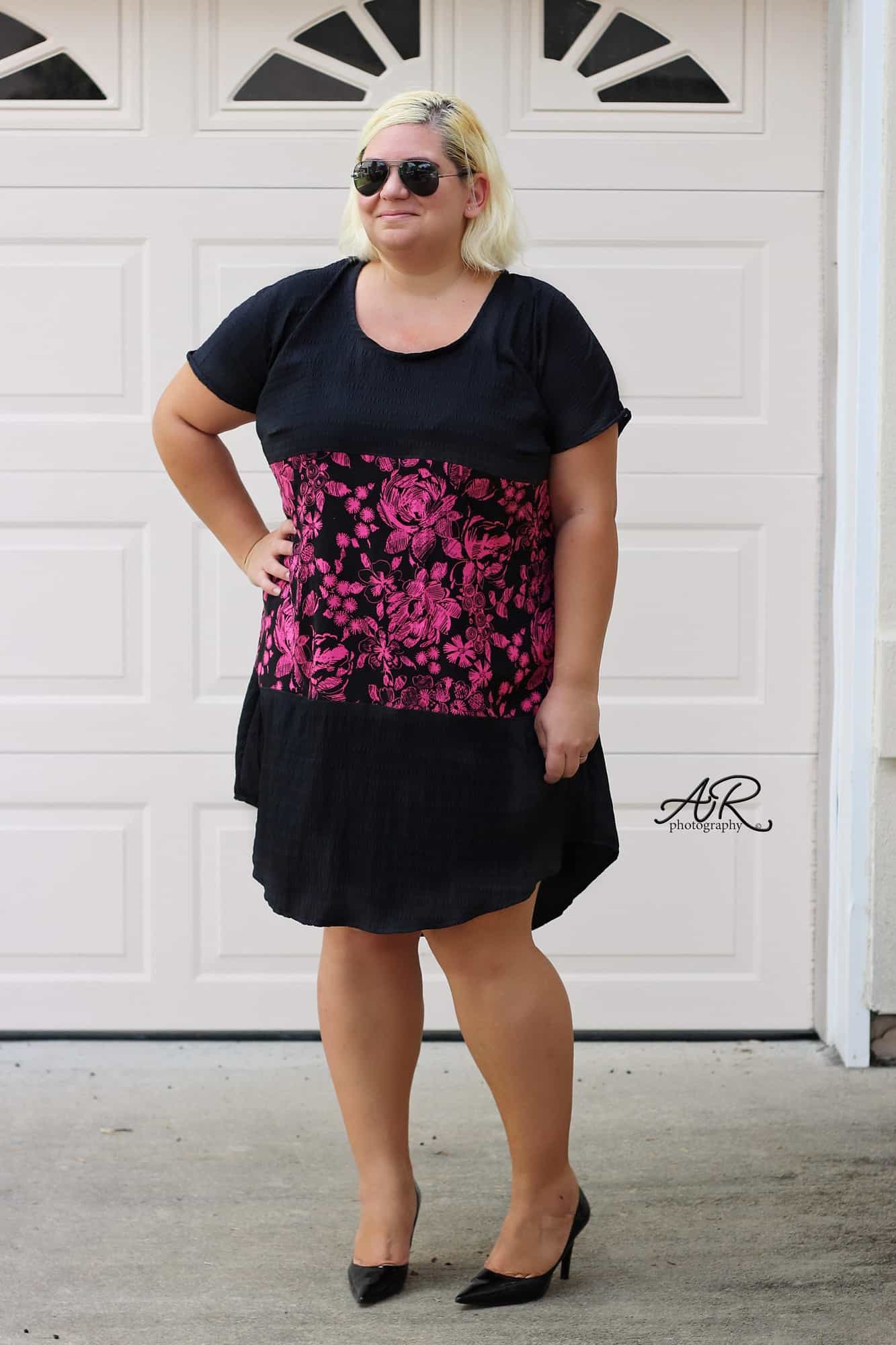
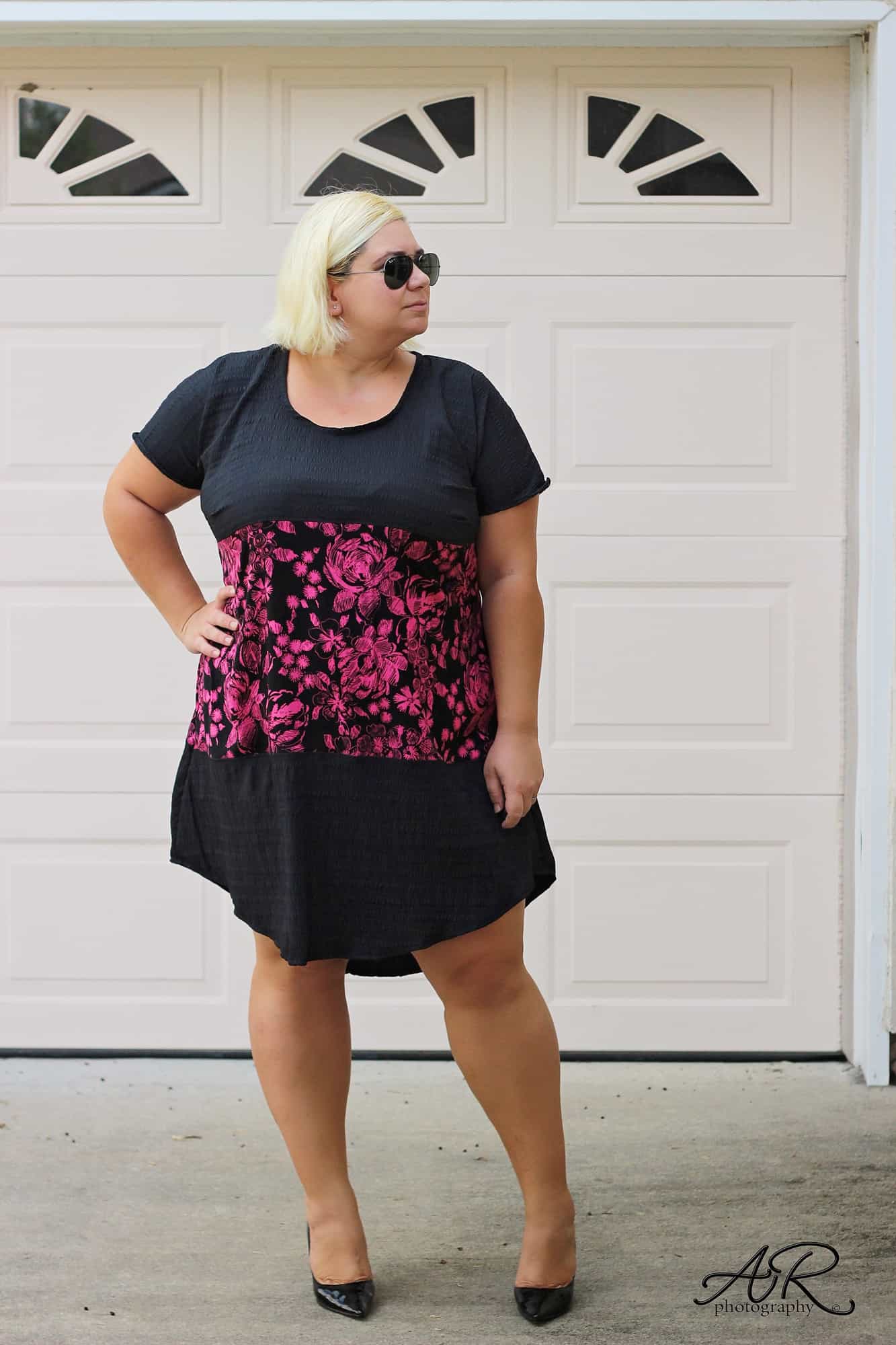
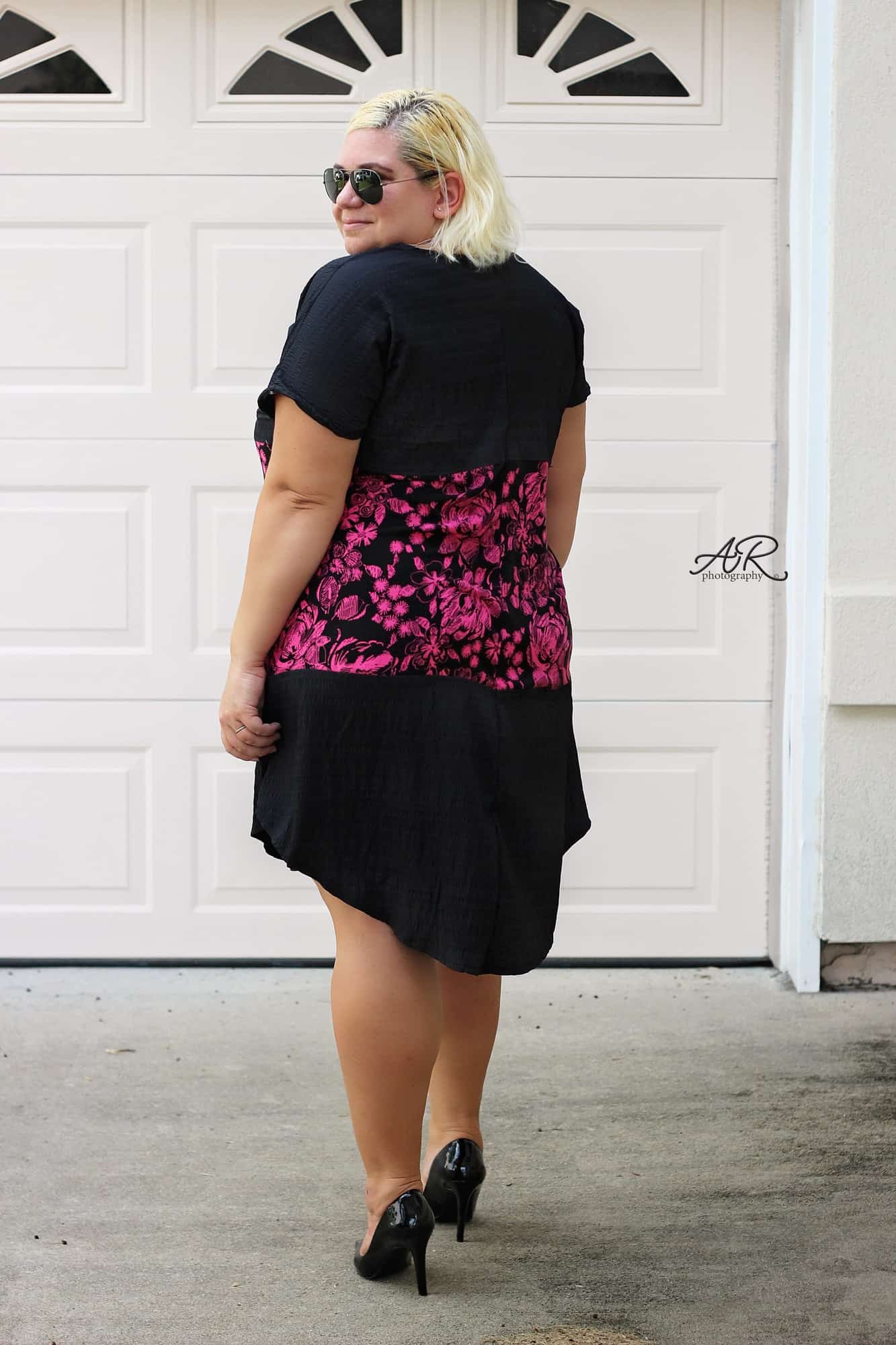
Color Block Dress

First off I will show you how to achieve a color block look with the dress option of the Brunch Blouse. You can use the same principles for the top option, you will just need to adjust some measurements. Start by printing the pattern in the size you need. Now grab a ruler and some scissors or a rotary cutter (for paper only 😉 ) because we’ll do some cutting.

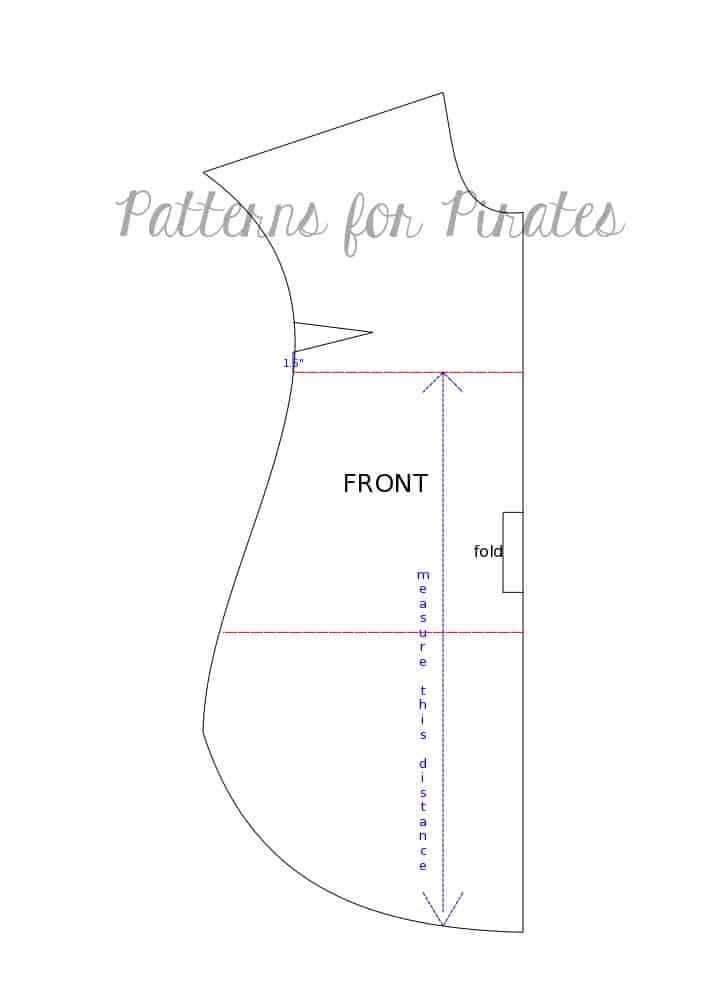
Take the front pattern piece and mark 1.5″ down from where the dart mark is. Now draw a horizontal line (perpendicular to the center fold). Measure the distance between this line and the bottom of the dress.

Divide the length in half and draw a horizontal line at the half way mark. You have now split the front in 3 separate pieces.

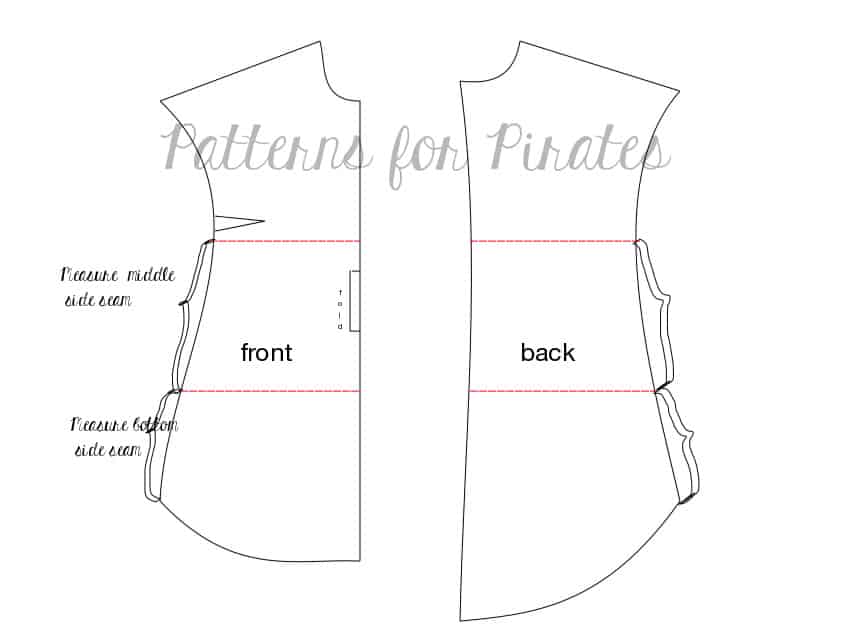
Measure the side seam from the bottom to the bottom colorblock line. Take your back piece and measure up on the side seam the same amount and mark it. Now draw a horizontal line on the back piece. We will be measuring the front middle part side seam now. Mark the point on the back piece from the bottom colorblock line to whatever the measurement was for the middle front side piece. Draw a horizontal line front that marking point. You have now color blocked your back pattern pieces too, making sure that they will line up beautifully with the front color block pieces. Great job!

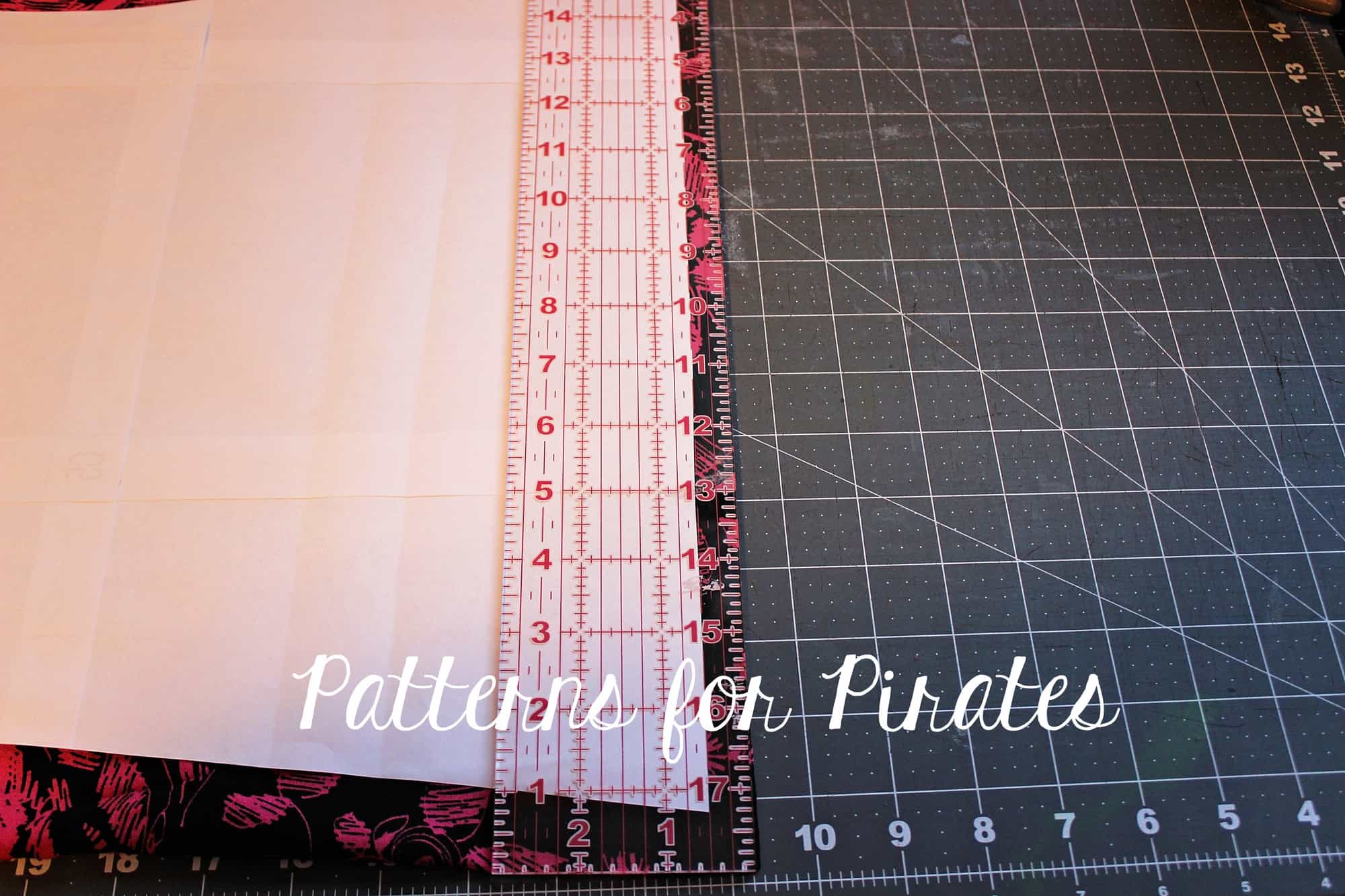
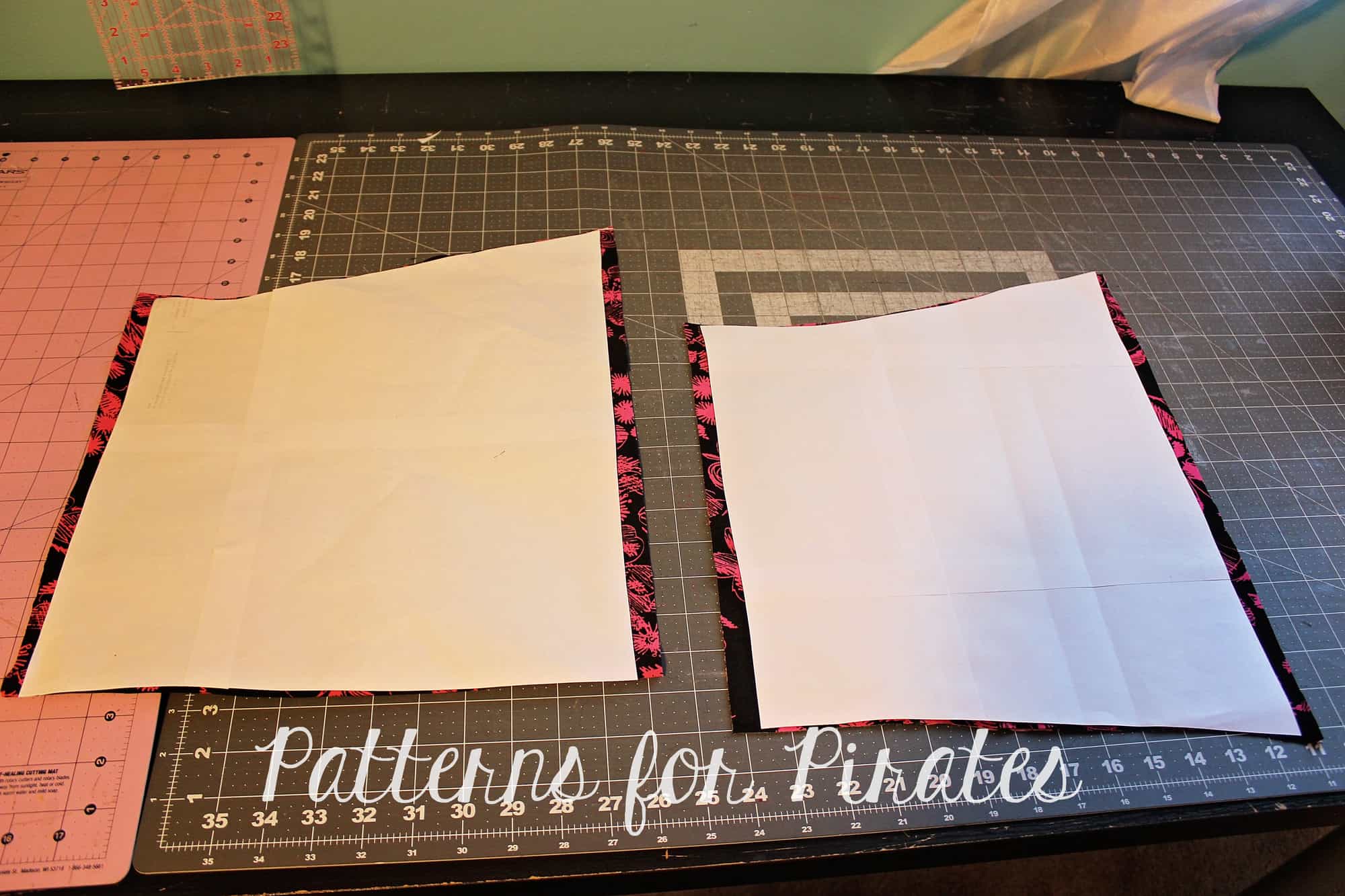
We will now cut the fabric. DO NOT FORGET THE SEAM ALLOWANCE! Since we are only dealing with straight color blocking lines, I will show you the easiest way to add SA. Simply use a quilter’s ruler and cut away 1/2 from the newly designed pattern pieces. Remember you need to add seam allowance only to the colorblock parts, NOT the center fold or side and middle back seam. Those seam allowances are already included in the pattern.

Once you have all your pieces cut (3 for the front, 6 for the back) you will start sewing them together. First sew the front top to the front middle (RST) with 1/2″ seam allowance, serger your raw edges and optionally top stitch. You will now sew the front bottom to the front middle, right sides together. You now have your front piece ready. Repeat the process for the back pieces. Remember that the back of the Brunch Blouse is not cut on fold so you will end up with two mirrored back cuts.

Finish sewing your BB dress as per the tutorial instruction. How easy and fun was that? You can get creative with your color blocking…just imagine a beautiful ombre blouse, or a blouse with lace overlay for the top colorblock. The possibilities are endless.

. . . . .

Belt Loops and Sash Hack

This hack is super easy but a fun option for a different look than the normal Brunch Blouse!  You can do this hack with any option except the one that already includes the waist tie.


1. First, sew up your blouse/dress as usual.  Make sure to mark the notches on the side seams, add a pin as well after you’ve sewn the side seams so that you can still see where the notch is.

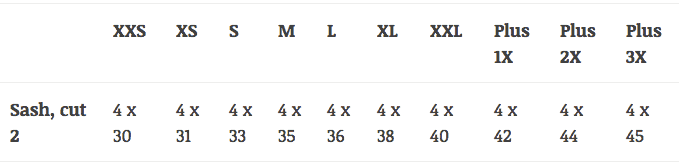
2. To make the sash, refer to this cut chart based on your size.  Cut two.


3. Right sides together, sew the short ends together.  Press open and finish edges.


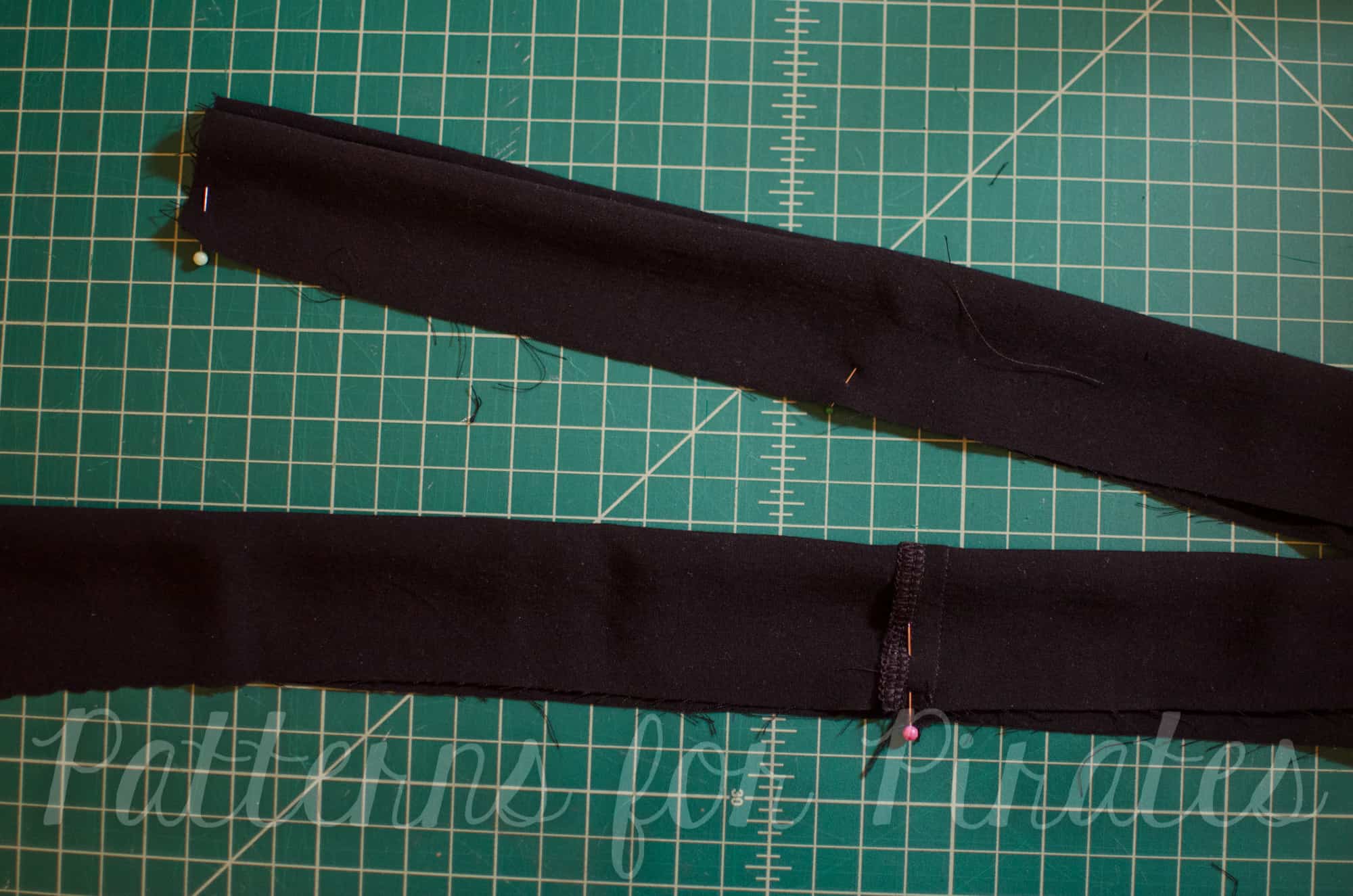
4. Right sides together, sew the long edges now, but leave 2″ unsewn in the middle.  This is how you’ll turn it right side out when you’re done.
 

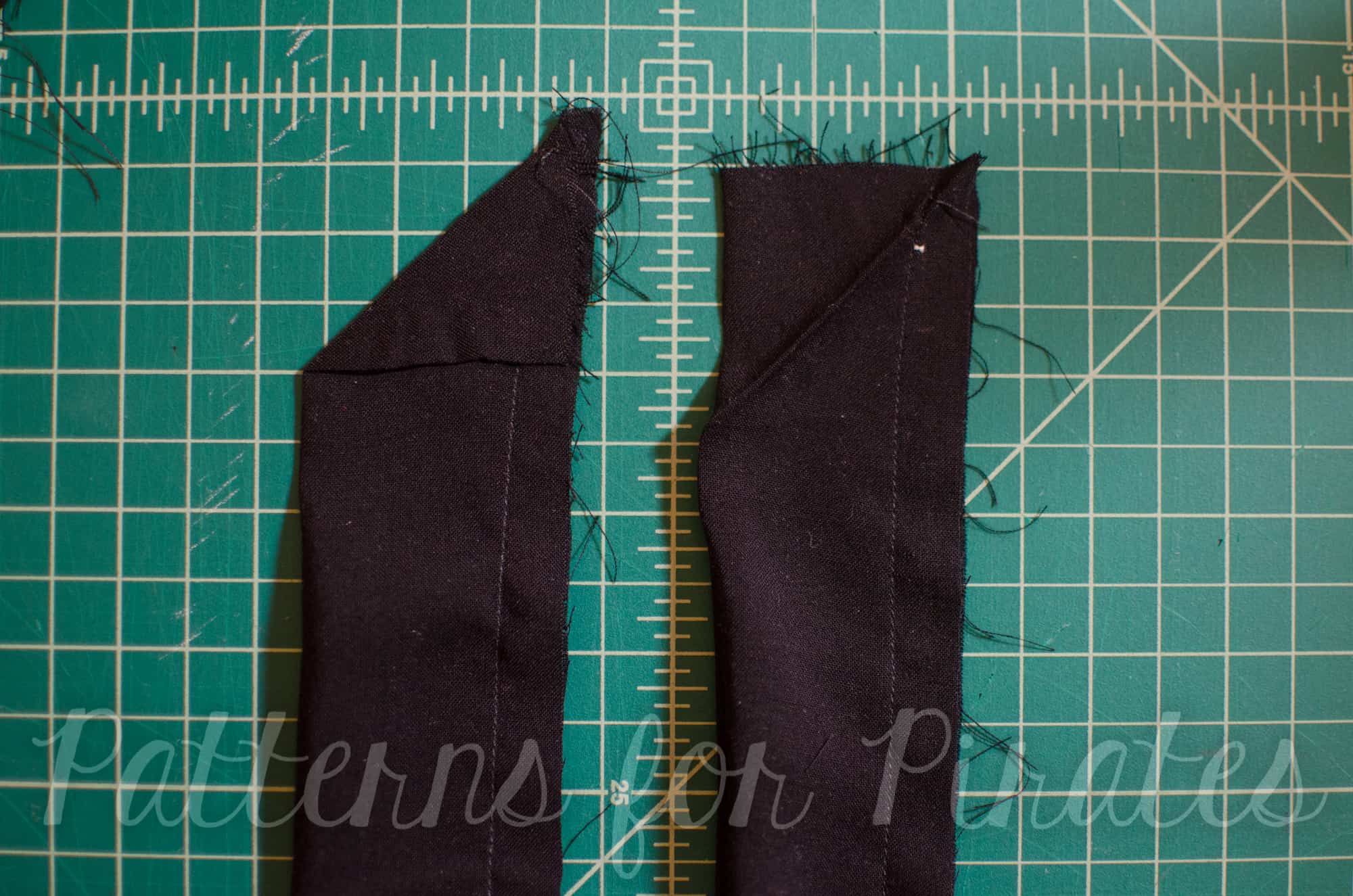
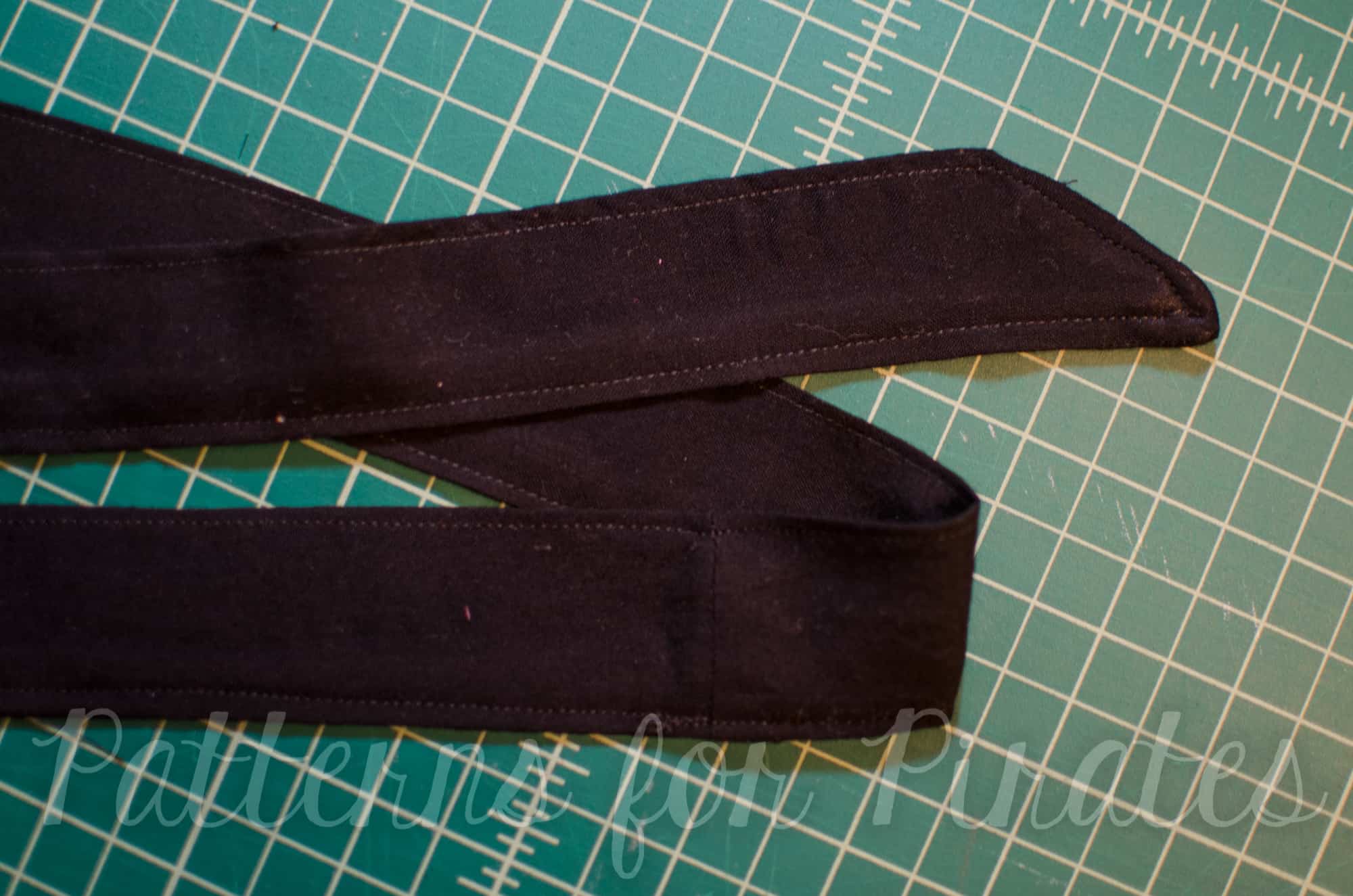
5. Iron the short edge over to form a triangle.  Now sew here to make the pointed edge, and trim the seam allowance down to 1/2″.


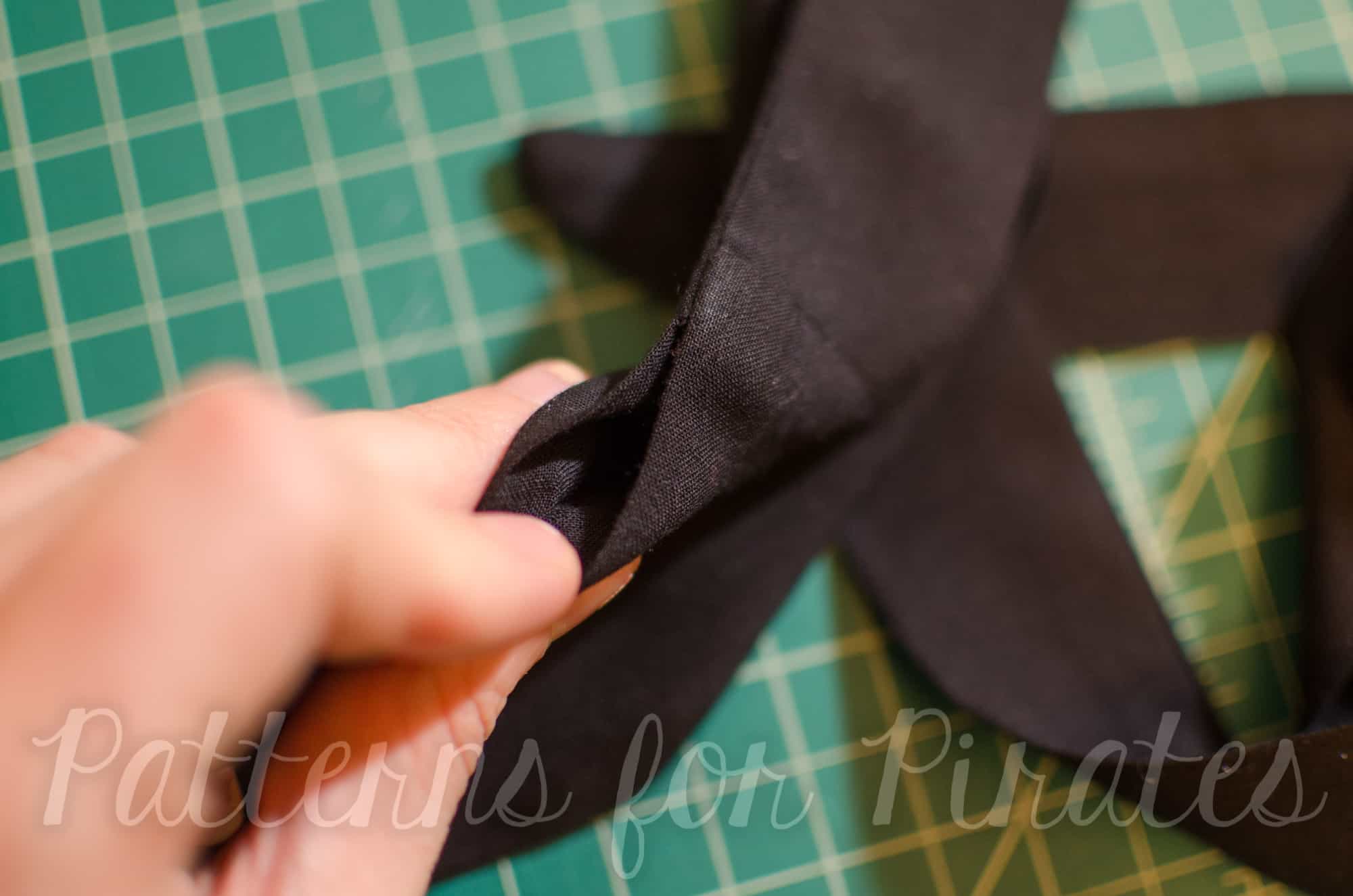
6. Turn right side out, press, and topstitch as close to the edge as you feel comfortable.  When you get to the 2″ you left open, align the seam allowance inside and and stitch shut while topstitching.


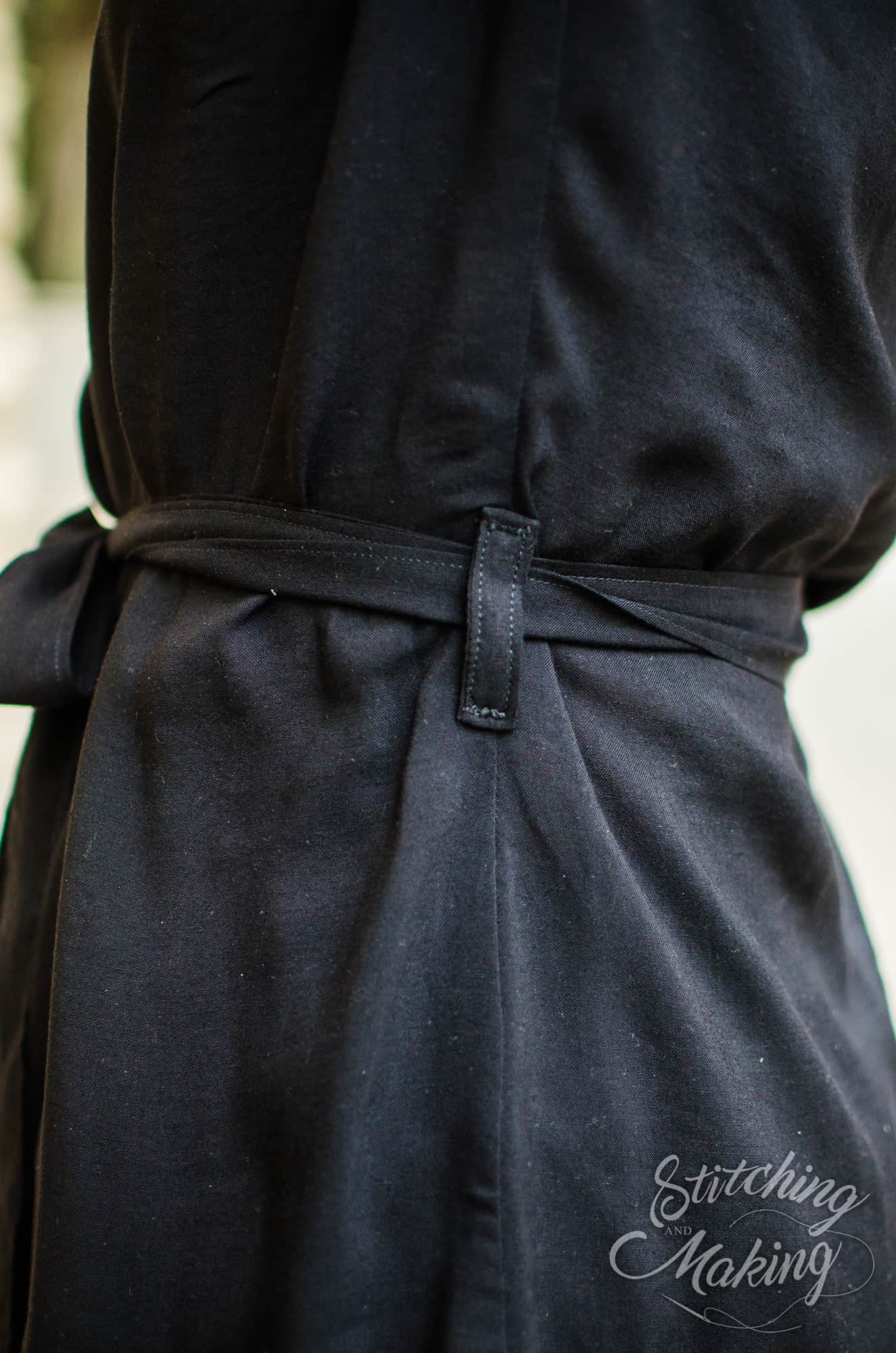
7. For the belt loops, first decide if you want two or three.  I opted for two because I didn’t want one on the back (I just don’t like the feeling).

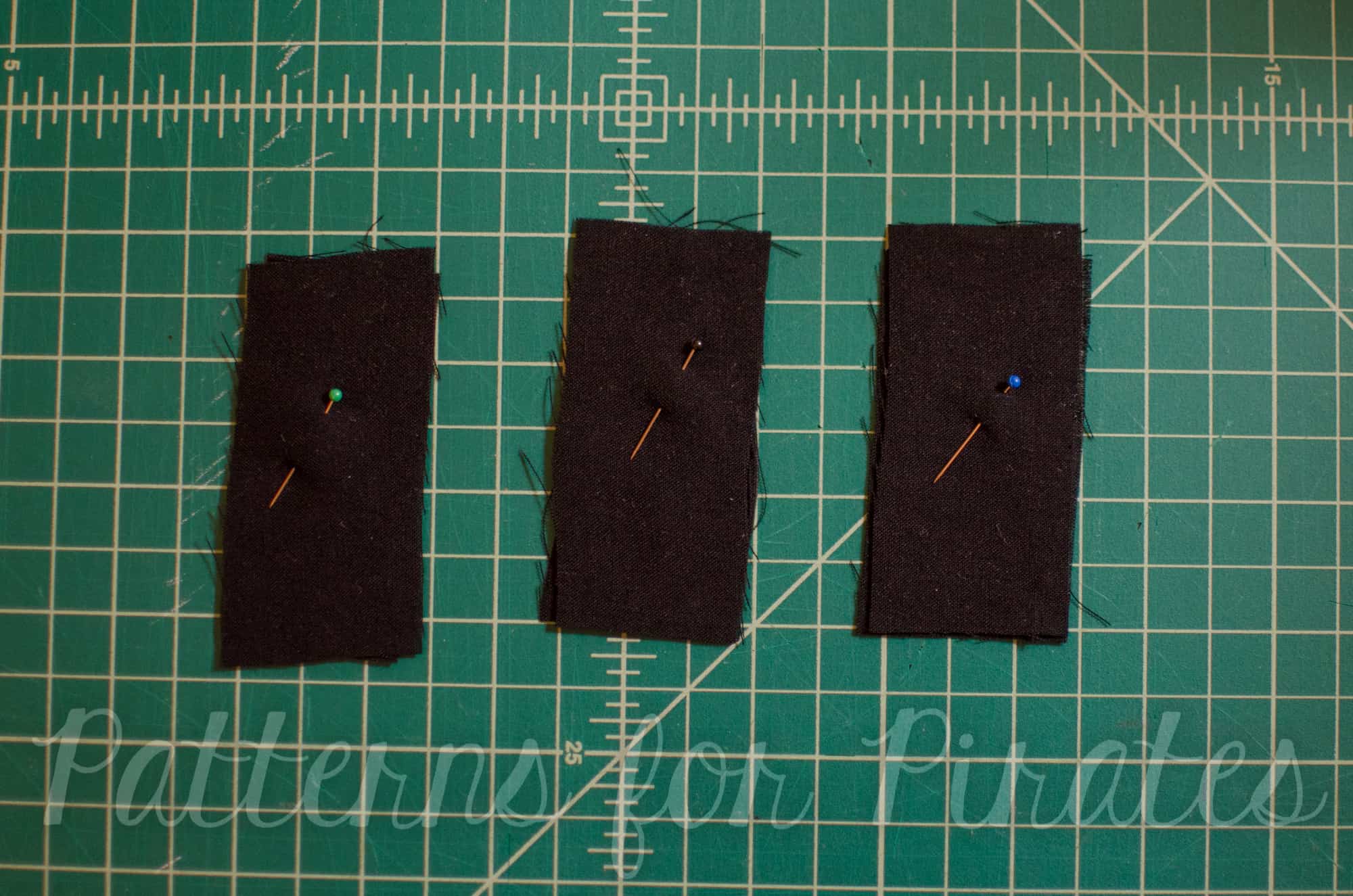
8. Cut rectangles 3″ x 1.5″ – four for two belt loops or six for three belt loops.


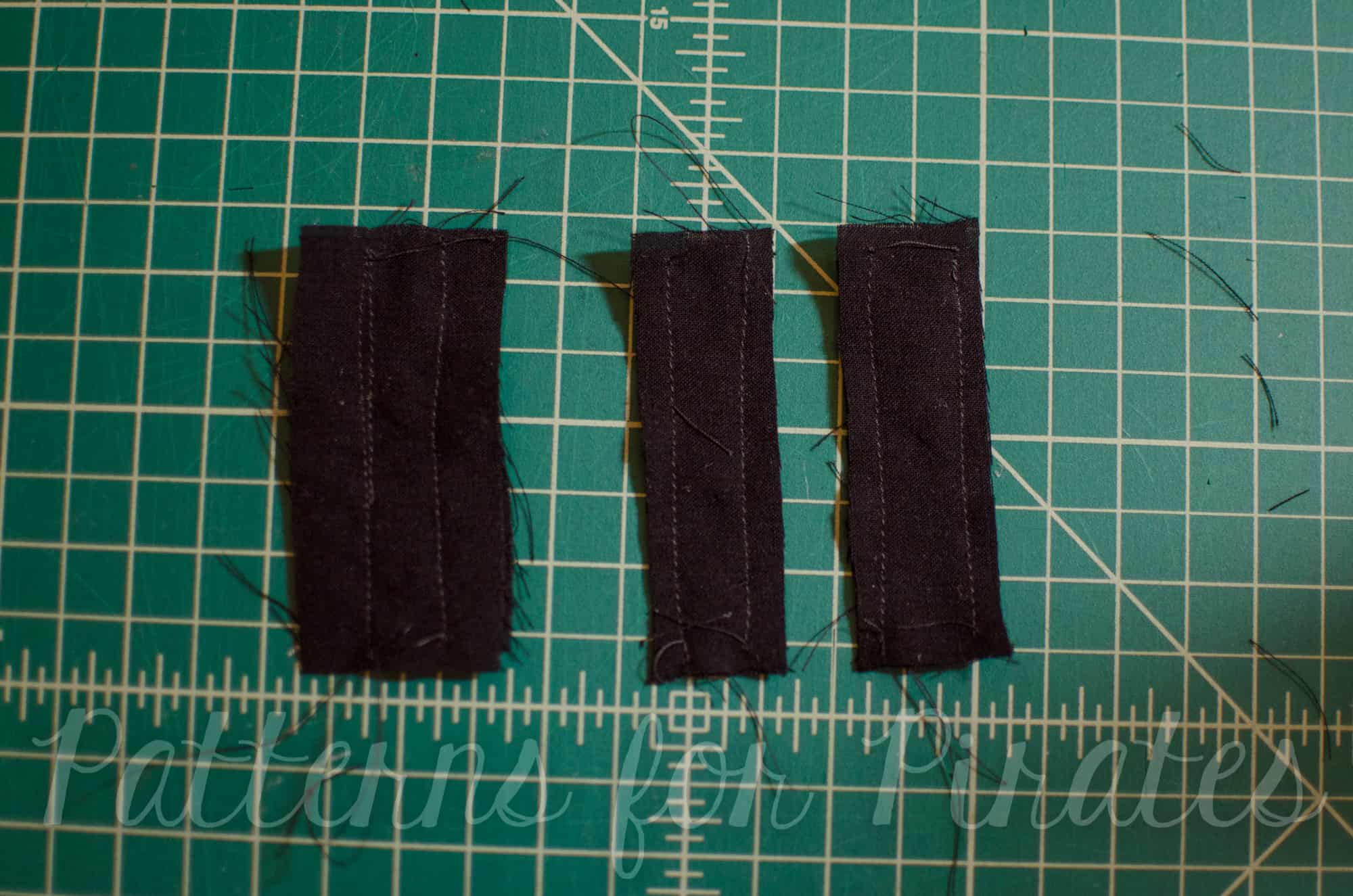
9. Stitch along the long edges, right sides together.  Then trim seam allowance to 1/4″.


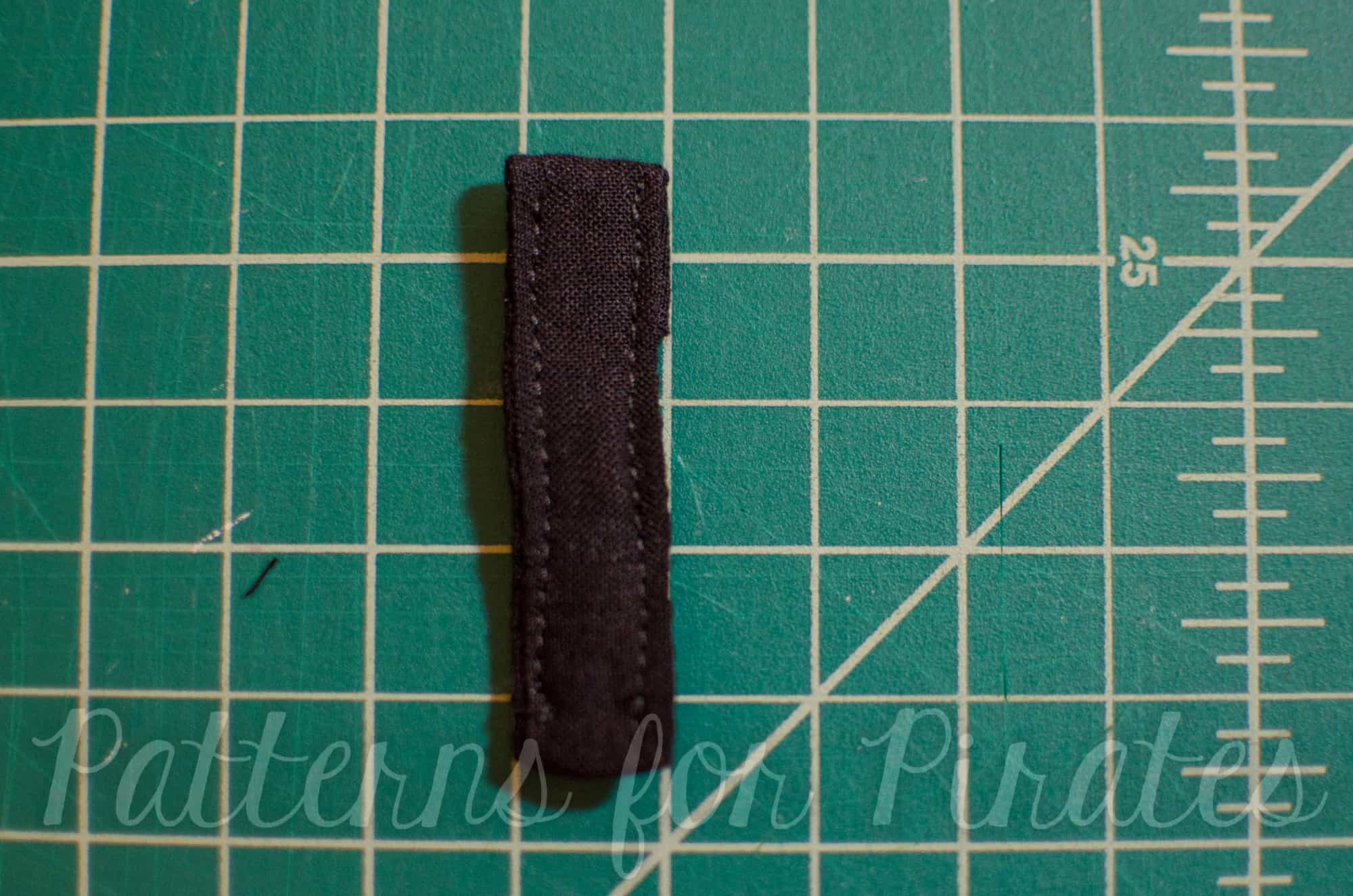
10. Turn right side out, press short raw edges to the back 1/2″. then topstitch down the long edges as close to the edge as you feel comfortable.


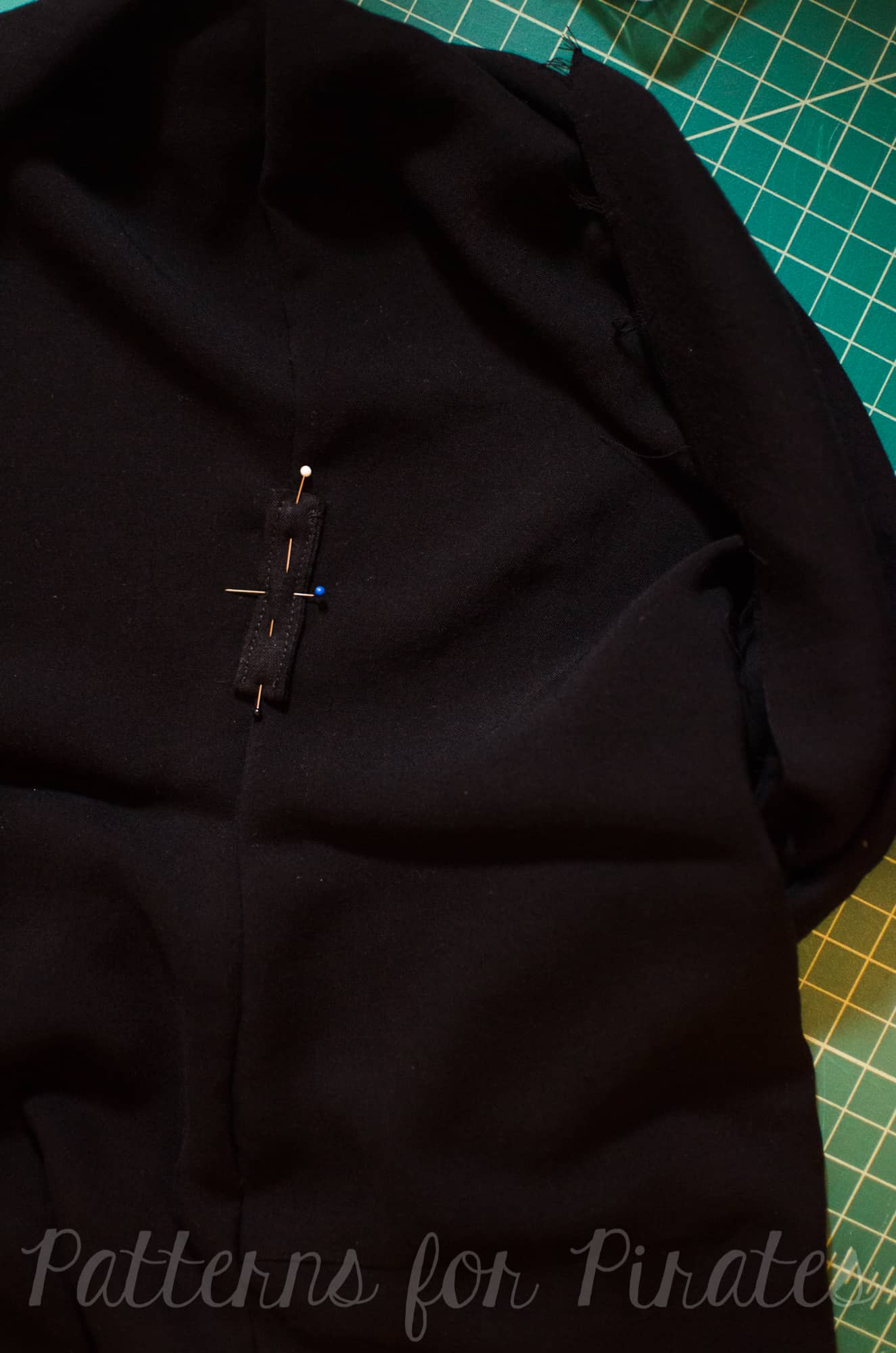
11. Find the notch on the blouse side seams you marked earlier.  Sew the loops on to the side seams, over the notch, by topstitching the short side 1/4″ from the edge.  If you’d like a loop on the back too, find the middle of the back neckline and use a ruler to find the center back of the blouse from there and attach.


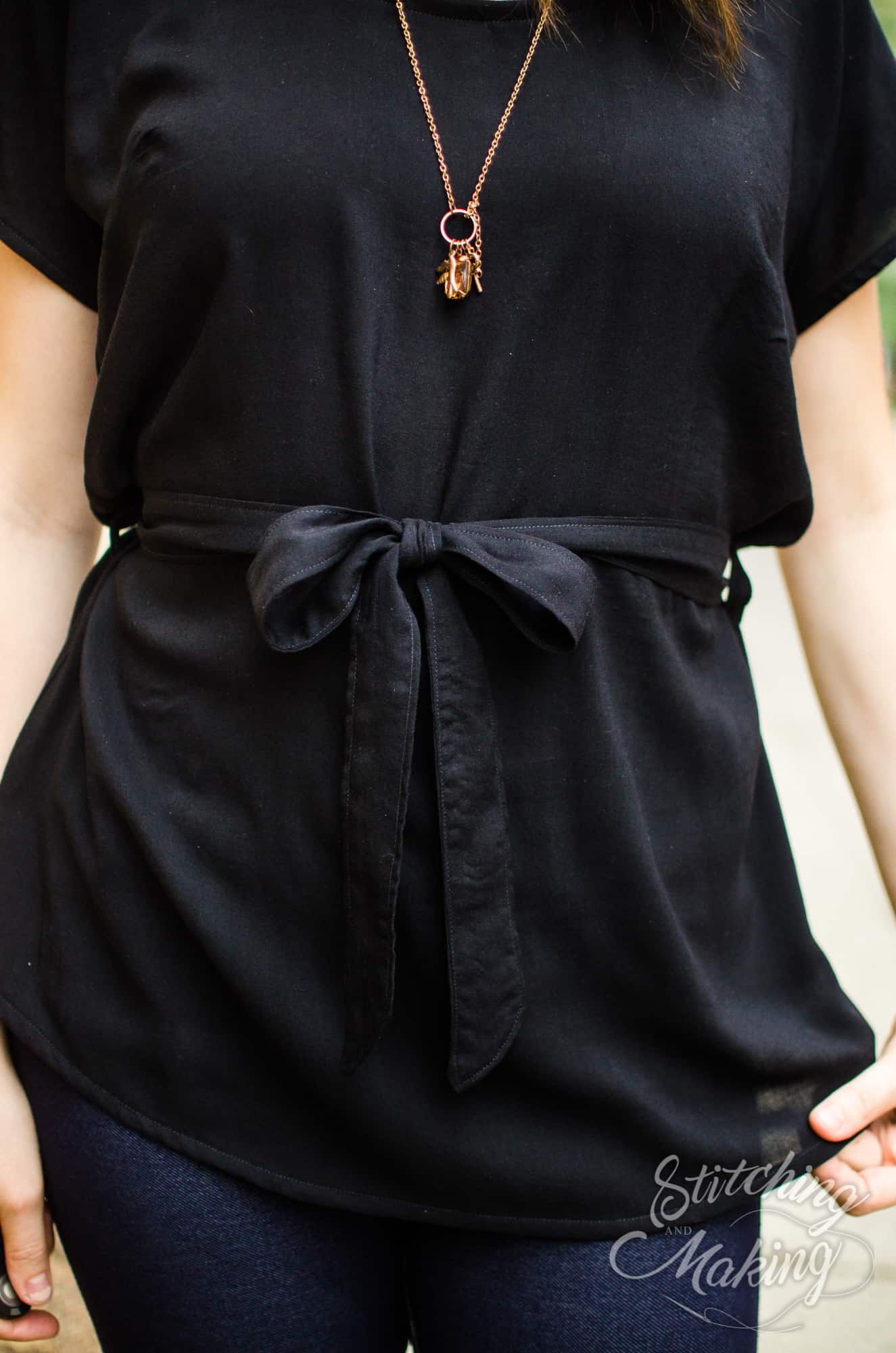
12.  Press everything one last time.  Slip in your sash into the loops and wear your new blouse!


~Elisabeth

. . . . .

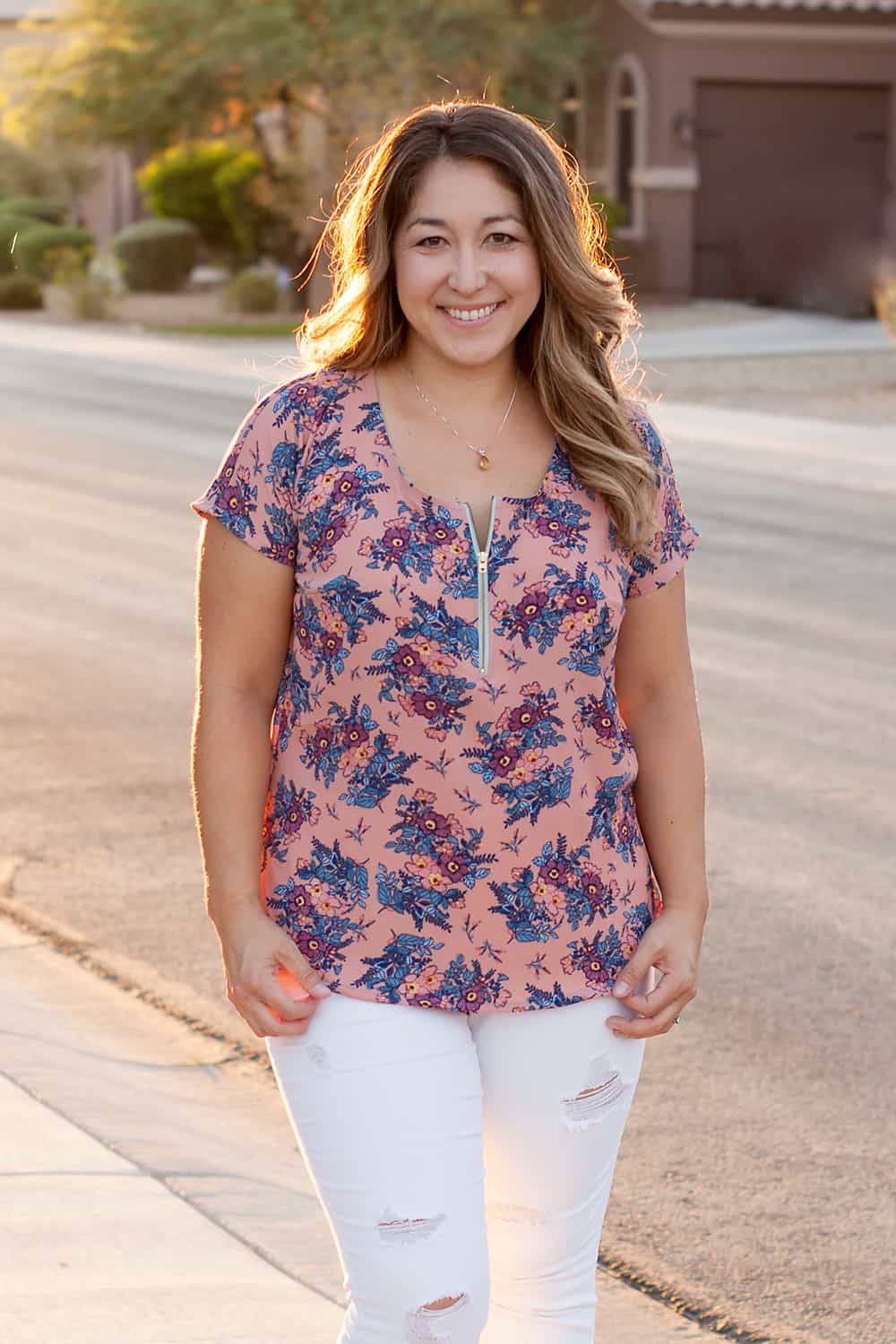
Front Zipper Hack


This is a little more intense and involves one of those scary things… you know, a zipper!  Now, if you’ve never installed a zipper this may be a little daunting, but I promise, take it slow, you can do this!

I am using a 7″ (I think?) exposed metal zipper but you can choose your preferred length if you want it shorter or longer.  If you’re choosing this option, do this prior to any other step in completing your top.  So now, let’s get started.

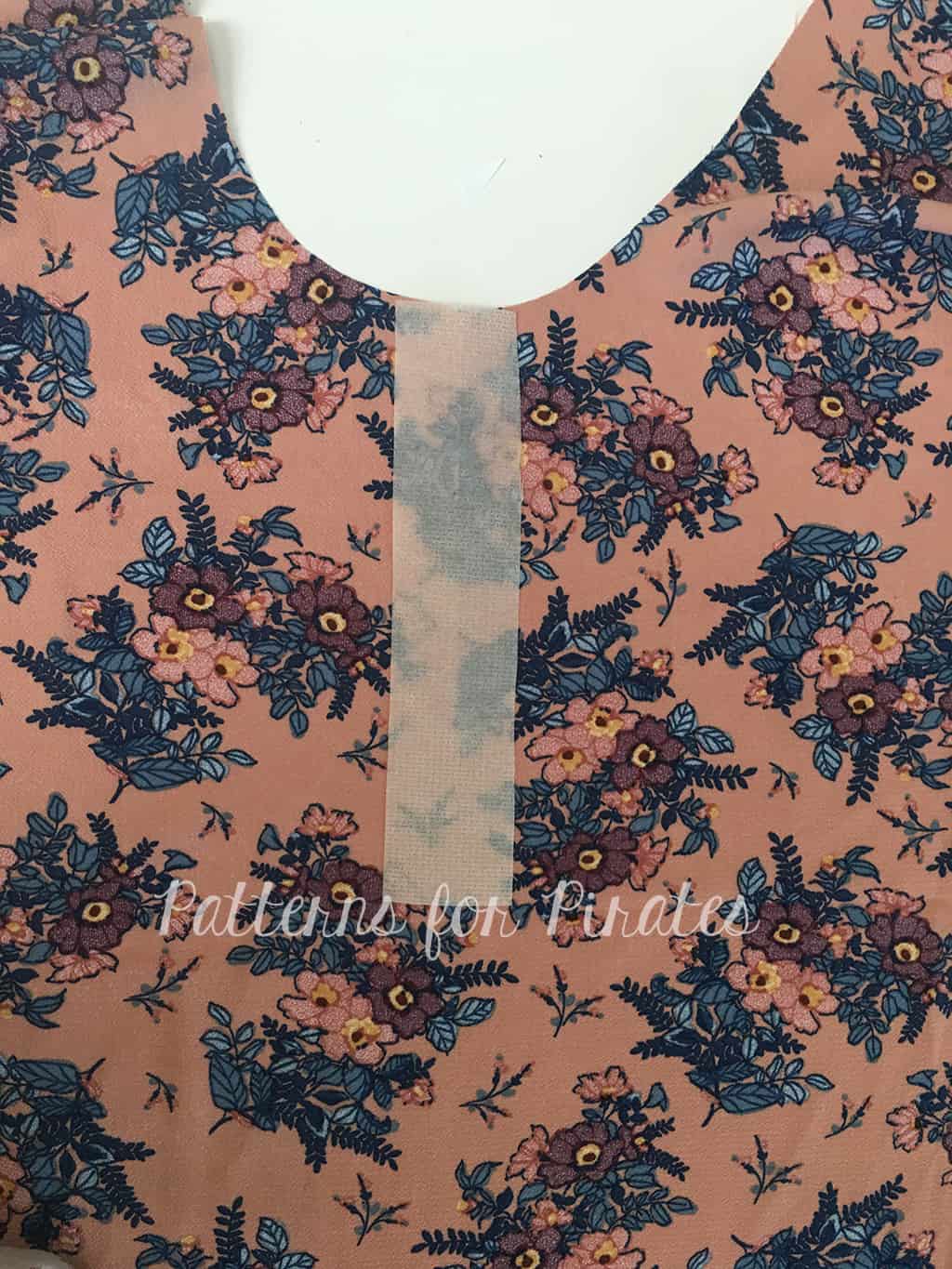
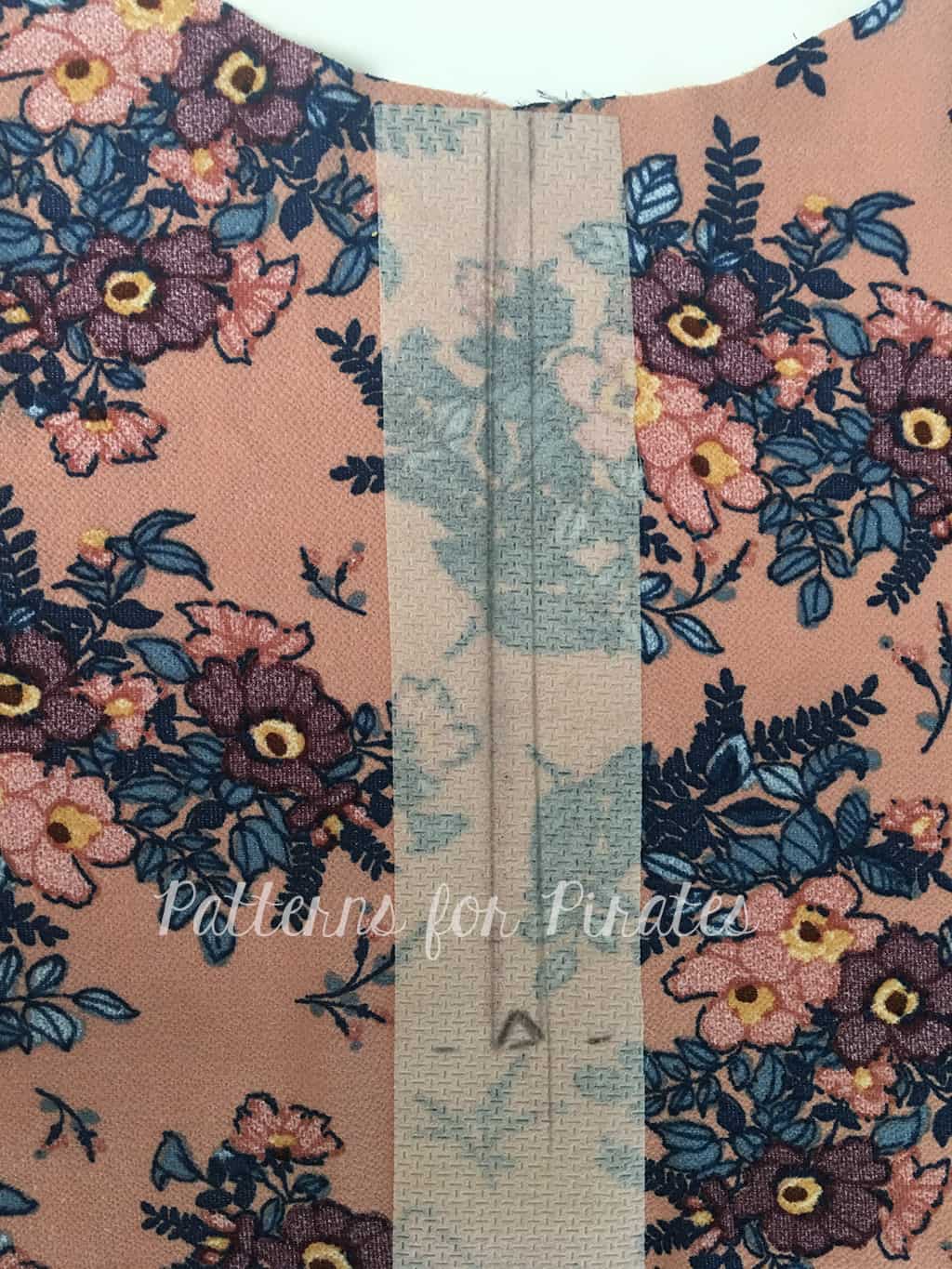
Find center front of neckline and iron on interfacing to wrong side of fabric.
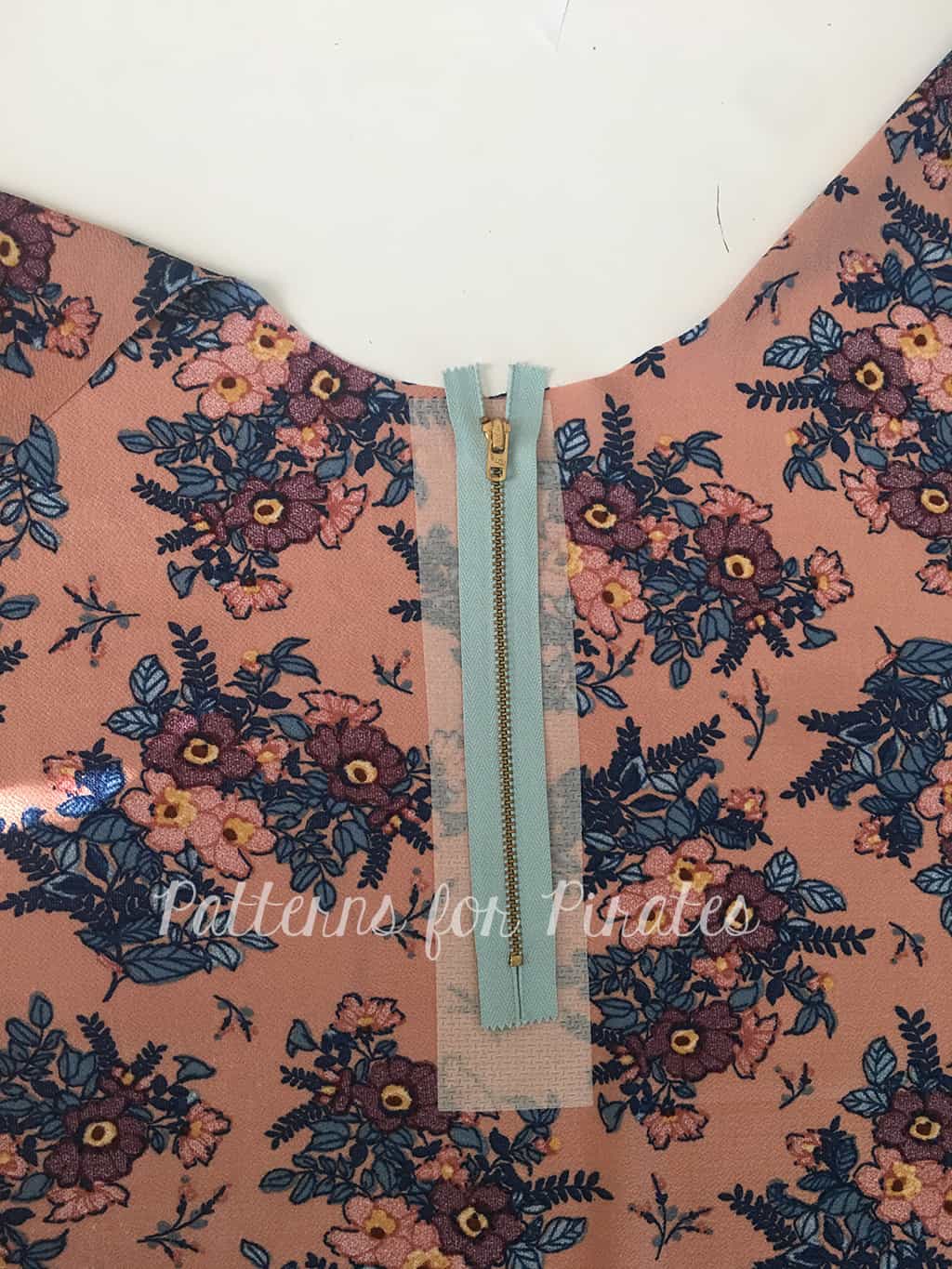
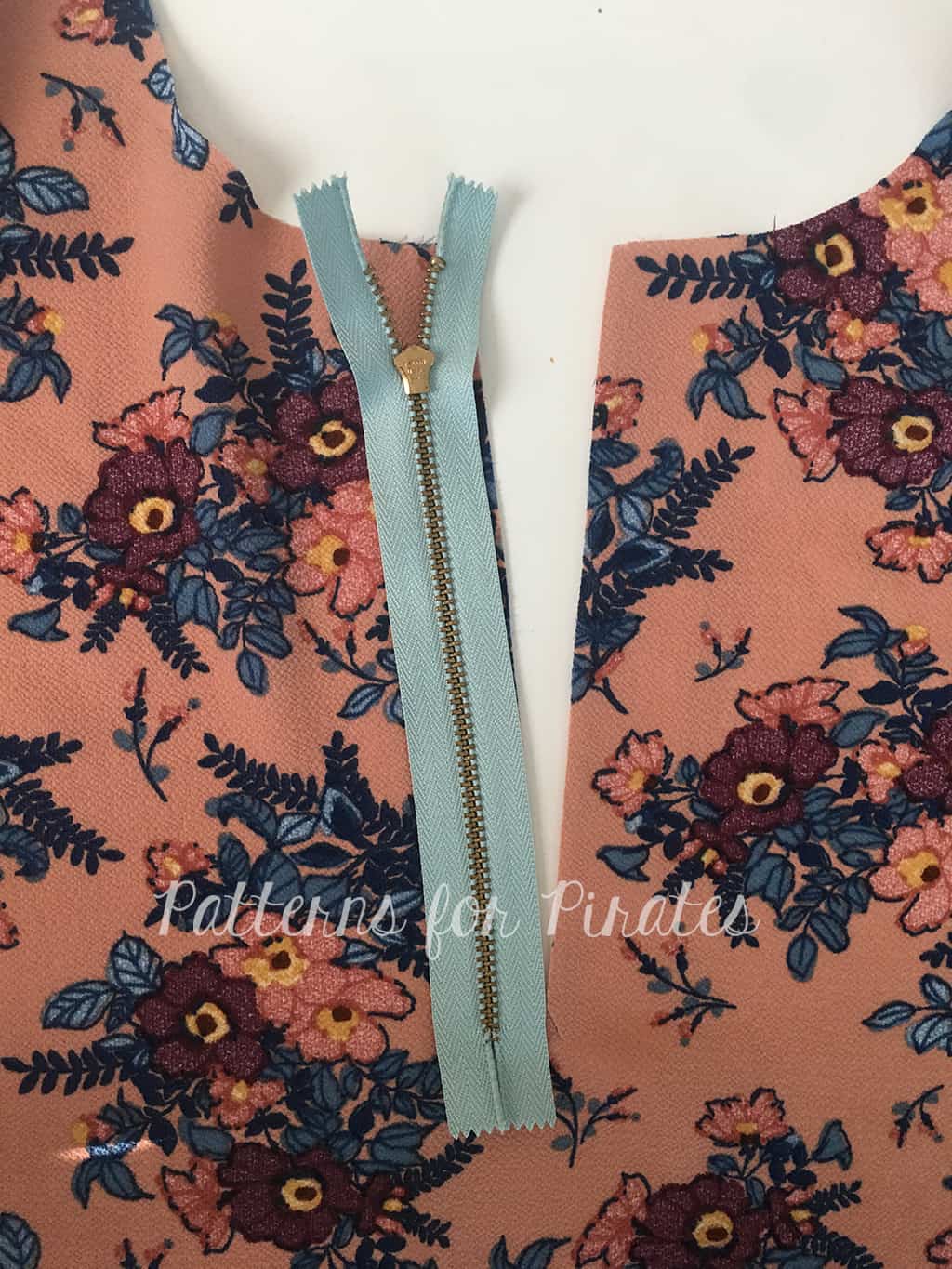
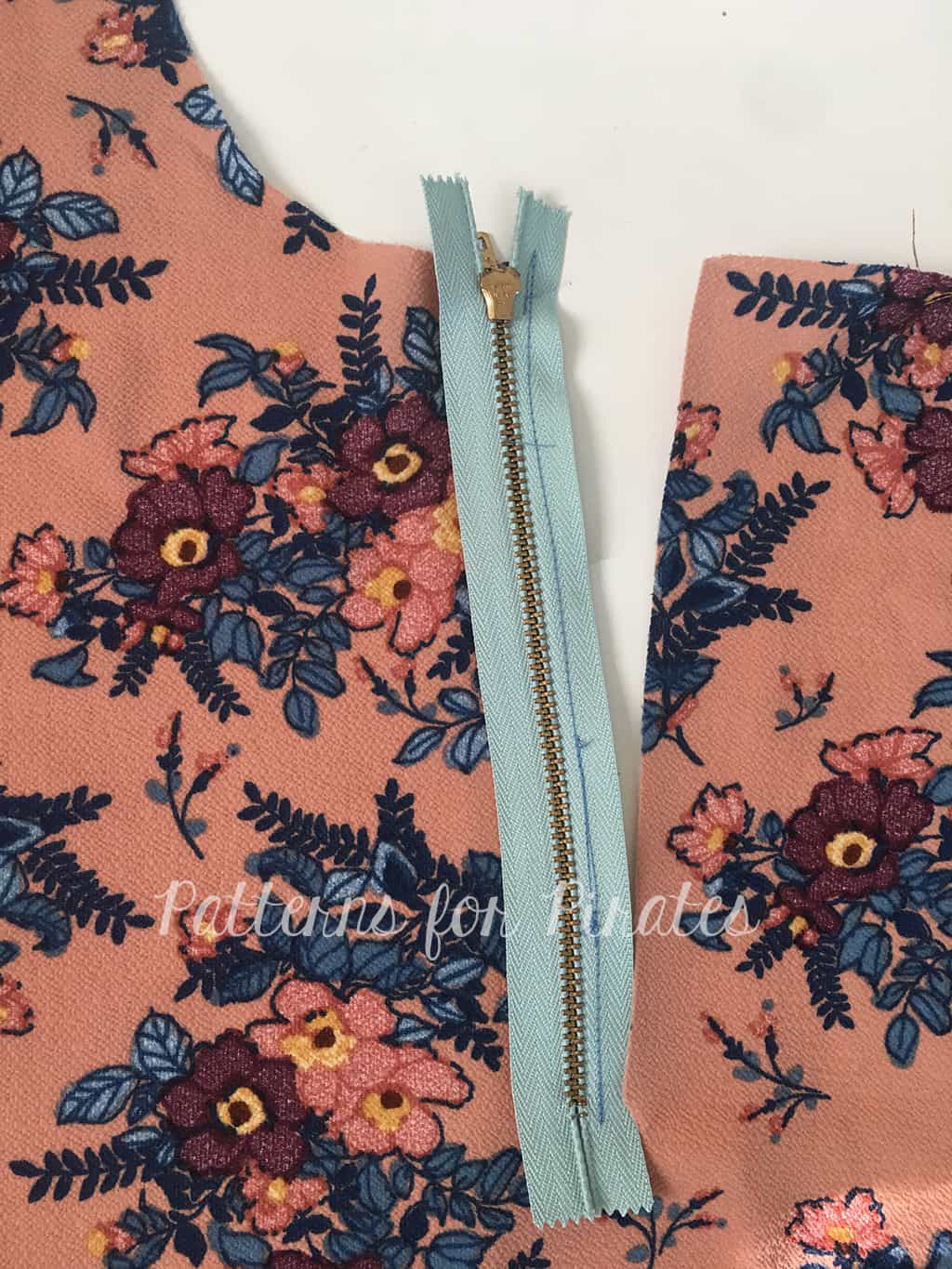
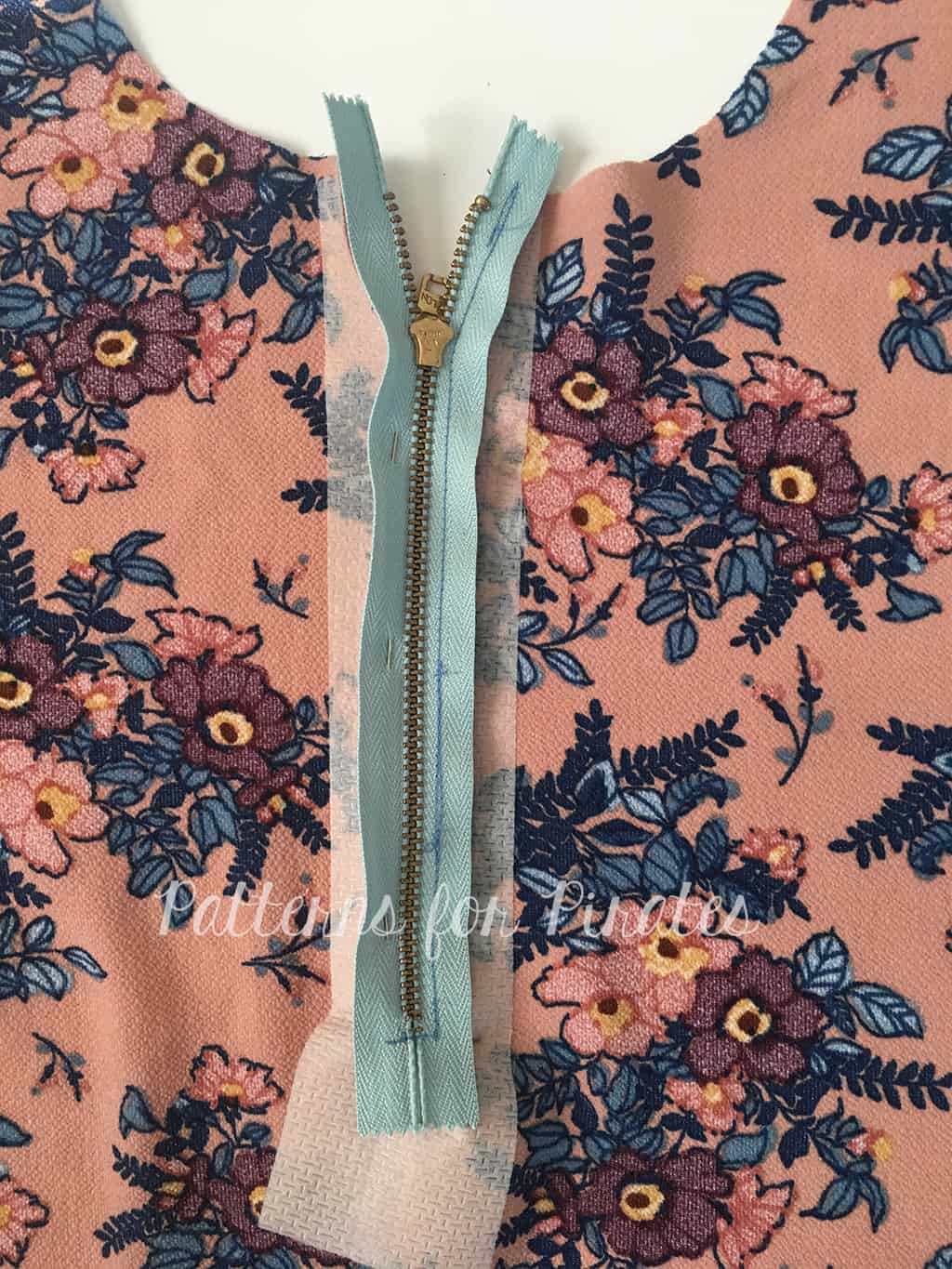
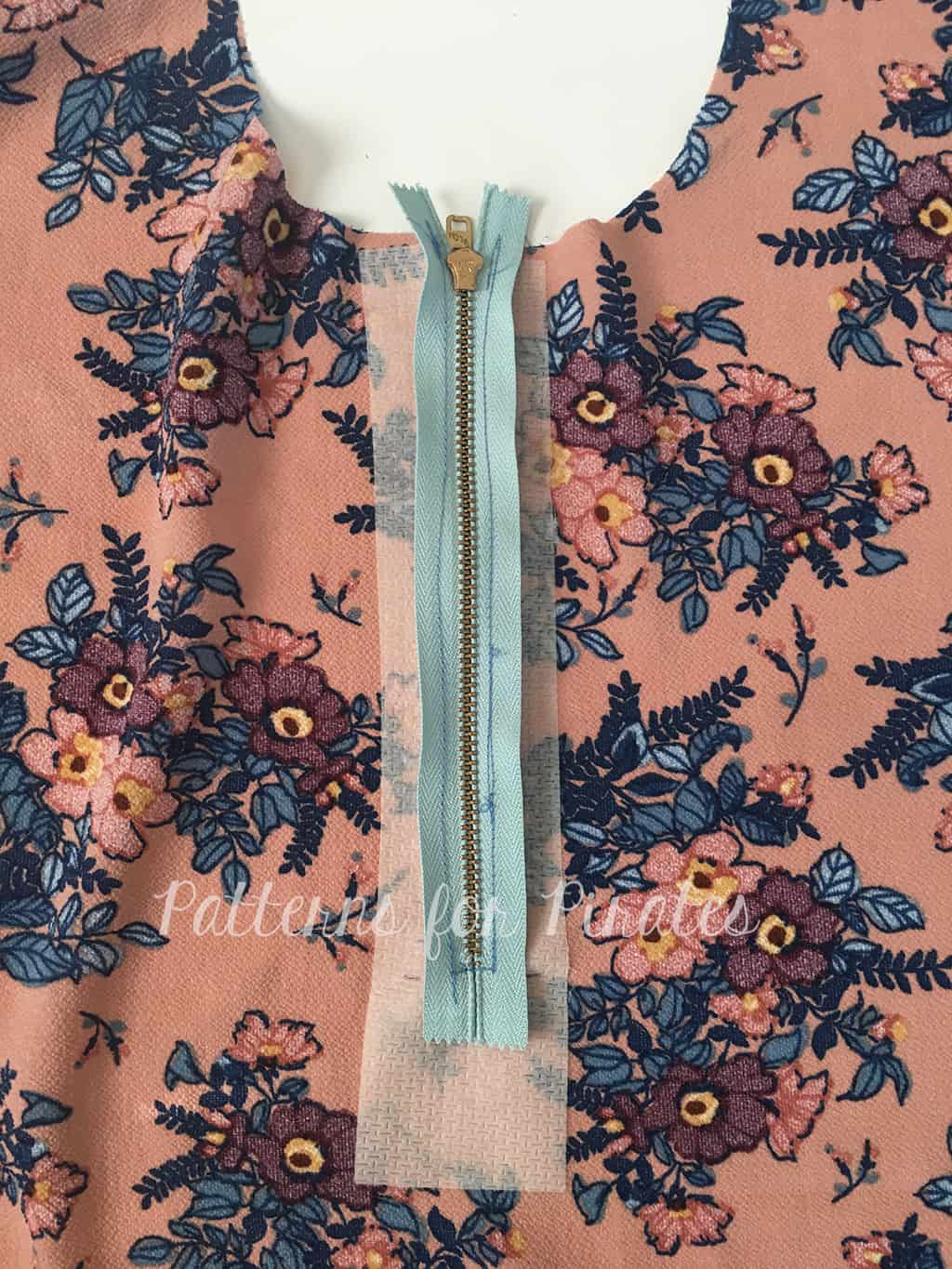
Place top of zipper 1/4″ below raw edge of neckline. If your tails are longer, you can trim them later.
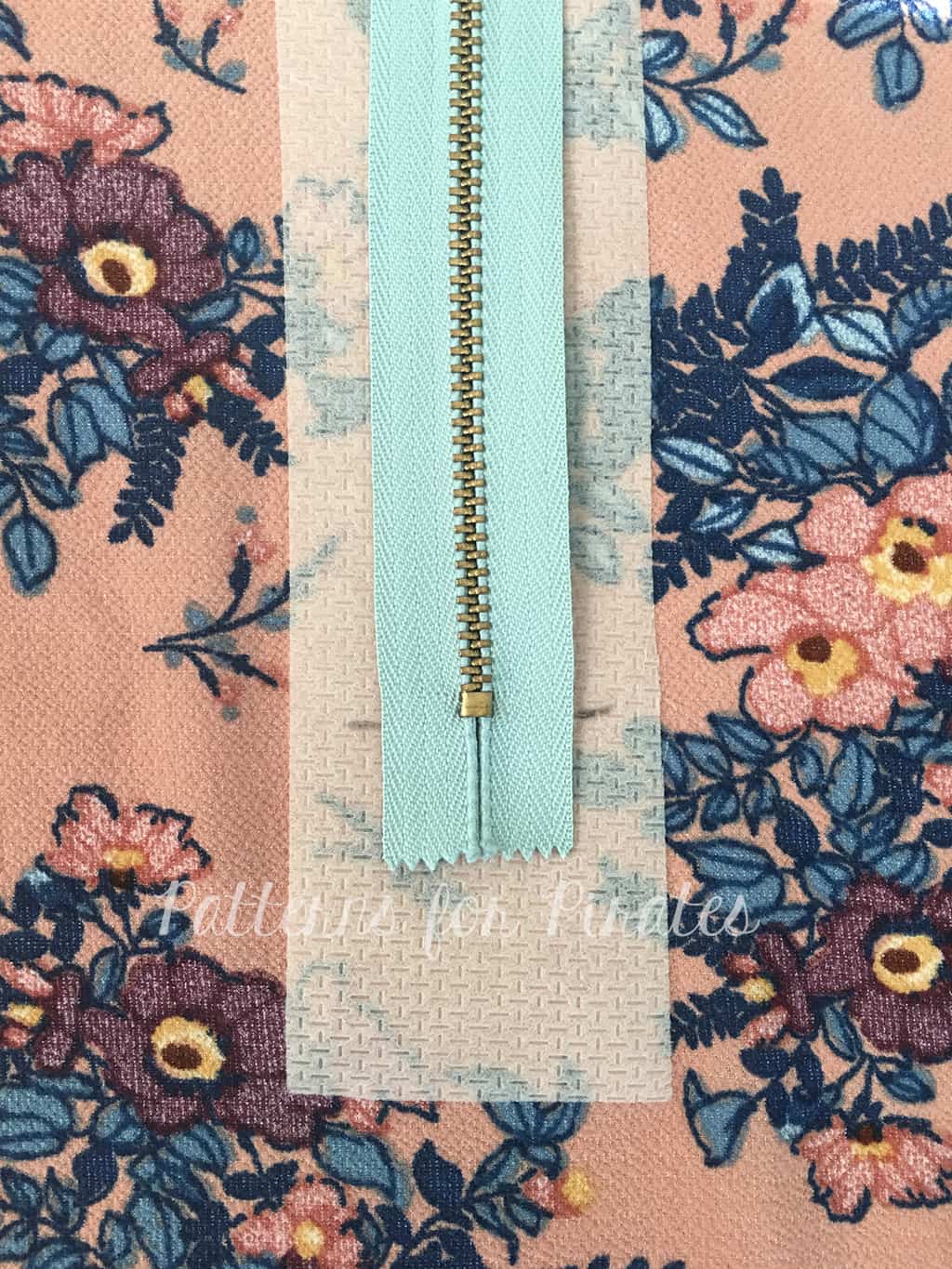
Mark the zipper stop placement on your interfacing.

Draw a 1/2″ rectangle down the center of the front bodice. (this will be your stitch guide)
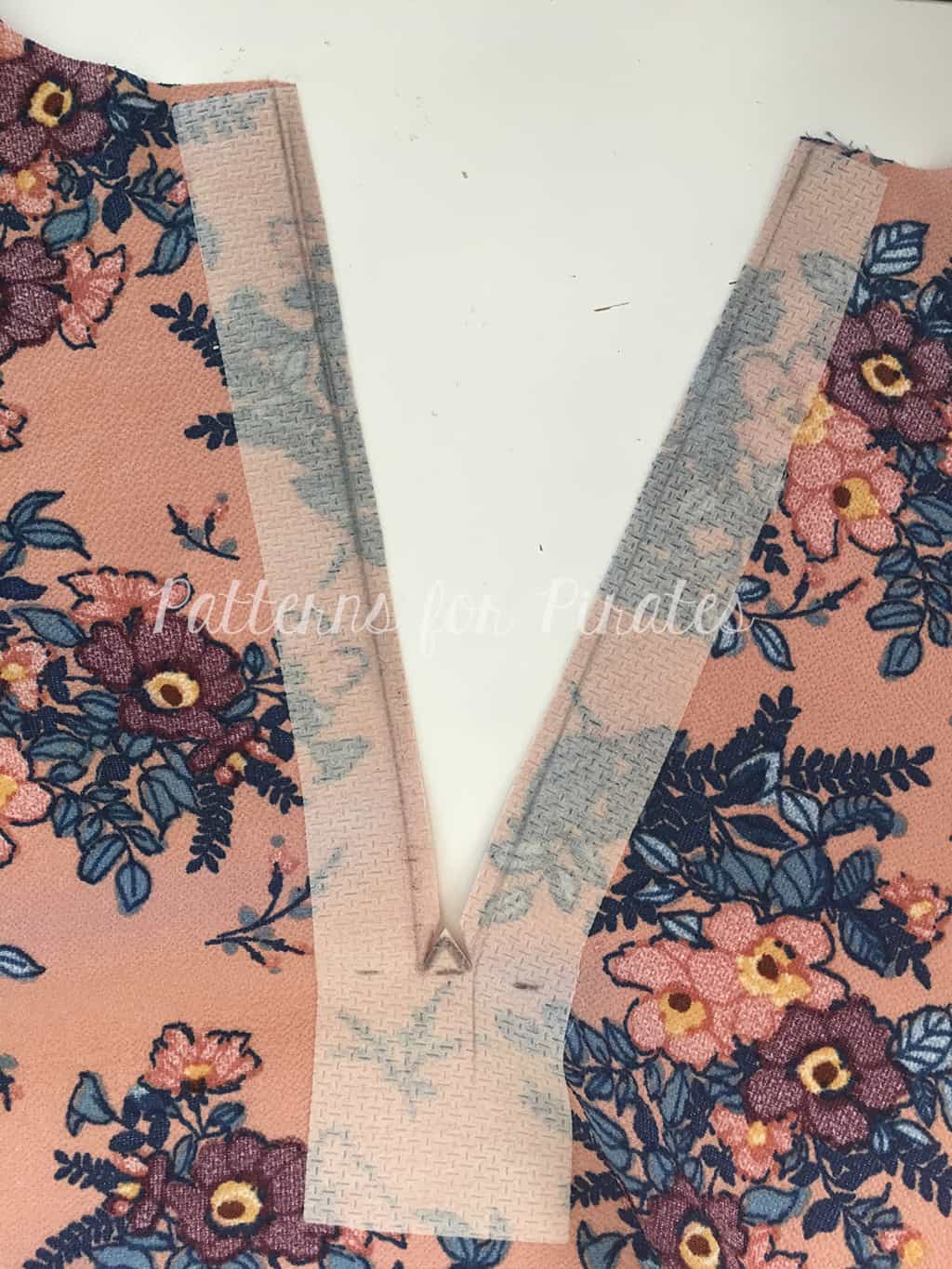
Cut down the center of the rectangle. Stopping just above the bottom, snip at a 45 degree angle to the corners.
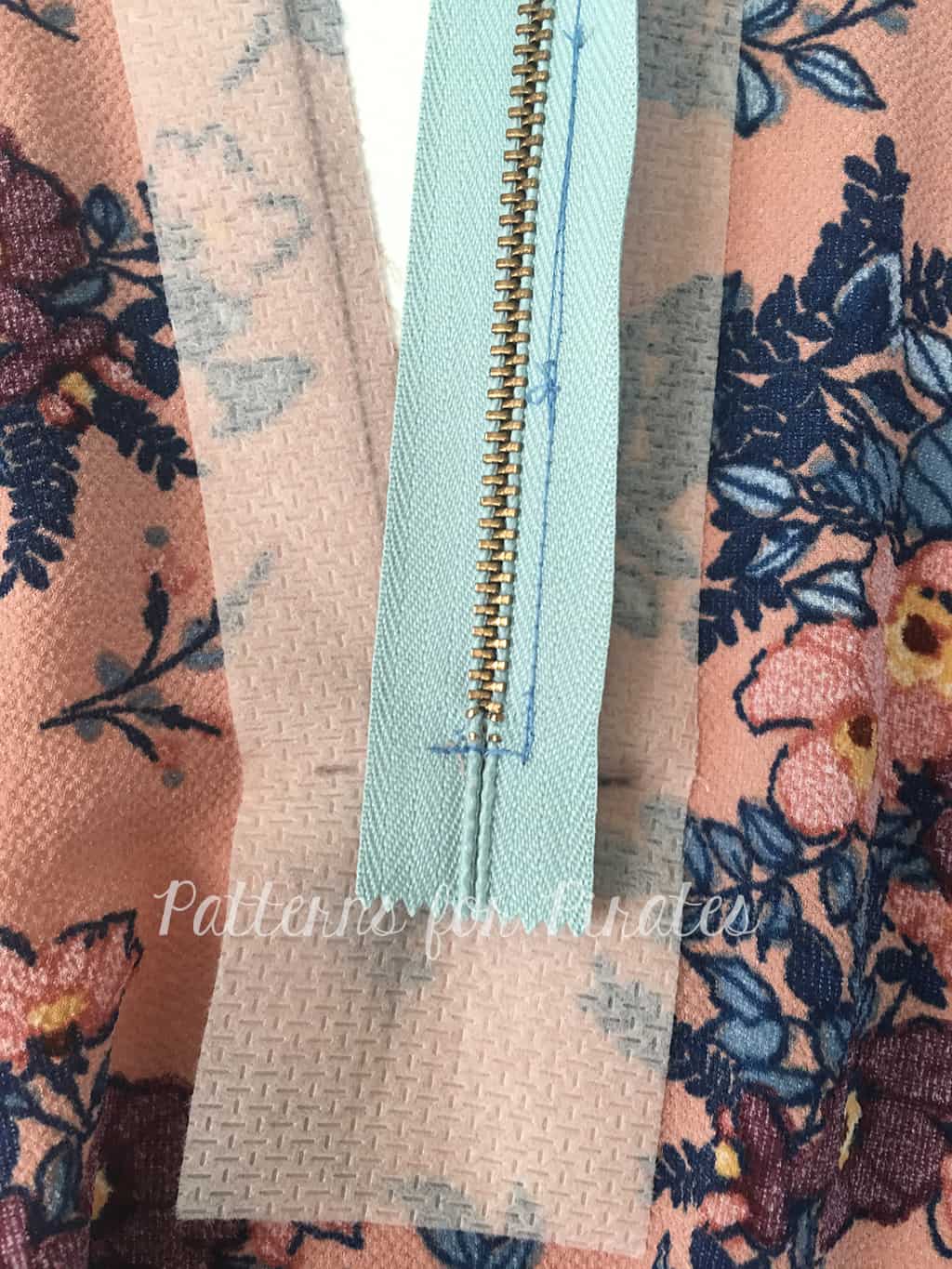
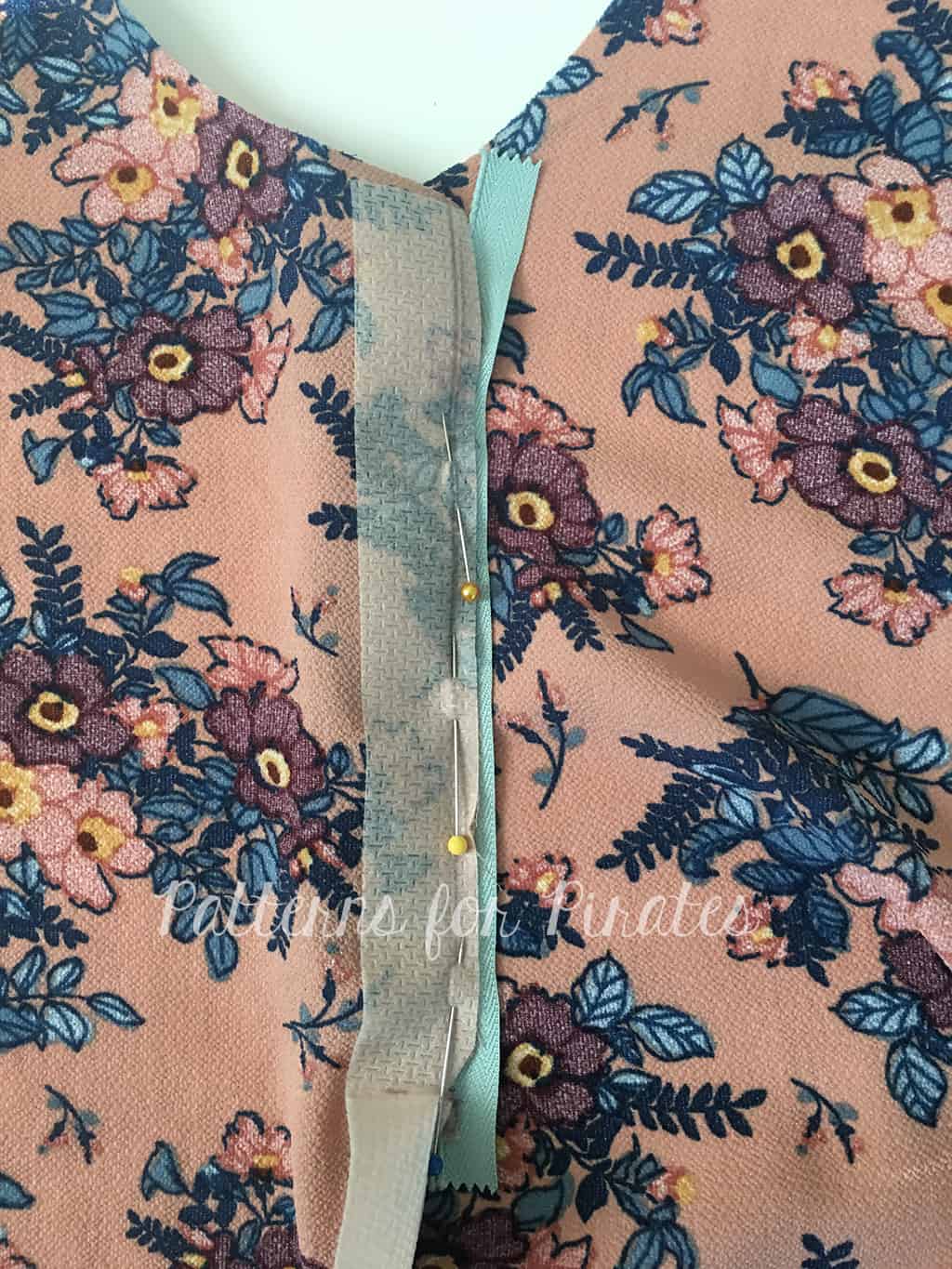
With right sides together, pin zipper in place.

The raw edge of your fabric should line up toward the center of the zipper tape.
Be sure that your zipper stop is aligned with the bottom edge of your rectangle.
Stitch.

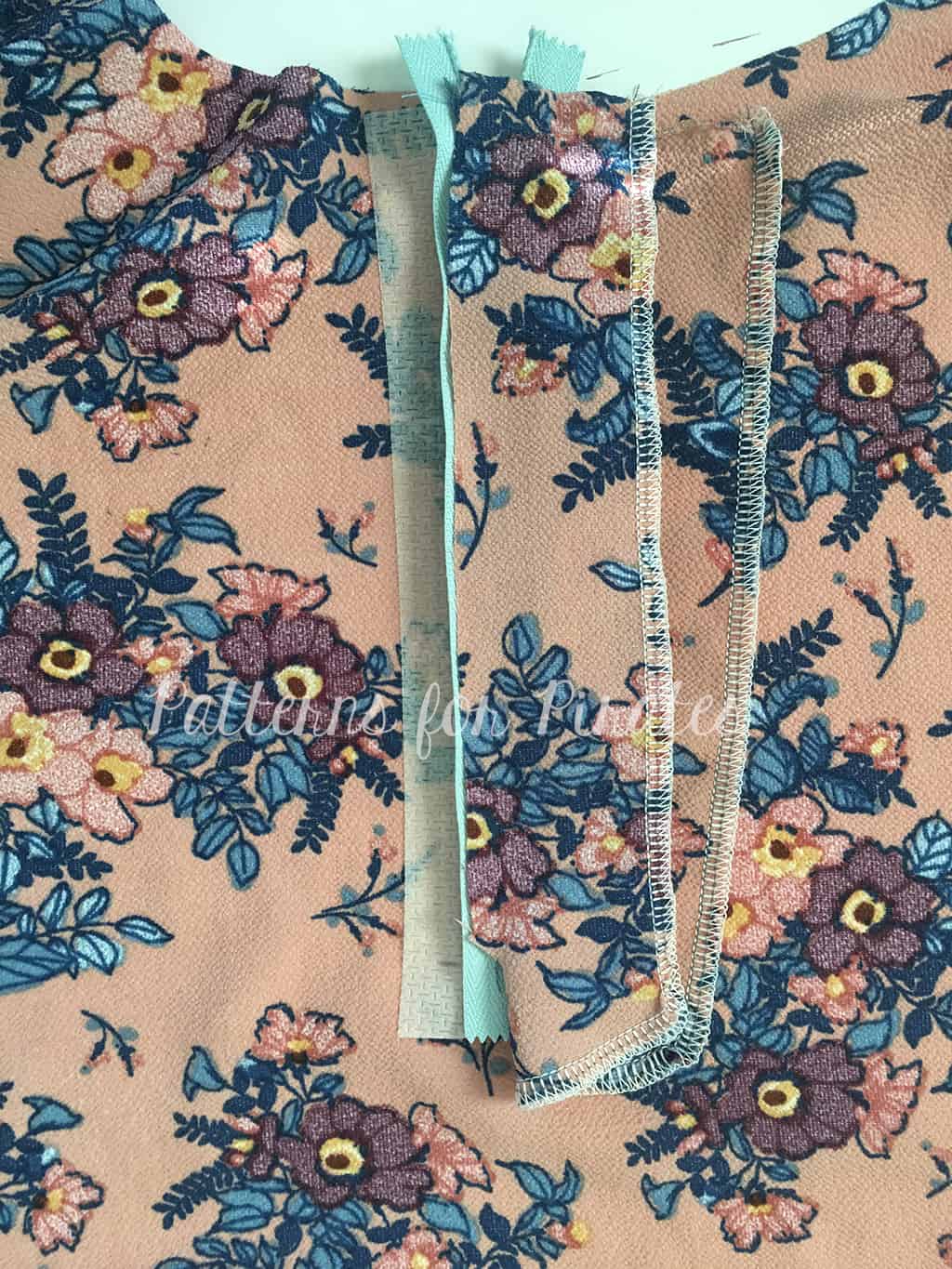
View from the front
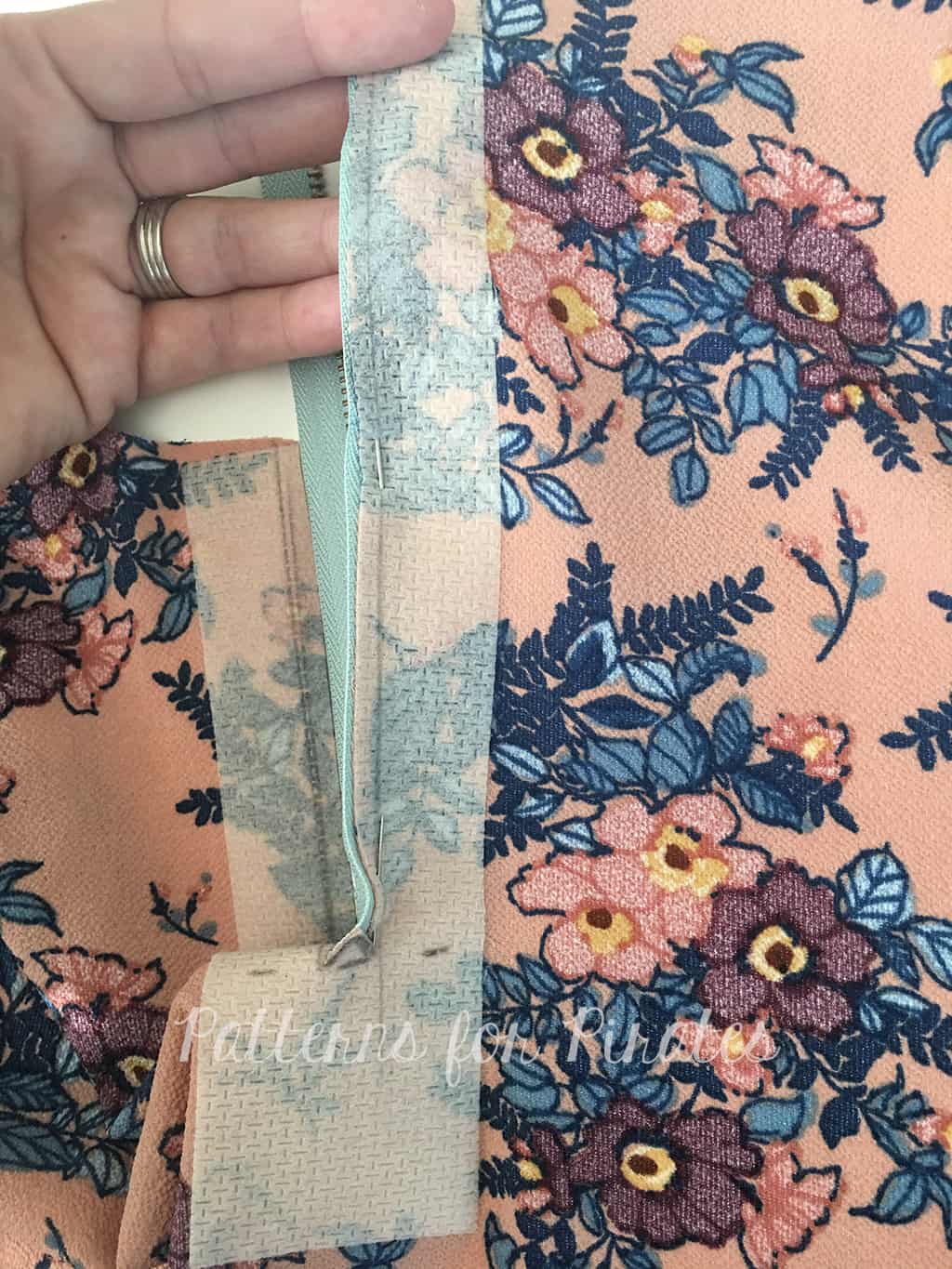
Flip notch upward and stitch.
View from back of zipper.

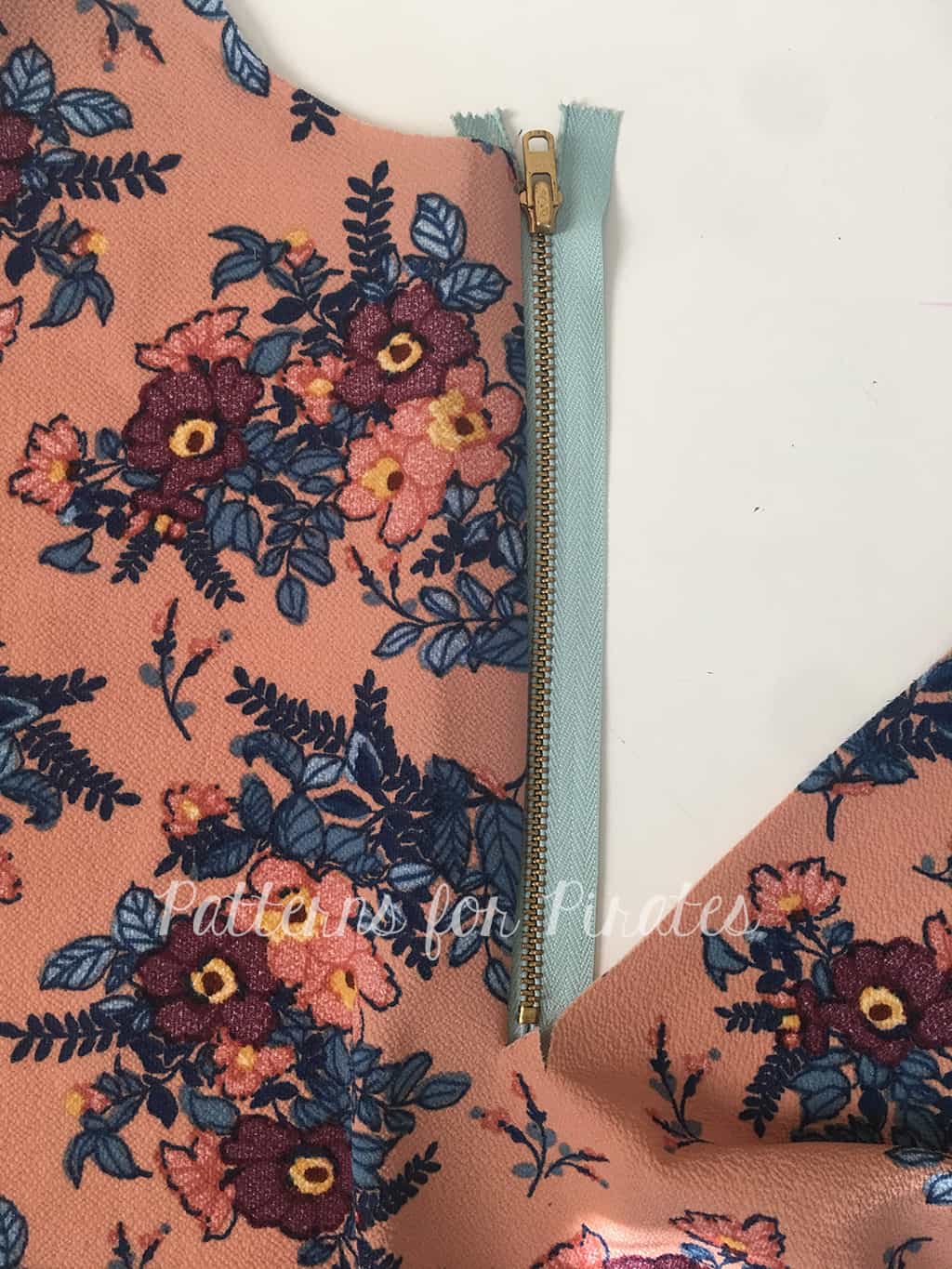
Repeat with opposite side. With right sides together, pin zipper to front bodice.
Stitch.
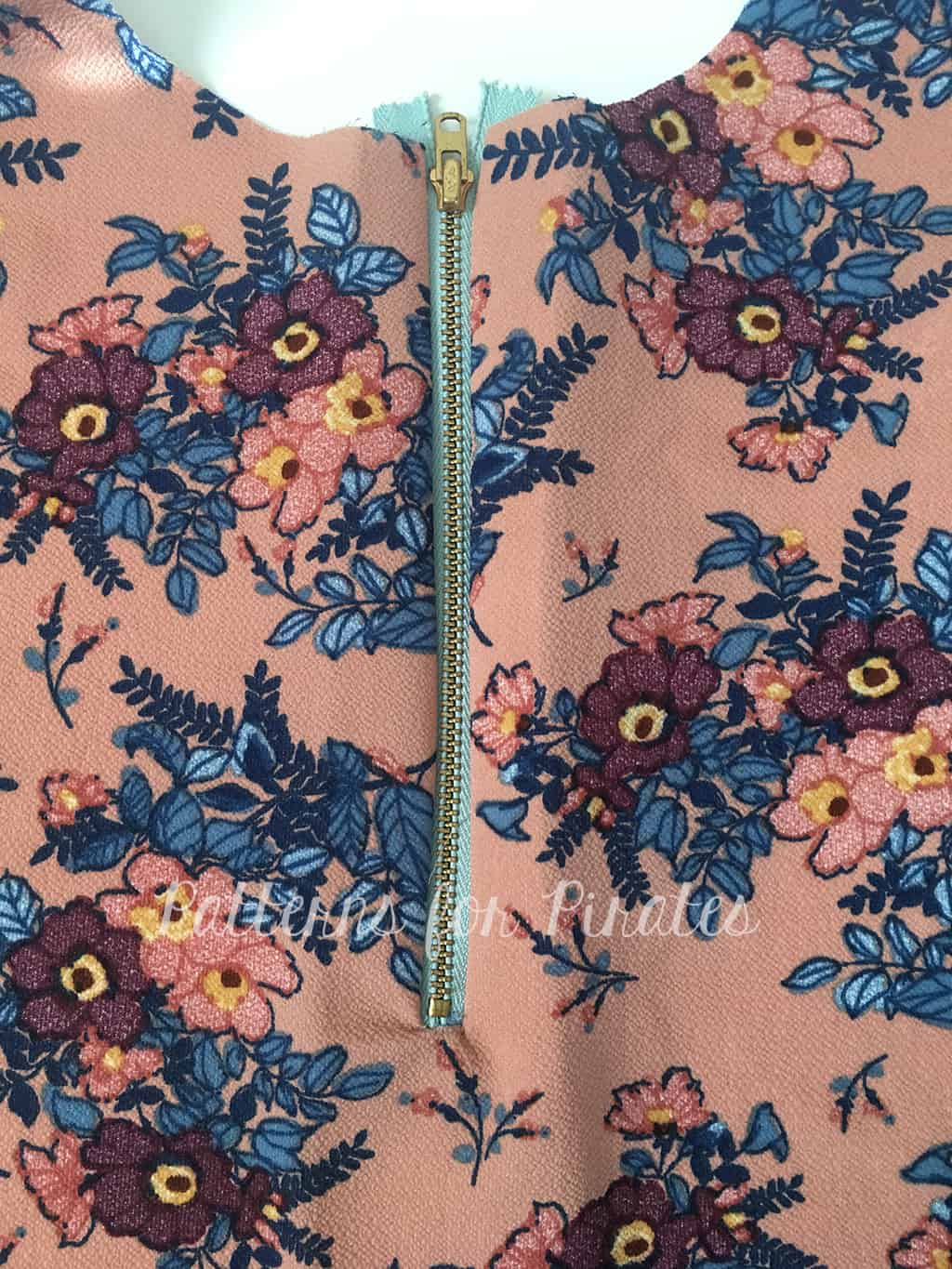
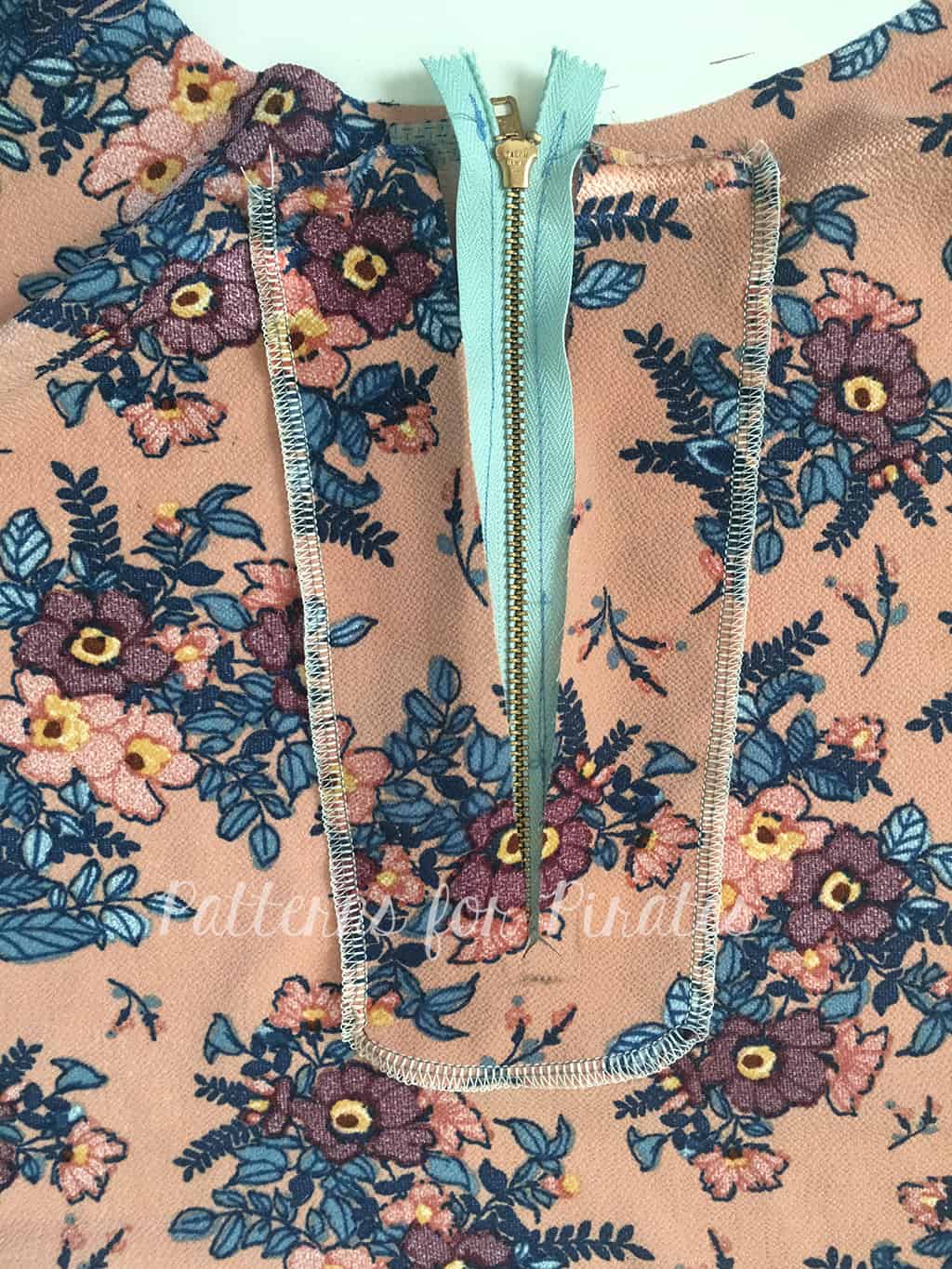
View from back of completed zipper.

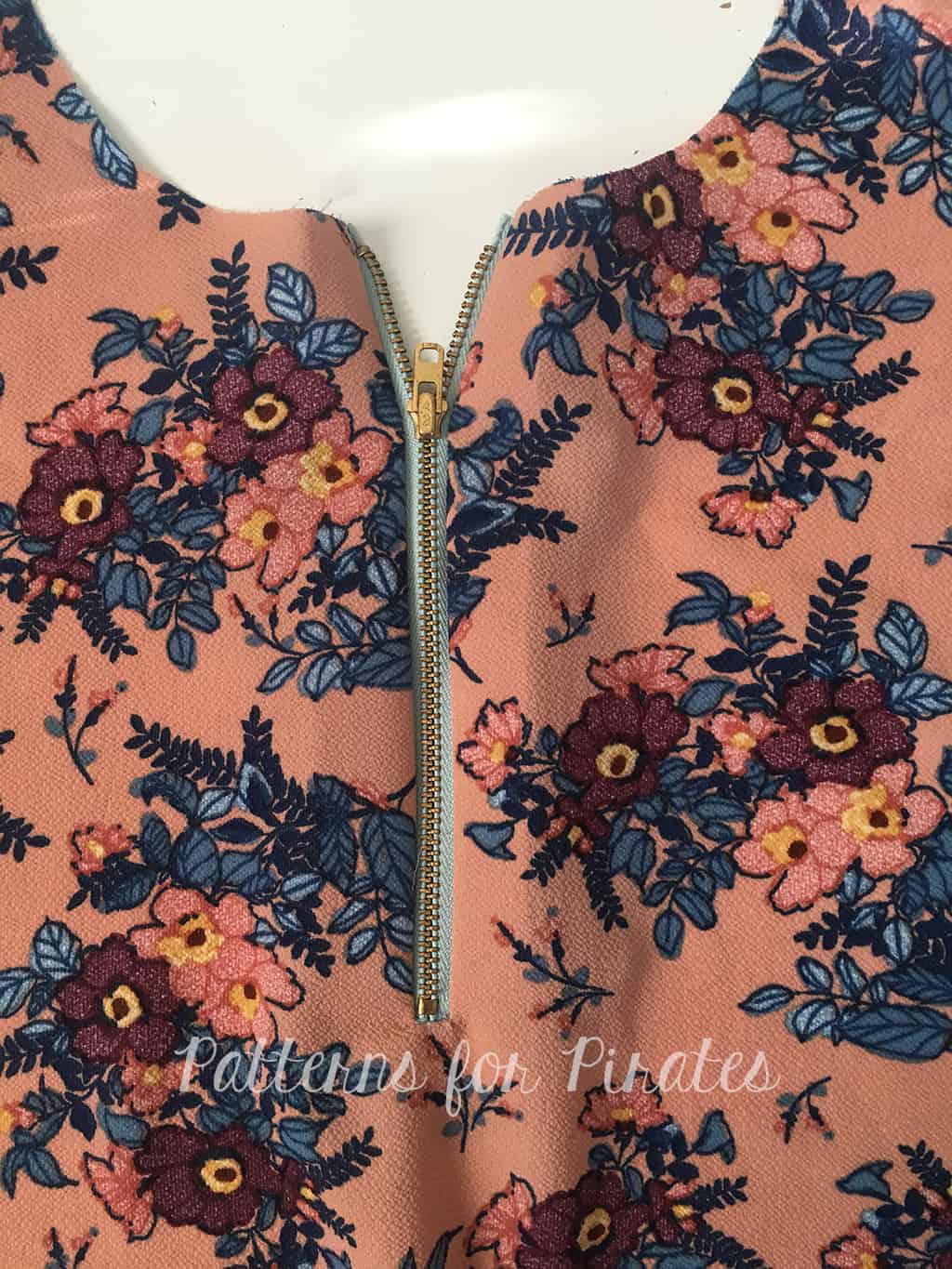
View from front. You can stop here and top-stitch if you do not mind the zipper showing inside your item. Proceed to next step if you want to enclose it.
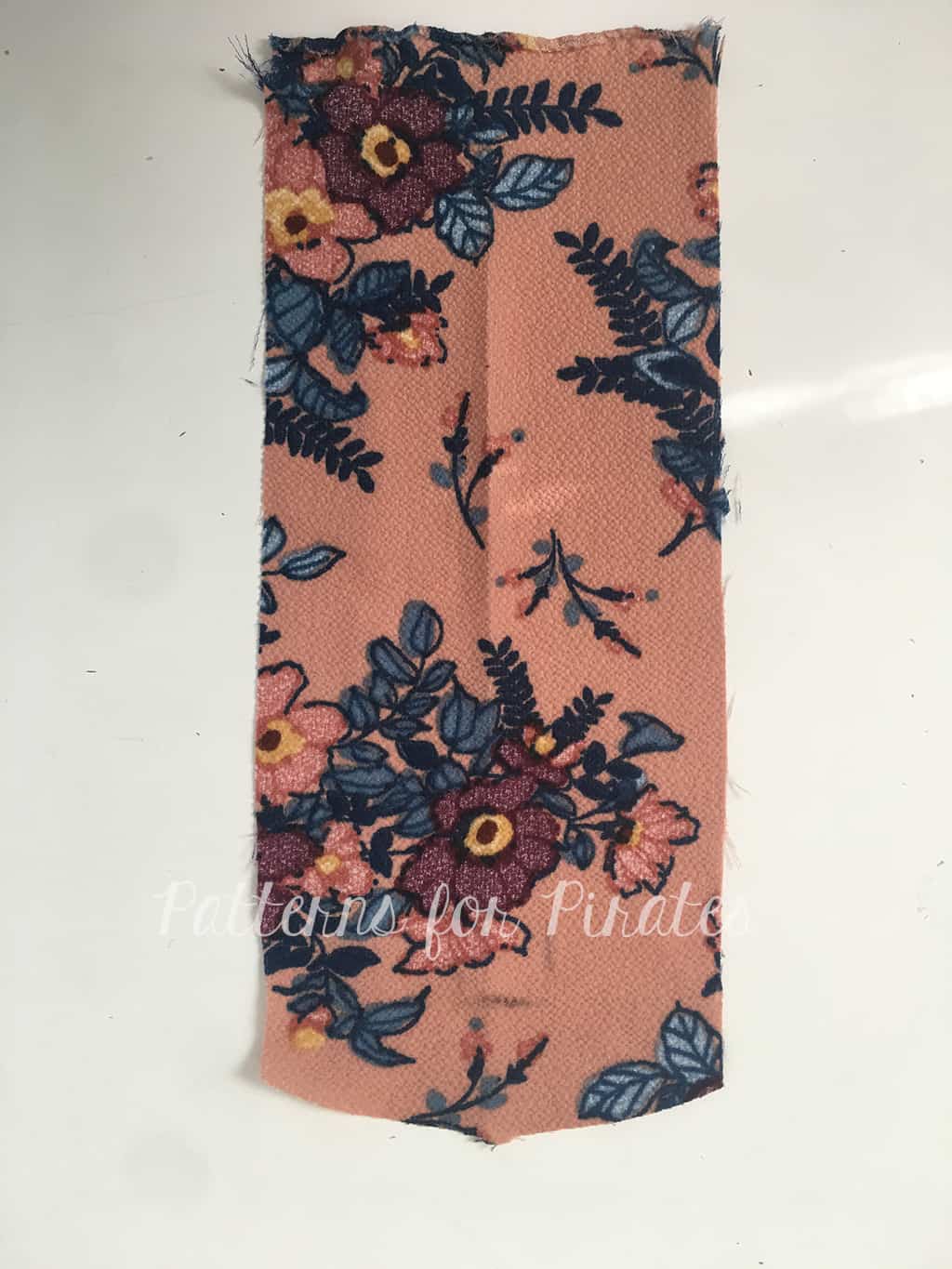
Cut a facing and transfer the markings as previously done in the first few steps.
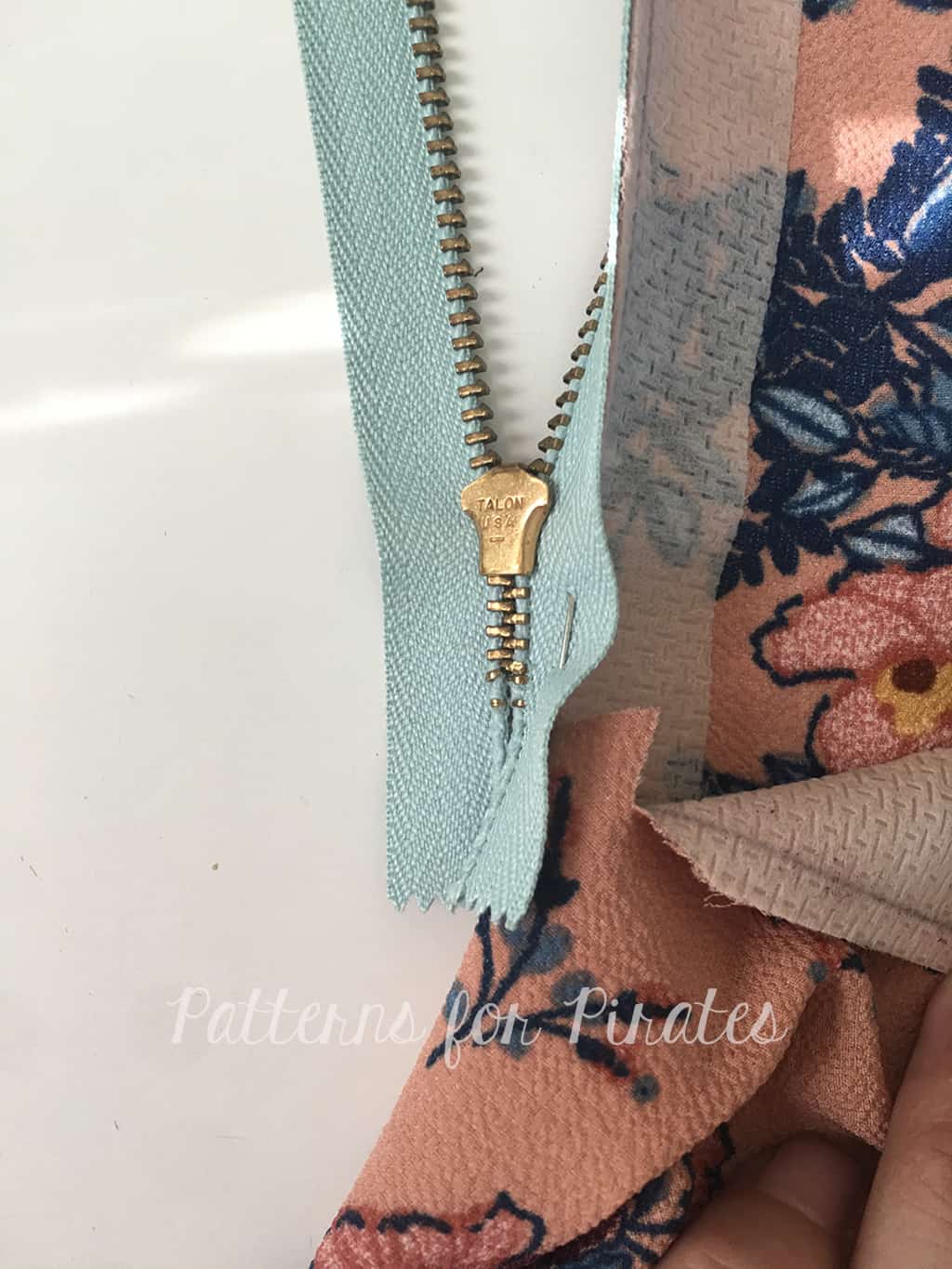
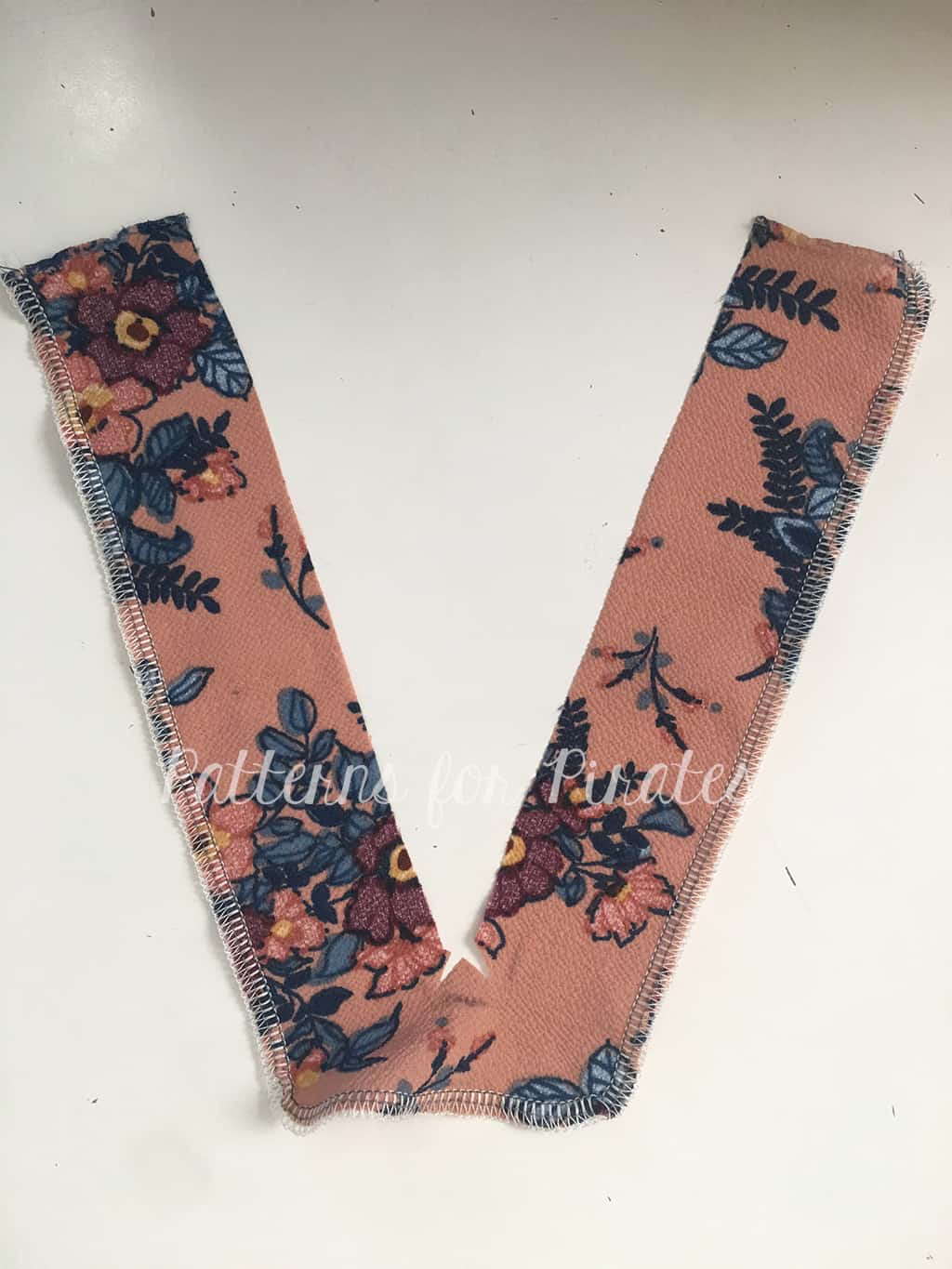
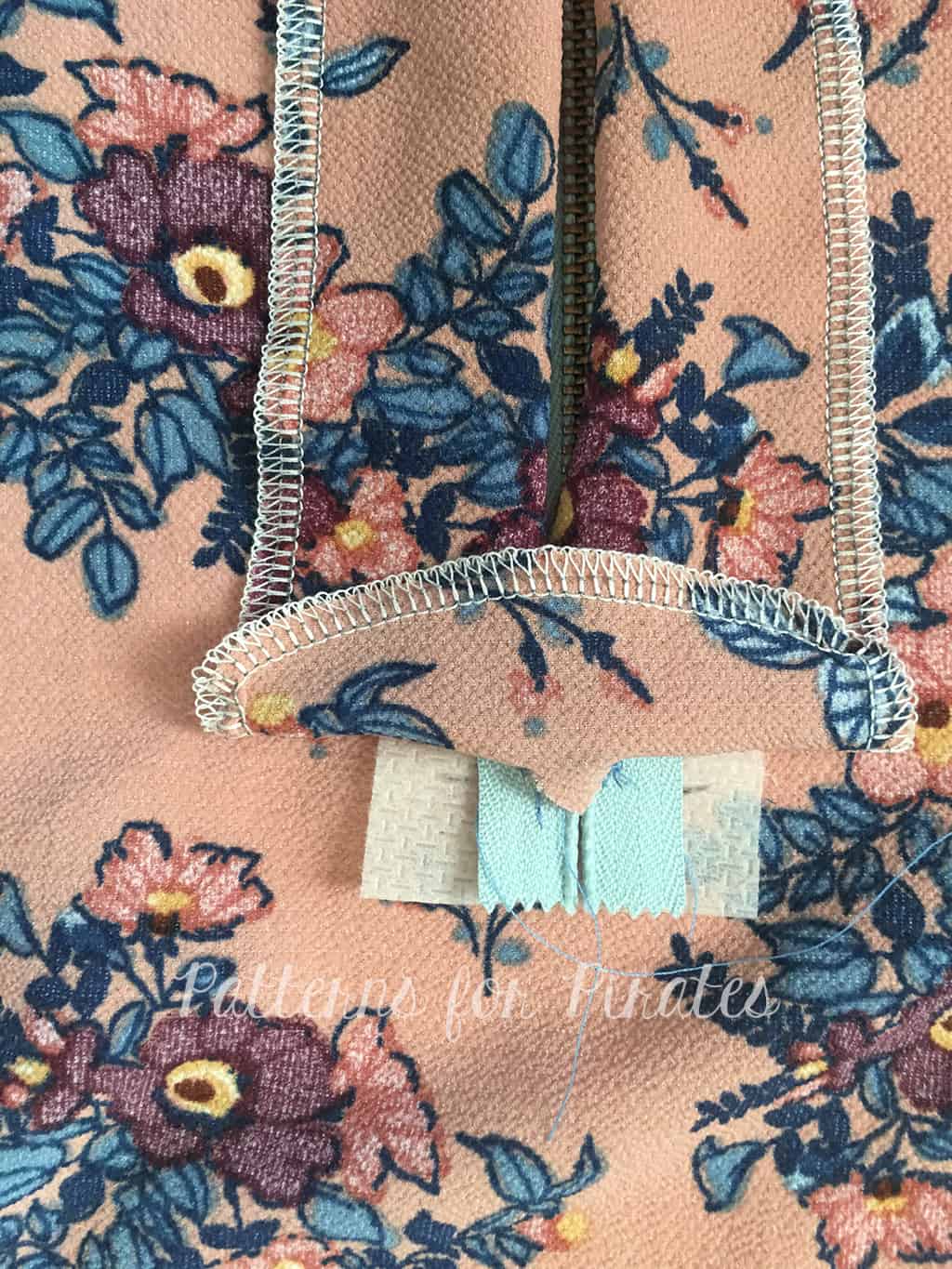
Finish raw edges. Cut down the center of the facing and snip towards the corner at a 45 degree angle.

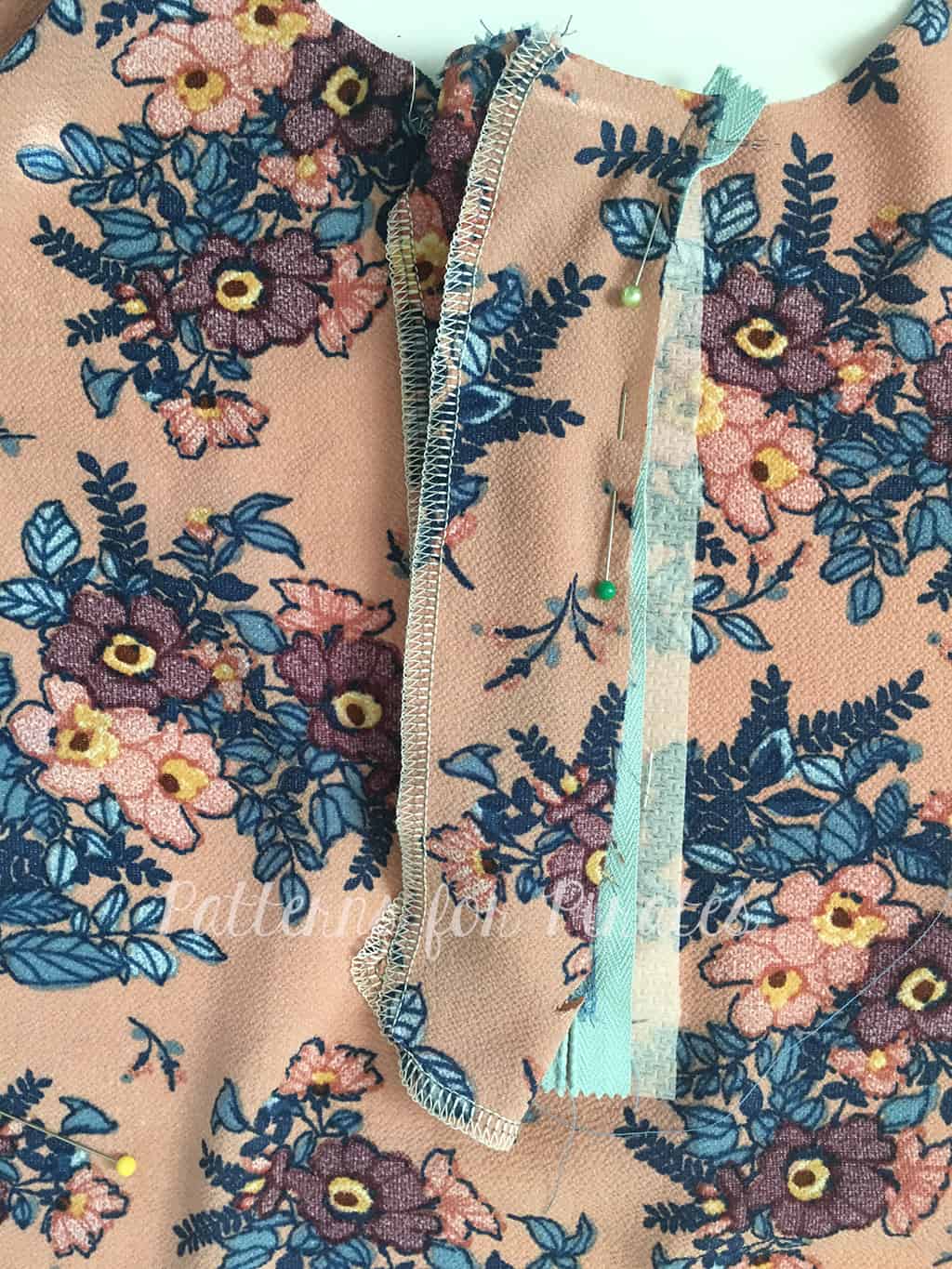
Lay the facing right side up on top of the wrong side of your zipper and front bodice.
Flip the facing toward the center so that the right side is now lined up with the wrong side of the zipper. Stitch.
View of left side of facing stitched.

Repeat on opposite side. Stitch.
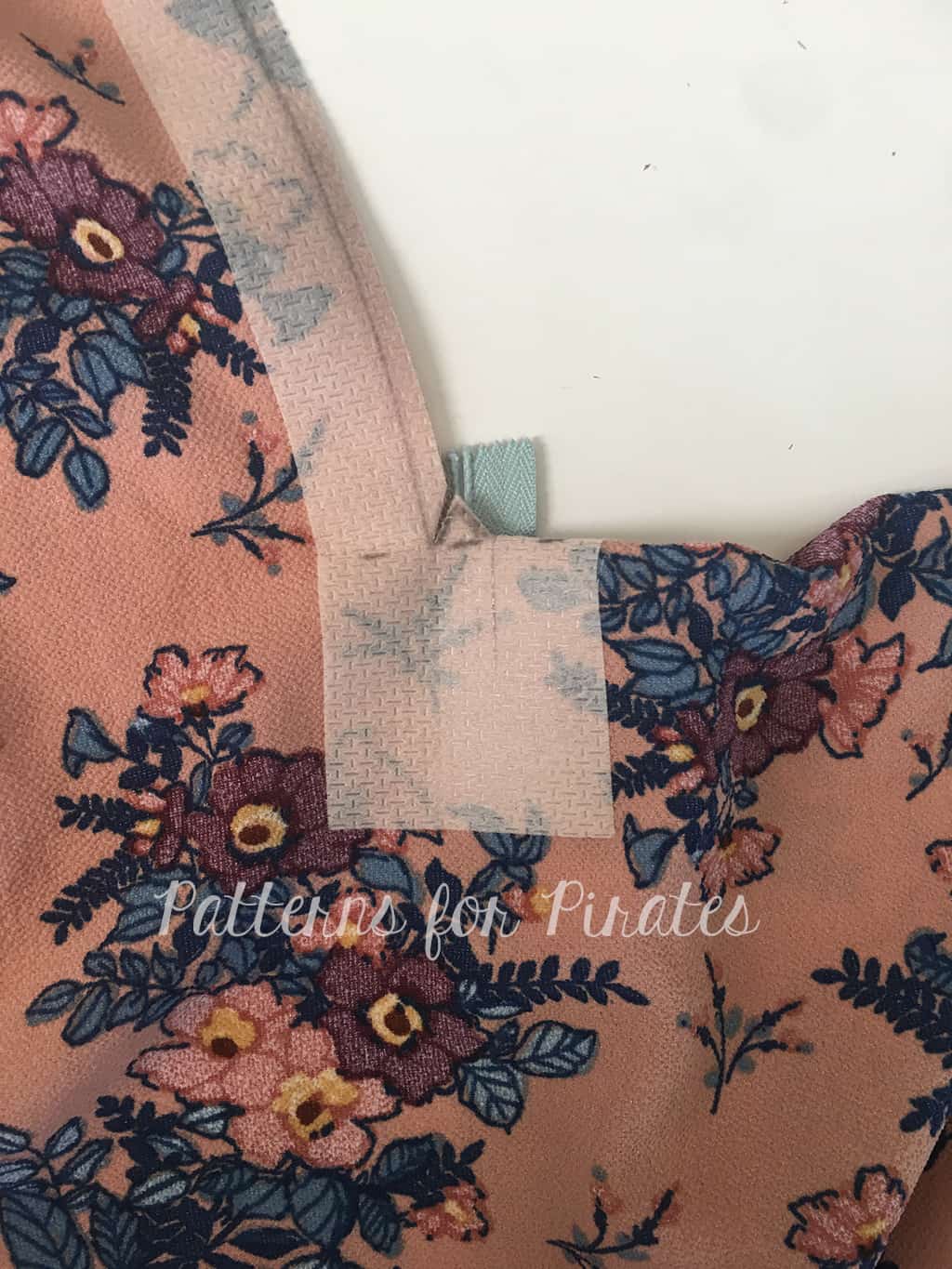
Pull notch down and stitch in place. (same as you previously did on your main front body).
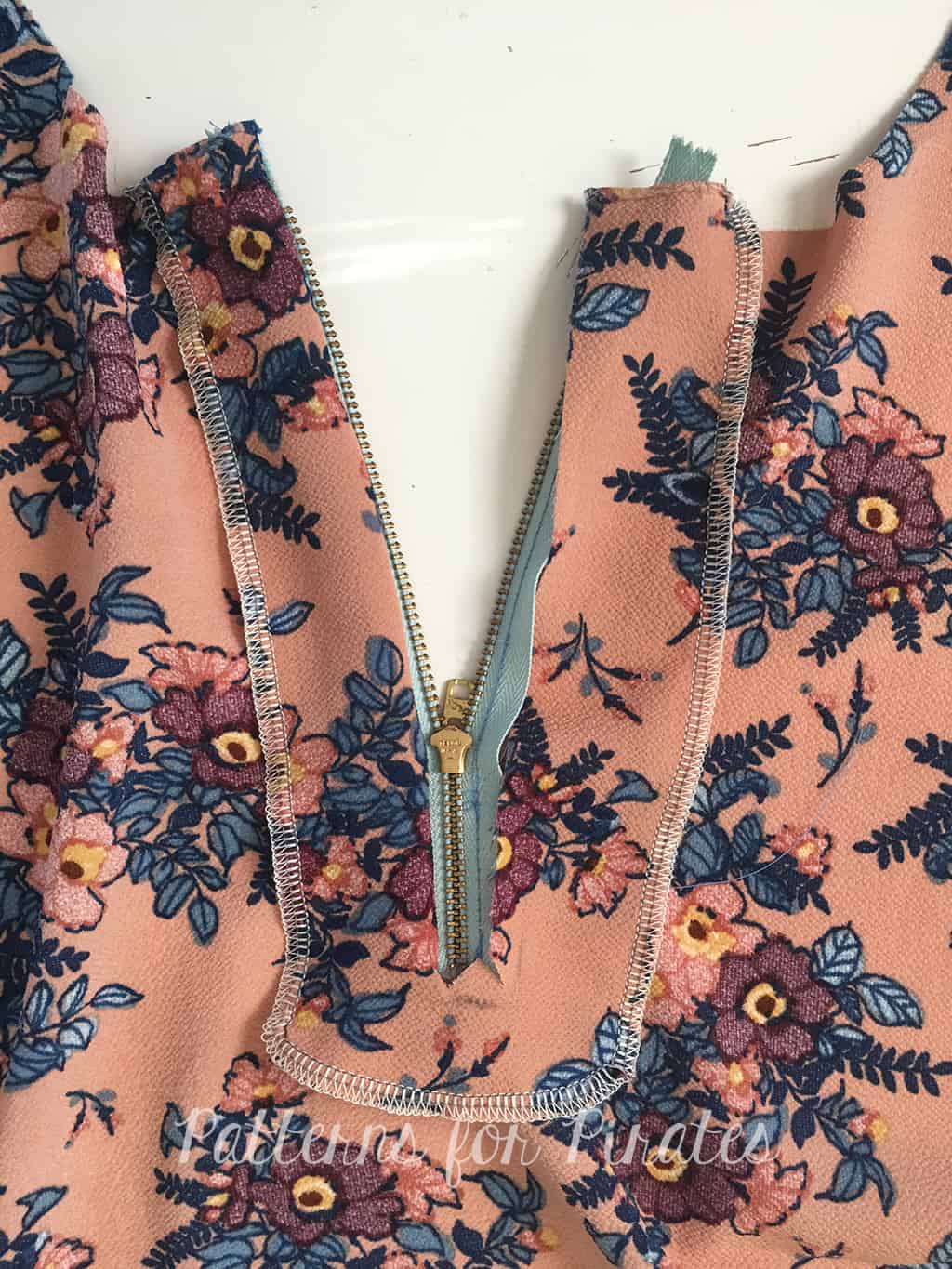
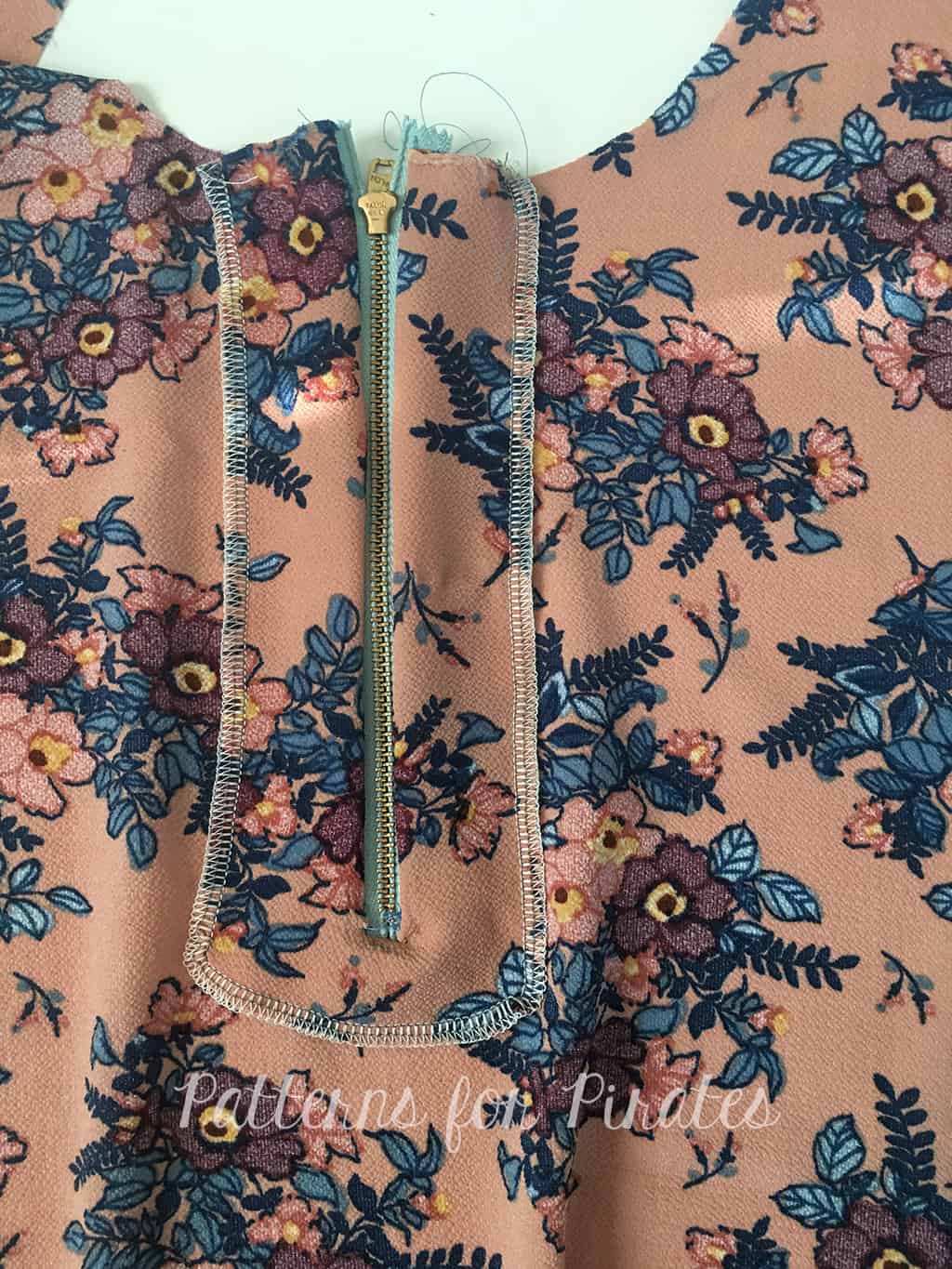
View from back.

Top-stitch around zipper.
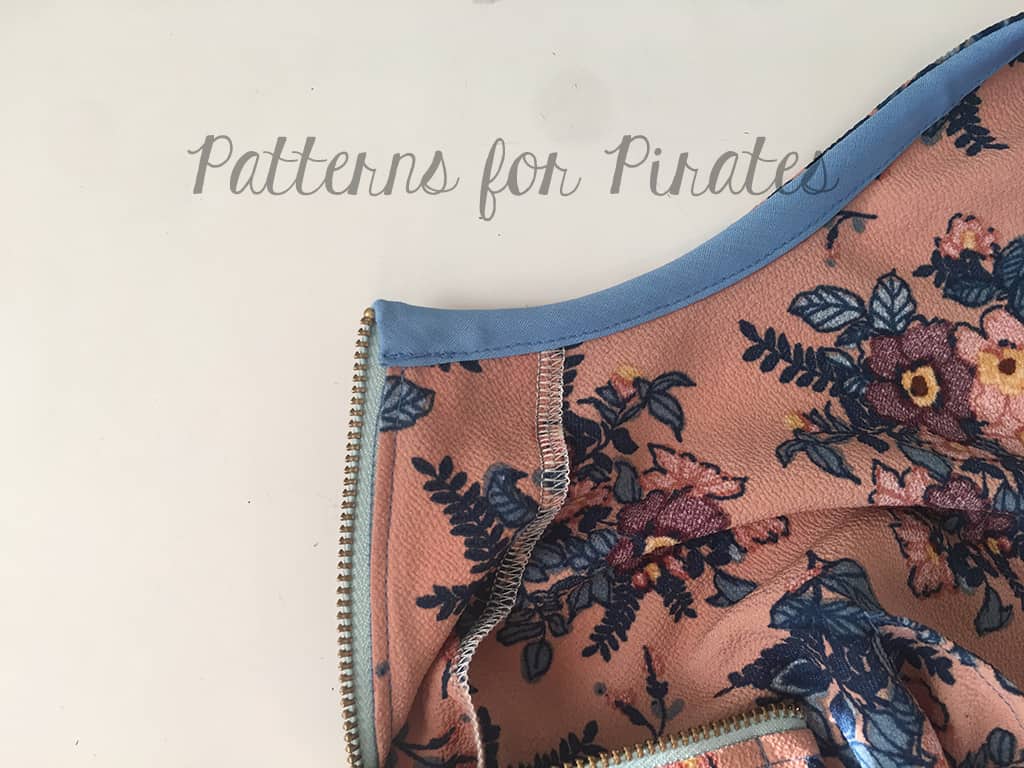
Finish neckline using single fold bias tape as shown in the tutorial.

There you have it!  I hope that wasn’t as difficult as it appears.  If you’re not sure you’re ready to tackle the zipper on your top, try it on a few scrap pieces first.  Practice makes perfect right?


We hope you enjoyed the hacks as much as we did.   Don’t forget to share your makes in the Facebook Group, we’d love to see them!  Happy Sewing!

Filed Under: Pattern Hacks, Pattern Release, Uncategorized Leave a Comment

P4P University – plackets

September 13, 2017


Ohhh….plackets! Why are you so scary? Today on the blog I’m hoping to change that perceptions of them and help you face this fear.

What are plackets?

Plackets are basically just a slit or an opening in the fabric that allows for garments to be easily put on or taken off. Sometimes plackets are purely decorative. You can find them on sleeves, on pants, back of skirts and neckline. You can have a placket on the back of the neckline or on the front. The most common neckline front plackets are for Henley or Polo style shirts. On this blog I will be using the new Brunch Blouse placket but you can certainly utilize the same principles for a Yo Ho Henley or a Women or Men Henley shirt too.
 

Interfacing? Yay or nay?

My first tip/recommendation is to always use light weight interfacing for the placket piece. Simply fuse a piece of interfacing to the wrong side of the pattern piece. You can get away with not using any if you’re making a woven pattern but even so, the result will be so much better if you do add it. Interfacing will help stabilize your piece which in turn will make it a lot easier to sew. ALWAYS use interfacing for knit plackets!
Mark and press!

As you can see in the video above, I use a tailor chalk to mark the pressing and sewing lines on the back of the placket piece. You can use a soluble fabric pen or a fabric marker too.

If you have a tailor clapper now would be a good time to use it. It will defiantly come in handy and help keep those pressing marks firm. Spray starch will help too!

Sew slowly!

Make sure you pin a lot and catch any notches that need to be enclosed! This may be the most tedious part of adding a front neckline placket so it is well worth paying extra attention and sewing slowly.

Enjoy the fruits of your labor! 🙂

Now that you took the time to create the perfect placket, show it off! Be proud of your achievement and don’t let sewing techniques intimidate you! Speaking of showing off…don’t forget to brag about your Henleys and Brunch Blouses in the P4P group.


Filed Under: P4P University, Sewing Techniques, Uncategorized 4 Comments

Sweet Bow :: Pattern Release/Update!

September 7, 2017

Summer might be coming to an end, but we’ve still got some “Summer of Wovens” patterns up our sleeves!

Before we get to the fun: If you already own a copy of the original Sweet Bow, you will NOT need to re-purchase to get the updates.  If you bought here (PatternsforPirates.com) or on the Craftsy store, you will simply need to sign into your account and re-download the file.  If your purchase was via Etsy, email help@patternsforpirates.com (WITH PROOF OF PURCHASE) and you will get an updated file.  It’s as easy as that, we promise!

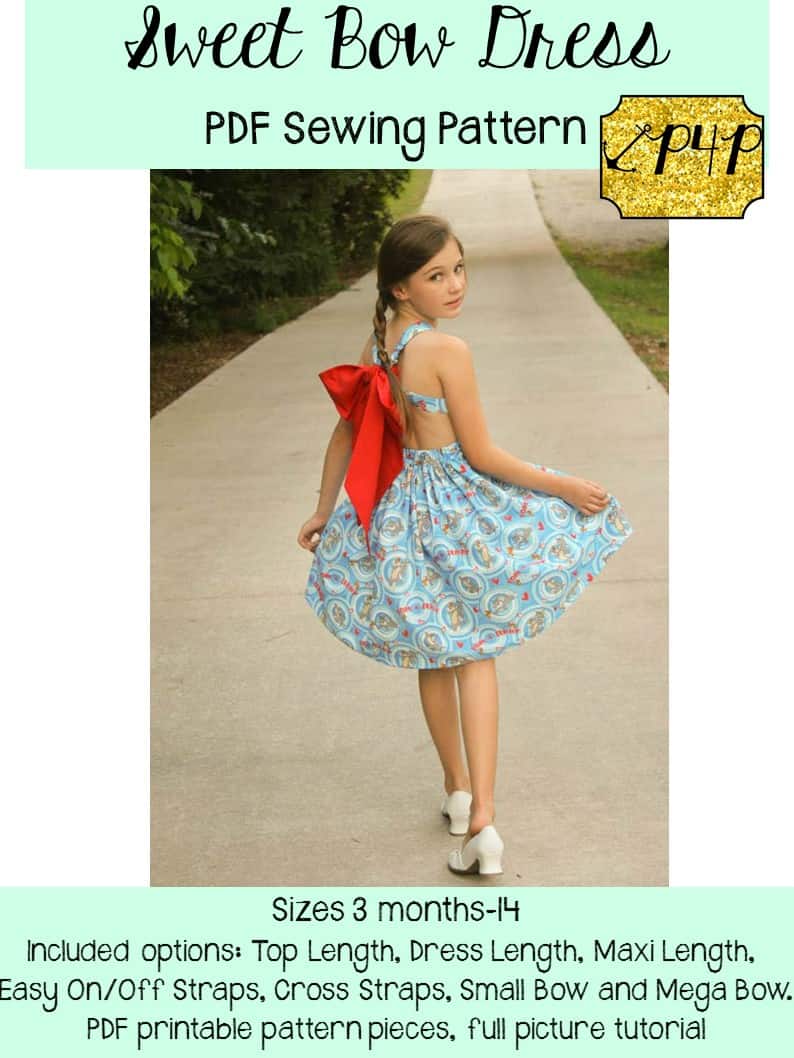
The Sweet Bow is a stylish pattern with a sweetheart neckline, a bodice that hits at the natural waistline, and features a very full and twirly skirt.

This was one of the earlier Patterns for Pirates patterns and we wanted to make sure to update it to the current P4P standards.  The pdfs now include our layers feature and can be found in letter and A4 (no A0- it is only 2-3 pages to print!).  We also tweaked the fit for the smallest sizes and added maxi length option for some extra glamour.

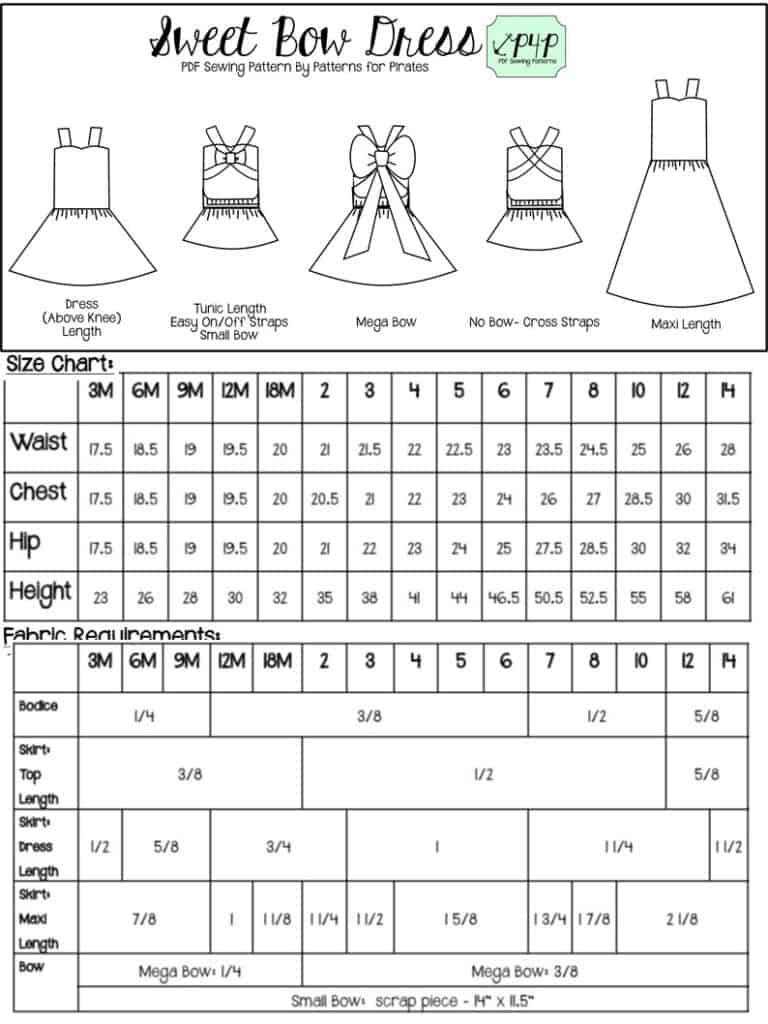
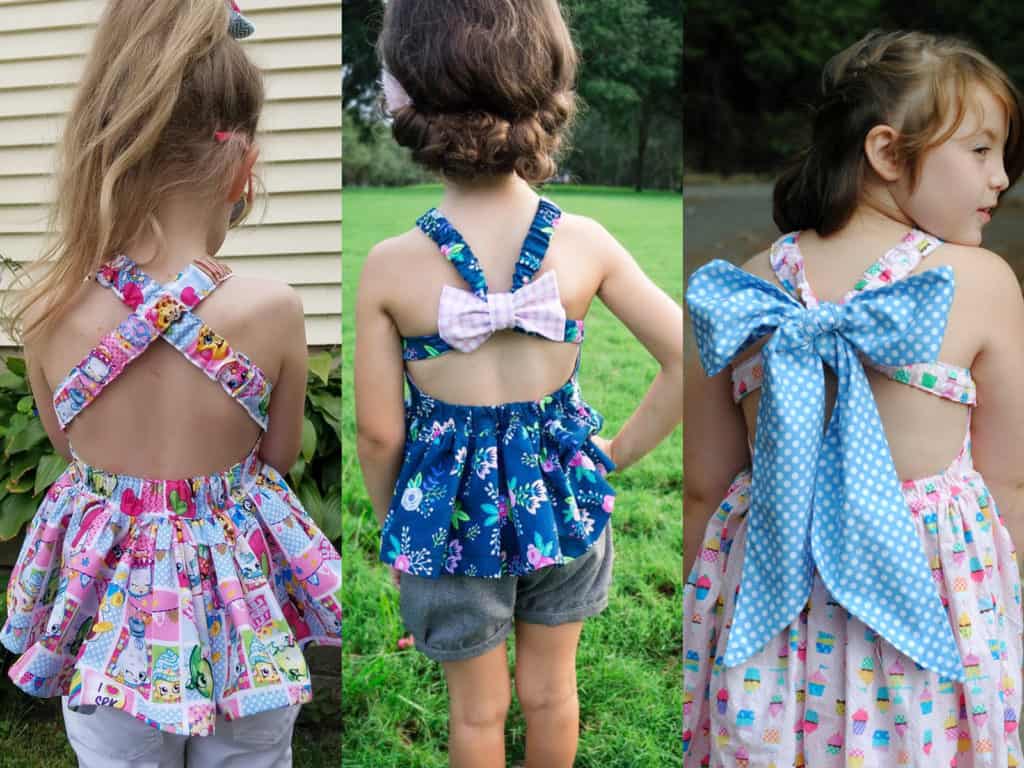
The Sweet Bow now features three hemlines (top, dress and maxi), two strap options (cross and easy on-off), and optional bow embellishments (small and mega bow).

**Want to learn more about how to measure for this pattern?  We’ve got you covered with an in-depth blog HERE.  In case you’re new to Patterns for Pirates and PDF patterns in general, we have a great blog full of new user tips HERE to help you get started!  And don’t miss out on the Measurement Chart printables, to help keep all of those crazy numbers in one easy-to-reference spot.

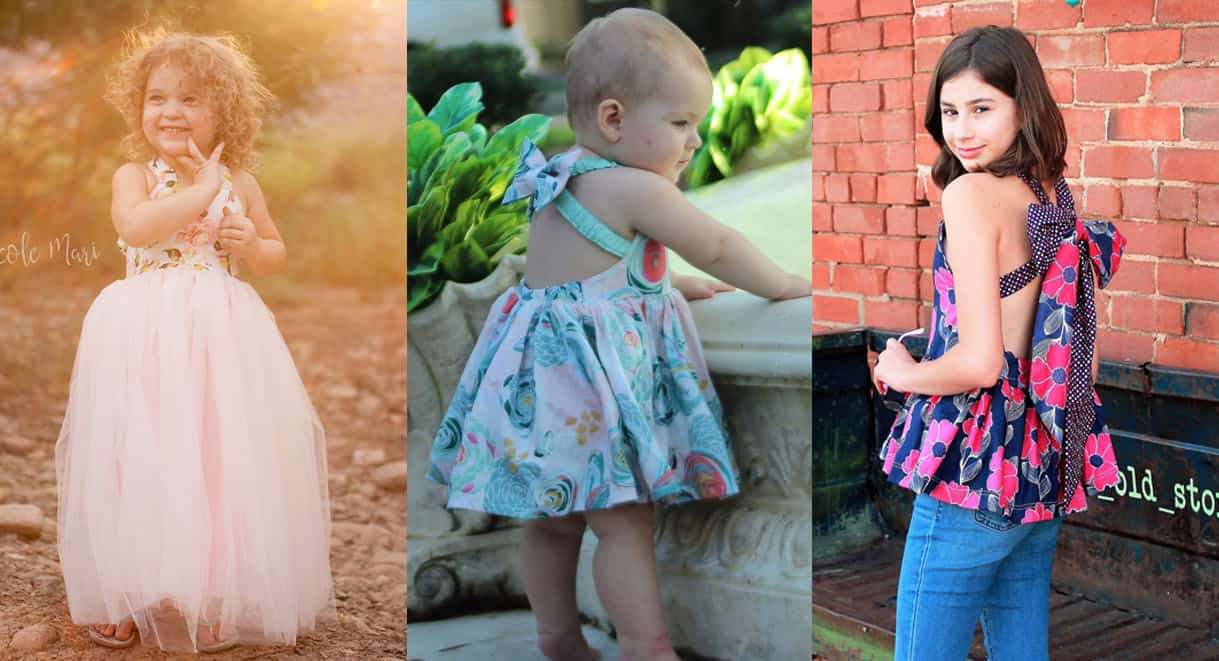
Here’s a quick rundown of the options:

Three Hem Lengths

Cross Straps, Small Bow + Mega Bow


Ready to purchase the Sweet Bow and get to sewing yourself?  Go grab your copy HERE!!  The pattern is on a re-release sale through Sunday, September 10, 2017.

If you’re still needing more inspiration, be sure to head over to the Patterns for Pirates Facebook Group Album to see everything our beautiful testers have sewn for their littles.  Don’t forget to tag us on Instagram (@patternsforpirates | #patternsforpirates) and to share your finished items over in our Facebook group!  We love to see what you make!

Happy sewing, friends!

Filed Under: Pattern Release 2 Comments

  • « Previous Page
  • 1
  • …
  • 49
  • 50
  • 51
  • 52
  • 53
  • …
  • 68
  • Next Page »

connect with me

  • Email
  • Facebook
  • Instagram
  • Pinterest
  • YouTube
Privacy & Cookies: This site uses cookies. By continuing to use this website, you agree to their use.

To find out more, including how to control cookies, see here: Cookie Policy
  • Privacy Policy
  • Refund Policy
  • Contact Us
  • About

Copyright © 2026 Patterns for Pirates

Copyright © 2026 · Genesis Framework · WordPress · Log in